Home Blog Page 297

Iran security forces kill four armed militants

The Islamic Revolution Guards Corps (IRGC) forces have killed at least four members of a militant group following an armed clash in Iran’s southeastern province of Sistan and Baluchestan.

The clash took place over the past week near the country’s border with Pakistan, Fars news agency reported.

At least two other militants were injured as the IRGC forces attacked the nine-member team linked to the Jaish Al-Adl (Army of Justice) group in Saravan County.

Jaish Al-Adl claims that it has taken up arms since 2012 to fight for what it says are the rights of Iran’s minority Sunni population.

The report said that the militant group is affiliated with Saudi Arabia and the US. 

Sistan and Baluchestan Province has witnessed frequent clashes between Iranian forces and drug smugglers as well as rebels.


Source

Fighting rages between Kurdish forces and Iranian Revolutionary Guards

0

ERBIL – At least six members of the Iranian Revolutionary Guards and two Peshmerga fighters were killed in renewed clashes in western Iran, according to officials. Also, Iranian bases near Bokan were attacked by Kurdish Peshmerga forces. 

“A group of our Peshmerga fighters were ambushed by the Iranian forces near the Bolfat area when they were preparing to conduct a series of political activities on Sept. 6,” Mouloud Swara, member of Central Committee and Representative of Kurdistan Democratic Party (KDP-I) in UK, told ARA News.

“It started when one of our comrades stepped on a blast mine, which had been planted by Iranian Revolutionary Guards. After the initial explosion, Iranian forces started shelling and shooting at the Peshmerga group,” he said. 

“The Peshmerga responded to the attack and the fire exchange lasted for at least 20 minutes. The group of Peshmerga succeeded to repel the attack and left the area. As a result of these clashes two Peshmergas named Azad Ali and Amir Nadir were killed and one Peshmerga was injured,” Swara reported. 

At least six Iranian Revolutionary Guards were killed and four were injured in the clashes. 

“Iranian military forces have lately increased their military activities in the western part of the country, especially in Oshnawieh, Sardasht and Piranshahr. Tehran frequently puts pressure on political parties in the Kurdistan Region of northern Iraq, asking them to put pressure on the Iranian Kurdish parties, amongst them our party, to bring an end to their political activities inside Iran,” the official told ARA News. 

“We cannot bow for any pressure and our struggle will continue until our people enjoy the freedom and rights proclaimed in the International Human Rights declaration. With some 2,000 Peshmerga forces based in remote bordering areas, the KDP-I is historically considered to be the most formidable military organization opposing the Islamic Republic in Tehran,” Swara said.

Speaking to ARA News, the head of Foreign Relations in the Democratic Party of Iranian Kurdistan’s (PDK-I), Loghman Ahmedi, said that the Peshmergas from the PDK-I also clashed with Iran.

“Our Peshmergas conducted several operations in Bokan yesterday,” he said.

The KDP-I is different from the PDK-I. At a 2006 convention, KDP-I members elected Mustafa Hijri as leader, forcing a split that created the KDP-I under the leadership of Khalid Azizi, and the PDK-I under Hijri, the local Kurdish news agency Rudaw reported in 2012.

On 6 September, the PDK-I said its forces carried out two operations against Iranian military bases near the city of Bokan.

“These operations were conducted following a number of terrorist attacks and ambushes against PDK-I’s Peshmerga Forces and the party’s officials in eastern Kurdistan by Iran’s Islamic Revolutionary Guards Corps (IRGC),” the PDK-I said in a statement. 

“The Iranian authorities also carried out a wave of executions of Kurdish political prisoners and prisoners of conscience, beside killing Kurdish civilians on a daily basis,” the statement added.

Clashes between Iranian Kurdish groups and Iran’s IRGC erupted on June 15 and have continued ever since. The Iranian authorities have accused Saudi Arabia of backing the Kurdish groups, but the Kurds have rejected the accusation.

A recent shelling by the Iranian forces on Kurdish areas near the borderline with Iraq has led to the injury of at least five civilians, including three children, and displaced dozens.

Ceng Sagnic, a researcher with the Tel Aviv-based Moshe Dayan Center for Middle Eastern and African Studies, told ARA News that Iranian Kurds are trying to gain a new foothold.

“It [increase in clashes] is mostly because Iranian Kurdish parties are seeking for a renewed foothold in regional politics while Iran’s influence is growing rapidly,” Sagnic said.

Iranian Kurdish Peshmerga forces are now also benefiting from US-led coalition support for the Kurdish Peshmerga forces in Iraq, receiving training to fight ISIS.

The Associated Press (AP) reported that the Iranian Kurdish group Kurdistan Freedom Party (PAK) is being trained by US-led coalition forces as part of the war against ISIS. They have played a crucial role on the Kirkuk front in repelling ISIS offensives.

Reporting by: Wladimir van Wilgenburg

Source: ARA News

Kabul Protests After Iran Cages Afghan Detainees

0

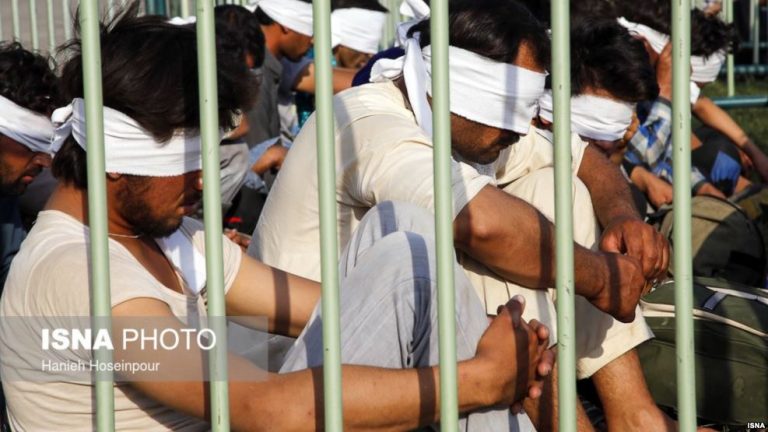
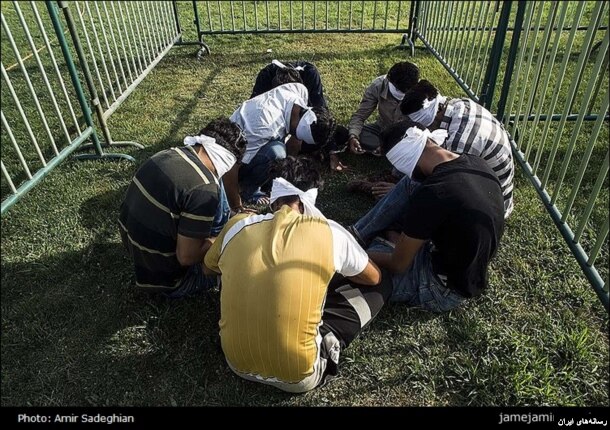
The Afghan government is protesting Iran’s decision to blindfold several Afghans and put them in cages in the center of Shiraz this week.

Nearly two dozen handcuffed Afghan refugees were displayed in a large metal cage. Police also exhibited confiscated items, including weapons, explosives, drugs, alcohol and smuggled soft drinks. 

The deputy police chief of Shiraz, Nasser Keshawarz, said the refugees were among some 200 foreign nationals who entered Iran illegally and were arrested. Pictures of the public detention went viral on the internet, drawing outrage from Afghans and human rights activists, and an official diplomatic protest from Kabul.

The Afghan government is protesting Iran's decision to blindfold several Afghans and put them in cages.

The Afghan government is protesting Iran’s decision to blindfold several Afghans and put them in cages.

“Afghanistan’s Ministry of Refugees and Returnees strongly condemns this inhumane and humiliating treatment and violation of human dignity of Afghan refugees by the Shiraz city police,” the Afghan government said in a statement. “This behavior undoubtedly contradicts Human Rights, the 1951 [Refugee] Convention, and the 1967 Protocol Relating to the Status of Refugees, and stands against the bilateral refugee agreements between the two countries.”

There was no response from Tehran or on official state-run media.

Criticism of Iran

Mohammad Reza Khoshak, an Afghan parliament member from western Herat province, which borders Iran, denounced the Iranian regime.

“In Shiraz, a city well-known for its poet Saadi, who asks for equality for all humans, my fellow citizens are put in cages and mistreated in a way similar to what militants of the Islamic State do to their prisoners,” he told an Afghan newspaper.

Well-known Afghan poet Mustafa Hazara criticized Iran on his Facebook page. “How low a human could go?” he asked. “Look, my Iranian friends, if you travel outside your geographic location [country], you would realize that the value of humans is different than what you think of.”

‘Systematic prejudice’

Roughly 3 million Afghans live in Iran. Most of them settled there after fleeing war and conflict in their homeland, and many lack basic rights and live without a formal status. About 950,000 Afghans in Iran are classified as refugees.

Iran has sent thousands of Afghan refugees, mainly ethnic Shi’ite Hazaras, to Syria to fight alongside forces of Hezbollah and Iran’s elite Revolutionary Guard forces in support of the Syrian government. Dozens of Afghans have died in the Syrian war.

In his online post, Hazara asked educated Iranians to fight what he termed a systematic prejudice by Iran against Afghan refugees.

In general, Afghans living in Iran try to keep a low profile so as to not anger the regime.

“They [Iranian authorities] are very tough on us, and even one of my colleagues got a threatening message to not talk with foreign media about the incident,” Afghan journalist Kazem Sharafuddin told VOA from Mashhad.

The caging of Afghans has angered some Iranians, as well. Former Iranian President Mohammad Khatami’s spokesperson, Abdollah Ramezanzadeh, condemned the move. 

“We are ashamed before Afghan people, ashamed before humanity,” Ramezanzadeh said on his Instagram account.

Iran sentences UK-Iranian woman to 5 years in prison

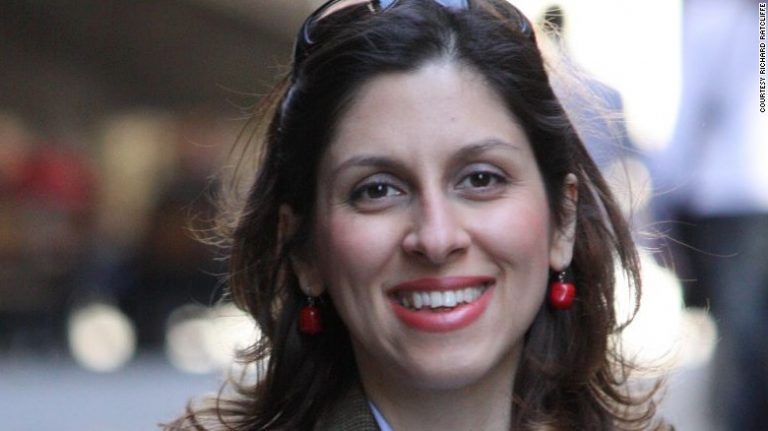
(CNN)A British-Iranian woman has been been sentenced to five years in prison for allegedly working with organizations that Iran’s Islamic Revolutionary Guard Corps claims were attempting to overthrow the government.

Nazanin Zaghari-Ratcliffe’s prison term was disclosed Friday by her employer, the Thomson Reuters Foundation. 
“This is a very serious condemnation that comes without any charges or evidence being made public,” foundation CEO Monique Villa said in a statement. 
Zaghari-Ratcliffe, who has dual citizenship, was arrested April 3. She’s being held in Kerman prison in southeast Iran.
She had been visiting family in Iran with her 22-month-old daughter when she was detained at the airport in Tehran as she checked in to fly back to the UK. Her daughter was placed in the care of Zaghari-Ratcliffe’s parents in Iran.
The Iranian government accused her of working for a UK media network allegedly involved in activities against the Islamic Republic, according to an IRGC statement released in June.
“By being a member of foreign companies and institutions, she has been participating in their scheme and implementation of their media and cyber projects for their soft overthrow of the sacred system of Islamic Republic,” the IRGC said. 
“She headed one of the main obstinate networks that have continued their criminal activities during the past few years, under the guidance and support of media and foreign government spy services. “
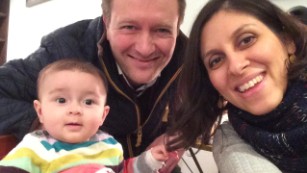
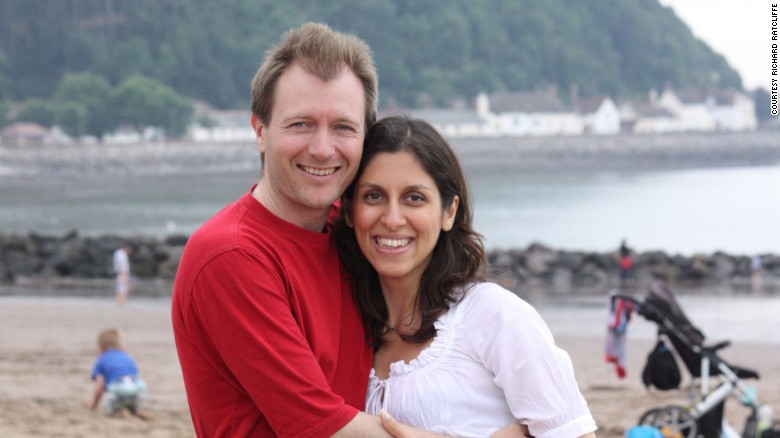
Nazanin Zaghari-Ratcliffe is pictured with her husband Richard and daughter Gabriella.

 
But Villa reiterated Friday that Zaghari-Ratcliffe had no dealings with Iran in her role as a project coordinator with the foundation, which is the charitable arm of the international news outlet Thomson Reuters. Villa said the foundation “does not operate in Iran directly or indirectly.”
“I have instructed the Thomson Reuters Foundation’s lawyers to find out what these charges are and I know that Nazanin’s family has asked the same of their lawyer in Iran,” Villa said. “As Nazanin’s husband Richard says, this is a ‘punishment without a crime’ which is contrary to the rule of law.”
Zaghari-Ratcliffe had been unable to visit her daughter or access a lawyer since being taken to prison, Richard Ratcliffe said in June.
The foundation said Zaghari-Ratcliffe had worked with the organization for the last four years. Ratcliffe said his wife trained journalists in developing countries such as Morocco and Burma, though she’s never worked in Iran for the Reuters foundation.
Richard Ratcliffe and wife Nazanin Zaghari-Ratcliffe.

 
Ratcliffe has launched a petition calling on the British Prime Minister and Iran’s Supreme Leader Ali Khamenei to help free his wife.

Arrested at the airport

Zaghari-Ratcliffe moved to Britain in 2007, and has visited her family in Iran four times since having baby Gabriella almost two years ago, according to Ratcliffe.
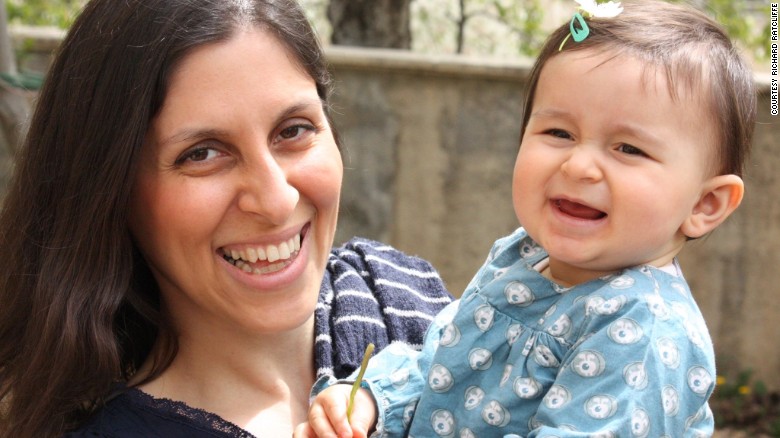
Nazanin Zaghari-Ratcliffe and daughter Gabriella.

 
The last time Ratcliffe spoke to his wife was over the phone on April 2. He fears his wife is in solitary confinement.
Their child, who has British citizenship only, had her passport confiscated by authorities, and remains with her grandparents in Tehran, according to Ratcliffe.
The International Campaign for Human Rights in Iran said the country does not recognize dual citizenship and that it “routinely harasses citizens and dual nationals with trumped up national security charges.”
This means Zaghari-Ratcliffe is only recognized as Iranian, and as such is prevented from accessing British consular assistance.
The rights group told CNN that it was aware of several dual nationals imprisoned in Iran. These include Iranian-Americans Siamak Namazi, a businessman who has been held since October last year, and his 80-year-old father, Baquer Namazi, who was arrested in February.

Arrested Afghans Put On Display By Police In Iran, Sparking Anger

0

Some Iranians and Afghans have taken to social media to condemn authorities in the Iranian city of Shiraz for putting arrested, blindfolded Afghan refugees on display. 
 
The criticism came after Iranian media, including the semi-official ISNA news agency, published a series of photographs of Afghans — who had been detained on suspicion of illegally entering the country — sitting behind barricade fences wearing white blindfolds.
 
A sign on one of the fences said: “Arrest of foreign nationals.”
 

The photos were published as part of a series of images depicting items confiscated by the police in Shiraz, including drugs, stolen cars, weapons, and alcohol.

Many expressed outrage that the Afghans were put in “cages” like animals and humiliated.
 
“I’m ashamed of being an Iranian,” wrote a woman on Facebook in reaction to the photos.
 
On Twitter, an Afghan posted a picture of the arrested refugees alongside a sign for a street in Afghanistan that is named in honor of Iranian diplomats killed by the Taliban in 1998.
 
“I don’t have anything to say. Look at the photos; one in Afghanistan, the other in Iran,” the social media user wrote. 

 
Afghan lawmaker Mohammad Reza Khoushak also criticized the move on his Facebook page.
 
“It’s been [reported] that in the city where [Iran’s great poet] Saadi wrote: ‘If you have no sympathy for human pain, the name of human you cannot retain’, its people have displayed humans…in cages,” he wrote. 

Khoushak wrote that to display people in such a manner was to behave “like Daesh” — a term for the extremist group Islamic State, which has committed severe atrocities.
 
The move also prompted criticism from a former Iranian presidential spokesman, Abdollah Ramezanzadeh, who served as a spokesman for former Iranian President Mohammad Khatami.
 
On his Instagram account, Ramezanzadeh described the decision to put Afghans on display as “shameful.”
 
“I‘m ashamed for humanity. I’m ashamed for Afghans,“ Ramezanzadeh wrote.

Iranian authorities have been long accused of mistreatment and harassment of Afghan refugees who travel to Iran illegally in search of jobs.
 
Iran says it has hosted more than 3 million registered and unregistered Afghans for three decades with little help from the international community.
 
Speaking in June, Iran’s Foreign Minister Mohammad Javad Zarif called on the UN refugee agency and donating countries to ramp up investment in Afghan economic projects to pave the way for the voluntary return of Afghans to their country. 


Source

Head of Iranian Judiciary’s Human Rights Council Defends Wave of Executions

0

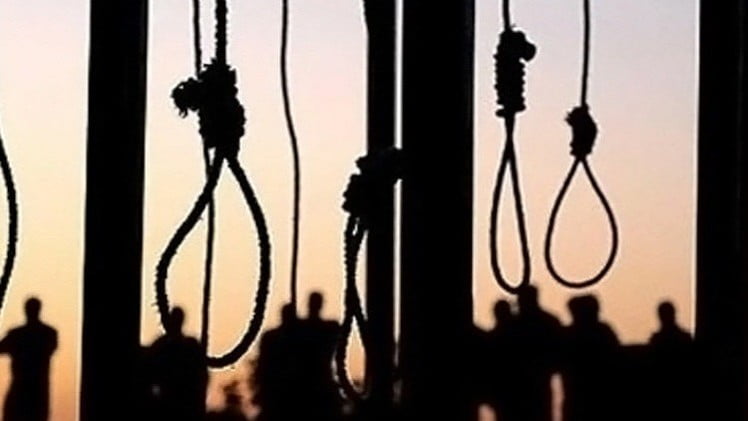
In less than a month, between August 2 and August 27, 2016, at least 37 prisoners were executed in Iran. Shortly afterwards, the head of the Iranian Judiciary’s Human Rights Council, Mohammad Javad Larijani, claimed Iran was doing members of the international community a favor by executing drug traffickers.

Many, though not all, of the victims were convicted of drug-related crimes, which do not meet international standards regarding the possible application of capital punishment only for the “most serious crimes.”

“[The United Nations Special Rapporteur on Human Rights in Iran] Ahmed Shaheed and Western countries should be thanking Iran because narcotics produced in Afghanistan end up in Paris, Berlin and Washington,” said Larijani on September 1. “But instead of praising us, they are condemning us.” 

In addition, the UN has noted serious concerns regarding the denial of due process in Iran, including cases in which capital punishment has been carried out.

On August 2 Iran executed at least 20 Kurdish Sunni prisoners at Rajaee Shahr Prison in the city of Karaj. Many of these men were convicted of moharebeh (enmity against God) for their alleged membership in a radical Sunni Islamic group. Despite claims by Prosecutor General Mohammad Javad Montazeri that due process was carried out, family members of the victims and sources close to the cases said many of the executed prisoners were blocked from using lawyers of their choice and were quickly prosecuted in secret trials based on charges brought by the security establishment and confessions obtained under torture. 

On August 9 five Kurdish prisoners were executed in Urmia Central Prison while 12 were executed in Karaj Prison. All of the prisoners except Mohammad Abdollahi were executed for narcotic-related charges. Abdollahi was charged with moharebeh for his alleged membership in a Kurdish political party; he insisted that he had obtained a membership card from the group so he could legally work to support his family.

The Chairman of the Legal and Judicial Affairs Committee in Parliament Rouhollah Hazratpour saidon August 21 that Iran currently has “4,500 death-row prisoners in legal limbo in the country and we must think of a solution for them.”

UN Rapporteur Ahmed Shaheed issued a statement on August 20 describing the executions as a violation of international law. “It is also troubling that courts continue to issue death sentences in trials that not only breach international fair trial standards but even domestic due process guarantees,” he said.

On September 1, in an interview with the Judiciary’s official news service, Mizan, Larijani defendedthe executions.

“These accusations [by the UN Special Rapporteur] are not new. We have a set of laws by which we severely punish those who play a major role in trafficking drugs and in destroying the lives of our young people,” he said. “These punishments may be life in prison or executions.”

Another senior Judiciary official has, however, admitted that capital punishment has not served as an effective deterrent against drug trafficking. 

“Punishing drug traffickers with the death penalty has not been a deterrent so far and we have expressed this to the judiciary chief in writing,” Judiciary Deputy in Charge of Crime Prevention Mohammad Bagher Olfat said in an interview on August 27. “Those who are being executed are not the real traffickers; they don’t get involved in transporting drugs. Instead they pay a small amount to those who don’t have enough income [and make them carry out the transportation.]”

Call for Investigation 

Twenty-two human rights organizations, including the International Campaign for Human Rights in Iran, called for an immediate halt to the executions on August 16 “including against Kurds and other minority groups” and for the United Nations Human Rights Council to investigate the alarming use of the death penalty.

“One focus of the investigation should be the extent to which executions are being carried out as a means to silence political dissent and free association in the country,” said the joint statement.

The Campaign has confirmed the names of ten of the victims who were hanged in Rajaee Shahr on August 2: Bahman Rahimi, Mokhtar Rahimi, Yavar Rahimi, Arash Sharifi, Kaveh Oveisi, Kaveh Sharifi, Ahmad Nasiri, Behrouz Shahnazari, Taleb Maleki and Shahram Ahmadi

On August 8, seven death-row prisoners were moved to solitary confinement in Orumiyeh Central Prison in preparation for their execution. The following day, prisoners Parisa Aghaie and Tohid Pourmahdi were spared, but Jahangir Razavizadeh, Jebraeel Kanani, Kamran Pourrafat, Amir Azizi and Mohammad Abdollahi were hanged

Abdollahi’s lawyer, Mostafa Ahmadian, told the Campaign on August 7 that he requested a stay of execution for his client before Abdollahi was killed.

“There have been many instances of blatant violations of the law in Abdollahi’s case that I am willing to discuss with any relevant official,” he said. “Initially the judicial investigator had issued an order to nullify my client’s prosecution. But the judge unlawfully pursued the case and the prosecutor agreed to go ahead with the unlawful process. In addition, there is ample evidence that suggests my client did not resort to using a weapon and played no role in the charges issued against him….”

The names of nine of the 12 prisoners who were executed in Karaj Prison on August 20 are: Alireza Madadpour, Bahman Rezaie, Arman Bahrami, Alireza Assadi, Mohsen Eslami, Mehdi Rostami, Amir Sorkhah, Alireza Sorkhah and Hossein Bayrami.


Source

Soldiers of the Revolution

0

In August, news emerged that Russia had begun to use Iran’s Shahid Nojeh Air Base to stage bombing raids on northern Syria. For those familiar with the region, this was a shocking reversal of long-standing Iranian policy—signaling the first time since the 1979 Islamic Revolution that foreign troops had been allowed to use Iranian bases.

The significance was not lost on Iranians. In protest, one member of parliament quoted the revolutionary slogan “Neither East nor West,” which had symbolized Iran’s quest for self-determination and rejection of American and Russian imperialism. National security officials defended the agreement, but within days, Iran’s defense minister, Brigadier General Hossein Dehghan, announced that Russia’s use of the base had ended. Dehghan explained that Russia’s access had been based on shared strategic interests in Syria and could occur again, but also blamed Russia for “showing off” by publicizing the partnership to begin with. Whatever Dehghan’s intentions, his explanation highlighted the fact that the Syrian conflict had compelled Iran to rethink one of the ideological cornerstones of the Islamic Revolution.

Dehghan’s position was also ironic. In addition to being a government official, Dehghan is a senior officer in the Islamic Revolutionary Guard Corps (IRGC)—Iran’s foremost military institution and one famous for its hard-line politics against foreign influence in Iran. That the agreement with Moscow was said to have been personally arranged by Major General Qassem Soleimani, Iran’s most revered IRGC commander, only added to the apparent contradiction.

But to base one’s view of the IRGC purely on its outward reputation is to misread it. The IRGC is at once both a champion of Iran’s revolutionary ethos and a pragmatic organization, with an approach to strategic affairs that comes closer to realpolitik than Islamism. Understanding the IRGC is essential to understanding Iranian politics; the organization’s history is in many ways a microcosm of the Islamic Republic’s, from the struggle to carve an independent path to its controversial rise as a regional power.

ISLAMIC ASPIRATIONS

In 1979, the goal of ending American and foreign influence in Iran unified the diverse revolutionary movement that toppled the government of Shah Mohammad Reza Pahlavi. As the revolution developed and the rival factions began to compete with one another, supporters of the hard-line cleric Ayatollah Ruhollah Khomeini gradually erased that diversity, establishing in its stead a theocratic system of government that gave Khomeini unchecked authority as Iran’s first supreme leader.

In the midst of this postrevolutionary power struggle, the IRGC was established as an umbrella group uniting numerous pro-Khomeini militias and gangs. By bringing these groups together under Khomeini’s banner, the IRGC became the central node of armed Islamism in Iran. Their use of violence and coercion, moreover, was instrumental in the Khomeinist faction’s monopolization of power.

In its early days, the IRGC was more a collection of ideas and aspirations than a true organization. Above all, the corps saw itself as the guardian of the revolution. Service to Khomeini and to Iran’s Islamic system were matters of religious faith rather than simply acts of patriotism. The IRGC adopted trappings from Islamic history to link itself to the broader Shiite tradition, and pledged to support liberation movements throughout the Muslim world. More pan-Islamic than nationalist, the IRGC established like-minded armed groups outside of Iran, such as Hezbollah in Lebanon, and provided ongoing support to Palestinian militants. In its early days, the IRGC was more a collection of ideas and aspirations than a true organization.

Iraq’s 1980 invasion of Iran forever altered the course of the revolution and of the IRGC. The IRGC entered the war as a ragtag militia that lacked adequate weaponry and training, and the Iranian political leadership initially entrusted the country’s defense to Iran’s demoralized regular military, which had recently had much of its Shah-era command and officer corps purged by the revolutionaries.

The IRGC performed well in the disastrous early stages of the war, when Iran was hampered by political infighting and logistical problems. Once the Khomeinists fully consolidated power following the 1981 impeachment of President Abolhasan Banisadr, the IRGC, which enjoyed the backing of the clergy, became Iran’s favored armed force in the war. Later that year, as Tehran began a series of offenses aimed at pushing Iraqi forces back across the border, the IRGC began to deploy its famed human wave attacks, to some initial success. These attacks, which became a trademark of IRCG operations throughout the war, featured successive waves of thousands of Iranian soldiers—mostly teenagers recruited into the IRGC’s Basij militias—charging headlong into enemy positions and overwhelming them through sheer numbers and will. By the end of the war, Iran’s casualties stood in the hundreds of thousands, the majority of which came from the Basij and IRGC.

Unsurprisingly, the Iran-Iraq War contributed to Iran and the IRCG’s paranoid view of the outside world. Iran’s belligerent rhetoric and counter-invasion of Iraq had alienated it from other regional and foreign powers. Fearing that Iran’s revolutionaries would dominate the region were Saddam to fall, the Arab sheikhdoms of the Persian Gulf eagerly bankrolled the Iraqi war effort. France, Russia, and the United States sold Saddam advanced weaponry, and the U.S. Navy entered the Persian Gulf to help protect Arab oil shipments. The only country to side with Iran was Syria. Alienated and alone, Iran came to see the war as a vast international conspiracy designed to destroy its revolution.

MOMENT OF ARRIVAL

The war’s conclusion in 1988 was shortly followed by the death of Khomeini, in 1989. His successor as supreme leader, former President Ali Khamenei, lacked the standing and support base of the revolution’s founder, and power in Iran seemed to be shifting to the presidency, occupied by the more politically astute Ali Akbar Hashemi Rafsanjani. The IRGC, worried about its failure to defeat Saddam and acrimony with Rafsanjani, which had intensified over disagreements in war planning, decided to support Khamenei in his turf battles, thereby helping to forge a tighter bond between the IRGC and the supreme leader. The IRGC offered Khamenei fierce loyalty, and in return, Khamenei secured the IRGC’s prominence and favored its positions.

During the 1990s, the IRGC became the standard-bearer of hard-line politics in Iran. All forms of social and political reform, and any hint of warming relations with the United States, were anathema and ran counter to what the IRGC believed its soldiers had fought and died for during the war. Yet this was a time when Iranian society was headed in the other direction, culminating in the 1997 election of the reformist Mohammad Khatami as president. With a network of activists on the ground and the support of the supreme leader and other conservative clergy, the IRGC led much of the opposition to Khatami during his two terms in office (1997–2005).

It was in 1999, in the heat of opposition protests against Khatami, that the IRGC finally signaled its arrival as a power player in Iranian politics. That year, increased pressure by the IRGC and other regime institutions on reformism, including the forced closure of a leading reformist newspaper, had sparked a series of student protests. Tensions grew as hard-line pressure groups and Basij militants battled students on university campuses across Iran. The unrest provoked the IRGC’s top officers to send Khatami an ultimatum: either he could end the protests, or the IRGC would bypass his authority and do it themselves. Khatami relented, and the IRGC led a violent crackdown on the protesters—a role it reprised in 2009, when massive demonstrations contesting the reelection of President Mahmoud Ahmadinejad were similarly crushed.

GOING ABROAD

Having consolidated its role in domestic politics, the IRGC was given an opportunity to expand its international influence by the United States’ wars in Afghanistan and Iraq. Although the IRGC had interests in seeing both Saddam Hussein and the Taliban toppled, U.S. President George W. Bush’s famous “axis of evil” line in the 2002 State of the Union convinced Iranian hard-liners that the Afghan and Iraqi wars were aimed at encircling Iran. The IRGC therefore pursued strategies in both countries to deter U.S. aggression.

The IRGC does not formally set Iran’s foreign policy—that job falls to the elected government and the Supreme National Security Council (SNSC), Iran’s top decision-making body, composed of leading government officials, military chiefs, and representatives of the supreme leader. However, the IRGC has enough influence on the SNSC, and with the supreme leader himself, that its foreign activities generally proceed without much resistance or oversight from the government. These activities can effectively drive Iran’s foreign policy, particularly in states such as Lebanon and Syria where the IRGC has substantial investments. This was the case in post-Saddam Iraq, where the IRGC became the main conduit of Iran’s influence in the country.

Iraq was a factory for IRGC experimentation and success. The IRGC benefited from its long-standing ties to Iraqi expatriate groups, especially the Supreme Council for Islamic Revolution in Iraq, which had been founded by pro-Khomeini Shiite activists in Iran during the 1980s, and the council’s military wing, the Badr Corps, which operated as part of the IRGC during the Iran-Iraq War. Members of these groups and others friendly with Iran began to occupy influential positions in Iraq’s political and military establishments, expanding the reach of the IRGC. The organization also began developing a new cadre of more extreme, more outwardly pro-Iranian allies among Iraq’s Shiite militants, which were regularly used to target and harass U.S. forces. Iraq was a factory for IRGC experimentation and success.

By the time the Obama administration withdrew U.S. troops in late 2011, Iran had become the dominant outside player in Iraq. The IRGC’s close links to militants enabled Iran to influence politics from below, and its close relationships to Shiite politicians provided similar influence at the top. The IRGC had already developed important strategic assets through Hezbollah in Lebanon and Palestinian groups, and it now benefited from an even more formidable network in Iraq.

At the same time, Iran initially hailed the Arab Spring as a new wave of Islamic revolutions. But when unrest began to take hold in Syria, Iran’s closest state ally and the lifeblood of its support to Hezbollah, the IRGC quickly moved to defend the Bashar al-Assad regime. With its Arab rivals and Western enemies throwing their support behind the largely Sunni rebellion, the IRGC determined that if Assad were to fall his replacement would pose an existential threat to Iran.

The task of defending Assad fell to Qassem Soleimani, head of the IRGC’s foreign operations, who was crafting a reputation as Iran’s most effective military leader. Under Soleimani, Iran sent aid, materiel, and scores of advisers to Syria. Soleimani brought Hezbollah and Iraqi Shiite militias to the fight, and organized battalions composed of Afghan refugees and Pakistani Shiites to serve on the front lines. Soleimani was also reportedly the one that convinced Moscow to intervene in the war on behalf of the Assad regime in September 2015. As Iran’s involvement escalated, so too did its death toll, which officially stands at around 400, including dozens of senior and mid-ranking IRGC officers.

The rise of ISIS and its invasion of northern Iraq led Soleimani to oversee a similar effort to aid the Iraqi government. Beyond sending materiel and advisers, Soleimani himself began appearing on the front lines of the war. Soleimani was accompanied by the commanders of the pro-Iranian Shiite militias he had helped establish, and his presence in the field symbolized Iran’s commitment to its allies and its emerging status as a regional heavyweight. Outside of Iraq and Syria, the Houthi rebels who toppled the Yemeni government in early 2015—and provoked a military response from Saudi Arabia—are also known allies of the IRGC.
FUTURE OF THE REVOLUTION

The 2015 nuclear deal between the P5+1 and Iran occurred in the middle of the IRGC’s regional military expansion. As much as the deal symbolized a desire by the government of president Hassan Rouhani to open up Iran to engagement with the West, it also caused consternation in Israel, Saudi Arabia, and other Gulf Arab states. From their perspective, the deal normalized Iran’s involvement in the Middle East and effectively ended America’s leverage against it. Without the threat of sanctions, Iran’s behavior would be as unchecked as its ambitions. Gulf states, feeling abandoned, have moved to counter Iran more directly on their own.

The wars in Iraq, Syria, and Yemen bear the imprint of Iran’s cold war with Saudi Arabia. Because the IRGC is the author of Iran’s regional and strategic activities, understanding it and its motivations is more vital now than ever. Beyond its role in Iran, the IRGC has had a pronounced impact on the Middle East through its cultivation of transnational, non-state networks. As conflict and sectarianism continue to persist in the region, the political importance of non-state forces allied with IRGC and those backed by rival governments will increase. The more academics and policy-makers grapple with the factors promoting such growth, and the more attention given to the endogenous factors propelling war in the Middle East, the more informed and effective future policy can be.

Bernard Kouchner: The victims of the Iran regime should not be forgotten

France’s former foreign minister has spoken out about a policy of “silence” in Western governments surrounding the human rights situation in Iran.

Dr. Bernard Kouchner, who was attending a seminar for Iranian-European communities said: “There [was] always this state policy I had to fight all my life, that makes it easier to leave the stones unturned, rather than turning them to see the blood that nourishes the earth. I know the state policy demands silence. “

He realises now that this policy was wrong and dangerous.

He said: “Certainly, the balance in the area was fragile, and it still is. But step by step, we forgot, we wanted to forget what was happening in Iran.”

Kouchner discussed the problems involved with trying to put the Regime on trial i.e. the length of time that has passed since the 1988 massacre.

He said: “We need a specific court to judge the mullahs’ crimes… It’s very difficult because of the obstacles standing in our way… we always refer to the international community. But what is it? What did the international community [or] the UN do? The international community sadly has to take into account influences and political stakes, and the balance of powerful countries.”

Kouchner is counting on Hillary Clinton, with whom he has a long working relationship, to become the next president of the United States; because of her strong stance on human rights he believes that she will lead the international community to bring Iran to account for its crimes against humanity.

When talking about the 2015 nuclear agreement, he said: “Nothing changed since the agreement, and I’m not saying I was against it. Because if someone ask you to choose between a possibility of peace, or a possibility of nuclear war, obviously we prefer peace. In spite of all that, we need to know the daily reality. Everybody rushes to sign contracts in Tehran. And then we realize we signed contracts with the Revolutionary Guards.”

He finished his speech with a plea that the victims of the regime should not be forgotten and not be allowed to die in vain.

He said: “They’re the reason we have to act once more, and they won’t let us forget all the human rights violations. Their sacrifice is a reminder, their names shall be repeated, and we shall say each time, that we owe our hope to them. Thank you for not forgetting them, and thank you for reminding us of the necessity of this everyday battle we have to give in the name of those who died, but a battle we also have to fight against ourselves. We can’t let the human rights idea die.”
Those in attendance at the seminar, held in Paris at the National Council of Resistance of Iran headquarters, included Maryam Rajavi, president-elect of the Iranian Resistance, Ed Rendell, former leader of the US Democratic Party, Struan Stevenson, President of the European Iraqi Freedom Association.

Pentagon Officials: Armed IRGC Boats Swarmed U.S. Navy Ship in Persian Gulf

0

Seven armed boats from the navy of Iran’s Islamic Revolutionary Guards Corps (IRGC) swarmed a U.S. Navy patrol ship in the Persian Gulf on Sunday, forcing it to change course after the Iranians came within 100 yards and stopped their vehicles in the American ship’s path, officials from the U.S. Defense Department said on Tuesday.

The incident was “unsafe and unprofessional due to lack of communications and the close-range harassing maneuvering,” a U.S. Defense official told Reuters on condition of anonymity. The official added that manned weapons were visible inside the Iranian boats.

This was at least the fourth such incident in the past month, prompting American concern about the possibility of a more dangerous encounter in the future. “The big concern here is miscalculation,” U.S. Central Command chief Gen. Joseph Votel said last week, adding, “If they continue to test us, we are going to respond, and we are going to protect ourselves and our partners.”

There have been 31 other such incidents this year, about double the amount as of this time last year, a Defense Department official told Reuters. “We don’t see this type of unsafe and unprofessional activity from any other nation,” he added.

Sailors aboard the USS Nitze recorded an encounter last month when Iranian boats came as close as 300 yards, forcing it and the USS Mason to change course to avoid a collision. Two weeks later, two U.S. patrol coastal ships, the USS Tempest and the USS Squall, were operating in international waters in the northern Gulf when IRGC boats approached them at high speed and passed within 600 yards of Tempest three times. The Iranians ignored radio warnings that their actions were dangerous.

U.S. Navy 5th Fleet spokesman Cmdr. Bill Urban said at the time that Central Command had “assessed all of these interactions as unsafe and unprofessional due to the Iranian vessels not abiding by international law and maritime standards, including the 1972 Convention on the International Regulations for Preventing Collisions at Sea (COLREGS) maritime ‘Rules of the Road.’”

These incidents are the latest Iranian challenges to the American presence in the Persian Gulf and its commitment to keep the area open to international shipping.

Ten American sailors and their two boats were seized by IRGC naval forces in January of this year, in violation of international law.

Subsequent to the sailors’ release, Iran portrayed their capture as a victory against the U.S., releasing the sailors after claiming that Washington had apologized for the incident. Iranian Supreme Leader Ayatollah Ali Khamenei proclaimed that the naval forces who captured the sailors did “God’s deed” and issued medals to the commanders involved, while the IRGC announced plans to build a statue to commemorate the seizure.

In May, the deputy commander of the IRGC threatened to close the strategic Straits of Hormuz to the U.S. and its allies if they “threaten us,” adding: “Americans cannot make safe any part of the world.”

The U.S. Navy reported last month that in 2015, there were close to 300 encounters or “interactions” between American and Iranian naval vessels in the Persian Gulf. While most of the encounters were not considered to be harassment, the behavior of the Iranian navy was found to be less disciplined than that of other navies. Lt. Forrest Griggs, the operations officer of the USS New Orleans, explained that risks arise from the unpredictable behavior and uncertain intent of the Iranian vessels. “It’s very common for them to come up to within 300, 500 yards of us, and then they’ll turn, or parallel us and stop,” he told Fox News.

Vice Adm. Kevin Donegan, the commander of the Navy’s 5th Fleet, observed in November that Iran’s “malign behavior” at sea had not changed since the announcement of the nuclear deal four months earlier.

[Photo: U.S. Naval Forces Central Command / Flickr ]


Source

Iran’s Continued Imprisonment of Dual Citizens

Iran’s Continued Imprisonment of Dual Citizens


Haleh Esfandiari, a dual citizen of the U.S. and Iran, is director emerita of and a senior scholar at the Middle East program at the Woodrow Wilson International Center for Scholars. She was held in solitary confinement in Evin Prison in Tehran for 105 days in 2007. The views expressed here are her own.