Make No Mistake: Iran is a Threat – History is replete with strategic incidents that were unforeseen but set in motion events that shaped the strategic landscape for decades. The collapse of the Berlin Wall in 1989 was one such event, which foreshadowed the end of the Cold War and resulted in an easing of transatlantic tensions. The world hasn’t been the same since.
Make No Mistake: Iran is a Threat
Fast forward to 2014 and the world’s witnessing another intriguing, strategic transaction being played out: the US and Iran are collectively seeking to degrade Islamic State extremists—or daeshas they are pejoratively referred to. Some see it as an odd alignment of diametrically-opposed ideologies; others as a pragmatic convergence of strategic self-interest.
Still, logic would suggest that using Iranian military force against daesh in Iraqi Sunni territory probably doesn’t help Sunnis think that Baghdad is interested in governing Iraq as a unitary state. Iran is, at best, a fair-weather friend of the US and the international forces confronting daesh. But it has a different strategic agenda at play in relation to its influence in Iraq, which doesn’t help Iraq stay united.
The issues that arise from this interaction are maddeningly complex. Where will it end, and what if anything can be done about the residual ‘elephant in the room’: Iran’s emerging, or, by now, nascent nuclear capability?
Three issues stand out above the ruck of diverse complexities.
The first is the question of whether the ‘Iranian leopard can change its spots’. Iran has played—and continues to play—a resolute and determined long game. For more than a decade it has been steadfastly unwilling to compromise or cooperate with the international community. Why would it? It hates the liberal and free West, and consciously eschews more than essential minimal interaction with it.
Notwithstanding Iran’s confrontation of daesh, nothing has emerged in recent times to suggest any prospect of the leopard changing. Make no mistake, Iran has a deep investment in its nuclear program and a determination to leverage the anticipated benefits of that investment. To think otherwise is for the West to bury its head in the sand—to the further advantage of an established Islamic State, and one which is potentially far more dangerous than its much-publicised namesake.
The second issue is that of an ‘opportune smokescreen’, behind which Iran has advanced its nuclear ambitions. This is due to the competing regional strategic distractions of Iraq, Afghanistan, and now, daesh. Each has—and continues—to soak up Western blood, treasure and resolve, now closer to evaporation than at any other time since September 11.
Meanwhile, Iran’s leadership has pursued its nuclear ambitions, unfettered by the West’s democratic challenges of factional division and dissenting public opinion. That situation is now further exacerbated by an increasingly constrained US President, with less than 700 days left in office, a frustrated domestic and international agenda, and diminishing executive authority, both symbolically and practically.
It’s been a good time for Iran to fly under the international radar of scrutiny, at a time when there should have been increased, not diminished, transparency and accountability. Near-term strategic priorities have crowded out a supremely-important dilemma.
Lastly, to the matter of the scale and dimension of the looming threat.
The threat posed by daesh is grim but at its ‘high-water mark,’ their barbarity and mayhem is counted in thousands. However, the threat now posed by a nuclear malevolent Iran is emphatically much worse, with the resulting chaos almost unimaginable in its wake, turbulence and duration.
As the crow—or more aptly, the missile—flies, the distance between Tehran and Tel Aviv is just under 1600 kilometers (approximately 1000 miles). Hence, the time from launch to impact is brief; potentially mere minutes to Armageddon and the worst crisis the world has seen since 1945. The ripples and ramifications of such an event would extend to the end of the 21st century.
No, Iran hasn’t gone away; nor will its strategic aspirations be dissipated by a near-term and welcome outbreak of common sense. To date, containment hasn’t worked. Nor have the much-anticipated and variously described—‘useful/helpful/intense/continuing’—negotiations in Geneva, designed to break the impasse of 12 years of Iranian delay and obfuscation.
The self-imposed deadline of November 24, 2014 to resolve the standoff has passed. An unnamed member of Tehran’s delegation was quoted in recent days as saying that uranium enrichment and how to remove sanctions remain as sticking points. Another seven months of talks to follow. More delay and obfuscation as Iran’s nuclear program develops into an even more serious threat to regional and international security
In the end, Iran is neither just a Middle East nor a US problem. Rather, it’s a pressing global concern, to which a global collective solution must be found.
Iran’s Occupation of Syria – Most people immersed in Middle Eastern affairs have heard the charge, ad-nauseam, “Israeli occupation” of the West Bank.
Iran’s Occupation of Syria
The United Nations (UN) agencies, the European Union (EU), large segments of the American and European media, and many of the so called human rights watchdogs have been critical of Israel’s “occupation,” albeit the Jewish state has attempted to make peace with the Arab states and the Palestinians all along. Moreover, UN Security Council Resolution 242 considered the West Bank “disputed territory.” What one does not hear from the shrill chorus of the aforementioned voices is criticism of the Iranian occupation of Syria. There are no UN resolutions demanding Iranian withdrawal from Syria, or a firm U.S. government statement to that effect. This amounts to sheer hypocrisy and a double standard.
The current fighting in the Syrian civil war is being directed, fought, and funded by the Islamic republic of Iran. It employs the Iranian Revolutionary Guards (IRGC) and Lebanese Hezbollah in the fighting, as well as other non-Syrian Shiite militias (essentially Iraqis). They were moved to Syria with Iranian funds. The Alawi-led (Alawi’s are a breakaway sect of Shiite Islam) Assad regime would not have survived without the direct intervention of the Iranian regime. Whereas prior to the March, 2011 civil war in Syria, Tehran and Damascus have had a mutually beneficial alliance, which has now become one where Iran is the dominant force in the territories still controlled by the Assad regime.
Shiar Youssef, head of the Naame Shaam’s Research and Advocacy Team had this to say about the Iranian involvement, “There is sufficient evidence to try the military and political leadership of Iran for complicity in various crimes committed in Syria. This ranges from inciting, endorsing, and adopting specific criminal and terrorist acts to aiding and abetting war crimes and crimes against humanity.” Youssef added, “The Syrian regime is little more than a puppet in the hands of the Sepah Pasdaran (IRGC), Qassem Soleimani is the de facto ruler of Iranian occupied Syria.”
Naame Shaam is an independent campaign group focusing on the Iranian regime’s role in Syria. It is a source of independent news commentary on the Syrian revolution and the Iranian regime’s role in suppressing it. The group is comprised of Iranian, Syrian and Lebanese activists and citizen-journalists. The group’s Campaign Director is Fouad Hamdan from Lebanon, and Shiar Youssef from Syria.
According to Naame Shaam, there is a legal case for treating the war in Syria as an international conflict that involves a foreign occupation by the Iranian regime and its militias, and a liberation struggle by Syrian people against this foreign occupation, as defined by the 1907 Hague Regulations and the Fourth Geneva Convention of 1949. Youssef charged that, “The war in Syria should be regarded as an international conflict that warrants the application of the four Geneva conventions. Regime-held areas in Syria should be considered – in the strict legal sense of the word – territory occupied by Iran.”
Saudi Arabia’s Foreign Minister Prince Saud al-Faisal, at a meeting with German Foreign Minister Frank-Walter Steinmeier in the Red Sea city of Jeddah on October 13, 2014, pointed out, “Iran must withdraw its occupying forces from Syria to help resolve the country’s conflict.” He added, “In many conflicts, Iran is part of the problem, not the solution. In this case, we can say that Iranian forces in Syria are occupying forces aiding President Bashar al-Assad who is an ‘illegitimate’ leader.”
While Steinmeier viewed the Islamic State (IS) as a “threat to the entire world,” he failed to note that Iran is no less of a threat, and by all measures a much greater threat. Writing for the Australian Strategic Policy Institute, Andrew Nikolic asserted that “Admittedly ISIL (also known as ISIS and IS) cast a long and fearful shadow, but there are potentially worse – albeit quieter –threats lurking, which demand urgent attention. They include the maverick trifecta of Iran, Russia and North Korea. Unlike ISIL, each of those international ‘problem-states’ comes disproportionately better armed, including ready–made or emerging nuclear capability, accompanied by an unpredictable senior leadership.” Nikolic added, “Replace the ghastly specter of ISIL‘s severed heads and slain thousands with an Iranian nuclear device used somewhere in the Middle East, and the mind is concentrated wonderfully about the broader potential for a worse crisis.”
It is not only the threat of a nuclear Iran that should frighten the free world. Iran’s sponsorship of worldwide terror, and it meddling throughout the Middle East, in its hegemonic drive to control the region and the world if possible, should cause free people everywhere sleepless nights.
Addressing the UN last September, Israel’s Prime Minister Benjamin Netanyahu said, “Make no mistake, ISIL must be defeated, but to defeat ISIL and leave Iran as a threshold nuclear power is to win the battle and lose the war.” Ron Dermer, Israel’s ambassador to the U.S. stated that “(Iranians) are not a partner, they were not a partner, and they never will be a partner. Iran as a nuclear power is a thousand times more dangerous than ISIS.” Dermer was referring to President Obama’s suggestion of cooperating with Iran on defeating ISIS.
U.S. President Barack Obama has been silent about Iran’s occupation of Syria. His inaction with regards to the Iranian/Assad atrocities against Syrian civilians is deafening. The Obama administration did nothing as the Syrian regime with Iranian and Hezbollah’s help destroyed Syria’s famed cities of Aleppo and Homs, long before the emergence of ISIS and the al-Qaeda affiliated Nusra Front. Obama’s red-line against Assad’s use of chemical weapons poisoning Syrian civilians was embarrassingly shelved.
Recent moves by the Obama administration reveal that it has exploited the U.S. led military campaign against IS in order to increase cooperation with Iran in matters of regional security.
The Obama administration, as expected, dismisses allegations of “coordination” with Iran. Yet, President Obama is pursuing Iran’s Supreme Leader Ayatollah Ali Khamenei with letters offering cooperation, only to be dismissed. Khamenei keeps bashing the U.S., which refuses to get the message that Iran feels superior to the weak U.S. president and the morally rotting West.
Iran today controls Assad’s Syria and its IRGC runs the show. Iran is also the dominant power in three other Arab capitals; Baghdad, Beirut, and Sanaa (Yemen). The Obama administration has increasingly acquiesced to the new Middle Eastern regional strategic balance. In fact, President Obama has stated that “Iran has influence over Shiites, both in Syria and Iraq, and we have a shared enemy in ISIL “
The International community led by the U.S. should demand the withdrawal of IRGC and Hezbollah forces from Syria, while at the same time arming the Syrian opposition and combatting ISIL. There should be no lifting of economic sanctions on Iran if the Iranian regime fails to provide basic human rights. Nuclear negotiations with Iran should not be extended endlessly, allowing it to buy time in order to consolidate its dominance in Iraq, Lebanon, Syria, and Yemen as well as complete its nuclear weapons program. And finally, the U.S., its European allies, and the media, must clearly acknowledge and protest Iran’s occupation of Syria, and end their hypocritical singular focus on Israeli withdrawal.
Security Agencies and the Prosecution of Online Activists – In addition to the Iranian state’s efforts to develop the technological infrastructure of Internet control, the Judiciary and security organizations have also pursued the identification and prosecution of online activists. This is done through a variety of organizations, some of them official, some semi-official, and some that are almost completely opaque, facilitating a near complete lack of accountability.
FATA, THE IRANIAN CYBER POLICE
On January 23, 2011, the Iranian national police force established the Cyber Police, also known as FATA, as the cybercrime unit of the national police force.
Security Agencies and the Prosecution of Online Activists
In addition to fighting cybercrime, the officials justified the formation of the force as necessary to fight terrorism, and to guard against alleged threats to national security. However, FATA’s activities also include monitoring the activities of civil and political activists. During the ceremony establishing FATA, Chief of Police General Esmail Ahmadi Moghaddam said, in an explicit reference to the role of online social networks in the protests following the disputed 2009 presidential election, “Social networks on the Internet brought a lot of harm to our country because of spreading rumors and allowing anti-state groups to help each other.”
In essence, FATA pursues, through harassment, arrest, and interrogation, any citizen who expresses dissenting views online. Indeed, FATA officials have publicly boasted that they monitor all Internet activity around the clock. FATA’s arrest of Sattar Beheshti, the 35-year-old blogger who died under torture while in FATA’s custody in November 2012, only a few days after his October 31, 2012, arrest, is indicative of their aggressive pursuit of online activists.
Image of FATA cyber police’s letter to the Bayan company, pressuring them to reveal customer information.
The FATA cyber police have also pressured Internet providers to provide them with evidence they can use to pursue online activists. One Tehran-based company, Bayan, publicized FATA’s attempts to illegally obtain personal information about one of its online customers, publishing copies of four letters exchanged with FATA, including one in April 2014 in which FATA demanded that the company immediately hand over the activity records of a user for “necessary action.” Bayan resisted FATA’s demands and wrote to its customers on May 7, 2014: “Carrying out our mission in protecting the privacy of our customers requires technical and legal expertise. Therefore one of the difficult, time-consuming and expensive aspects of our company is the legal department whose activities are largely unknown to our customers. The following is an example of these efforts to protect the rights of our customers.”
CYBER ARMY
As its name signifies, Iran’s Cyber Army is the offensive arm of the state’s cyberspace activities, charged with attacking and bringing down any domestic website that engages in activities the authorities perceive as transgressive—as well as hacking and disrupting the websites of perceived foreign enemies.
Iran’s Cyber Army was created by the Revolutionary Guard Corp (IRGC) in the wake of the 2009 protests that followed the disputed presidential election in Iran that year. The protestors heavily utilized online platforms to mobilize and organize their protests, and as such the Guards sought to control all online channels of communication, especially social networks, in order to prevent the protestors from utilizing them. They began their activities by posting pictures of the protesters (so that they could be targeted for harassment and turned in to the authorities) and hacking Green Movement (the reformist political movement that arose in the wake of that election) and other opposition websites.
In early March 2010, Gholamreza Jalali, the head of the Ministry of the Interior’s Passive Defense Organization, announced that the “Cyber Warfare Headquarters of the Islamic Republic” would be established soon and invited the cooperation of “good intentioned” hackers. In an interview with the Mehr news agency on March 13, 2010, General Ali Fazli, the Commander of the Revolutionary Guards, formally confirmed the existence of the Cyber Army within the Guards and said it consisted of “experts from among Basiji academics, university students, religious seminary students, and Basiji sisters (female Basiji militia members).” Ebrahim Jabbari, commander of the Ali Ibn-e Abitaleb division of the Guards in Qom told Fars news agency on May 21, 2010, that not only had the Guards formed the Cyber Army but that it was “second in the world.” And in December 2011, Mojtaba Zolnour, the deputy commander of the Guards at the time told the weekly Noh-e-Day that while Iran was new in the field of cyber war, the use of the Cyber Army had resulted in successes in “hacking, disabling, and filtering enemy sites.”
The Iranian Cyber Army has taken specific responsibility for hacking websites such as Radio Zamaneh, the Green Wave of Freedom, Twitter, China’s Baidu search engine, Amir Kabir University newsletter, and Jaras, an opposition news site. In addition to bringing down websites it disapproves of, the Cyber Army also produces malicious botnet programs, which attack a targeted site by marshaling broad attacks involving many (unsuspecting) computers in the attack. According to a report in zdnet.com, one Cyber Army botnet attack infected some 20 million computers through the Windows operating system.
While the Cyber Army is a unit of the Revolutionary Guards, its actual structure and makeup are opaque and its lines of authority blurred. Its shadowy nature facilitates the lack of accountability it enjoys as it carries out its mission, namely the extension of state repression into cyberspace. Indeed, the effective anonymity of the Cyber Army is critical to its central role—to monitor, hack, and bring down websites that are perceived as posing a potential challenge to the authority of the government—and its ability to function extra-judicially, carrying out disabling attacks on websites and removing these voices of dissent, without court order or any responsible official that a citizen or organization can question or hold accountable.
All of the various organizations typically work together. For example, material that is obtained by a hacking operation is then used in the arrest and interrogation (and, frequently, torture) of targeted individuals by police, intelligence, and security officials, and then the illegally obtained online content, as well as the forced confession elicited under torture or threat during interrogation, is then used to convict the individual in court under typically vague national security-related charges.
SECURITY ACTIONS BY OTHER ORGANIZATIONS
Other state organizations, official and semi-official, are active in the persecution of online activists as well. In fact, arrests of such individuals have increased since Rouhani’s August 2013 inauguration, reflecting intensified efforts in this area by hardliners in the security and intelligence services.
Image from the Narenji website posting news regarding the arrest of its members.
For example, on December 3, 2013, the Narenji website posted a note on its site that members from its technical and writing teams had been arrested by units of the Islamic Revolutionary Guards. The arrested included Ali Asghar Honarmand, Abbas Vahedi, Alireza Vaziri, Nasim Nikmehr, Maliheh Nakhaie, Mohammad Hossein Mousazadeh, and Sara Sajadpour. The Narenji website was active in reviewing new information technology tools. In 2010, it received the award for Best Information at the Third Iranian Websites Festival and in 2013 Germany’s Deutsche Welle Persian radio service named Narenji the Best Persian Blog. On June 19, 2014, Yadollah Movahed, the public prosecutor of Kerman, said that eleven cyber activists in the city had been tried and condemned to between one and eleven years in prison (seven of which had been arrested in October 2013). Movahed did not reveal their names but said they were in connection with the Pot Shargh Guashir case, which is Narenji’s parent company.
The effective anonymity of the Cyber Army is critical to its central role—to monitor, hack, and bring down websites that are perceived as posing a potential challenge to the authority of the government—and its ability to function extra-judicially without court order or any responsible official that a citizen or organization can question or hold accountable.
In addition to the arrest of the Narenji members, the public relations office of the Revolutionary Guards in Kerman announced on December 22, 2013, that the Guard’s intelligence unit in Kerman Province had hacked nine “anti-Islamic sites” in an extensive cyber operation, including Neday-e Sabz-e Azadi, Sabznameh, Norooz, Ostanban, 30mail, Nogam, Iran Opinion, and Degarvajeh. “The anti-Islamic sites, which had been set up with millions [of dollars] in financial backing and support from internal seditious elements, were completely blocked from access,” Fars news agency quoted in its report.
Revolutionary Guard agents also arrested the online activist Moslem Boushehrian on January 22, 2014, according to the Jaras website, as he entered Tehran’s international airport. Boushehrian had been studying in China in recent months and was active on social networks. He was reportedly taken to an unknown location and, as of this writing, his family has still not been able to locate him, despite numerous visits to judicial centers seeking his whereabouts, or learn of any charges that have been filed against him. On January 25, 2014, three social network activists, Sasan Jannatian, Siavash Jannatian, and Reza Alenasser were arrested in Mashhad. News reports indicate that as they were leaving Azad University dormitory they were picked up by several armed agents with walkie-talkies and were forced into two cars. Siavash Jannatian was a student at Mashhad’s Azad University and had an active student blog. Sasan Jannatian had previously been detained as a student activist during the 2009 protests. Reza Alenasser had also been previously summoned and warned by security agencies in Khuzestan Province regarding his blog, “Kankash” (Inquiry).
Judicial officials have done their part to ensure hefty sentences to those convicted of transgressions online— at times to an extent greater than that allowed under Iranian law. In July 2014, for example, eight young Iranians were sentenced for their activities on Facebook by Branch 28 of the Tehran Revolutionary Court under Judge Moghisseh to prison sentences that were up to three times longer than permissible under Iran’s own laws.
The official news agency, Islamic Republic News Agency (IRNA) reported on July 13, 2014, that the individuals were convicted on charges of “assembly and collusion against national security,” “propaganda against the state,” and “blasphemy, insulting Heads of Branches, and insulting individuals.” If the case had been handled according to the law, even at maximum sentence, none of them should have received more than 7.5 years in prison. According to Article 134 of the New Islamic Penal Code, which was implemented in May 2014, if a suspect faces three or more charges, the judge must only rule for the maximum punishment of one of those charges. However, they received, in order of descending severity, 21 years, 20 years, 19 years and 91 days, 18 years and 91 days, 16 years, 14 years, 11 years, and 8 years in prison. All charges that were brought against these individuals were based on content and photographs they had posted on their Facebook pages. The IRNA report indicated that it was units from the Revolutionary Guard’s Sarallah Base that had arrested them.
These few examples are representative, not comprehensive. Yet they demonstrate that multiple official and semi-official organizations, including those whose remit does not specifically pertain to Internet issues, pursue online activists and IT professionals who disseminate technological information online. Indeed, this pursuit has not only has continued, it has intensified.
Actions Target Those Involved in the Purchase or Acquisition of U.S. Bank Notes by the Government of Iran and Two Technology Companies
WASHINGTON – Today the U.S. Department of the Treasury designated nine individuals and entities under various Iran-related authorities for their support of Iranian government sanctions evasion efforts and human rights-related abusers, including those engaged in censorship. Separately, Treasury updated information related to 30 vessels blocked for their affiliation with the Islamic Republic of Iran Shipping Lines (IRISL) under non-proliferation sanctions. These actions reflect the United States’ continued commitment to enforce existing sanctions while the P5+1 and Iran seek to negotiate a comprehensive solution to address the international community’s concerns over Iran’s nuclear program.
Treasury Designates Additional Individuals and Entities Under Iran-related Authorities
“Although we do not support the imposition of any new nuclear-related sanctions while negotiations are ongoing, throughout the JPOA period we have made clear, by word and deed, that we will continue to enforce our existing sanctions. Today’s actions underscore this commitment,” said Under Secretary for Terrorism and Financial Intelligence David S. Cohen.
Purchase or Acquisition of U.S. Bank Notes by the Government of Iran / Material Support to the Central Bank of Iran under Executive Order (E.O.) 13622
Treasury designated the following five individuals and one entity under E.O. 13622 for materially assisting, sponsoring, or providing financial, material, or technological support for the purchase or acquisition of U.S. bank notes by the Government of Iran: Hossein Zeidi, Seyed Kamal Yasini, Azizullah Asadullah Qulandary, Asadollah Seifi, Teymour Ameri, and Belfast General Trading.
The Iranian government contracted with Zeidi and Yasini to convert Iranian funds denominated in non-Iranian local currency into U.S. dollars. To date, these individuals and their network have effected the delivery of hundreds of millions of dollars in U.S. dollar bank notes to the Iranian government in violation of E.O. 13622. UAE-based Zeidi was responsible for converting foreign currency into U.S. bank notes, and Yasini facilitated the delivery of U.S. bank notes to the Iranian government.
Afghan national Qulandary worked with Yasini to convert Iranian government funds into U.S. dollars and deliver these bank notes to the Iranian government. Qulandary, Yasini, and Belfast General Trading collaborated to deliver U.S. bank notes to Iran. To date, Belfast General Trading has converted over $250 million, and Qulandary has dispatched couriers to hand carry this money to Tehran.
Since mid-2014, Seifi and Ameri have each delivered hundreds of millions of dollars in U.S. bank notes to the Iranian government in contravention of E.O. 13622.
Additionally, Asia Bank official Anahita Nasirbeik is being designated under E.O. 13622 for materially assisting, sponsoring, or providing financial, material, or technological support for, or goods and services in support of, the Central Bank of Iran (CBI), or the purchase or acquisition of U.S. bank notes by the Iranian government. In mid-2014, Asia Bank converted and facilitated the delivery from Moscow to Tehran of U.S. bank notes valued at more than $10 million to representatives of the Iranian government. Nasirbeik coordinated the deposit, conversion, delivery, and payment of the U.S bank notes. Asia Bank is an Iranian-owned bank that has provided support to the CBI and was designated by the Treasury Department under E.O. 13622 in August 2014.
Sanctions Related to Iran’s Support for Human Rights Abuses
Treasury Designates Additional Individuals and Entities Under Iran-related Authorities
Iranian information technology firm Douran Software Technologies is being designated under E.O. 13628, which targets censorship or other activities that limit the freedom of expression or assembly of the Iranian people since the June 2009 election. Douran Software Technologies acted on behalf of The Committee to Determine Instances of Criminal Content, which was previously designated under E.O. 13628, in connection with the filtering of prohibited web pages. Douran Software Technologies is one of the main vendors for an Iranian government project to monitor computer activity.
Iranian company Abyssec is being designated under E.O. 13553 for providing support to Iran’s Islamic Revolutionary Guard Corps (IRGC), which was designated under E.O. 13553 in June 2011 for committing serious human rights abuses. Abyssec was used by the IRGC to train its employees in cyber tradecraft and to develop offensive information operations capabilities. Abyssec assisted the IRGC with hacking projects involving web applications and web server services. Abyssec was considered a critical component of the IRGC’s cyber program. E.O. 13553 targets human rights abuses perpetrated by officials of the Iranian government and persons acting on behalf of the Iranian government since the June 2009 election.
Vessel Update
Treasury updated the names and flagging information of 30 vessels affiliated with IRISL that are already identified on the Specially Designated Nationals and Blocked Persons List (SDN List) pursuant to E.O. 13382, which targets proliferators of weapons of mass destruction and their supporters. IRISL was designated under E.O. 13382 in September 2008 for providing logistical services to Iran’s Ministry of Defense for Armed Forces Logistics (MODAFL).
Senate Dems: ‘Grave Concerns’ Iran ‘Exploiting’ Talks to Violate Sanctions at Energy Conference – A group of Senate Democrats has asked Treasury Secretary Jack Lew to investigate sanctions violations as Iran prepares to present $40 billion in projects to foreign investors at an upcoming London conference.
Senate Dems: ‘Grave Concerns’ Iran ‘Exploiting’ Talks to Violate Sanctions at Energy Conference
“We have grave concerns that Iran is exploiting ongoing diplomatic negotiations regarding its nuclear program to weaken the existing international sanctions regime,” says the letter sent to Lew today by Sens. Richard Blumenthal (D-Conn.), Charles Schumer (D-N.Y.), Bob Casey (D-Pa.) and Kirsten Gillibrand (D-N.Y.).
All senators would be likely “yes” votes on Iran sanctions when the Menendez-Kirk bill gets resurrected as expected in the new Congress.
“Recently, the National Iranian Oil Company’s (NIOC) deputy director for integrated planning, Moshtaghali Gohari, announced that 40 to 50 projects with a total value of $40 billion will be presented to foreign investors at a conference in London scheduled for February 23-25, 2015. We urge the Treasury Department to act quickly to investigate this matter and take enforcement actions if needed before the conference,” the senators wrote.
“As you are aware, it is a violation of current U.S. sanctions policy to provide material support to the Islamic Revolutionary Guard Corps (IRGC) or its affiliates. The Treasury Department designated NIOC as an affiliate of the IRGC in 2012. The IRGC and its affiliates have been sanctioned multiple times for their role in Iran’s nuclear program, support for terrorism, egregious human rights abuses, and support for the Assad regime in Syria.”
They added that the conference, sponsored by London-based energy company CWC Group Ltd., “is being promoted and organized with the full support of NIOC, and it features a number of high-ranking NIOC officials as speakers.”
“We believe it is possible that the CWC Group’s sponsorship of this conference could constitute material support, possibly placing it in violation of the sanctions policy, and we urge you to investigate any possible breach,” the Dems wrote. “As we continue our diplomatic efforts, it is vitally important that existing U.S. sanctions continue to be strictly enforced.”
The Iranians have said nuclear talks with the P5+1 are resuming Jan. 15, but the State Department hasn’t confirmed that.
Last week, Iran criticized U.S. moves to crack down on entities helping Iran skirt existing sanctions as harmful to nuclear talks.
“At a time negotiations are underway with P5+1, such a move raises doubts about America’s intentions and violates the good will principles,” foreign ministry spokeswoman Marzieh Afkham said, according to state news agency IRNA.
“This action is for mere publicity and will have no bearing whatsoever on our commercial policies,” she added.
Iran’s renewed anti-corruption drive ill-conceived from the start – Since coming to power in summer 2013, Iranian President Hassan Rouhani has identified the fight against corruption as one of the highest priorities of his administration.
Iran’s renewed anti-corruption drive ill-conceived from the start
This commitment was underscored at an anti-corruption conference in early December 2014, where Rouhani delivered a spirited speech, vowing to combat corruption and the monopolies that underpin it.
Most Iranian analysts interpreted Rouhani’s speech as an indirect swipe at the Islamic Revolutionary Guards Corps (IRGC), which expanded its economic portfolio under the previous Ahmadinejad administration.
Whilst it may be politically convenient to direct attention on the IRGC, this is not necessarily indicative of a serious drive to tackle corruption in Iran.
Corruption is a serious and, by all accounts, an intensifying problem in Iran. Tackling it root and branch requires not only a radical re-appraisal of the structures of the Iranian economy, but also a critical re-evaluation of popular culture and ordinary Iranians’ attitudes to their socio-economic obligations.
A perennial quest
One of the problems with Iranian anti-corruption drives is the fact that it is couched in intensely ideological language. There is a solid belief that the system as a whole is robust and clean and that deviant individuals and groups are the source of corruption.
This belief reflects the origins of the anti-corruption effort, which began in earnest in the early 1990s during the first presidential term of Ali Akbar Hashemi Rafsanjani.
There is widespread belief in establishment circles in Tehran that the country was largely free of governmental corruption in the 1980s when it was in the midst of war and revolutionary transition. This idea is tied to strongly held notions of revolutionary purity and the quest to prevail in the so-called “imposed war” (i.e. the Iran-Iraq War of the 1980s). As a result, it is a very difficult perception to challenge, let alone dislodge.
In the past quarter of a century Iranian leaders and high officials have consistently called for a zero tolerance approach to corruption and have promised to deal harshly with culprits. This approach is exemplified by the highest authority in the land, the leader Ayatollah Khamenei, who periodically warns of the dangers of corruption and beseeches officials to adopt a modest lifestyle.
However, despite public rhetoric, Iran is by most credible accounts, a remarkably corrupt country. According to Transparency International, Iran ranks 136 (out of 175) on its corruption perceptions index with a score of 27/100.
These figures are reinforced by regular headline-grabbing corruption scandals. The case of Iranian billionaire, Babak Zanjani, who was arrested in December 2013 on charges of defrauding the public purse to the tune of $1.9 bn, came as a huge shock to the establishment. Zanjani had been utilized by the previous Ahmadinejad administration to help Iran defeat the sanctions regime.
The Zanjani affair came on the heels of a banking scandal which involved the fraudulent acquisition of $2.6 bn in funds. A key player in the fraud, Mahafarid Ami-Khosravi, was executed in May. And then there is the case of insurance fraud, involving former Vice President, Mohmmad Reza Rahimi. The latter was reportedly given a custodial sentence in relation to the fraud, but there is no indication that he has actually gone to prison.
These scandals are, of course, only the tip of the iceberg, as ordinary Iranians have to wrestle with an expansive, inefficient and corrupt bureaucracy on a daily basis. Punishing key players and high officials caught up in scandals involving astronomical sums will not necessarily deal with the more pressing problem of petty corruption that affects every Iranian.
The wrong target
In the midst of several high-profile corruption scandals, it is understandable that the Rouhani administration has chosen to take a rhetorical swipe at the IRGC. The Revolutionary Guards (or Pasdaran) are a soft target from a political point of view as so much propaganda and misinformation surrounds their involvement in the economy.
There is nothing original in Rouhani’s approach as even the former President Ahmadinejad (who was initially thought to be close to the IRGC) took swipes at the Pasdaran, on one occasion describing them as “smugglers”.
The IRGC is indeed involved in the Iranian economy on a strategic level. The Pasdaran manage most of the country’s large infrastructure projects through their Khatam al-Anbia engineering arm. But instead of reflexively seeing this as a monopoly, there is the counter argument that the IRGC is filling a vacuum which the private sector cannot.
Furthermore, whilst the IRGC’s critics accuse it of distorting the Iranian economy, they don’t take sufficient stock in the fact that the Pasdaran supply a dependable layer of management in a country lacking in adequate managerial expertise.
If the Rouhani administration is serious about tacking corruption then it must come to grips with structural features and forces that go much deeper than the IRGC (which has only been around for 35 years). The issue of taxation and public attitudes toward paying taxes is of paramount importance, especially as the government will be less reliant on oil revenues in the years and decades ahead.
The issue of taxation and broader economic and commercial regulation and enforcement go to the heart of popular attitudes on economic and financial affairs. For several generations, Iranians have become accustomed to their government using oil and natural gas revenues to supply a wide range of goods and services, either free of charge, or at a subsidized price.
A shift in public attitudes, so that rights and obligations are placed on an equal footing, is as important to fighting corruption as is dealing with an inefficient bureaucracy and corrupt officials. A rhetorical approach that focusses on soft targets is doomed to fail.
Deaths in Iraq show two sides of Iran’s role in sectarian conflict – The funeral this week of a Revolutionary Guard commander killed in Iraq showed Iran’s official commitment to its armed forces, while the murkier dimensions of Tehran’s growing role in the region’s sectarian conflict have been highlighted by the death of an Iraqi militia leader with long links to the Islamic republic.
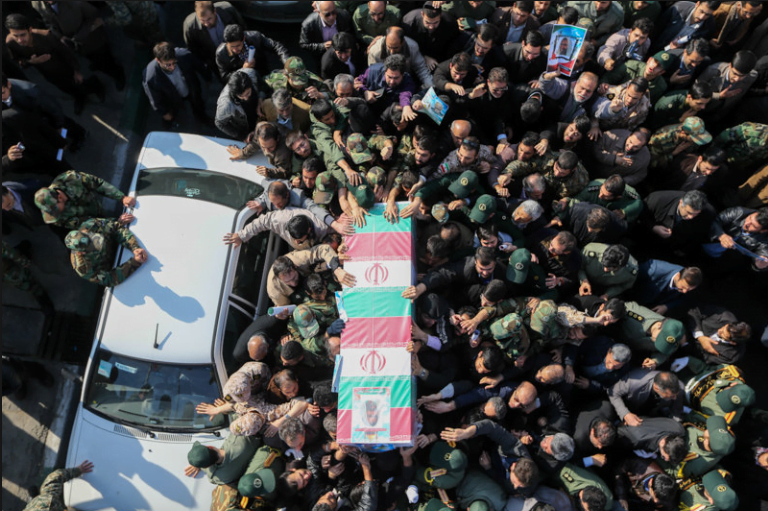
Thousands of Revolutionary Guards gathered in Tehran on Sunday for the funeral of Iranian Brigadier General Hamid Taqavi, who was reportedly killed by a sniper while organizing the defense of the Iraqi city of Samarra against Islamic State (ISIS) militants.
According to Fars News, Iran’s top security official Ali Shamkhani told mourners that if “people like Taqavi do not shed their blood in Samarra, then we would shed our blood [within Iran] in Sistan [-Baluchestan], [East and West] Azerbaijan [provinces], Shiraz and Esfahan [to defend the country]”.
Deaths in Iraq show two sides of Iran’s role in sectarian conflict
Mehr News reported the funeral was also attended by General Qassem Soleimani, commander of the Quds brigade, the overseas arm of the IRGC (Islamic Revolutionary Guard Corps), which has been active in Iraq. The Iranian Labour News Agency relayed condolences from Ali Larijani, the parliamentary speaker, “to the Lord of the Age [the 12th Shia Imam, believed to be in occultation], the Supreme Leader, the honorable Iranian nation, his comrades and respected and patient family members.”
Taqavi, 55, was the most senior Iranian military commander killed in Iraq, where Tehran calls its role “advisory” in assisting the Iraqi army, Kurdish forces and Shia militias against ISIS. While Taqavi’s funeral illustrated the clear official Iranian commitment to its armed forces, the murkier dimensions of Tehran’s growing role in the brutal sectarian conflict engulfing Iraq and Syria were highlighted by the death of Wathiq al-Battat, an Iraqi militant with long links to Iran and leader of one of Iraq’s several Shia militias.
The Mukhtar Army, the Iraqi militia, recently announced its leader Wathiq al-Battat had been killed in Diyala province. Battat had been a player in the shady war between Iraqi Shia militias and the Sunni militants of ISIS.
As general secretary of Hezbollah in Iraq, al-Battat’s militant anti-Sunni sentiments often unnerved Iraq’s mainstream Shia leaders. But he had often boasted of his links to Iran’s IRGC and proclaimed his loyalty to Ayatollah Ali Khamenei, Iran’s supreme leader.
The circumstances of his death on 20 or 21 December mired within the violence in Iraq, are unclear. Within two days of al-Battat’s demise, several Iranian conservative websites claimed Saudi intelligence was involved.
These also claimed Battat was killed by a remote-controlled road-side bomb, although the statement issued by Mukhtar Army had said he was “assassinated by accident” while Al-Quds al-Arabi, the London-based pan-Arab newspaper, quoted an Iraqi government source that Battat had been shot by “unidentified gunmen”.
Battat was a controversial figure who formed the Mukhtar Army in early 2013 warning of the dangers of violent Sunni groups committed to a virulently anti-Shia agenda. Later that year, Nuri al-Maliki, then prime minister, reportedly ordered Battat’s arrest for inciting sectarian conflict but it appears Battat was released from a brief detention early in 2014, perhaps to help take part in militant Sunni groups, including ISIS.
In its latest issue, Ya-Lesarat al-Hossein, the weekly publication of Ansar-e Hezbollah, the militant Iranian group, has published a profile of Battat. Ya-Lesarat al-Hossein assigned him a role in military operations in Iraq against both United States forces and the Mojahedin-e Khalq (MEK), the armed opposition group previously allied to Saddam Hussein. It also backed up past reports that Battat was involved in a mortar attack by Mukhtar Army in November 2013 on a Saudi military base 40km from the eastern Saudi town of Hafar al-Batin near the borders with Iraq and Kuwait.
According to Ya-Lesarat al-Hossein, this attack was a response to the bombing of Iran’s embassy in Lebanon three days earlier on 19 November, claimed by the Abdullah Azzam brigade, a militant Sunni Muslim group linked to al-Qaeda, in which 23 people died, including Iran’s cultural attaché Ebrahim Ansari and five other Iranians. The weekly also claimed Hassan Nasrallah, leader of Lebanese Hezbollah, had the day after the attack promised “Iranian officials” it would not remain unanswered.
Accusations of Saudi involvement with Abdullah Azzam brigade and the Beirut bombing are not new. In December 2013, Nasrallah claimed on television the group was linked to Saudi intelligence. When in the same month, Majid al-Majid, the Saudi leader of Adbullah Azzam brigade died of kidney failure in Lebanese army custody a few days after being arrested, Alaeddin Boroujerdi, chair of the Iranian parliament’s National Security and Foreign Policy Committee, drew attention to Majid’s nationality and called for an investigation.
The website of the Iraqi Kurdish weekly Rudaw also reported Battat’s death, which it said came in clashes with ISIS near the district of Uzem. It dubbed Battat a “firebrand Shia Iraqi cleric and militia leader known for his anti-Kurdish rhetoric and vehemently anti-Sunni diatribes”. Rudaw noted that Battat’s militia had been “fighting ISIS on different fronts, particularly in northern Diyala province, since the jihadis captured Iraq’s [Arab] Sunni provinces last summer.”
The Kurdish website quoted remarks from Battat describing Kirkuk, a city disputed between Iraq’s Kurds and Arabs, as a “red line” and warning that if the Kurds pressed their claim to the city “we will counter the Kurds as we counter ISIS” leading to “a sea of blood between us”.
Ya-Lesarat al-Hossein places Battat’s birth in Maysan province, Iraq, in 1973. It claims he moved to Iran in 1993 as an opponent of Iraq’s then president, Saddam Hussein, and joined the Badr group, the military wing of the Supreme Council for the Islamic Revolution in Iraq (Sciri), which had been established in 1980 in Tehran by Ayatollah Mohammed-Baqir Hakim and had close links with the IRGC. In addition to his military training, Battat attended Tehran university and studied to masters level in a field related in military science.
Ya-Lesarat al-Hossein claims he carried out resistance activities under the command of Hussein Shahrestani, now Iraq’s minister of education. Despite the imprisonment of his father and brother in Iraq, Battat crossed the border near Dehloran, Ilam province, to launch guerrilla attacks on Baathist forces,
Ya-Lesarat al-Hossein continues: in one operation, Battat was arrested along with 270 comrades, but remained unidentified by Baathist officials and later escaped from prison and returned to Iran.
Ya-Lesarat al-Hosseinreports thatBattat was again arrested in 1998 by Iraqi intelligence when part of a Badr mission to assassinate Ali Hassan al-Majid, known as “Chemical Ali” after his use of chemical weapons against Iraqi Kurds in 1988-90 (and who was executed in 2010). Battat was imprisoned for 20 months, condemned to death three times, but was for unknown reasons pardoned, according to Ya-Lesarat al-Hossein.He resumed guerrilla activities against Saddam Hussein in 2002, and after the fall of Saddam in 2003 returned to Iraq and became a member of the Mahdi Army, the militia of Shia cleric Moqtada al-Sadr.
a-Lesarat al-Hossein reports Battat also travelled to Lebanon before helping establish Iraqi Hezbollah, and in February 2013 was involved in setting up the Mokhtar Army as its militia “to assist the Iraqi government in its fight against terrorist groups”. As commander, he strengthened his links to the IRGC and especially its Quds brigade, responsible for operations outside Iran.
Iranian guards fire shells into Pakistan – Iranian border guards on Monday fired a barrage of mortar shells into a border region of Balochistan, leaving four people wounded. The pre-dawn shelling came hours after three soldiers of Iran’s Revolutionary Guards Corps were killed in an attack by ‘armed bandits’ in the southeast of Iran near the Pakistan border, according to Iranian media reports.
Iranian guards fire shells into Pakistan
“At least 42 mortar shells fired from Iranian side landed in Balochistan’s Zamuran area where transporters were present,” an official of the Turbat Levies told The Express Tribune. “As a result, at least four Pakistani transporters or drivers sustained minor injuries.”
The shelling came hours after three Iranian troops were killed in an attack in its border province. “Armed bandits killed the IRGC members late Sunday near the city of Saravan in the Sistan-Baluchestan province,” according to a statement carried by Iran’s Fars news agency.
Official sources in Pakistan confirmed the attack on Iranian troops and described Monday’s shelling as retaliatory action against the attackers who had tried to flee to the Pakistani side of border.
A few days ago, Iranian border guards shot and injured two Pakistani citizens in Panjgur. Security on the Pak-Iran border has been beefed up following the latest incident.
There have been frequent deadly attacks on Iranian forces near the border.
7000 Iranian Revolutionary Guards in Iraq to regain influence – There are currently thousands of Iranian Revolutionary Guards stationed in a number of Iraqi cities to help Tehran regime its loss in Iraq after the ouster former Iraq Prime Minister Nouri al-Maliki, according to the Iranian opposition, the National Council of Resistance of Iran.
7000 Iranian Revolutionary Guards in Iraq to regain influence
The guards that are estimated to be over 7000 are stationed in Baghdad, Diyala and Salah ad-Din provinces and the cities of Samarra, Karbala, Najaf, Khaneqain, Sa’adiyah and Jaloula.
A dispatched Revolutionary Guards include commanders and experts that accompany the militias in various areas of Iraq.
Regime’s fighter jets have been flying in Iraq since early November and are currently carrying out military missions in Diyala and Salah ad-Din provinces.
The presence of the Iranian Revolutionary Guards of Quds Force in Iraq is a blatant breach of UN Security Council resolutions.
The Iranian Resistance warns that Revolutionary Guards are not in Iraq to fight ISIS, but to compensate for the heavy blow caused by Nouri al-Maliki’s ouster to create a Velayat-e faqih caliphate in Iraq.
The slaughter and forced migration, along with aggression against the Iraqi people, in particular the Sunnis, and ridding them of their property by the revolutionary guards and their affiliated militias under the pretext of fighting ISIS has endangered peace and security throughout the region and fuels the machine of extremism and terrorism in the whole region.
High-ranking IRGC general killed in Iraq – A high-ranking general of Iran’s Islamic Revolution Guards Corps (IRGC), Hamid Taghavi, was killed in Iraq, the Fars news agency reported Dec. 28 citing the IRGC Public Relations Department.
High-ranking IRGC general killed in Iraq
Taghavi was reportedly killed during a mission in the city of Samara.
IRGC said that its member was in Iraq for military advice to the Iraqi army in fights against the terrorist organization known as the “Islamic State” (IS, formerly ISIL or ISIS).
Taghavi was one of the IRGC commanders during the Iran-Iraq War (1980-1988).
He will be buried Dec. 30 in his hometown of Ahwaz in southwest Iran.
The IS was created in 2003 in Iraq. Following the start of military confrontation in Syria between the armed opposition and the government forces, the IS penetrated the country in 2013.
Strengthening of the IS in Syria allowed it to return to Iraq, deploying military actions against government forces there.
Some western and Iraqi media have underscored the significant role of Iranian forces in fighting against the IS.
The media reports say Iranian forces have a decisive presence on the battlefield of the fight.
Meanwhile Iranian officials said the Islamic Republic gives only advice and organizational structure to the Iraqi forces.