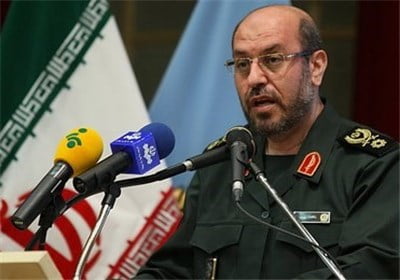
Iran’s Defense Ministry, Brigadier General Hossein Dehqan said his ministry plays a significant role in the country’s national development.
Iran’s Defense Ministry Playing Major Role in National Development
In a statement on the occasion of National Day of Defense Industry on Friday, Dehqan said the ministry has taken great strides to indigenize needed strategic defense products “by employing the potentials of the defense industry.”
He underlined that Iran’s defense industries constitute one of the pillars of ensuring the country’s security.
The minister further said that as a progressive industry in the scientific and technological fields, Iran’s defense industry is “capable of entering world markets” and foiling the unjust sanctions and restrictions imposed by the enemies.
On Thursday, General Dehqan inaugurated the production line of manufacturing advanced military batteries used in missile systems.
Utilizing scientific capacities of the country’s defense industry would thwart anti-Iran sanctions, he said in an address.
In recent years, the Islamic Republic of Iran has made great achievements in its defense sector and has attained self-sufficiency in producing essential military equipment and systems.
Tehran has repeatedly assured other nations that its military might poses no threat to the regional countries, saying that the Islamic Republic’s defense doctrine is entirely based on deterrence.
Twenty-seven political prisoners have been transferred from Evin Prison’s Ward 350 to quarantine, where they are now being held in conditions tantamount to clear and serious ill treatment.
Political Prisoners at Evin Transferred into Quarantine
In an interview with the International Campaign for Human Rights in Iran, Atieh Taheri, the wife of Saeed Matinpour, who is an Azeri journalist and civil activist and one of the prisoners transferred into quarantine, reported that Matinpour believes the transfer will last for some time. In a brief phone conversation with his wife, Matinpour said no reason had been given for the sudden transfer of prisoners from this ward.
Taheri told the Campaign that Matinpour described the quarantine ward as having four windowless cells and a narrow courtyard for fresh air. “As you can imagine from its name, the quarantine is a temporary holding place for detainees when they first enter prison. But Saeed and others have to live there,” Taheri said.
“I don’t know what’s happened exactly but apparently the legal representative for Ward 7 complained that the transfer of 50 prisoners from Ward 350 to Ward 7 had caused overcrowding and the authorities did not have room in other sections, so they sent 27 prisoners to the quarantine,” Taheri added.
Iranian judicial and prison authorities have not commented on the sudden transfers. There is speculation that following last April’s clashes at Evin’s Ward 350, when prisoners were attacked by security guards, a decision was made to break up the group of prisoners who were inside Ward 350 at the time of the incident.
Matinpour has spent six years in prison and suffers from serious stomach ailments. His conditions may now worsen in quarantine [where the food is consistently of substandard quality], his wife told the Campaign.
On August 2, Kalame, a news site close to Mir Hossein Mousavi, the opposition leader who has been held under house arrest for over three years, reported the sudden transfer of 50 prisoners from Ward 350 to other sections of Evin Prison, leaving 63 others. The news site predicted that the transfers from this ward, reserved for political prisoners since the 1979 revolution, would continue.
“Being returned to quarantine is hard on prisoners who have been in prison for a long time. It’s added torture and a repeat of the hardships of the first days of imprisonment,” Taheri told the Campaign.
Asked why the prisoners had been transferred to quarantine, Taheri said, “They have not given an explanation to us or the prisoners. They do not even acknowledge political prisoners and their families, let alone answer their questions. We don’t know what’s going on and when something happens we find out about it from web sites.”
Matinpour, 39, studied philosophy at Tehran University and wrote for the Zanjan Weekly. He was active in human rights and ethnic minority rights causes and was arrested on May 25, 2007, for participating in a seminar in defense of Azeri civil rights in Turkey. He was sentenced to eight years in prison by Branch 15 of the Revolutionary Court of Tehran, presided over by Judge Salavati, on charges of “contact with foreigners,” and “propaganda against the state.”
Iran’s Justice Minister Mostafa Pour-Mohammadi said on Thursday that the nation had no fear of enemy’s psychological war which would never come to an end.
Mostafa Pour-Mohammadi said on Thursday that the nation had no fear of enemy’s psychological war which would never come to an end.
Iran’s Justice Minister, We are Not Afraid of Enemy’s Psychological War
“The arrogant powers have conducted a massive propaganda campaign against the leaders and people of the Islamic Republic of Iran in recent years,” said Pour-Mohammadi during a cultural ceremony in the northern city of Qaem Shahr.
He emphasized that the spirit of unity and empathy should be bolstered among the country’s officials to counter what he called the enemy’s relentless psychological war.
For more than quarter of a century, Western countries have been waging a massive propaganda war against Islamic Republic of Iran over issues like the country’s record on human rights and Tehran’s nuclear energy program.
The Iranian official also rapped Western countries for their own record on human rights and widespread political corruption as well as economic inequality.
“Economic inequality continues to exist in arrogant countries like the US, and these countries are rife with social and moral corruption,” he concluded.
IRGC urban war town set up to confront youths, In fear of escalation of street clashes between youths and the security forces, the Iranian Revolutionary Guards Corps (IRGC) set up an “urban war town” to confront the youths and people’s uprising. Pasdar Bigdeli, the IRGC’s defense deputy in Tehran said that this town is built for Basij forces to practice urban war, and they will use real guns and bullets to be ready to confront any problem, a Basij press website reported on August 17.
IRGC urban war town
“A paintball Tournament is one of the programs to increase the level of preparedness of the IRGC personnel and Basij militia forces for battles,” Bidgeli said.
According to Basij press, the regime will review the tactics of urban war in IRGC’s paintball tournament in Tehran. “Paintball exercise is done by two approaches. The approach we have focused on is addressing the paintball combat techniques and also considering the tactics of urban war,” Bigdeli said.
Commander of the Islamic Revolution Guards Corps (IRGC) Aerospace Force Brigadier General Amir Ali Hajizadeh reiterated the Iranian Armed Forces’ full preparedness to defend the country, and said Tehran will give a crushing and deadly response to any aggression by the Zionist regime.
IRGC Commander Warns Israel of Deadly Response
“The Zionist regime might have a decision to make an aggression against Iran, but it will certainly come to the conclusion that it has taken an immature decision after studying the outcomes and consequences and the Islamic Republic of Iran’s much powerful reaction,” Hajizadeh said, addressing IRGC cadets in the Northeastern city of Mashhad on Wednesday.
He underlined Iran’s high preparedness for any possible attack against the country, and said, “The Zionist regime officials have many times raised threats against Iran, but they are well aware that the price of any attack on Iran and our response will be so heavy for them that even its imagination is like a deadly nightmare for them.”
“The Islamic Republic will respond to any threat at the same level,” Hajizadeh said.
Iranian officials, including Defense Minister Brigadier General Hossein Dehqan, have always reiterated Iran’s full preparedness to confront any possible enemy threat and aggression, and said that the country’s military forces will give a swift and decisive response to any US or Israeli threat.
“The westerners are angry at us and they use the nuclear issue as a worn-out pretext to leave an impact on our nation,” Dehqan said in February.
“Certainly, our nation will not be affected and is fully ready to confront any arrogant move of the US or its little child, Israel,” he underlined.
The Iranian minister advised the enemies to see the Iranian nation’s resolve, understand its greatness and shift their path to move on the right path.
Iranian President Hassan Rouhani renewedthat Iran Aids to Iraqis, Palestinians, Syrians and strongly criticized the Israeli regime for its savage attacks against the Palestinians in the Gaza Strip.
Iran Aids to Palestinians, Iraqis, Syrians
“Today the people of Iraq, Palestine, Syria and many other Muslim nations are waiting help from the Iranians and we should aid our brothers,” President Rouhani said, addressing a large group of people in the Northwestern city of Ardebil on Wednesday.
He pointed to the Israeli savagery against the oppressed Palestinians, and said, “The Israeli executioners pour barrage of bullets and bombs on the oppressed Palestinian nation which is not acceptable at all.”
Last month, Supreme Leader of the Islamic Revolution Ayatollah Seyed Ali Khamenei strongly condemned the recent Israeli attacks on the Palestinians, and underlined that Palestinians should continue their armed struggle against Tel Aviv.
“The armed resistance by the Palestinians is the only way to confront Israel,” Ayatollah Khamenei said addressing a group of Iranian university students in Tehran.
The Iranian Supreme Leader noted that criminal acts of wolfish, child-killer Zionist regime in Gaza have revealed its true nature, and said, “Only way to solve this problem is full annihilation and destruction of the Zionist regime.
“We should realize that the truth and reality of the United States is manifested in this approach, and the Iranian nation, too, will show in the International Quds Day with its huge and roaring demonstrations that they are the supporters of the oppressed and the enemies of the oppressors,” added Ayatollah Khamenei.
Last week, Secretary of Iran’s Supreme National Security Council (SNSC) Ali Shamkhani renewed Iran’s support for the establishment of peace and security in Iraq.
“The only way to establish peace and tranquility in Iraq is through respecting the constitution and forging unity,” Shamkhani told reporters.
He noted that the Iranian government and nation will use all their capacities to help establish sustainable security in Iraq.
In July, Iranian Parliament Speaker Ali Larijani underlined that the world powers should respect the Syrian people’s choice for their presidency and stop supporting the terrorist groups active in the Arab country.
“The world powers should accept the Syrian people’s votes and avoid confrontation with the Syrian nation,” Larijani said in a meeting with his Syrian counterpart Mohammad Jihad al-Laham in Tehran.
He referred to the present situation in the region, and said, “Those countries which supported the terrorists in Syria are now concerned about their situation due to the spread of the conflicts to Iraq.”
Iran is holding consultations with different countries, including the European states, to coordinate efforts aimed at fighting with the Islamic State in Iraq and the Levant (ISIL) terrorist group operating in Iraq, an Iranian spokesperson said.
Iran Confirms Consultations with World States on Fight against ISIL
Speaking to reporters at her weekly press conference on Wednesday, Iranian Foreign Ministry Spokeswoman Marziyeh Afkham did not rule out the recent comments by British Prime Minster David Cameron, who has alluded to the possibility of Tehran-London cooperation to eradicate the terrorist threats posed by the ISIL.
Last week, Cameron wrote in The Sunday Telegraph that the West must cooperate with the Middle East countries including Iran, Saudi Arabia, Qatar, Egypt and Turkey to encounter the extremist group.
As regards the procedures to counter terrorists in Iran’s western neighbor, Afkham stressed, “Iran launches such talks within the framework of the international regulations and according to the Iraqi government’s view, and welcomes them (the talks).”
The ISIL is a militant group that claims as an independent state the territory of Iraq and Syria, with implied future claims intended over more of the Levant, including Lebanon, occupied Palestine, Jordan, Cyprus, and Southern Turkey.
In addition to attacks on government and military targets, the group has claimed responsibility for attacks that have killed thousands of Iraqi civilians.
In early June, following its large-scale offensives in Iraq, ISIL seized control of most parts of Mosul, the second most populous city in Iraq and its surrounding Nineveh province.
Iranian Armed Forces General Staff on Wednesday reaffirmed that the great defense achievements have upgraded the country’s deterrent capabilities, and hailed the Islamic Republic as the number one power in the region.
Iranian Armed Forces: Iran Region’s Leading Power
“The great achievements and capabilities of the country’s defense industry in different arenas of aerospace, naval and ground (force), which have been obtained proportional to the modern global standards, have now turned the Islamic Republic into the region’s premier and uncontested power,” the Iranian Armed Forces General Staff said in a statement issued on the occasion of the National Day of Defense Industry (August 22).
It also noted that Iran’s military achievements in defense sector are capable enough to compete at trans-regional levels.
The statement further referred to Iran’s advanced defensive equipment as a contributor to the enhancement of the country’s “deterrent power.”
In recent years, the Islamic Republic of Iran has made great achievements in its defense sector and has attained self-sufficiency in producing essential military equipment and systems.
Tehran has repeatedly assured other nations that its military might poses no threat to other countries, saying that the Islamic Republic’s defense doctrine is entirely based on deterrence.
Iran’s Kurdish Region a Hotbed of Anti-Government Activism
IRGC warns against Intrusion into Iranian Kurdistan. IRGC General Mohammad Hossein Rajabi, commander of Bait ul-Muqaddas Corps, with area of responsibility covering the country’s Kurdish region, today warned “anyone with intention to disrupt the security of Kurdistan region of Iran should expect a crushing response by the IRGC.” (Fars News Agency, 19 August)
IRGC General Mohammad Hossein Rajabi, commander of Bait ul-Muqaddas Corps
Gen. Rajabi most likely was referring to the Islamic State, whose fighters have captured the town of Jalula, 14 miles west of the city of Khanaqin on the border of Iranian Kurdistan.
“No enemy can influence our security and we have the means and capability to fight at equal and even with more power the threats posed by the enemy as we believe maintaining security is our religious and revolutionary duty,” Gen. Rajabi said.
The Iranians have in the week since the Islamic State overran Jalula on 12 August, have issues declarations similar to Gen. Rajabi’s, probably showing their concerns of a possible ISIL’s move to capture Khanaqin, which will put them only 19 miles from the Iranian city of Qasr-e Shirin. Since the very first year of the founding of the Islamic Republic in 1979, Iranian Kurdistan, with predominantly Sunni population, has been a hotbed of anti-government activism and low insurgencies. The presence of the advancing Islamic State nearby could create serious security issues in Iran’s Sunni lands.
The Iranian military has extensively supported the Iraqis in their fight against ISIL, including organizing, directing, financing and arming Shia militias. But Islamic State’s possible move toward Khanaqin could trigger a more serious response by Iran, as General Rajabi was alluding to today. The Islamic State also knows this; yet any move against Iran, inside or close to its territory, could break the tacit coalition of all regional governments against ISIL. The Islamic State leadership might believe that in the event of direct operations against the Iranians, they could get the backing of the Persian Gulf countries, particularly the Saudis. Iran is signaling that they would instead face Iranian forces.
Iran English Radio: IRGC top advisor hails Iran’s missile power
A top advisor to the Commander of the Islamic Revolution Guards Corps (IRGC) underlined the Iranian Armed Forces’ preparedness to confront enemies, and said IRGC forces are equipped with state-of-the-art weapons and powerful missiles.
“Today, Iran’s missile systems are ready to respond to any enemy threats,” Brigadier General Komeil Kohansal said, addressing a gathering in the Northern city of Sari on Tuesday.
IRGC Missile
Elsewhere, he referred to the enmities of the arrogant powers, specially the US, with the Muslim states, and said the US is like a virus threatening the entire world, which wants to never see tranquility in Islamic countries and has killed over one million people in Iraq and Afghanistan.
Tehran launched an arms development program during the 1980-88 Iraqi imposed war on Iran to compensate for a US weapons embargo. Since 1992, Iran has produced its own tanks, armored personnel carriers, missiles and fighter planes.
Yet, Iranian officials have always stressed that the country’s military and arms programs serve defensive purposes and should not be perceived as a threat to any other country.