TEHRAN (FNA)- Lieutenant Commander of Basij (volunteer) Forces Brigadier General Ali Fazli underlined that the Persian Gulf will be the scene of any possible direct confrontation between Iran and the US, adding that Washington has earlier experienced failure against Tehran in this region.
“The US has always tasted defeat and withdrawal in the Persian Gulf’s waters and has directly witnessed the bravery and prowess of the Muslim fighters; therefore, it hasn’t and doesn’t dare even to leer down the Islamic Iran’s holy borders,” Fazli said in the Southern city of Bandar Abbas on Tuesday.
Lieutenant Commander of Basij (volunteer) Forces Brigadier General Ali Fazli
He described the Persian Gulf as the battlefield of any possible war that may break out between Iran and the US.
In relevant remarks in April, a senior commander of the Islamic Revolution Guards Corps reiterated the IRGC’s upper hand in the Persian Gulf, and said Iran monitors all the moves made by the regional and trans-regional naval forces in the region.
“The IRGC Navy fully monitors all moves in the Persian Gulf and we have proved our might and power in our naval patrols in the Persian Gulf,” Commander of the IRGC’s Second Naval Zone General Ali Razmjou said.
“The IRGC Navy, specially the Second Naval Zone, has the most advanced defensive weapons and technical equipment, and more importantly it has devoted and sincere human resources,” he added.
Razmjou said that the IRGC forces are always ready to devote their lives on the path of the Islamic Revolution causes, adding that this is not a claim and has many times been proven in practice.
The IRGC was appointed to defend the Persian Gulf security in 2008. The Iranian army has been tasked with controlling the Sea of Oman and the Caspian Sea, while the full responsibility for defending the Persian Gulf security has been entrusted to the IRGC.
The Iranian Army Navy and the Islamic Revolution Guards Corps Navy have tight cooperation in controlling the country’s waterways and protecting Iran’s interests inside territorial waters and in the high seas.
Iran’s naval power has even been acknowledged even by the foes. In a Sep. 11, 2008 report, the Washington Institute for the Near East Policy said that in the two decades since the Iraqi imposed war on Iran, the Islamic Republic has excelled in naval capabilities and is able to wage unique asymmetric warfare against larger naval forces.
According to the report, Iran’s Navy has been transformed into a highly motivated, well-equipped, and well-financed force and is effectively in control of the world’s oil lifeline, the Strait of Hormuz.
The administration of Iranian President Hassan Rouhani does not welcome the Islamic Revolutionary Guard Corps’ (IRGC) call for help.
According to trend, Ali Saeedi, representative of Iran’s leader Ayatollah Ali Khamenei to the IRGC, said that the government has not been welcoming IRGC’s help, Iran’s Fars news agency reported on June 10.
However, IRGC is prepared to help the government in different sectors, but that doesn’t mean IRGC seeks to take a share of the government’s profits, he explained.
In January, Saeedi said that “whenever the government needs help, the IRGC is available.”
At an April 18 ceremony marking Armed Forces Day in Tehran, Iran’s president Hassan Rouhani urged the military to “avoid interfering in political affairs.”
The president praised the army, which he said has sacrificed much since the 1979 revolution to protect the country from external threats “without requesting its share from the nation and the elected government.”
Rouhani’s comments were a clear reference to the IRGC, which has challenged Rouhani’s foreign policy from the start of his administration, especially after the influential organization found the president reluctant to grant it massive economic projects.
Soon after Rouhani won the election, he called on the IRGC to limit its economic activities to only a few national projects. That was unsatisfactory to IRGC commanders, who had been awarded at least 11,000 development projects, ranging from construction and aerospace to oil and gas, by the previous government between 2006 and 2013.
The commanders said their involvement in the economy was only meant to rein in foreign investors’ ambitions and that they would not continue it if the new government did not need them.
Maj. Gen. Mohammad Ali Jafari, the IRGC commander, complained in late March that the Rouhani administration had ignored his organization’s call for help.
He said the IRGC and its affiliated volunteer force, the Basij, were ready to assist the government with the “resistance economy” – the economic plan outlined by Khamenei to restore the country’s ailing economy and reduce reliance on oil revenues.
TEHRAN (FNA)- Deputy Commander of the Islamic Revolution Guards Corps for Political Affairs Rassoul Sanayee Raad stressed that the IRGC is not opposed to the nuclear talks with the world powers, but it cannot trust the opposite side.
“We agree with the principle of negotiations and support it but we don’t trust the foes,” Sanayee Raad said in the Southern city of Bushehr on Monday.
He said this mistrust has resulted from the lack of transparency and honesty of the western, specially the US, officials.
Sanayee Raad also warned of the US and other arrogant powers’ plots to sow discord among the Iranian officials and people, and called on the nation to keep vigilant against such plots.
In November 2013, Iran and the Group 5+1 (the US, Russia, China, Britain and France plus Germany) signed an interim nuclear deal in the Swiss city of Geneva that came into force on January 20.
They held their fourth round of talks in Vienna on May 14-16. The seven nations have been discussing ways to iron out differences and start drafting a final deal that would end the West’s dispute with Iran over the country’s nuclear energy program.
Iran said there has been no tangible progress in writing the draft text of the agreement and it blamed the US for the failure, saying Washington has made excessive demands beyond the agreements made in the previous rounds of talks.
Iranian Deputy Foreign Minister Seyed Abbas Araqchi announced on Sunday that he would have a trilateral meeting with his EU and US counterparts in Geneva Monday and Tuesday as part of the multilateral efforts made by Iran and the six world powers to resolve their nuclear standoff.
“The tomorrow meeting with the Americans will be trilateral and Helga Schmidt, the deputy of EU foreign policy chief Catherine Ashton, will be present there as well,” Araqchi said on Sunday.
Asked about the issues to go under discussion at the Monday meeting, he said, “No other issue than the nuclear topics will be discussed with the Group 5+1 and we have always emphasized this fact.”
Meantime, Araqchi said since the US is the main supporter and imposer of sanctions against Iran, the issue of embargos will also be discussed in the Geneva meeting which will last for two days.
He said that US Undersecretary of State William Burns will head the American delegation and will be accompanied by his colleague Wendy Sherman, while he and Majid Takht-e Ravanchi, another Iranian deputy foreign minister, will lead the delegation from Tehran.
Araqchi also said that the Iranian team will then meet Russian Deputy Foreign Minister Sergei Ryabkov and possibly representatives of other members of the G5+1 on the sidelines of a disarmament conference in Rome on Wednesday and Thursday.
He also said one of the other G5+1 member states is also likely to send a delegation to Tehran next week to do some coordination in bilateral talks with Iranian negotiators before the start of another round of multilateral negotiations between Iran and the world powers in Vienna from June 16 to 20.
HRANA News Agency – Mohsen Rahmani’s court verdict, 7 years imprisonment for raising Mir Hossein Moosavi’s photos, was confirmed by the Court of Appeal.
According to the report of Human Rights Activists News Agency (HRANA), Mohsen Rahmani political reformist activist was arrested by the security forces in the election campaign for Hassan Rohani with accusation of attempt to raise photo of Mir Hossein Moosavi (one of the Green Movement’s leaders) on first of June 2013.
Mohsen Rahmani
He was released after couple of months on the bail and his case was referred to the Revolutionary Court, branch 28, presided by Judge Mohammad Moqisehei and eventually a sentence of 7 years imprisonment was issued.
An informed source told HRANA reporter in this regard: “The authorities have informed his solicitors that his verdict was confirmed by branch 36 of the Appeal Court exactly as it was, and he will be informed till next week.
It has been announced that the accusations for his heavy sentence are: Assembly and collusion against national security through cooperation with counter-revolution network, propaganda against the Islamic Republic, disturbing public discipline with unconventional movements and chanting slogans in favor of the Intrigues leaders in the candidates’ conferences for presidential election, insulting the Supreme Leader Imam Khomeini in the cyberspace.
Iranian Defense Minister Brigadier General Hossein Dehqan
TEHRAN (FNA)- Iranian Defense Minister Brigadier General Hossein Dehqan announced on Monday that his ministry has overhauled 20 helicopters and brought them back into action for the country’s different military forces.
“The experts and staff of the Defense Ministry’s Aviation Industries Organization have overhauled 20 helicopters of the Armed Forces at PANHA (helicopter manufacturing) company and we are now observing their delivery to Iran’s honorable Armed Forces,” Dehqan said in Tehran today.
The minister said the 20 helicopters belonged to different categories and models, including “205, 212, 214, 412, SH, RH, CH and Mil”.
Iran’s Defense Minister Brig. Gen. Hossein Dehqan (L) and Navy Commander Rear Admiral Habibollah Sayyari (R)
Iran’s Defense Minister Brig. Gen. Hossein Dehqan (L) and Navy Commander Rear Admiral Habibollah Sayyari (R)
In recent years, Iran has made great achievements in its defense sector and attained self-sufficiency in producing essential military equipment and systems.
In November, the newly-overhauled SH3D combat helicopter came back into operation in a ceremony attended by senior Iranian commanders.
The helicopter came back into operation for the Navy after nearly 20 months of overhaul repairs and seven months of tests.
Lieutenant Commander of the Iranian Army Brigadier General Abdul-Rahim Mousavi and Iranian Navy Commander Rear Admiral Habibollah Sayyari were present in the ceremony.
Iran has completed the second phase of an air defense maneuver in the southeastern parts of the country, PRESSTV reported.
“Considering the sensitivity of the southeastern air defense zone and its adjacency to the Persian Gulf littoral states, the one-day Mesbaholhoda drill was planned for this air defense zone and its second phase has been carried out,” said Deputy Commander of Iran’s Khatam al-Anbiya Air Defense Base Brigadier General Alireza Sabahifard on Saturday.
File photo shows Iran’s Matla-ul-Fajr-1 (Breaking Dawn) radar system in operation
In the course of the maneuver, the electronic, artillery and missile radar systems and watchtowers were tested in combat scenarios and all the systems made satisfactory tactical moves against their targets, Sabahifard said.
The commander noted that a wide range of scenarios had been devised for these drills according to the existing threats in order to assess the readiness of the personnel and systems under real circumstances and enhance the operational and combat capabilities of Iran’s air defense units.
In recent years, Iran has made great achievements in its defense sector and attained self-sufficiency in producing essential military equipment and systems.
On June 2, Iran’s Islamic Revolution Guards Corps (IRGC) officially put into service a domestically developed long-range radar system, named Ghadir, capable of detecting stealth aircraft.
The state-of-the-art radar system uses three-dimensional (3-D) technology to detect airborne targets, including radar-evading aircraft, cruise and ballistic missiles, and satellites in low orbits.
The Islamic Republic has frequently announced that its military might poses no threat to other countries, stating that its defense doctrine is based on deterrence.
Whether leaked by enemies of the Islamic Revolutionary Guard Corps (IRGC) or the IRGC itself, the video revealing statements by the IRGC commander about preventing the election of Reformists in 2009 may reveal cracks in the regime’s leadership.
According to al-monitor What many suspected before, that Iran’s 2009 elections were a sham, seems no longer to be in dispute.
The proof came in the form of a leaked video in which Mohammad Ali Jafari, the commander of the Islamic Revolutionary Guard Corps (IRGC), stated that the victory of the Reformists in the 2009 elections and their return to power was a “red line,” and how and why it was prevented.
Mohammad Ali Jafari, the commander of the Islamic Revolutionary Guard Corps (IRGC)
But that was in 2009. Five years have passed. Mahmoud Ahmadinejad is no longer president. Will the release of such a controversial video really have an impact on Iranian politics?
The answer is no, at least not on the surface.
One of the immediate lessons learned from these new revelations is how much power the IRGC wields, not just in the military and economic sphere but also in politics.
These new revelations also show how close the IRGC is to the supreme leader, and how much he trusts it. Let’s not forget that Jafari is directly chosen and appointed as the head of the IRGC by Iran’s most powerful man, Supreme Leader Ayatollah Ali Khamenei. Whatever the IRGC did in the 2009 elections would have been with the blessing of the supreme leader, if not a result of his direct instructions.
We also have to remember that the IRGC is also close to the conservative camp in Iranian politics. Many important institutions are firmly in the hands of the conservatives. These include the powerful Guardian Council, the Majles (parliament) and the all-powerful judiciary. All these bodies can affect the policies of the government, currently in the hands of the moderates, headed by President Hassan Rouhani.
Therefore, a strong military, economic and political domestic superpower such as the IRGC, which is close to the supreme leader and Iran’s conservative camp, is not going to be embarrassed off its perch by the findings of the recent video. Rouhani and the Reformists can refer and hint to this video all they want, but for now it won’t change a thing.
What this video does show is that underneath the surface, more cracks are appearing in the foundations of the regime.
We have to remember that the video, first published by Iranian political activist Mohammad Nourizad on his Facebook page, was supposed to have been a secret. It was not for public screening, because its contents were very controversial. A contentious video such as this didn’t just fall out of the sky and land in Nourizad’s lap. So how did he get hold of it?
There are at least two possibilities:
One is that a powerful person, or even a powerful group within the Iranian regime, is angry with the IRGC’s involvement in Iranian politics. By releasing this video, it wanted to show the people of Iran what a destructive force this organization has been before and can be again.
The other possibility is that the IRGC deliberately sanctioned the release of this video as a warning to its rivals. To say to them: Look at how much power we have. We did all of this in 2009 and if pushed, we could do it again. So watch your step.
Either scenario would show that the infighting between different factions inside the regime is becoming more intense and nasty than we realized, so much so that they are willing to go public with such controversial information to hurt or warn off the other side: that what we are witnessing is a tip of an iceberg of differences that is surfacing.
But we have seen videos being leaked before as part of political infighting. In February 2013, then-President Ahmadinejad publicized a secretly recorded video to undermine his rival Ali Larijani. So what’s so different this time?
It’s one thing to fight over who is more financially corrupt. It’s quite another to show evidence that an entire election was a sham, and that the voice and opinion of the people of Iran were worthless unless approved by Iran’s most powerful man and most powerful military body, who were willing not just to ignore the people’s voice but to use violence as well. Such revelations in the long run can be a much more direct challenge to the very legitimacy of the regime, even among its own supporters.
Judging by another speech by Jafari, the premeditated decision to intervene in the 2009 elections — if true — had consequences far more dangerous than a demonstration by a group of people from “North Tehran” who would not “tolerate difficulty,” as Jafari states in the newly leaked video.
In his public speech on Oct. 2, 2009, Jafari stated that the post-election disturbances brought the regime close “to the edge of being overthrown,” and that the disturbances were the “biggest danger to the core of the system and the Islamic revolution in the last 30 years, even more dangerous than the Iran-Iraq War.”
The revelations of this video suggest intense infighting, even more than is generally assumed. Twenty-five years after the death of Ayatollah Khomeini, the regime may be more divided now than when he was alive. It also reveals the willingness of the regime to use brute force to prevent any candidate it does not approve of from winning in elections. While these cracks inside the Iranian regime may be a warning for the long run, the IRGC, for now, still seems safe in its role.
TEHRAN (FNA)- Iran tested its radar and missile systems in a series of tactical air defense drills, codenamed ‘Mesbah Al-Hoda’, in the Southern parts of the country, Lieutenant Commander of Khatam ol-Anbia Air Defense Base Brigadier General Alireza Sabahifard announced on Saturday.
“This stage of Mesbah Al-Hoda (Lantern of Guidance) military drills was held concentrating on Kish air defense group, and radar, missile, artillery and electronic systems (as well as watchtowers) were tested in different combat scenarios,” General Sabahifard said.
He underlined that all systems proved high levels of efficiency in the drills.
General Sabahifard explained that Mesbah Al-Hoda exercises are comprised of several phases. “The drills have been designed for all air defense zones throughout the country,” he said, and added that each air defense zone is tasked with conducting the drills and evaluating the personnel and air defense systems throughout the year.
“Given the variety of the scenarios considered for these exercises and considering that they have been designed to deal with everyday threats they can assess and evaluate the preparedness level of the personnel and systems against all types of threats in a pragmatic way, and hence result in boosting the combat and operational capabilities of air defense units in the country,” General Sabahifard stressed.
Earlier this year, Sabahifard underlined the preparedness of his forces to confront any possible enemy threats, saying “We monitor the airspace of the country day and night and we will not allow anyone or anything to violate our country’s airspace.”
Commander of Khatam ol-Anbia Air Defense Base General Farzad Esmayeeli announced in April that Iran has mounted data gathering and transmission systems on the equipment used by watchmen in its air defense sites.
“The Rassed 32 system is among the good achievements of the (Khatam ol-Anbia) Air Defense Base in surveillance and reconnaissance fields which can send the data pertaining to the direction, altitude and speed of flying targets to the control centers from 15km away,” the commander of Khatam ol-Anbia Air Defense Base said.
“Using the achievement, the watchman sends data and information about the direction, speed and altitude of flying targets to the control centers through the system fixed in his helmet or optical systems,” he added.
The Iranian officials have always stressed that the country’s military and arms programs serve defensive purposes and should not be perceived as a threat to any other country.
The funeral procession of an Afghan recently killed in fighting in Syria attended by Qom Iran Revolutionary Guards Corps commanders.
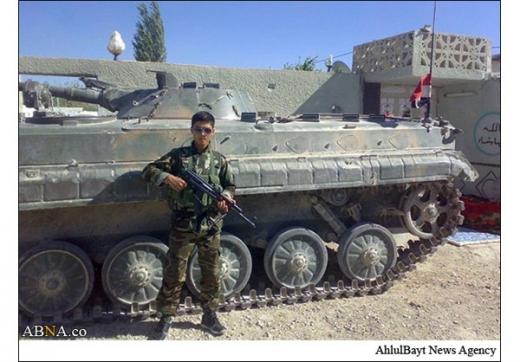
Iran has been accused of recruiting and sending Afghanistan’s Shia Muslims to fight alongside the Assad regime in war-torn Syria. Afghan migrants say they are being trained and deployed by the country’s notorious Revolutionary Guards.
The funeral procession of an Afghan recently killed in fighting in Syria attended by Qom Iran Revolutionary Guards Corps commanders.
Iranian, Afghan and international media outlets have reported on this influx of Afghan migrants to Syria for several months. Several have also published photos of funeral processions of Afghan Shia “martyrs” in different cities across Iran: from Qom, to Mashhad, and Isfahan, the men are buried in ceremonies that are reportedly attended by local Revolutionary Guards Corps commanders.
FRANCE 24 has spoken to one Observer who accuses Iran’s Revolutionary Guards of offering incentives to Afghan migrants based in the country to encourage them to fight for the Syrian regime. Afghan politicians have reportedly condemned the allegations, accusing Iran of exploiting the poverty of a migrant population that numbers some four million. Afghan authorities and the country’s embassy in Tehran are promising to investigate.
Two of our Observers based in Afghanistan told FRANCE 24 they can corroborate these reports, saying the deployment of young Afghan Shia fighters is “no secret.”
“They were told that their families would receive permanent residency in Iran if they were killed in Syria”
Ahmad – who lives in Afghanistan – says two of his family members have been sent to Syria. He’s been able to keep in touch with them sporadically.
Both of them [Ahmad’s family members] fled to Iran a few years ago to escape poverty and unemployment. About 11 months ago – having been offered incentives – they went to Syria to defend the mausoleum of Hazrat Zeynab.
The Revolutionary Guard offered them 1.5 million toman [equivalent to 430 Euros or 585 US Dollars. The Wall Street Journal reports that refugees were offered 500 US Dollars] in monthly payments, a six-month residency permit for all family members and – on condition that they stayed to fight in Syria for more than six months – even long-term residency in Iran for family members. That includes parents, siblings and wife for those who are married. They were told that their families would receive 15 million toman and permanent residency in Iran if they were killed in Syria.
The offer of a residency permit for their families became one of the most important factors motivating my relatives’ decision to go to Syria. Whenever I tried to dissuade them they would reply that their cause was holy and accused me of not being religious enough.
Funeral procession of Afghans in Qom.
They both received military training in Iran for a few months before they were sent to Syria. One told me he and 80 other Afghan fighters had received training and fought alongside Hezbollah [the Lebanese group] for a while in Syria. He once told me about an operation in which four of his friends were killed near Damascus. The Syrian government gave them 170 dollars each [125 Euros] as a reward for the success of that operation.
In addition to initial reports that accuse Iran of searching among Afghan refugees for potential recruits, FRANCE 24 spoke to one Observer who claims that Shia clerics in Afghanistan are also playing a hand in persuading young men to fight. He says Iran’s Revolutionary Guards help the Shia youths find safe passage to Syria.
Photo of an Afghan fighting in Syria who, according to Fars News Agency, was a resident of Mashhad
“They tell them to defend the sacred Shia mausoleums in Syria”
Vafa lives in the town of Herat in Afghanistan. When a group of youths from his neighbourhood took the decision to go to Syria, he managed to talk them out of it.
There are some Afghan Shia clerics who – not publicly or in their sermons at the mosque – but in small gatherings encourage Shia youths to go to Syria. They tell them to defend the sacred Shia mausoleums in Syria and fight what they call the enemies of Ali [the first Shia Imam]. The only thing they publicly state in their sermons is that Shia Islam is in danger.
Those who went to fight were promised that their families would be allowed to live in Iran if they fought for six months in Syria. My acquaintances were almost recruited by a Shia cleric. They were only 18 years old. This happened in Herat where I live, but I know other youths were recruited from cities such as the capital, Kabul, Balkh, Sarpol, Samangan as well as Faryab and Nimrooz in Afghanistan.
This photo of the decapitated head of an Afghan citizen residing in Iran was initially released by Jihadist groups opposing Bashar al-Assad. It was later said to be authentic by Fars News Agency
According to several Afghan journalists, large groups of Afghans are already fighting on both sides of the Syrian conflict. Whilst President Assad’s regime is dominated by Shia Muslims, the majority of rebels fighting to overthrow it are Sunni. In Afghanistan, where the overwhelming majority of the population is Muslim, only 19% belong to the Shia branch of Islam. Like Syria, the majority of Afghanistan’s Muslims are Sunni.
One obvious example of Iranian intervention in foreign affairs, and of the regime’s duplicity about it, is the Syrian Civil War. International organizations and national governments alike have assembled considerable evidence that aside from sending great quantities of weapons and military equipment to the Assad regime, Iran is also recruiting and transporting fighters to contribute to the war effort on Assad’s behalf.
The IRNA news agency announced on Sunday that the state was conducting a ceremony to commemorate AbdollahEskandari, a General in the Iranian Revolutionary Guard Corps, who was killed amidst fighting in Syria.
Iran claims that Eskandari was simply helping to defend the SayidaZeinabshrine, and that its forces are only serving in an advisory role. However, apart from the fact that there are IRGC war dead, it is understood that Iran has sent Iraqi volunteers to the front and that it has offered Afghan refugees money and Iranian citizenship to fight for Assad.
Last week, Syrian opposition leader Ahmad Jarba met in Paris with Maryam Rajavi, the leader of the National Council of Resistance of Iran. The meeting may have signaled the potential for foreign support for the Syrian rebels, and the unity of opposition groups fighting against the two allied nations.
The world is looking forward to the resumption of much different negotiations later this month when Iran and the five permanent members of the UN Security Council plus Germany come together for a new round of nuclear talks. But right now, these powers remain in a relatively quiet phase of the process.
There are signs, however, that they will face all new challenges when talks resume. Iranian Oil Minister BijanZanganeh has already rejected the limits to oil exports that were supposedly imposed by the interim agreement that was reached in November. However, the Obama administration has steadfastly maintained that Iran would comply with the overall limits by the time the interim period ended.
With exports having risen again in May, compliance is now a “mathematical impossibility” according to The Tower website. When pressed by journalists on the topic, State Department Spokesperson Jen Psaki rejected that claim, saying that there is a “range of data” to be looked at which might still support the notion that decreased exports in June could bring Iran in compliance with the agreement.
However, Psaki’s comments may be self-defeating. If alternative data may show lower-than-reported exports for the month, it is equally possible that other alternatives may show those exports to be higher than reported. This is quite plausible in light of the fact that Iran has been known to evade sanctions by bartering for its oil exports and avoiding monitored international payment systems. This may still be occurring in spite of temporary sanctions relief.