Home Blog Page 354

Commander: Muslim Infighting Result of Western States’ Plots

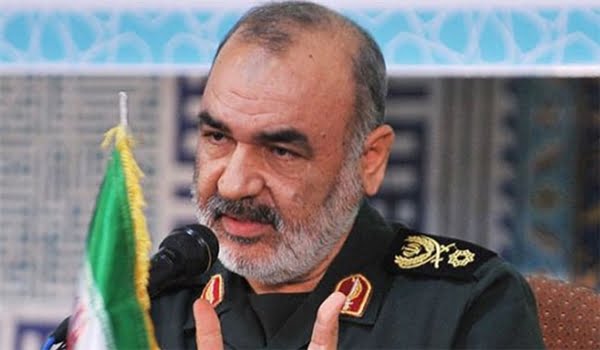
TEHRAN (FNA)- Lieutenant Commander of the Islamic Revolution Guards Corps (IRGC) Brigadier General Hossein Salami underlined that internal disputes and clashes among Muslims are just the result of the plots hatched by the arrogant world powers.

“The current waves of insecurity in various Muslim countries are caused by the blatant interferences of the US and the western countries in the region,” General Salami said late Thursday.

salami5
Lieutenant Commander of the Islamic Revolution Guards Corps (IRGC) Brigadier General Hossein Salami

In relevant remarks in April, Supreme Leader of the Islamic Revolution Ayatollah Seyed Ali Khamenei warned against the plots hatched by the enemies to create rift among different Muslim sects.

“The goal of the enemy is to bring Islam to its knees and prevent the Shiite community from becoming a role-model,” Ayatollah Khamenei said, addressing a group of eulogists on the occasion of the birth anniversary of Hazrat Fatemeh (AS), the beloved daughter of Prophet Mohammad (PBUH), the wife of Shiite Islam’s first Imam and the mother of Shiites’ second and third Imams.

The Supreme Leader underlined that the Shiism has access to unique possibilities and tools to confront the enemy’s plots.

Ayatollah Khamenei pointed to the attempts made by the enemies to harm Muslim unity and sow discord between Shiite and Sunni Muslims, and said, “Creating rifts among Muslims is like a sword in the hands of the enemies of Islam …”

Iran has always attached crucial importance to paving the way for the enhancement of interaction and cooperation among Muslim nations in a bid to strengthen Muslim unity throughout the world.

In June 2013, Ayatollah Khamenei asked Muslim nations to grow united against the arrogant powers, warning that gaps in the Muslim community will create an opportunity for the Zionist regime to implement its plots against them.

“Unity and companionship among Muslims is an urgent obligation,” Ayatollah Khamenei said in Tehran at the time.

He pointed out that massacre, bloodshed, blind terrorism and its related catastrophes as well as the opportunities created for the occupying Zionist regime are all outcomes of division and difference in the Islamic Ummah.

“Today is the day of test for the Muslims and Islamic states, and Muslim nations should be completely vigilant,” the Iranian Supreme Leader cautioned.

Ayatollah Khamenei warned of the West’s campaign against Islam and the Muslim world, and said the western enemies are showing their hostility towards Muslims very openly, “thus, the Islamic Ummah should reinvigorate its intrinsic ability and power factors, and one of the most important factors in this regard is unity, integration and focus on commonalities”.

In relevant remarks earlier in 2013, Ayatollah Khamenei warned Muslim nations about the plots hatched by the enemies to sow discord in the Islamic community.

Addressing a group of Iranian officials and the foreign participants of the 26th International Islamic Unity Conference in Tehran in February, Ayatollah Khamenei felicitated birthday of Prophet Mohammad (PBUH) and stated that unity among the Islamic community was the main mission of the Holy Prophet.

The Leader pointed to the wave of the Islamic awakening in the Muslim World, and reiterated that the world arrogance targeted the Islamic Awakening movements and aims to divide the Muslims pitting them against each other.

“Therefore, the main duty of the elites in the Muslim world is to help expose the enemies’ plots and take serious efforts to materialize the motto of Islamic unity,” the Leader underlined.


Iran Police Chief: Tehran Could Intervene in Iraq to Protect Shia Shrines

Esmail Ahmadi-Moghaddam says Tehran would take action in Iraq if Shia shrines and cities were threatened by the Sunni jihadis who have taken control of Mosul.

“The border patrol has increased its vigilance on the Iran-Iraq border,” said Iran’s police chief, Esmail Ahmadi-Moghaddam. “The country’s Supreme National Security Council would consider intervening to protect Shia shrines and cities.”

ACcording to Thedailybeast, Ahmadi-Moghaddam has been the only high-ranking Iranian official to comment on the advances made by the Sunni extremist group Islamic State in Iraq and Syria (ISIS). According to IranWire sources, Iranian officials have been ordered to remain quiet about the events in neighboring Iraq and ISIS victories. “Iranian officials have been told not to comment, or else,” said a wary former high-ranking Iranian diplomat to IranWire.

shrine


According to the former diplomat, Iranian plans in Iraq are summarized in the wisdom of one man: “We all know that Haj Ghassem is hard at work trying to control the situation”—referring to Ghassem Suleimani, the legendary commander of the Quds Force, Iran’s Revolutionary Guards Extraterritorial Force, and perhaps the closest person to Iran’s Supreme Leader Ayatollah Ali Khamenei. “Our forces will do whatever it takes to protect the border, and the holy shrines from this bunch of thugs. And ISIS are nothing but a group of hooligans. They know what can happen if Iran gets involved in the situation, and that is why they are in such a hurry to carry out their dirty acts.”

Iran’s designs in Iraq, and the rest of the Middle East, have been looked at with a degree of cynicism and fear. Many Arab diplomats regard Persian Iranians as untrustworthy neighbors who secretly ally themselves with anyone to protect their interests.

Last week a member of Syrian opposition accused Iran of secretly helping ISIS. According to Abdul Halim Khaddam, the former vice president to Syria’s Bashar Assad, Iran is arming ISIS in order to undermine the Syrian opposition. By strengthening ISIS, Khaddam claimed, Iran was seeking to draw Syrian public sentiment back toward Assad, recasting the battle as Bashar’s battle against extremist onslaught.

Iranian Foreign Minister Mohammad Javad Zarif categorically denied this accusation. He said Iran has been battling Salafi extremists and al Qaeda itself for years, and would never stoop to such measures.

“Our forces will do whatever it takes to protect the border, and the holy shrines from this bunch of thugs.”

Iran has a troubled history with Sunni extremists in its neighborhood. In August 1998 the Afghan Taliban stormed Mazar-e-Sharif, which was then a base for the Northern Alliance, and enacted a massacre of Persian-speaking and Shia Hazaras. The Taliban also attacked Iran’s consulate in Mazar-e-Sharif, killing nine Iranian citizens, eight of them diplomats. Iran’s Supreme National Security Council weighed how to react and most supported military action to destroy the Taliban, deciding to deploy 100,000 troops along the border with Afghanistan.

Hassan Rouhani, the current Iranian president, at the time was the secretary of Iran’s Security Council. He opposed military intervention in Afghanistan, but with the majority vote for intervention, Iran was just one step away from war. According to former diplomat Hossein Mousavian, who wrote of the episode in his recent memoir, it was only the veto of the Supreme Leader, Ayatollah Khamenei, that prevented military action.

For many years now, Iran has also been engaged in a fight against Sunni Kurdish separatists known as Party of Free Life of Kurdistan (PJAK). Iran’s Revolutionary Guards are responsible for the struggle against PJAK for fighting the Baluchi terrorist group Jeish al-Adl in the southeastern border area with Pakistan.

Iranian media was abuzz throughout Wednesday, with reports anxious that the fall of Mosul will lead the conflict eventually to the Iran-Iraq border.

First Syria, now Iraq: Iran sends troops to ally

IRAN has sent special forces and elite troops to Iraq to bolster efforts by the government to halt the advance of militants.

According to Theaustralian, a 150-man unit of the Quds Force, the elite section of Iran’s Revolutionary Guard, has deployed to Iraq, supported by a team of Saberin, Iran’s equivalent of the SAS. They will assist Iraqi forces as they regroup after the loss of Mosul and Tikrit.

maleki
Iraqi Prime Minister Nouri al-Maliki

With troops already fighting in Syria to defend the regime of President Bashar al-Assad, Iran’s decision to send soldiers into Iraq underscores its concern that another key ally is under threat.

Iran backs the Shia-dominated government of the Iraqi Prime Minister, Nouri al-Maliki.

It has been dismayed at Iraq’s failure to quell the Sunni insurgency led by al-Qa’ida offshoot the Islamic State of Iraq and al-Sham. The fall of Mosul brings the insurgency to within 400km of Iran’s borders.

The Iranian troops are led by General Hasan Gohari, a veteran of the Iran-Iraq War and a close confidant of Tehran’s powerful spy chief, Qassem Suleimani. It is understood that the Iranian troops were deployed at the weekend, before the capture of Mosul.

Iraqi authorities must hit back hard and fast in Mosul, before ISIS has a chance to erect defences.

Khamenei envoy in IRGC stresses on meddling in Syria

Mullah Ali Saeedi, Khamenei’s envoy in the Revolutionary Guards, emphasized on the necessity for meddling in Syria.

“Our defending of Syria is a defense of security, beliefs and strategic measures. However, there are those who don’t accept this viewpoint,” he said, with his remarks cited by the state-run ISNA news agency.

saeedi
Mullah Saeedi and dispatching IRGC forces to Syria

“Some media outlets and news agencies linked to the IRGC, and it is expected the Fars news agency and others to use a comprehensive approach in reporting news, because at times there are reports that are aired lacking accuracy and any considerations. In fact, we must act in a way that the government feels the media outlets are sensitive about these issues,” Saeedi added.

“As General Firuz-Abadi said the news must be reported with accuracy. One must not be negligent because of speedy news service because this is not what is expected from armed forces, and we shouldn’t bring about further damages and costs in this regard,” he continued.

Basij Commander: US-Sponsored Takfiri Groups Blemishing Real Face of Islam

TEHRAN (FNA)- Commander of Iran’s basij (volunteer) Force Brigadier General Mohammad Reza Naqdi condemned the crimes committed by Takfiri and Salafi groups in different regional states, specially in Syria and Iraq, and said these groups which are supported by the US have scratched the beautiful face of Islam.

Addressing a gathering in the Southeastern province of Sistan and Balochestan on Thursday, Naqdi said that the US is manipulating the Takfiri terrorists to tarnish the image of Islam and the Muslims.

naghdi1
Commander of Iran’s basij (volunteer) Force Brigadier General Mohammad Reza Naqdi

He, meantime, underlined that although certain Western countries are trying to mislead the world people’s understanding of Islam and Muslims, the number of people converting to Islam is growing across the globe, including the US itself.

Iranian officials have always warned that major world powers and their regional allies are supporting and helping to the spread of Takfiri currents in the Middle-East.

They have repeatedly warned those states that are supporting Salafi and Takifiri terrorists in the region that their policy would backfire and the same groups would eventually target them as well.

“Takfiri groups are used as a tool by enemies of Islam and they seem to lack a true understanding of Islam,” Chairman of the Iranian Parliament’s National Security and Foreign Policy Commission Alaeddin Boroujerdi said in a meeting with Syrian Grand Mufti Sheikh Ahmad Badreddin Hassoun in Tehran in January.

He highlighted the role of clerics in reinforcing the resistance of the Syrian nation as well as fostering unity in the Arab country, and warned against plots by enemies to incite religious and sectarian rifts among Muslims.

Boroujerdi also praised the resistance of the Syrian people against the foreign-sponsored crisis in the country.

Also in January, senior military aide to the Iranian Supreme Leader Major General Yahya Rahim Safavi warned that Takfiri terrorists are killing Muslims for the sake of Israel’s interests in the region.

“Takfiri groups are advancing Israel’s interests in the Middle-East through violence and terrorism,” Major General Rahim Safavi said.

“Through the massacre of innocent people in countries like Syria, Iraq and Bahrain, Takfiri groups are pushing the situation in the region in favor of the Zionist regime (of Israel),” he said.


Commander: Iran’s Enemies Weaker Than Ever

TEHRAN (FNA)- Lieutenant Commander of the Islamic Revolution Guards Corps Brigadier General Hossein Salami underlined IRGC’s full readiness to foil enemies’ plots, and said the enemies of Iran are in their weakest position.

“At present, the Islamic Republic of Iran is more powerful than ever before,” he said, addressing a local gathering in the Northern province of Semnan on Thursday.

He underlined that the nation’s enemies are at their weakest position.

salami4
Lieutenant Commander of the Islamic Revolution Guards Corps Brigadier General Hossein Salami

The IRGC is fully ready to thwart any plots and foreign meddling in the country’s internal affairs, he said.

In relevant remarks in late May, Salami had underlined that while Iran is making progress in different fields, its enemies are on the verge of collapse.

Addressing a local gathering in Tehran, he pointed to the Islamic Republic of Iran’s achievements in various fields, and added the enemies are on the verge of collapse.

Salami said that the IRGC forces always have been forerunner in defending the Islamic Iran and Revolution.

The commander stressed that the IRGC forces always have stood against various threats posed by the enemies of the Islamic Republic and Revolution.

Defense analysts and military observers say that Iran’s wargames and its advancements in weapons production have proved as a deterrent factor, specially at a time of heightened threats by Israel and the US.

Tehran launched an arms development program during the 1980-88 Iraqi imposed war on Iran to compensate for a US weapons embargo. Since 1992, Iran has produced its own tanks, armored personnel carriers, missiles and fighter planes.


Manner to Confront the Enemy Must Change

The commander of Iran’s Revolutionary Guards general Mohammad-Ali Jaafari announced that the approach to confront the threat against Iran’s Islamic regime had to change because the manner of the threat by the enemies of the regime had changed.

According to roozonline Jaafari made these remarks after the broadcast of a video speech in which he talked about the 2009 presidential elections and its aftermath that resulted in widespread demonstrations across Iran producing a serious political and security crisis for the regime.

jafari
The commander of Iran’s Revolutionary Guards general Mohammad-Ali Jaafari

Jaafari made these remarks while visiting a command responsible for protecting the Revolutionary Guards, (the IRGC). “The mission of the command to protect the Guards is one of the many other missions entrusted to the IRGC,” he said. “The Guards must be reconsider some of the approaches in fulfilling its missions because it must act within current conditions. And since the manner of the threats have changed, the methods to confront them must adjust accordingly.”

The protection command of the IRGC is entrusted with such activities as protecting the airports of the country and its important buildings.

In his speech, Jaafari once again said the main mission of the Guards was to “protect the values of the revolution.” He said in fulfilling its mission of protecting the leading personalities of the regime, the Guards should not harm other values of the regime. “The top priority of the Guards beyond the protection of regime personalities and buildings, is the protection of the revolution itself,” he stressed.

The IRGS has different units tasked to carry out its missions of protecting personalities, buildings, airports, etc.  The budget and performance of IRGC units are not under any public oversight and fall under the general IRGC funding, which is itself classified and a guarded secret. The Ansar al-Mahdi and the Vali Amr forces for example, responsible for protecting key buildings and the supreme leader of the Islamic regime respectively, are estimated to comprise of about 30,000 and 11,000 recruits.

While the budget of the IRGC remains a secret, a news report had announced that there would be an increase of nine billion Toman in the force’s total funding, raising it to 24 billion Toman.

The IRGC is fully under the supervision of the supreme leader who also appoints all of its commanders. The recruitment process and the training for the Ansar al-Mehdi and the Vali Amr forces are different. Protection of key personalities of the Islamic republic is the responsibility of Iran’s national security council and not the Guards, a body that is headed by the minister of the interior, which is itself part of the supreme national security council headed by the president.

Last winter, Mohammad Hassan Kazemi, the deputy commander of the protection unit of the Guards announced, “Protection of personalities was passed on to the Guards after the assassination of Iran’s nuclear scientists, after which no assassinations have taken place.”

Iran to Use Drones for Patrolling Borders

TEHRAN (FNA)- Commander of the Iranian Border Guards Units General Hossein Zolfaqari underlined that his forces will soon use Unmanned Aerial Vehicles (UAVs) to patrol the country’s borders.

“We are in the process of signing contracts with the manufacturing companies to use drones for protecting the country’s borders,” Zolfaqari told reporters on Wednesday.

General Zolfaqari also pointed to the abducted Iranian border guard who is in custody of Pakistan-based Jeish al-Adl terrorist group, and said that although the terrorist group has claimed that it has executed Jamshid Danayeefar, “we have sufficient evident to prove that he is still alive”.

zolfaghari
Commander of the Iranian Border Guards Units General Hossein Zolfaqari


Danayeefar was among the five Iranian border guards who were abducted by Jeish Al-Adl terrorist group in Iran’s Southeastern Sistan and Balouchestan province earlier this year. Four of them were released after two months, while the group had claimed a week earlier that it had executed Danayeefar.

Iranian officials have repeatedly stressed that they would not accept the allegation until they see corroborative evidence.

Jeish Al-Adl has done a number of terrorist operations in the province in the last several months. The group is based in Pakistan and escapes to the country each time it conducts an operations in Iran.

To have a better monitoring and control over the borders, Iranian border guard forces have announced that they plan to make use of various technological tools and equipment to better fight such terrorist actions.

In March 2013, General Zolfaqari announced Iranian border guards have begun testing UAVs for patrolling the country’s Eastern borders.

“The implementation of this project has begun in South Khorasan and Sistan and Baluchestan Provinces, and multiple daily flights are conducted to evaluate the performance of the drones,” Zolfaqari said.

He added that upon the completion of the pilot project, Iranian border guards will use UAVs to patrol borders.

In April 2014, General Zolfaqari said that Iran plans to modernize its borders monitoring system.

“Border monitoring system will be deployed in border regions after the parliament allocates the needed budget,” General Zolfaqari told reporters on the sidelines of Eqtedar (Might) 3 border guards exercises in the Western province of Kermanshah.

He noted that border monitoring systems will help better control border conditions and movements, and “through the online observation of the borders, the border checkpoints will be notified in case of having a weakness (in their performance).”

General Zolfaqari also added that once the monitoring systems are stationed, electronic watch towers will be set up along the borders as well.

Earlier in the day, Zolfaqari said that his forces have tested new weapons and reconnaissance balloons in their four-day-long exercises in the Western parts of the country.

“We have used the new weapons in different scenarios and in various time frames,” General Zolfaqari told reporters.

He pointed to using two reconnaissance balloons in the drills, and said, “The balloons took photos from the entire region in a bid to study all the movements in drill zone.”

He reiterated that all possible scenarios were considered and the weapons were used in different face-to-face combat situations during the drills.


Basij Commander: Takfiris’ Crimes Supported by West, Petro Dollars

TEHRAN (FNA)- Commander of Iran’s Basij (volunteer) Force Brigadier General Mohammad Reza Naqdi condemned the crimes committed by the terrorist Takfiri and Salafi groups in the region, and said these crimes are supported by the western states and certain oil-rich Arab countries.

“These (Takfiri) streams that introduce Shiites as infidels, issue decree for their killing, commit crimes and massacre innocent people under the pretext of (obeying) Islam and differences (between Shiite and Sunni Islam) in their fatwas (religious decrees) say nothing but lies,” Naqdi said in the Southeastern province of Sistan and Balouchestan on Wednesday.

naghdi
Commander of Iran’s Basij (volunteer) Force Brigadier General Mohammad Reza Naqdi

He said that the Takfiri groups commit crimes in line with the ominous goals of the arrogant powers and obey the western and Israeli think tanks as they are supported by certain regional Arab countries’ petrodollars.

In relevant remarks in June, a senior Iranian foreign ministry official said Saudi Arabia has turned into a collaborator of Takfiri groups in their crimes against the regional people, specially the Syrians.

“Saudi Arabia is equipping terrorists in Syria with different (types of) light and heavy weapons in breach of all international regulations and conventions, not to mention its overt military intervention in Bahrain,” Iranian Foreign Ministry Spokesman Seyed Abbas Araqchi said.

He added that Saudi Arabia has turned into an accomplice in the crimes committed by the Takfiri terrorists against the defenseless Syrian people.

Araqchi stated that Saudi Arabia is a “big country with great potentialities” that can create unity among Muslim countries and resolve the problems facing the Muslim world, expressing regret, however, that such potential is currently being used in an opposite way.

Syria has been gripped by deadly violence since March 2011. According to reports, the western powers and their regional allies – specially Qatar, Saudi Arabia and Turkey – are supporting the militants operating inside Syria.


Top Commander: Enemies Fear Global Repercussions of War against Iran

TEHRAN (FNA)- Chief of Staff of the Iranian Armed Forces General Hassan Firouzabadi said enemies shrug off attacking Iran because they are fearful that such an invasion might spread to the rest of the world and ignite another World War which could engulf them and their interests.

Firouzabadi said the enemies had earlier thought that they could wage a war against Iran similar to their invasion of Iraq and Afghanistan in type, but today they have come to realize that such a move is impossible and they, thus, feel disappointed,

“Today they know that this won’t be a war on the Islamic Republic as it will involve the whole world,” Firouzabadi said in Tehran on Tuesday.

firoozabadi2
Chief of Staff of the Iranian Armed Forces General Hassan Firouzabadi

“therefore,” he said, they “are trying to destroy us from inside.”

Firouzabadi described psychological war, media propaganda and cyber attacks as the new weapons used by the enemies against Iran after they failed in waging a military war on the country.

Defense analysts and military observers say that Iran’s wargames and its advancements in arms production and technologies have proved as a deterrent factor.

In relevant remarks on Monday, Iranian Ground Force Commander Brigadier General Ahmad Reza Pourdastan said his forces are in best conditions and would give a crushing and irreversible response to any enemy who would dare to make an aggression against the country.

“Iranians have always been and are a peace-loving nation, but in case of an enemy aggression against Iran’s territories, the aggressor will be given an irreparable blow,” General Pourdastan said.

The Iranian commander noted that the numerous drills have made his forces fully ready for any war.

General Pourdastan said the Iranian Armed Forces are at the highest level of preparedness, but they need to maintain this level.

Also last week, Lieutenant Commander of the Iranian Navy Rear Admiral Gholamreza Khadem Biqam warned of the Navy’s crushing and rigid response to the enemies who would dare to make an aggression against the country.

“If any threat is made against Iran’s interests we will kill it in the bud and give crushing response to the enemy,” Rear Admiral Khadem Biqam said during a visit to Iran’s Kharg Naval Base in Persian Gulf on Friday.

Rear Admiral Khadem Biqam reiterated that protecting Iran’s interests is one of the main duties of the Navy.