The Iran government has warned about any military intervention in Iraq. The response came after the U.S. administration has said that they were sending a warship to the Persian Gulf.
The Iraq government is preparing to fight a Sunni extremist group called the Islamic State of Iraq and the Levant (ISIL), which have taken control of four Iraqi cities and several small villages.
The local Kurdish media have reported that Iranian forces have entered Nineveh province and will be staging in the area until they receive orders to attack ISIL. The first Iranian Revolutionary Guard Corps (IRGC) soldier has been killed in Iraq.
The guardian has reported that there are 2000 IRGC soldiers that were sent to Iraq and are assisting the Iraq government. Both governments are working together to fight the ISIL in northern Iraq. The ISIL are continuing to reorganize their logistics and supply lines for the up coming assault on Samarra. The ISIL have stated that they would like to flatten all Shia Shrine’s in Iraq.
Abstract: Under the totalitarian regime of Iran, the IRGC is increasingly expanding its inhuman repressive activities against innocent citizens by utilizing all possible spaces to create and run its secret prisons, which in the Tehran Province numbers more than 15 and in each county and each provincial capital city there exists more than three such secret prisons. This is a dark side of the crimes against humanity committed by the IRGC as these locations are used to detain, torture, interrogate, rape and even secretly execute men and women suspected of being opposed to the regime. This practice of hiding hapless victims, in secret prisons away from the view of civil and judicial authorities, is the most heinous crime being perpetrated by the IRGC. Their criminal activity has rendered innumerable social, political, cultural, civil and human rights activists, students and journalists vulnerable to persecution.
The IRGC is a unique political, security and military entity in Iran—which is a power-center in its own right—exercising arbitrary power and playing an arbitrary role in different social spheres. So far, as its composition and functioning is concerned, no organ of state authority has ever been able or is in a position to hold it accountable for its misdeeds. From the early days of its formation until now, it has always been a repressive, coercive and terrorist force and the scope of its operations has now transcended the Iranian borders.
Within its information security division are organs whose members operate namelessly and facelessly in plain clothes. These operatives who are known as the “Detection and Prevention Unit” are active in different spheres of society at large. They keep surveillance over individuals engaged in multifarious vocations and walks of life—from taxi drivers and road sweepers to university teachers and managers of enterprises—and has created its cells in all administrative departments and public bodies. These personnel completely shun the identity, distinctive marks and the uniform of the regular cadres of the IRGC. In accordance with instructions given during their training and the prescribed code of conduct, such personnel of the Corps are required to resemble, as far as possible, the ordinary folk and should not cause suspicion by their countenance, manners or conduct.
These personnel wear stylish foreign name brand clothing, wear contemporary fashion such asthe belts liked by young men. These are some of the tricks used by the operatives of the Unit for Protection of Information Security of the IRGC to disguise themselves.
The Real Purpose of the Detection Unit
In addition to its multi-sided and ubiquitous presence in the Iranian society, the real objective of this unit is to continuously gather information about social activities and the events and developments taking place in the society at large. Such information is transmitted round the clock, day and night, to the higher officers of the concerned unit.
Within this unit of the IRGC, a specialized cell has been created which has major responsibility for taking cognizance of and keeping track of activities of prominent persons and those holding positions of importance in the society.
In addition to performing its formidable functions within the country in direct coordination with the Ministry of Information to detect, apprehend, torture and eliminate the opponents of the regime, it has established its interrelated and coordinated networks in neighboring countries such as Syria, Iraq and Lebanon, which carry out terrorist operations to destroy and render ineffective any person or movement which, in their reckoning, may jeopardize the interests of the IRGC. Thus, they abduct suspected individuals and groups within and outside the country and secretly eliminate them. Journalists, students, doctors, university teachers, lawyers and civil society activists are included in the top of the control list of this unit of the IRGC who, in the event of observing any suspicious activity, movement or matters that are not to the liking of the IRGC, are referred to the information security command of the IRGC for arrest and detention.
Their Modus Operandi
Apprehending suspected individuals by the Information Security Unit of the IRGC does not require any court order or consent of organs authorized to approve arrest warrants. All such arrests are made at the absolute will and in arbitrary discretion of the IRGC.
Persons arrested in this manner are invariably transferred to detention sites, which are separate from official and public prisons operating under the supervision of the judiciary and the National Prisons Organization. Ordinarily, these detention sites are built in complete secrecy or are informally designated as such. The secret prisons of the IRGC are also completely separate from the secret prisons maintained by the Information Ministry. In this respect, the IRGC acts independently and arbitrarily. Accordingly, in respect of secret prisons and concealed détenus, it might be said that the IRGC operates as an adjunct of the Information Ministry and intelligence agencies to arrest, detain, torture and eventually secretly eliminate the détenus.
A number of such sites are located within the IRGC training barracks, command headquarters and places which are screened from all sides and placed under strict vigilance. A lot of these sites are used as secret prisons of the IRGC and are generally located far from military complexes in places which are known only to the high-ranking functionaries of the IRGC and the Information Security Unit. These sites exist in the form of residential houses outside cities and in the underground blocks of government complexes, company buildings, and apartments secretly controlled and guarded by the IRGC.
Buildings with varying accommodation space and constructed of material of uneven quality are completely barricaded and no point of entry and exit for persons and vehicles is made because they are meant for the opponents of the theocratic regime/IRGC for interrogation, torture, extraction of forced confessions and eventual execution.
The IRGC also maintains a special section within such prisons, which is specifically meant for the cadres of the IRGC. Those cadres, who for any reason decline to enforce IRGC policies or raise objections against these policies or do something else which is perceived by the IRGC as a threat to its authority, are lodged within this military section of the prison. Most of these former members of the IRGC that are considered dangerous or as a headache for the IRGC, when finally released from detention generally develop heart troubles or eventually die of heart attack or brain stroke. Apparently, their death may appear to be related to natural causes but in fact it is a consequence of the harsh treatment meted out to them by the IRGC to get rid of them.
In addition to secret prisons and detention centers of this type, the IRGC also maintains its own special sections within the central prisons administered by the Directorate-General of Prisons which acts under the direct supervision of the judiciary. In these special sections under the jurisdiction of the IRGC, a number of political prisoners, whom the theocratic regime/IRGC designate as “security prisoners”, are kept. They are completely managed under IRGC’s supervision and control. Neither the chief of the prison nor other jail officers have any executive authority or say or can intervene in these cases as the affairs of this special category of prisoners are under the exclusive jurisdiction of the IRGC.
Another category of secret prisons of the IRGC is located within the police stations and vigilance establishments. Beside the different sections of the vigilance department under the authority of the regular police force where ordinary offenders are kept under custody, there is a building or several places reserved for the IRGC who keep a number of their own détenus for interrogation and torture. The rationale for keeping this category of secret prisons of the IRGC is that police stations and vigilance establishments normally detain ordinary offenders. However, in exceptional cases or emergency situations, a political suspect may conveniently be lodged in IRGC’s section without raising suspicion or attracting public attention.
Savagery and Barbaric Treatment
The prisoners of the secret prisons are treated in an absolute barbaric and punitive manner. As a matter of course, to extract information from them, they are beaten harshly, tortured psychologically, assaulted sexually and even killed while nobody knows about them and their voices can reach nowhere.
A specialist cadre of security guards, interrogators, torturers, physicians and healthcare staff is attached to these prisons. This specialist cadre possesses advanced professional tools, mostly imported from China and other friendly countries, which are manufactured and supplied for use by the IRGC. These include convulsion producing drugs, injection ampules which transmit rare diseases and drugs which shake the nervous system so as to drive the concerned to commit dangerous acts such as committing suicide. In addition, a series of drugs and specific ampules which induce heart attacks, heart failures and brain strokes are available. In addition, a large number of instruments and tools are used to inflict physical torture upon the victims.
Torture and Pressurization
The IRGC operatives deployed in these secret prisons do not hesitate to employ any form of inhuman torture to extract confessions from the détenus. What is important for them and the administrators of these secret prisons is to demonstrate their ability to produce reports containing information and confessions forcibly extracted from the helpless political prisoners who are deprived of all their fundamental rights. These prisoners are held in complete secrecy. Nobody knows of their fate or place of detention; they have no communication with their families; they can have no contact with the world outside the prison; and they cannot engage a lawyer for self-defense.
The captives in these prisons are subjected to severe physical beatings which debilitate them and break them down. Some instances of their torture are:
1- Causing severe physical assaults and injuries
2- Deliberately breaking the bones of hands, feet and heads of the prisoners
3- Beating the prisoners with thick cable with their hands and feet tied
4- Inflicting psychological pressure and depriving them from rest and sleep
5- Performing mock execution procedures over the prisoners and putting blind cover over their faces
6- Committing sexual violence against the prisoners
7- Transgressing upon the members of the family of the prisoners before their eyes
8- Threatening the prisoner of defamation in the society
9- Taking nude photos of the prisoner or of his family members and threatening to make them public
10- Forcing the prisoner to make fake TV confessions
11- Burning parts of the prisoner’s body with a hot iron and cigarette butts.
Sinister Role of the Healthcare Unit
It is ironic that the deployment of an independent healthcare unit in these secret prisons is also a tool used by the IRGC to secure the death certificate and burial permission for such prisoners who die under sustained torture and exhaustion. These physicians issue certificates under their signatures and seal certifying that the death of a person—who died under torture—was from natural causes due either to heart failure, brain stoppage or suicide. In this way, they cover up their crimes which never get exposed.
Most individuals from the counties of Iran and belonging to minority nationalities like Azeri, Baluch, Arab, Kurd, etc., who raise their voice in favor of their rights and express their demands through political, social, cultural and student forums, are in the first list of the victims of the crimes of the IRGC who end up in their secret prisons.
Their Healthcare Unit itself is involved in carrying out inhuman actions against the prisoners which are inconceivable such as:
1- Injecting drugs which devastate the nervous system of the victims
2- Extracting large quantities of blood from the victims for the IRGC’s blood bank
3- Performing trials of different types of drugs and chemicals on the bodies of the victims
4- Injecting large quantities of morphine in the bodies of victims and making them addicts of narcotics
5- Cutting the bodies of the executed prisoners into pieces and using their organs for transplants
6- Administering nerve-breaking drugs to freed prisoners to make them insane
7- Administering drugs which in the long run make the victims vulnerable to strokes and/or heart attacks.
A significant example of such high-handed actions of the IRGC is Ramin Pour Andarjani.
Dr.Ramin Pour Andarjani
Misfortune of the Concealed Prisoners
Nothing is known about the manner of their arrest, the place of their detention and the ultimate fate of most of these concealed prisoners. They are the unfortunate beings about whom no news or information is available during the long-drawn years. The main reason for IRGC’s secret prisons in the border provinces and the peripheral areas of Iran is that possibilities of leakage or circulation of such types of news within the counties are quite limited and almost non-existent.
Saeed Zeinali is another outstanding example of a victim who has lingered in one such secret prison for a long time without any information known about his whereabouts. Saeed Zeinali was arrested on 23 Tir 1378 HS/4 June 1999 before his mother’s eyes. From that day until now, except for a brief telephone call, there has been no trace of the whereabouts of this computer science graduate of the Tehran University. During the past 14 years, the parents of Zeinali have contacted all security centers and judicial authorities but no proper reply has been given to them yet.
[Source: Akram Niquabi, mother of Saeed Zeinali says: “They do not give any clear reply. A month ago a phone call came from the prosecutor’s office telling us that Saeed Zeinali has been released. You cannot estimate how happy we became. But afterwards they denied it. They said we have checked the case, we made a mistake. Later they told us don’t worry; we are pursuing the case; we will inform you.”
She adds: “We went to the prosecutor’s office. They said we have summoned the representative of the IRGC. We will hold a meeting with him and get the case sorted out. It was expected they will hold the meeting within ten days. But now 25 days have passed and there is no news.”
She narrates further: “Mr Khudabakhshiyan, the Superintendent-Magistrate of the Evin Prison (in Tehran), told Saeed’s father: We shall make all effort to discover the location of Saeed and inform you. He has been shifted to some other place. But he does not explain who has shifted Saeed and exactly who is keeping Saeed in custody? Is he really alive?”].
Punitive measures that injure and knock out the dignity, personality and humanity of the victims are normal and are a premeditated course of these secret detention centers.
Saeed Zeinali
Sexual Violence against Prisoners
Sexual violence against ladies, young girls and even gentlemen who are rounded up for their participation in student movements or movements for protection of freedom and human rights is widely prevalent at these centers. Because of these traumas, sometime after their release from these centers, it has been observed that the victims become insane, meet accidental death or commit suicide.
Most of these suicides have been motivated by the sense of dishonor and humiliation suffered by the prisoners during the period of their detention as a result of sexual violence and physical abuse.
Sheler’s Grave
One such unfortunate victim is a young girl named Sheller about whom Muhammad Nurizad has written in his official website: This girl was a student of M.A. (Political Science) at Tehran University. She was taken into custody and met her unfortunate end because her only crime was that she had signed a memorandum regarding the conditions in the university.
[Source: Two, three, four months passed. During the fifth month somebody told the father of the girl: Come and take away your daughter. The anxious father arrives in Tehran. Goes to Evin Prison. After some time the gate of the jail opens. Two policewomen brought out Sheller holding her armpits. She had no shackles on her feet.
Sheller Farhadi
My God! Sheller cannot be recognized. She had a beautiful face; she was clever; she was a sports girl; she was even playful; she is now reduced to less than 40-50 kilo in weight. The father takes custody of his daughter on condition that whenever they ring up to say: Bring her here, bring her here, he would take her there. Sometime last year the “Brothers” [jail staff] telephoned her father to produce Sheller before them. The magistrate told her: Get ready; they have given only three days’ time to you. For two days Sheller remained lost in herself, fearful and trembling. On the evening before the third day when she was to be taken to Evin she was found lying motionless. She had ended her life with an old sports gun which her father had kept in home].
Payman Kavousi, an electrical engineer, is yet another victim who has been locked in a prison of the IRGC for allegedly committing an offence of sexual transgression. What sexual transgression did he commit but raising his voice against the wrong policies and excesses of the theocratic regime and its killer force, the IRGC?
Peiman Kavousi
IRGC’s influence and intervention has spread to all echelons of state authority. It has not spared even the judicial branch. By virtue of its hegemony, the IRGC has been able to get its agents recruited to most of the key posts in the judicial administration down to the level of judicial assistants. Thus, this dreadful mafia of man-devouring IRGC is able to use them in any way they desire.
IRGC’s Power Game
The sole purpose of the IRGC in creating and maintaining these secret prisons and detention centers is to root out any ideas, movements or activities which it deems to be inimical to its power and position. Among the priorities of this force is the suppression of intellectuals, elimination of all protest movements and prevention of the emergence of any anti-regime group, body, guild or association.
In addition to striking awe and terror across the society, the objective of the IRGC in creating and maintaining these secret sites is to produce division, alienation, and mutual suspicion, dread of being arrested and place in jail with the attendant consequences. In short, the power game of the IRGC throughout the period of its existence is nothing but manslaughter and destruction. It follows no democratic principles and understands no democratic idioms. It is an evil machine which is geared at annihilation of movements which are not compatible with its ambitions. It has nothing for its opponents but violence, torture, and death.
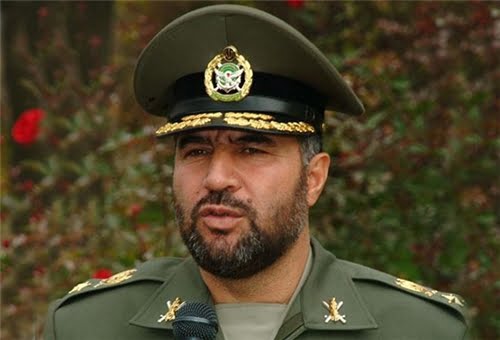
TEHRAN (FNA)- Lieutenant Commander of Khatam ol-Anbia Air Defense Base Brigadier General Alireza Sabahifard underlined the Iranian Armed Forces’ power and might, and said any aggressive move against the country will be given a fatal and crushing response at once.
“The Armed Forces’ might has created stability and security in the country and this might has prevented the enemies from (even) thinking about penetrating the sacred land of the Islamic Republic of Iran and certainly any aggression will be killed in the bud,” Sabahifard said on Monday.
Lieutenant Commander of Khatam ol-Anbia Air Defense Base Brigadier General Alireza Sabahifard
Elsewhere, he referred to the insecurities created in the regional countries, specially the attacks by the terrorist Islamic State of Iraq and the Levant (ISIL) in Iraq, and said, “With God’s help, the Iraqi army and people will give a crushing response to the aggressors through unity and sympathy.”
Yesterday Lieutenant Commander of the Iranian Army’s Ground Force Brigadier General Kioumars Heidari reiterated full control over the country’s borders, and said the terrorists active in Iraq don’t dare to pose a threat to Iran.
“We don’t assume any threat posed to our borders since the Iranian nation and the country are awake and they enjoy full vigilance under the guardianship of Velayat (Supreme Leader of the Islamic Revolution Ayatollah Seyed Ali Khamenei) and we also act upon our responsibility,” Heidari told reporters in Tehran on Sunday.
He, meantime, said Iran always monitors its borders vigilantly and has recently tightened border controls to give a crushing response to any possible threats.
Heidari referred to the recent events in Iraq and the terrorist attacks in the neighboring country, and said what is happening in the regional states is a part of the plots hatched by the arrogant powers and the Zionist regime.
TEHRAN (FNA)- Iranian Foreign Minister Mohammad Javad Zarif voiced Tehran’s concern over the ongoing bloodshed by the Islamic State of Iraq and the Levant (ISIL) terrorist group across Iraq, but meantime, rejected the claims that Tehran has dispatched its forces to Iraq.
In an interview with the New Yorker on Friday, Zarif denied reports that Tehran has already dispatched battalions of the Islamic Revolution Guards Corps (IRGC) to Iraq to aid and protect Prime Minister Nouri al-Maliki’s government.
“It is in the interest of everybody to stabilize the government of Iraq. If the US has come to realize that these groups pose a threat to the security of the region, and if the US truly wants to fight terrorism and extremism, then it’s a common global cause,” the top Iranian diplomat said.
Iranian Foreign Minister Mohammad Javad Zarif
In similar remarks on Saturday, Iran’s president Hassan Rouhani underlined that the Iraqi nation is able to ward off terrorism.
“We, as the Islamic Republic, are Iraq’s friend and neighbor and have good relations with the Iraqi government and nation,” Rouhani told reporters in a press conferenc.
“If the Iraqi government wants help, we will study it; of course no demand has yet been raised until today but we are ready for help within the framework of the international laws and at the request of the Iraqi nation,” he added.
“Of course, we should know that help and assistance is one issue, and interference and entrance (into the battlefield) is another. If the Iraqi government demands us we will help them, but the entrance of the Iranian troops (onto the scene of battles in Iraq) has never been considered,” the president said.
“Since the onset of its establishment, the Islamic Republic has never taken such measures and we have never sent our troops to another country for operations,” he said, and added, “Of course, we will provide countries with our consultative views.”
The Iranian president further warned of Iran’s tough confrontation with the ISIL or any other terrorist group which might come close to the Iranian borders, and said, “If a terrorist group approaches our borders, we will definitely confront it, because our duty is defending our territorial integrity and national interests.”
He also warned those states which are providing financial back up and arms supports for the ISIL and other terrorist groups, cautioning that they would return to set fire to those countries as well.
He also dismissed a report by a western media outlet alleging that an unnamed Iranian official has informed of impending Iran-US cooperation against the terrorists in Iraq, and said, “The Americans might want to do something, but I am not informed of it.”
He described terrorism as an important issue in the region, and said the recent events in Iraq happened because the terrorist groups are mad at the results of the election which kept the Shiites and al-Maliki in power through a completely democratic trend.
He said some groups’ intention for “compensating their loss and failure in the election through terrorism is not acceptable”.
Rouhani further played down the power of the ISIL terrorists, saying that the collapse of Mosul was the product of a whole set of elements and some coordination (made with a number of traitors in the city).
The US Wall Street Journal in a report on Friday claimed that Tehran has sent two elite units of its Islamic Revolution Guards Corps (IRGC) to Iraq to fight against the Islamic State of Iraq and the Levant (ISIL, also known as ISIS) terrorists – an Al-Qaeda offshoot.
A few hours later, Iranian Deputy Foreign Minister Hossein Amir Abdollahian categorically rejected the report, and told FNA that “the dispatch of Iranian military forces to Iraq is not true”.
The Iranian deputy foreign minister also stressed Iraq’s strong military capabilities, and reiterated that Iraq’s armed forces are powerfully fighting against the ISIL militants.
Iraq’s Foreign Minister Hoshyar Zebari did not confirm the WSJ report when asked if Iran’s Islamic Revolution Guards Corps (IRGC) was entering the fight.
“Frankly I have no idea about that. I am in London now,” he told the WSJ in a phone interview.
In Tehran, Foreign Ministry Spokeswoman Marzieh Afgham had already stressed that Iran is not involved in the clashes in Iraq, saying, “Until now we haven’t received any requests for help from Iraq. Iraq’s army is certainly capable in handling this.”
TEHRAN (Tasnim) – The recent unrest in the Middle East region is the result of measures taken by the Western countries and their regional allies, said Islamic Revolution Guards Corps (IRGC) Lieutenant Commander Brigadier General Hossein Salami on Saturday.
“The result of (the measures taken by) Western countries and their allies is the continuation of unrest in the regional countries like Iraq which is aimed at sowing the seeds of American sedition in other countries,” Salami said in a ceremony in Iran’s northern province of Mazandaran.
Islamic Revolution Guards Corps (IRGC) Lieutenant Commander Brigadier General Hossein Salami
“The plots hatched by the enemies in Iraq and other regional states will be soon foiled, God willing,” Salami underlined.
Militants from the so-called Islamic State of Iraq and the Levant (ISIL) have taken over a huge swathe of predominantly Arab territory in northern and north-central Iraq since launching their offensive in the country’s second city, Mosul, on Tuesday. They have since pushed south into ethnically divided Diyala province, towards Baghdad.
On Friday, they were fighting pro-government forces near Muqdadiyah, just 80km from Baghdad city limits.
On June 10, Iraq’s northern Nineveh Province fell into the hands of ISIL militants. The Takfiri (extremist terrorists’) attacks have reportedly forced more than half a million people in and around Mosul, the capital of Nineveh Province, to flee their homes.
Takfiri militants have vowed to march toward the capital, Baghdad.
Takfiri groups are reportedly entering Iraq from neighboring Syria and Saudi Arabia to undermine security in the country.
Iran Busts over 20 Terrorist Cells in 6 Months Iran SNSC Secretary Urges Shiite -Sunni Unity to Defend Iraq Zarif: Technical, Bilateral Meetings Needed to Reach Common Basis Colombia’s Santos Re-Elected, Tells Rebels It’s Time for Peace Hrayr Mkoyan Joins Esteghlal Football Team Iran Slams Powers’ Support for Terrorist Groups Pro-Russian Rebels Seize Ukraine State Bank in Donetsk Israeli Forces Arrest Palestinian Parliament Speaker At Least 25 Killed in Nigeria Market Attack Iranian FM Holds Talks with British Counterpart on Iraq
TEHRAN (FNA)- Commander of Iran’s Basij (volunteer) Force Brigadier General Mohammad Reza Naqdi said the recent attacks by the terrorist Islamic State of Iraq and the Levant (ISIL) in Iraq are a new US plot after Washington was defeated in its confrontation with resistance groups in the region.
“Today the enemy has targeted us in multiple soft-war fronts, because it knows that it cannot combat us in a battlefield,” Naqdi said, addressing a Basij forum in Tehran on Sunday morning.
Naqdi said the US has experienced defeat in its confrontation and plots against Iran’s allies in Palestine, Lebanon and Syria, and now “they have started the same experience in Iraq”.
Commander of Iran’s Basij (volunteer) Force Brigadier General Mohammad Reza Naqdi
“Once they attacked Iran, but the powerful Basij and the Islamic Revolution Guards Corps (IRGC) were created and established as a result of that attack; they attacked Lebanon but a faithful resistance group was formed which is now among the regional powers; then they attacked Palestine which gave birth to a mighty and powerful resistance, and then they attacked Syria which also led to the formation of a powerful popular Basij (volunteer group),” he said.
He said the enemies have experienced all these failures in the Middle-East, but they have not received any lesson and they are now repeating another mistake in Iraq by orchestrating ISIL raids against the Iraqi people, “and again a huge popular force has rushed to the scene in the country which will foil their ominous plots”.
The General said these popular forces created in the regional nations have now grown into a chain stretching across the Middle-East.
In relevant remarks on Wednesday, Naqdi condemned the crimes committed by the terrorist Takfiri and Salafi groups in the region, and said these crimes are supported by the western states and certain oil-rich Arab countries.
“These (Takfiri) streams that introduce Shiites as infidels, issue decree for their killing, commit crimes and massacre innocent people under the pretext of (obeying) Islam and differences (between Shiite and Sunni Islam) in their fatwas (religious decrees) say nothing but lies,” Naqdi said in the Southeastern province of Sistan and Balouchestan.
He said that the Takfiri groups commit crimes in line with the ominous goals of the arrogant powers and obey the western and Israeli think tanks as they are supported by certain regional Arab countries’ petrodollars.
TEHRAN (FNA)- Lieutenant Commander of the Iranian Army’s Ground Force Brigadier General Kioumars Heidari reiterated full control over the country’s borders, and said the terrorists active in Iraq don’t dare to pose a threat to Iran.
“We don’t assume any threat posed to our borders since the Iranian nation and the country are awake and they enjoy full vigilance under the guardianship of Velayat (Supreme Leader of the Islamic Revolution Ayatollah Seyed Ali Khamenei) and we also act upon our responsibility,” Heidari told reporters in Tehran on Sunday.
Lieutenant Commander of the Iranian Army’s Ground Force Brigadier General Kioumars Heidari
He, meantime, said Iran always monitors its borders vigilantly and has recently tightened border controls to give a crushing response to any possible threats.
Heidari referred to the recent events in Iraq and the terrorist attacks in the neighboring country, and said what is happening in the regional states is a part of the plots hatched by the arrogant powers and the Zionist regime.
In relevant remarks on Saturday, Commander of the Iranian Border Guards Units General Hossein Zolfaqari announced that his forces have intensified security measures along the country’s Western borders with Iraq in a bid to prepare for any unexpected conditions.
“All the possible outcomes for any type of activity along the country’s Western borders have been studied and we are prepared for confronting any possible conditions,” General Zolfaqari said.
He noted that some Iraqi citizens may look for a safe haven in Iran due to inclement conditions in their country, “and we have offered some proposals to the officials in this regard”.
Earlier in the day, Iranian President Hassan Rouhani warned of Iran’s tough confrontation with the ISIL (the Islamic State of Iraq and the Levant) or any other terrorist group which might come close to the Iranian borders, and said, “If a terrorist group approaches our borders, we will definitely confront it, because our duty is defending our territorial integrity and national interests.”
Yet, Rouhani rejected alleged reports on the deployment of Iranian troops in Iraq, but said Tehran is ready to help its Western neighbor in its war on terrorists based on the international laws if requested by Baghdad.
“We, as the Islamic Republic, are Iraq’s friend and neighbor and have good relations with the Iraqi government and nation,” Rouhani told reporters in a press conference in Tehran.
“If the Iraqi government wants help, we will study it; of course no demand has yet been raised until today but we are ready for help within the framework of the international laws and at the request of the Iraqi nation,” he added.
“Of course, we should know that help and assistance is one issue, and interference and entrance (into the battlefield) is another. If the Iraqi government demands us we will help them, but the entrance of the Iranian troops (onto the scene of battles in Iraq) has never been considered,” the president said.
The US Wall Street Journal in a report on Friday claimed that Tehran has sent two elite units of its Islamic Revolution Guards Corps (IRGC) to Iraq to fight against the Islamic State of Iraq and the Levant (ISIL, also known as ISIS) terrorists – an Al-Qaeda offshoot.
A few hours later, Iranian Deputy Foreign Minister Hossein Amir Abdollahian categorically rejected the report, and told FNA that “the dispatch of Iranian military forces to Iraq is not true”.
The Iranian deputy foreign minister also stressed Iraq’s strong military capabilities, and reiterated that Iraq’s armed forces are powerfully fighting against the ISIL militants.
Several other Iranian officials have also rejected the report in the last two days. Foreign Minister Mohammad Javad Zarif said Tehran is deeply concerned over the ongoing bloodshed by the ISIL terrorist group across Iraq, but it has not dispatched its forces to Iraq.
In an interview with the New Yorker on Friday, Zarif denied reports that Tehran has already dispatched battalions of the Islamic Revolution Guards Corps (IRGC) to Iraq to aid and protect Prime Minister Nouri al-Maliki’s government.
Interior Minister Abdolreza Rahmani Fazli also said Iran is willing to support its neighbors against the flow of Takfiri and terrorist groups, but not by sending military forces to those countries.
“Such supports do not mean dispatching forces, but condemning terrorist moves and closing the borders are their meaning,” the Iranian interior minister said, addressing the administrative council meeting of North Khorassan province on Saturday.
According to the Wall Street Journal, Iran has already dispatched at least three battalions of the Revolutionary Guard Corps’ Quds Force to Iraq, as uprisings by various groups rocked the country and threatened Nouri al-Maliki’s hold on power. This in turn has threatened the Shiite dominance and close Iranian alliance that Maliki engendered for Iraq.
Iran may view its involvement as a necessary move to preserve what has been a hugely important strategic ally in the region, which has provided Iran with a conduit for its military support of another regional dictator, Bashar al-Assad. The loss of either or both of these allies could be Iran’s biggest setback in 25 years, according to former commander of US Central Commad, General James Mattis, as paraphrased in Business Insider.
Iranian involvement in Iraq is already beginning to look quite similar to its involvement in Syria, where it has successfully prolonged Assad’s hold on power, with many analysts suggesting that he would have been unseated by the opposition if not for Iranian arms and fighters. Yet Iran has largely denied active participation in the Syrian conflict, sometimes explaining the deaths of Revolutionary Guards there by saying that they were merely defending Shiite shrines.
Iran preemptively used this cover for its actions in Iraq, according to the Daily Beast, which quotes the Iranian chief of police and an Iranian diplomat as saying that they will do whatever it takes to defend the Iran-Iraq border and Shiite holy sites against the opposition fighters in Iraq.
But the article also points to the extent of distrust of the Iranian regime, and quotes a member of the Syrian opposition as accusing Iran of arming an extremist group in Syrian in order to try to manipulate public sentiment, even though it plans to fight this very same group in Iraq. Both actions would theoretically help to secure Iranian influence in each country over the long term.
TEHRAN (FNA)- Head of Iran’s Civil Defense Organization General Gholam Reza Jalali called on the country’s scientific centers to double their efforts to find the potential sources of threat, and said war with the US now takes place at the think tanks.
“The scientific basis and roots of the threats make us give up the traditional approach, avoid repetition of the past and look at the future,” Jalali said, addressing a ceremony to inaugurate the website, journal and library of Iran’s Civil Defense Organization’s Studies and Research Center in Tehran on Saturday.
Head of Iran’s Civil Defense Organization General Gholam Reza Jalali
“The basis of the offensive and defensive war with the US is now shaped and designed in scientific and theorization centers,” he added.
Jalali underlined the necessity for holding workshops, translating different texts and scrutinizing the enemy’s viewpoints as a first step to understand the real and potential sources of threat, and said scientific centers and think tanks should act preemptively in dealing with threats.
He also pointed to updating current approaches, structures and strategies of scientific centers as another necessary step for fighting enemies’ threats.
In relevant remarks in 2012, Jalali said that the enemy is developing, mastering and using the hi-tech to strike at Iran, and Tehran should adopt a smart civil and cyber defense strategy against this approach.
Jalali said his organization aims to harness and reduce threats against Iran, “so, threats determine the direction of our movement”.
Noting that the threats in the cyber space are changing qualitatively and quantitatively, he said that the enemy is enhancing its technologies using smart systems to have their control wherever these technologies are used.
Then, technologies have become a tool of power in today world, he said, and added that most of the world’s new technologies and systems enjoy an IT system to compile and send reports to the producer of that technology.
“I think that utilizing hi-tech is like playing in enemy’s court because it has been developed based on the capabilities of the enemy,” Jalali said.
He then said the US and Israel own a major share of infrastructural companies and hi-tech firms to the very same end. “Thus, Iran is necessitated to design a new model for cyber defense,” he said, adding that such a civil defense model should not be a conventional and symmetric one, given the aforementioned facts.
In recent comments Ali Saeedi, representative of the supreme leader to the Islamic Revolutionary Guard Corps (IRGC), appeared to acknowledge Islamic Republic of Iran Armed Forces Chief of Staff Majour-General Hassan Firouzabadi’s statements admonishing IRGC-linked media for their attacks on President Hassan Rouhani. However, this should not necessarily be seen as reflecting warming ties between Rouhani and the IRGC.
According to iranpolitik At a press conference at the Islamic Revolutionary Guard Corps (IRGC) public relations center, Ali Saeedi, representative of the supreme leader to the IRGC, acknowledged comments by Islamic Republic of Iran Armed Forces Chief of Staff Majour-General Hassan Firouzabad, who recently admonished IRGC-linked media for their attacks on President Hassan Rouhani on his conduct of nuclear negotiations. Prompted by a journalist, Saeedi said that this issue had two aspects. The first, according to him, was “logical, fair, and well thought out criticism and no one is against criticism, even the president has said that we are seeking criticism. Criticism creates the ground for growth.”
Ali Saeedi, representative of the supreme leader to the Islamic Revolutionary Guard Corps (IRGC)
“The other perspective is that we come and take information, without accuracy about different aspects of the issue, put it on a website, and General Firouzabadi said why do some media outlets, which can be in a way associated with the armed forces, publish news without the necessary accuracy.”
He went on to say that “Whether we want it or not, some news agencies and media that are perceived to be associated with the IRGC; and it is expected from media like Fars News Agency that they respect the necessary thoroughness. Of course, they are completely accurate and trustworthy, but sometimes it is possible that a news report is distributed that has consequences.”
“General Firouzabadi had also said that in distributing news and criticism, and spreading information, there should be necessary accuracy, lest we pay an unnecessary price. Paying an unnecessary price is illogical. Let us say realities which create the ground for the growth and blooming of society, and come from compassion rather than sadness.”
Responding to another journalist question, this time on the recently leaked video showing IRGC commander Majour-General Mohammad-Ali Jafari speaking about the controversial 2009 Iranian presidential election, Saeedi appeared to evade the question by saying that:
“Anyone can have any interpretation from any speech that is different from the mind of the speaker and I do not think that for the present discussing this issue is necessary. Although I have not seen the video, cutting in before and after the speech cannot convey the intended meaning of the speaker.”
During the same press conference however, Saeedi was sure to emphasize the IRGC’s differences with the Rouhani administration in the economic arena where the president has tacitly criticized the IRGC and accused it of seeking a share of the country’s economic pie:
“In the economic sector the IRGC has announced its readiness to the administration and we know that it has high capacities for help. However, unfortunately there has not been and will not be a good welcome of this capacity…If the IRGC declares readiness this does not mean asking for a share, however we saw that it was interpreted like this.”
Emphasising the importance of the IRGC in meeting the economic challenges brought forth by Western sanctions, he asserted that: “The only solution for confronting the sanctions and pressures of the enemy is relying on internal strength and domestic capacity and the IRGC places whatever it has at its disposal in the service of the administration and people.”
Saeedi’s acknowledgement of Firouzabadi’s comments may point to the delicate nuclear consensus we have in the past argued exists between all political currents in Iran. The regime is seeking to show a united front on nuclear negotiations, and does not want any media outlets to create the impression that majour differences exist within the regime elite. Simultaneously, they may be seeking to prepare the small but vocal constituency which is deeply antagonistic to nuclear negotiations for any deal which may be signed in the coming months. And, underneath it all, tensions between Rouhani and the IRGC appear to persist, especially in the economic realm, where the president has tried to weaken the organization’s influence.