Iran has strengthened its military capability despite the sanctions imposed on Iran over its nuclear energy program.
Iran has unveiled its latest achievements in defense sector and attained self-sufficiency in producing essential military equipment and systems in recent years.
A senior Iranian military commander said recently the country has upgraded its ballistic missiles to hit moving targets with pinpoint precision, Press TV reported.
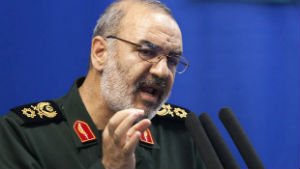
Second-in-Command of the Islamic Revolution Guards Corps (IRGC), Brigadier General Hossein Salami said it may seem scientifically impossible, but in addition to Iran, this is only Russia which is likely to possess the technology and even the United States does not possess it.
Salami said Iran’s ballistic missiles are capable of destroying moving targets with pinpoint precision.
He also said Iran’s military has improved its air defense system but declined to disclose further details due to the confidential nature of the issue.
Iran has repeatedly assured other nations that its military might poses no threat to other countries and that its defense doctrine is based entirely on deterrence.
Earlier, Salami said Iran is capable of targeting strategic interests of the enemy at any location across the globe in case of any act of aggression against the country.
The remarks came following recent aggressive statements by U.S. President Barack Obama against Iran.
In an address at the U.S. Military Academy in West Point, New York, on May 28, Obama said there is an opportunity to resolve disputes over Iran’s nuclear energy program but reiterated that Washington reserves “all options” against Iran.
Subsequently, Deputy Chief of Staff of the Iranian Armed Forces Brigadier General Masoud Jazayeri warned that any U.S. act of aggression against Iran will sound the death bell for the Israeli regime and see war engulfing the United States.
In an exhibition held on May 11, the Islamic Revolution Guards Corps unveiled two new types of home-made ballistic missiles dubbed Hormuz 1 and Hormuz 2.
Since 1992, Iran has made its own tanks, armored personnel carriers, missiles, radars, boats, submarines, and fighter planes.
Iran also unveiled its first domestic long-range Unmanned Aerial Vehicle (UAV) in 2010.
Before boasting about Iran’s unparalleled “top secret” air defense systems Saturday, one of Iran’s top military leaders told Muslim news sources days earlier that the “global U.S. empire is coming to an end.”
According to Onenewsnow IranIranian Revolutionary Guard Corps (IRGC) Lieutenant Commander Hossein Salami made it quite clear to the world that he believes Iran is about to give the world a big surprise.
“The [Islamic] revolution has changed the balance of power to such an extent that no security and political equation in the Muslim world is possible without winning Iran’s satisfaction,” Salami told the Fars news agency.
The lieutenant commander went on to express that Iran’s Muslim allies around the world are no longer “stretching out a red carpet” for American officials.
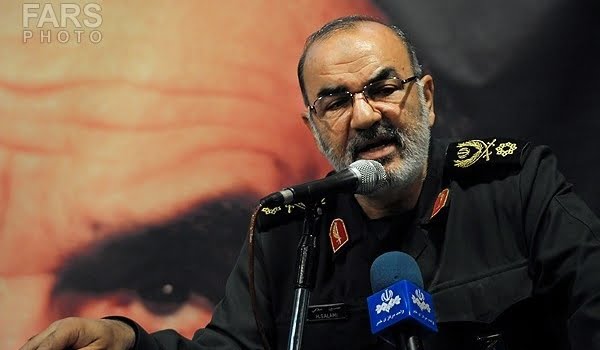
The IRGC brigadier general, Hossein salami
One recent example of this, according to Salami, took place when President Barack Obama was forced into a surprise/unannounced visit of U.S. soldiers at Afghanistan’s Bagram Air Field to celebrate Memorial Day weekend, when the commander-in-chief told them their nation’s longest war would end before the year’s close.
Salami stressed that while Iran is growing in power and influence among Muslims, the presence of U.S. troops in Islamic nations across the globe is declining as its foothold in these areas is weakening.
The Muslim military leader also sent out a warning to those getting in Iran’s way. “Any enemy plot will entail an unexpected ending for him and this is due to the Iranian nation’s reliance on religious and Islamic beliefs,” Salami warned.
The brigadier general attributes part of Iran’s growing threat to its recent technological advances in its military that he says are top-secret and will “remain confidential.”
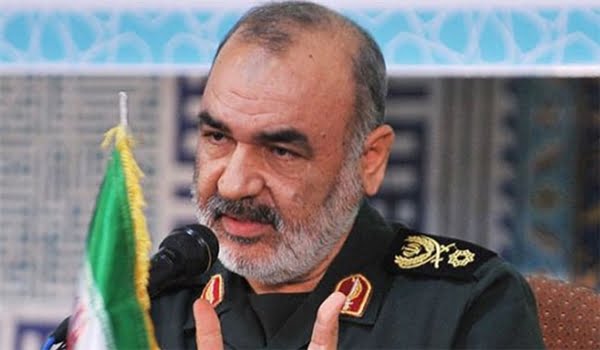
Hossein Salami (IRGC)According to Salami (left), the Iranian Revolutionary Guards’ new “unlimited range” drones and air missile defense system that replaces the S-300 system, which it was formerly slated to purchase from Russia, is more advanced than anything on the planet.
“[It is] an air defense system more advanced than what they didn’t supply to us, due to their strategic interests,” Salami told Iran’s state-run media, saying it has “pinpoint precision capability when fired at mobile targets.”
His boast was an attempt to put Iran’s military might in perspective.
“This might be impossible in terms of science, but it is true and, in addition to us, only the Russians might possess this technology and even the Americans do not have it,” Salami continued.
Salami claims that above Iran’s new missile defense system, complete with drones, the IRGC’s new missiles are capable of high-altitude missions “without being limited in range.” He emphasizes that these enhancements are taking his forces over the top.
“[The Iranian Revolutionary Guards] stand atop the world, given its hundreds of martyrdom-seeking battalions and hundreds of highly trained combat battalions,” the commander expressed.
This view of Iran’s military dominance has recently been corroborated by fellow Iranian Revolutionary Guard Commander Mohammed Jafari.
“Islamic revolution is not confined to Iran’s borders,” Jafari proclaimed in a recent press conference. He asserted that Iran must retaliate against “Satanic crimes “perpetrated by the United States and Israel.
He stressed that the battlefield stretches beyond Iran’s borders when it comes to jihad.
“Syria will turn into a more dangerous and deadly battlefield than the Vietnam War, and in fact, Syria will become the second Vietnam for the United States,” Jafari said weeks ago, promising that a military attack led by the U.S. against Syria would result in Israel’s “imminent destruction.”
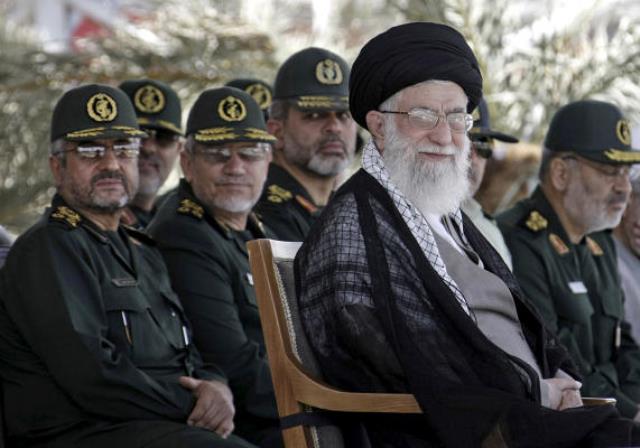
Piling up the warnings, Iranian Supreme Leader Ayatollah Ali Khamenei sent a message to the U.S. last week that Iran is not intimidated by Western threats and that America’s diminishing global influence is being supplanted by Iran’s expanding reach. He maintains that the U.S. peacekeeping attempts are little less than a ruse for global dominance.
“Today the pretext [for Western pressure] is the nuclear issue, another day it is human rights, and some other time, it will be something else,” Khamenei said.
He says Iran is continuing to garner global support to impede the “imperialist” motivations of the U.S. Khamenei fuels this with the allegation that America’s endeavors to curb Iran’s nuclear program are just another excuse the West uses to try and “bully” the Islamic Republic, but he insists that the U.S. will succumb in the end.
“The [U.S.] got angry, so let them,” Khamenei stated. “Let them die in their anger.”
Iran Brings Advanced Air Defense Radar into Service
TEHRAN (Tasnim) – A new long-range radar system, manufactured by the Islamic Revolution Guards Corps (IRGC) Aerospace Force, became fully operational on Monday.
The advanced air defense radar system, dubbed the “Qadir” (Almighty), has been totally designed and produced by the local military experts at the IRGC aerospace force.
The Qadir identifies the aerial targets on the basis of 3-dimensional detection. The system enjoys nonstop monitoring activity.
With an approximate range of 1,100 kilometers, the homegrown radar system can even detect the targets with pretty small cross-section area.
Stationed in a radar base in the city of Garmsar, the new radar was officially integrated into the country’s air defense network this morning.
Iran has in recent years made great headways in manufacturing a broad range of military equipment, including the air defense systems that use cutting edge technologies.
Tehran has repeatedly stated that its military might is defensive in nature and poses no threat to other countries.
The Iranian regime held a commemoration Sunday for a commander of Revolutionary Guards (IRGC) who was killed in Syria, the state-run IRNA reported.
The death of General Abdollah Eskandari underscores Iranian regime’s high-level, hands-on involvement in Syria, fighting for President Bashar Assad, to quell an uprising against his rule.
Abdollah Eskandari, a senior commander in the Iranian Revolutionary Guards Corps (IRGC), was killed last Monday in fighting just south of Damascus, according to a statement released by the Iranian regime’s Defense Ministry.
The Iranian regime has provided troops, training, weapons and cash to help support Assad.
Eskandari’s death brings the number of Iranian officers killed in Syria to 60, according to Syrian opposition sources.
IRGC Brig. Gen. Hossein Hamadani, former commander of IRGC for Greater Tehran, was reported by the Fars News Agency to have said that 130,000 Basij fighters, a paramilitary force composed of civilians, were ready to fight in Syria.
Hamadani also added to speculation that Iran is now forming a new paramilitary group, trained by Hezbollah under the supervision of the IRGC.
“With Allah’s assistance, the Iranians have been able to form a second Hezbollah in Syria,” he was quoted as saying.
TEHRAN (FNA)– Lieutenant Commander of the Islamic Revolution Guards Corps (IRGC) Brigadier General Hossein Salami underlined that while Iran is making progress in different fields, its enemies are on the verge of collapse.
Commander of the Army Ground Force Brigadier General Ahmad Reza Pourdastan
Addressing a local gathering in Tehran on Thursday, Salami pointed to the Islamic Republic of Iran’s achievements in various fields, and added the enemies are on the verge of collapse.
He said that the IRGC forces always have been forerunner in defending the Islamic Iran and Revolution.
The commander stressed that the IRGC forces always have stood against various threats posed by the enemies of the Islamic Republic and Revolution.
In relevant remarks in February, Commander of the Army Ground Force Brigadier General Ahmad Reza Pourdastan warned Washington against a military move against Iran, and said the US is moving towards a final collapse.
“Based on the remarks of the Supreme Leader of the Islamic Revolution (Ayatollah Seyed Ali Khamenei), the world arrogance is moving on a historical twist and if it repeats its wrong method against Iran, it will no doubt have no destiny, but decomposition like the Soviet Union,” Pourdastan said in the Western city of Kermanshah.
He further reiterated that the US is moving on the path of collapse.
Pourdastan also, underscored the Iranian Armed Forces’ preparedness to defend the country, and said even the US has always acknowledged the crucial importance of Iran’s sensitive position in the region.
Iran’s IRGC threats toward the world to be continued, . . .
IRGC Commander Calls on Muslims to Keep Vigilant against Enemies’ Divisive Plots
TEHRAN (FNA)– Commander of the Islamic Revolution Guards Corps’ Ground Forces Brigadier General Mohammad Pakpour lashed out at the arrogant powers for their hostility towards Islamic states, and urged Muslims to be more united to be able to foil the plots hatched by the enemies.
IRGC Brigadier General Pakpour
Addressing several foreign states’ military attaches in Tehran on Saturday, the IRGC commander underlined that during in the recent decades the objective of the arrogant powers, especially in the Middle East, has been waging wars and fomenting internal disputes within the Islamic countries, regardless of their sect.
The military attaches of 35 foreign embassies, including from Syria, Saudi Arabia, Azerbaijan, Tajikistan, Afghanistan, Oman, Austria, Poland, Ecuador, Turkey, China, Kyrgyzstan, Armenia, Kazakhstan, India, Japan, Algeria, Greece, Ukraine, North Korea, and Indonesia had participated in the meeting.
In relevant remarks On Tuesday, addressing several foreign ambassadors of Islamic countries to Tehran, Supreme Leader of the Islamic Revolution Ayatollah Seyed Ali Khamenei underscored that the bullying powers are seeking to sow discord among Muslims to cover up their own problems.
The Supreme leader further underscored that the hegemonic powers are trying to create Shiiteophobia and Iranophobia to safeguard the Zionist regime.
Iran has always attached crucial importance to paving the way for the enhancement of interaction and cooperation among Muslim nations in a bid to strengthen Muslim unity throughout the world.
Three-year cyber espionage campaign targeted hundreds of world leaders from the U.S., Britain, Saudi Arabia, Syria, Iraq and Afghanistan.
In an unprecedented, three-year cyber espionage campaign, Iranian hackers created false social networking accounts and a fake news website to spy on military and political leaders in the United States, Israel and other countries, a cyber intelligence firm said on Thursday.
ISight Partners, which uncovered the operation, said the hackers’ targets include a four-star U.S. Navy admiral, U.S. lawmakers and ambassadors, members of the U.S.-Israeli lobby, and personnel from Britain, Saudi Arabia, Syria, Iraq and Afghanistan.
The firm declined to identify the victims and said it could not say what data had been stolen by the hackers, who were seeking credentials to access government and corporate networks, as well as infect machines with malicious software.
“If it’s been going on for so long, clearly they have had success,” iSight Executive Vice President Tiffany Jones told Reuters. The privately held company is based in Dallas, Texas and provides intelligence on cyber threats.
ISight dubbed the operation “Newscaster” because it said the Iranian hackers created six “personas” who appeared to work for a fake news site, NewsOnAir.org, which used content from the Associated Press, BBC, Reuters and other media outlets. The hackers created another eight personas who purported to work for defense contractors and other organizations, iSight said.
The hackers set up false accounts on Facebook and other online social networks for these 14 personas, populated their profiles with fictitious personal content, and then tried to befriend target victims, according to iSight.
The operation has been active since at least 2011, iSight said, noting that it was the most elaborate cyber espionage campaign using “social engineering” that has been uncovered to date from any nation.
To build credibility, the hackers would approach high-value targets by first establishing ties with the victims’ friends, classmates, colleagues, relatives and other connections over social networks run by Facebook Inc, Google Inc and its YouTube, LinkedIn Corp and Twitter Inc .
Iranians surf the web at an Internet cafe, in Tehran, Iran, May 27, 2013. Photo by AP
The hackers would initially send the targets content that was not malicious, such as links to news articles on NewsOnAir.org, in a bid to establish trust. Then they would send links that infected PCs with malicious software, or direct targets to web portals that ask for network log-in credentials, iSight said.
The hackers used the 14 personas to make connections with more than 2,000 people, the firm said, adding that it believed the group ultimately targeted several hundred individuals.
“This campaign is not loud. It is low and slow,” said Jones. “They want to be stealth. They want to be under the radar.”
ISight said it had alerted some victims and social networking sites as well as the U.S. Federal Bureau of Investigation and overseas authorities. An FBI spokeswoman declined to comment.
Facebook Inc spokesman Jay Nancarrow said his company had discovered the hacking group while investigating suspicious friend requests and other activity on its website.
“We removed all of the offending profiles we found to be associated with the fake NewsOnAir organization and we have used this case to further refine our systems that catch fake accounts at various points of interaction on the site and block malware from spreading,” Nancarrow said.
LinkedIn spokesman Doug Madey said the site was investigating the report, though none of the 14 fake profiles uncovered by iSight were currently active.
Twitter declined to comment and Google could not immediately be reached for comment.
Post-Stuxnet Era
ISight disclosed its findings as evidence emerges that Iranian hacking groups are becoming increasingly aggressive.
Cybersecurity company FireEye Inc reported earlier this month that a group known as the Ajax Security Team has become the first Iranian hacking group to use custom-built malicious software for espionage.
Iranian hackers stepped up their activity in the wake of the Stuxnet attack on Tehran’s nuclear program in 2010. The Stuxnet computer virus is widely believed to have been launched by the United States and Israel.
ISight said it could not ascertain whether the hackers were tied to the government in Tehran, though it believed they were supported by a nation state because of the complexity of the operation.
The firm said NewsOnAir.org was registered in Tehran and likely hosted by an Iranian provider. The Persian term “Parastoo” was used as a password for malware associated with the group, which appeared to work during business hours in Tehran, according to iSight.
Among the 14 false personas were reporters for NewsOnAir, including one with the same name as a Reuters journalist in Washington; six employees who purportedly worked for defense contractors; a systems administrator with the U.S. Navy; and an accountant working for a payment processor.
A spokesman for Thomson Reuters Corp, which owns Reuters, declined to comment.
John Bolton, the former U.N. ambassador under George W. Bush, is playing an unexpectedly prominent role in an Iranian cyber spying campaign. In Iran’s intelligence war against America, the regime has a new weapon: “John R. Bolton.” No, Iran has not turned President Bush’s former ambassador to the United Nations into a sleeper agent. Instead, hackers believed to be connected to the Tehran government are posing as Bolton on social media platforms in a scheme to get human rights activists and national security wonks to hand over their passwords and user names. The fake Bolton LinkedIn account provides a window into how Iran’s hackers are trying to penetrate the policy networks of their government’s adversaries. Most experts say Iran lacks the sophistication to launch the kinds of advanced cyber attacks it has suffered at the hands of the west, such as the Stuxnet worm that burrowed into the Natanz uranium enrichment facility. But the Linkedin attack and others like it exposed this week by the cyber security firm iSight Partners show how aggressive Iran’s cyber spies can be to obtain the kind of personal information that could be used to blackmail and compromise the people Iran’s regime considers its enemies in Washington.
Ir.CA
Here’s how it works. “John R. Bolton” sends a request to connect on LinkedIn. If you respond, he begins to strike up a conversation through its private message function. Over a period of weeks, the hacker builds trust and then Bolton asks for your input on a new website he is launching. When you get to the website—which is not yet ready to be seen by the public—you are asked for your email and password. If you proceed, it will only be a few hours until some hacker in Tehran is downloading your electronic correspondence. This is what happened to Kit Bigelow, one of Washington’s leading advocates for the Baha’i, a religious faith that has been the subject of mistreatment in Iran. “I was surprised to get this invitation from him, but it was not completely out of the blue,” she told The Daily Beast. “Why would he be in touch with me? We had not been in touch for several years but because we had been in touch on and off I did not think it was outrageous.” Bolton confirmed that he did indeed know Bigelow and had sought her counsel many years ago. But he also said he has not made a LinkedIn connection for more than a year and never uses the network’s private message function. The messages from the fake Bolton began with chit chat, and expressed a desire to get together after all these years. Then came the ask, albeit in less than perfect English. “Speaking of the meeting tells me to remind you of the new project I am recently conducting with a team of specialists under my supervision,” the hacker wrote through a private LinkedIn message. “Considering your experience and background in Bahaism and some other related fields, I’d like to offer you an opportunity for cooperation! I have recently established a web site containing a summary of what actually will be done within the purview of our research. I will do my best to show you the web site in the week to come.” “I am honored to be selected by the Ayatollahs for this distinction. Maybe I should create a fake Iranian LinkedIn account and offer to give away the country’s nuclear weapons secrets. I will try to get to John Kerry first.” Bigelow said the fake Bolton had taken two months to build up trust before sending her the link to the website he asked her to review. When she finally got around to doing it, the intrusions started soon after. “During that night in the middle of the night, there were two attempts from the United States to break into my professional Gmail account. They had the chutzpah to send me a test email from an outlook.com address. I woke up that morning and Google had sent me a note that said someone from Tehran has tried to break into your account,” she said. She then changed her passwords and ended all contact with the Iranian Bolton and then alerted the office of the real one. It’s difficult to prove with courtroom certainty, but experts believe the fake Bolton LinkedIn account was part of a sophisticated Iranian scheme to steal the passwords and credentials of government officials, journalists, human rights activists and members of the pro-Israel lobby. John Hultquist, an analyst with iSight Partners, said the fake Bolton profile matched the methods used by Iranian hackers exposed in his firm’s new research paper on Iran’s cyber-espionage operations through social engineering. That paper exposed an elaborate network of fake social media profiles and even an entire fake news site known as newsonair.com, where Iranians posing as journalists or other kinds of analysts sought to connect through Twitter, Facebook and LinkedIn with their targets. “We saw connections in neoconservative think tanks as well as the Bahai faith,” Hultquist said of his research. Because the hackers targeted the pro-Israel lobby, Baha’i activists and others who would be considered hawkish on Iran, Hultquist said these matched the intelligence targets for Iran more generally. In some ways the operation echoes “Shady Rat,” a similar kind of scheme that penetrated the email systems of journalists and human rights activists critical of China’s government. In his research, Hultquist also saw how the time stamps on most of the activity on these fake profiles were conducted during business hours in Iran. Beyond that, the newsonair.com website was hosted by Iranian servers and the malware used in the final attacks had Persian words written into their codes. “This is consistent with the modus operandi of the newscaster operatives from Iran,” Hultquist said after reviewing the LinkedIn messages between Bigelow and “John R. Bolton.” Hulquist declined in his research to publicly name any of the victims of the hackers. The first person to suspect something was fishy with the Bolton LinkedIn profile was one of the former ambassador’s highest profile rivals, Steve Clemons, who is now an editor at large of the Atlantic. Back in 2005, Clemons led a campaign to sink Bolton’s nomination in the Senate to be the U.S. ambassador to the United Nations. Bolton was granted a recess appointment. In January, Clemons warned his readers to avoid the LinkedIn request from Bolton after an Atlantic information technology specialist suspected it was part of a phishing scam. It’s not the first time Bolton has been associated with hackers. In December Foreign Policy reported that Bolton’s AOL email account was hacked after he sent out an alarming email asking friends for money after he and his family were robbed at gun point in the Philippines. For now Bolton is taking the episode in stride. “I am honored to be selected by the Ayatollahs for this distinction,” he told The Daily Beast. “Maybe I should create a fake Iranian LinkedIn account and offer to give away the country’s nuclear weapons secrets. I will try to get to John Kerry first.”
As a result of failure in Iran’s negotiations with group 5+1 on nuclear program, Iran threats toward region and the world is continued. On the other side, Iran is under pressure about human rights violations from America and Western countries.
It seems that Iran’s regime and its military force, IRGC ,will be difficult days ahead.
TEHRAN (FNA)– Lieutenant Commander of the Islamic Revolution Guards Corps (IRGC) Brigadier General Hossein Salami underlined the preparedness of the Iranian Armed Forces to repel any kind of possible enemy threat against Iran.
“The brave Iranian nation is not afraid of the enemy’s threats and sanctions as the country’s Armed Forces are in the best conditions of preparedness,” Brigadier General Salami said, addressing a gathering of seminaries in the Central City of Qom on Thursday night.
He pointed out that Iran’s eye-catching advances in different political, economic, military and scientific areas, and said, “Such advances have amazed the enemies of Iran.”
Brigadier General Salami referred to the enemies’ plots, and said, “Today the Islamic Republic of Iran is in a calm situation despite being surrounded by instabilities in the Middle East.”
In relevant remarks on Thursday, Commander of the Iranian Ground Force Brigadier General Ahmad Reza Pourdastan reiterated that the country is now enjoying the best military force with unique features, that are fully prepared to confront any possible enemy threat and aggression under any conditions.
Iran’s Armed Forces will be never shocked by enemies’ moves, Pourdastan stressed, addressing a gathering in Tehran.
“Today, we are facing new threats that are totally different in terms of type, shape and size compared to those of the past,” he added.
Defense analysts and military observers say that Iran’s wargames and its advancements in weapons production have proved as a deterrent factor, specially at a time of heightened threats by Israel and the US.
Tehran launched an arms development program during the 1980-88 Iraqi imposed war on Iran to compensate for a US weapons embargo. Since 1992, Iran has produced its own tanks, armored personnel carriers, missiles and fighter planes.
Yet, Iranian officials have always stressed that the country’s military and arms programs serve defensive purposes and should not be perceived as a threat to any other country.
Iran was invited on Sunday to this week’s “Geneva 2” Syria peace talks, prompting Syria’s political opposition to threaten to withdraw its attendance.
Iran’s Foreign Minister Mohammad Javad Zarif Reuters
Reuters reported that UN Secretary-General Ban Ki-moon said that he had invited Iran to attend the first day of talks on January 22 in Montreux, Switzerland and that Tehran had pledged to play a “positive and constructive role” if it was asked to participate.
In response, less than 48 hours since Syria’s main political opposition group in exile, the National Coalition, agreed to attend the talks, it threatened to withdraw, the report said.
“The Syrian Coalition announces that they will withdraw their attendance in Geneva 2 unless Ban Ki-moon retracts Iran’s invitation,” it said in a Twitter post, quoting National Coalition spokesman Louay Safi.
Another senior Coalition member, Anas al-Abdah, was quoted as having told Al-Jazeera TV by phone that the body was “surprised” by the invitation to Iran.
“It is illogical and we cannot in any way accept it,” he declared.
The United States has in the past expressed its objection to Iran attending while Russia, one of the co-organizers of the Geneva 2 conference, supports participation by Tehran.
Former Iranian President Mahmoud Ahmadinejad personally sanctionedthe dispatch of officers from the Iranian Revolutionary Guards to Syria to fight alongside Assad’s troops.
Western and Gulf Arab nations have been reluctant to support the idea of Iran participating at all because of its support for Assad, as well as the fact that it has never backed a plan for a political transition in Syria agreed at an international conference in Geneva in June 2012.
Responding to the invitation to Iran, State Department spokeswoman Jen Psaki said in a statement, “If Iran does not fully and publicly accept the Geneva communiqué, the invitation must be rescinded.”
The United States remains “deeply concerned about Iran’s contributions to the Assad regime’s brutal campaign against its own people,” she added.
Ban said he had spoken at length with Iran’s Foreign Minister Mohammad Javad Zarif in recent days and that he believed Tehran supported for the Geneva 2012 plan.
“He has assured me that like all the other countries invited to the opening day discussions in Montreux, Iran understands that the basis of the talks is the full implementation of the 30 June, 2012, Geneva communiqué,” he said, according to Reuters.
“Foreign Minister Zarif and I agreed that the goal of the negotiations is to establish by mutual consent a transitional governing body with a full executive powers,” Ban said. “It was on that basis that Foreign Minister Zarif pledged that Iran would play a positive and constructive role in Montreux.”
News of Iran’s participation in the Geneva conference comes on the heels of reports that Zarif has been involved in talks to bring a ceasefire to Syria – along with Iraq, Lebanon, and Russia.
Zarif stated to a press conference held together with Senegal’s Foreign Minister Saturday that the ceasefire would be an important step in achieving negotiations, and that the Syrian people should have a say in the direction of a new, unified government.
On Friday, Syrian Foreign Minister Walid Muallem reportedly offered tonegotiate a ceasefire with opposition forces in Aleppo. Aleppo has seen intensified fighting in recent weeks