Table of contents:
- Background: US illusions about the Iranian regime
- Summary
- The weight and impact of trade lobby
- Follow the lobby partners: Iranian-American organizations
- Start of lobby
- Iranian organizations, 1997-2002:
-
- 1997, creation of USA*Engage
- American Iranian Council (AIC)
- Iranian Trade association (ITA)
- Iranians for international cooperation (IIC)
- National Iranian American Council (NIAC), 2002 – present
-
- Creation of NIAC: 1999, Cypress conference and roadmap for creation of lobby
- NIAC’s partner, Atieh Group, part of Iran’s economic Mafia
- NIAC’s lobby : goals and strategy
- NIAC joint lobby with US Corporations, USA*Engage
- Campaign for New American Policy on Iran (CNAPI) 2007-2010
Background: US illusions about the Iranian regime
One word best defines the United States’ attitude toward the Iranian regime in the past 32 years: “illusion”. In September 2008, the Secretary of Defense Robert Gates, made a speech at National Defense University in Washington and masterfully defined this aspect of US policy toward Iran in the past three decades. He declared:
“I have been involved in the search for the (I)elusive Iranian moderates for 30 years. Since 1979, every administration has reached out to the Iranians in one way or another and all have failed.”
This “illusionary search for moderates” in Iran and the hope that the Iranian regime will transform into a more rational player and will end hostilities with US, has in some occasions, led to political scandal. In 1986 President Reagan who sought friendship with “moderate” president Rafsanjani secretly sent his National Security Advisor to Tehran. As reported by the press, in addition to the arms requested by the Iranian regime, McFarlane also offered as souvenir, a cake in the shape of a key, symbolizing a new opening in the US-Iran relations.
In September 2000, President Clinton’s illusions about “reformist” president Khatami pushed him to public embarrassment when both presidents addressed the UN general assembly. After 4 years of UN unilateral goodwill gestures towards Iran, the US administration was hoping for an “accidental” and friendly encounter between 2 presidents inside the UN building to break the taboo of US-Iran friendship. What happened next was humiliatingly bizarre. While president Clinton was waiting in the UN hallways to shake hands with the Iranian president, Khatami ws hiding in a room refusing to come out!
But, the US misconceptions and illusions about the Iranian regime have in some occasions resulted in strategic missteps.
The most dramatic example occurred in 2002-03 when Bush administration coordinated the invasion of Iraq with the Iranian regime. This invasion gave the clerical rulers of Tehran a historic and golden opportunity to become the major player in Iraq, challenge the US presence, shape the future of this country and finally strengthen their position in the Middle East.
President Obama is not an exception to this rule. In 2009, in the middle of the Iranian uprising, while millions of Iranians were challenging the regime, Obama ignored this historical opportunity and instead sent his envoys to sit down with Iranian officials and engage in vain negotiation over nuclear issue. As the Iranian regime was fighting for its survival in the streets of Tehran, the American and Europeans were offering security guarantees to the regime.
Why over three decades, US administrations have nourished an exaggerated and ill-conceived hope that someone will emerge in Tehran and will respond positively to US extended hand? And Why the US has nurtured so much illusion about the Iranian regime?
Why, at every turning point when the policy makers arrived at an impasse with Iran and were ready to examine alternative policies, they were given advice and fresh hope that a new pragmatist, moderate, realist or reformist leader will rise in Iran and would resolve US concerns.
Are the US government, think-tanks, intellectuals and policy makers so inept that they cannot even learn from their repeated mistakes? Are the Iranian ayatollahs so shrewd that they have outsmarted the US constantly for more than thirty years?
It can be argued that the American government, along with the American people are the victims of an incessant and relentless campaign of misinformation and manipulation by special interest groups that try to maintain the policy of permanent engagement with Iranian regime.
Summary
Since the beginning of the Islamic Republic, advocates of coexistence and friendship with the Iranian regime have tenaciously strived to influence Washington’s policy on Iran. A key set of players in this tireless advocacy are US corporations, particularly the oil industry. Iran has the fourth largest oil reserves, and first largest natural gas reserves in the world. Oil lobbies argue that engagement with Tehran will open Iran’s energy sector to US corporations, bring stability to the region, secure the oil supply from the Middle East, and allow access to significantly cheaper oil and gas from Central Asia.
In 1997, the so-called reformist Mohammad Khatami became president and launched a charm offensive to soften the western attitude toward Iran. The American business interests grasped the opportunity and launched a lobbying campaign to change US policy with Iran and remove economic sanctions. The National Foreign Trade Council (NFTC), representing large US corporations, launched its own lobby arm called USA*ENGAGE joining forces with oil giants.
Khatami’s presidency acted as the real start of pro-engagement lobby in Washington that has continued to grow in power and influence since 1997.
Since 1997, the trade lobby and its political allies have spearheaded a large-scale and lavish campaign that has effectively influenced US policy and transformed the political discourse about Iran. Countless advisory reports, expert analyses, press articles and books have been produced, and hundreds of conferences have been held to promote friendship and coexistence with Tehran. In this process, a new generation of “scholars,” journalists, think-tankers and “Iran experts” surfaced to troupe the campaign.
The Weight and Impact of the Trade Lobby
Disappointingly, few studies and little information are available to evaluate the extent of this lobby. Nonetheless, there is some official data available to trace the direct lobby made by oil companies in Congress to oppose sanctions against Iran. Each company or lobbying firm is required to file a quarterly “Lobbying Disclosure Report” in the House and the Senate, and these filings are accessible to the public.
(Here are some of these quarterly reports filed by oil companies in the House that show lobbying against specific Bills related to sanctions against Iran: Exxon Mobil: (1 – 2 – 3 – 4 – 5 – 6 – 7 – 8 – 9 – 10), Conoco Phillips: (1 – 2 – 3– 4 – 5), Chevron: (1 – 2 – 3 – 4 – 5 – 6 – 7), BP: (1 – 2 – 3 – 4 – 5), American Petroleum Institute (API): (1 – 2– 3 – 4– 5 – 6 – 7)
However, the collection and examination of all these reports filed by various lobby firms and corporations is an immense task. Moreover, many of the lobbying activities are never reported. For example, documents released during a defamation lawsuit in Washington show that during 2006-2009, the National Iranian American Council (NIAC), a Washington-based anti-sanction lobby organization and USA*ENGAGE carried out extensive joint lobby in Congress to oppose sanctions bills against Iran. In an internal document drafted by NIAC lobbyist Emily Blout, she admitted that in one month alone, NIAC had fifty meetings with Congressional offices to discuss sanction legislations. Neither NIAC nor USA*Engage reported these meetings. (See NIAC Defrauded IRS, did not report lobbying)
Moreover, direct lobbies in Congress or with the government are only a slim part of the campaign to influence US policy toward Iran. The more important aspect is the advocacy and media campaign created to influence public opinion and decision makers, which are carried out in think tanks, media and universities.
Corporations and their affiliated foundations are generally the key contributors to the think tanks and academic centers but it is hard to find out which corporation contributed to a specific program. For example, the Middle Eastprogram at Wilson Center is among the most active centers in Washington in favor of friendship with Tehran and the removal of sanctions, but there is practically no data available to show who pays for this program.
In order to understand how difficult it is to trace the source of funding for the pro-engagement and anti-sanction programs in US think tanks, let us discuss the case of a $900,000 donation by an Iranian businessman to the Brookings Institution.
Vahid Alaghband is the chairman of the Balli group in London with multiple large holdings inside Iran. In 2010, Ballipleaded guilty to illegally exporting Boeing 747 Aircrafts to Iran and agreed to pay $15 Million in fines to the US government. (See also, Iranian web of influence)
During a defamation lawsuit in Washington, a series of emails were released and some of them were related to Alaghband. In one email, Alaghband asked the California-based Parsa Foundation to receive his $900,000 donation and then re-send that money to the Brookings Institution. Apparently, Alaghband preferred to use a “detour” for his donation to Brookings so that the public could not connect Brookings’ activities to Alaghband’s contribution.
Alaghband’s donation coincided with the start of Suzanne Maloney’s career at Brookings. She is one of the most ardent defenders of engagement with Iran and an opponent of sanctions. After joining Brookings in 2007, she launched a series of programs, organized conferences and published reports to support friendship and coexistence with Iran. Was Alaghband’s $900,000 donation in support of such activities?
The case of Maloney is very revealing. Before joining Brookings, she was a policy planner at the Department of State and prior to that, she worked for Exxon Mobil and advised the oil giant on Middle East and Iran issues.
She also resided and studied in Iran. In 2000, the oil companies launched a huge lobby to prevent the extension of the Iran-Libya Sanctions Act (ILSA) (read this article), and several CEOs from oil corporations travelled to Iran. Maloney was in Tehran and arranged the meeting between oil representatives and Iranian officials. (Read transcript of Brookings’ conference. p. 17)
In 2004, while she worked for Exxon Mobil, Maloney directed an important report by the Iran Task Force at the Council on Foreign Relations. Zbigniew Brzezinski and Robert M. Gates co-chaired the Task Force and two dozen experts contributed to the report.
The report was released in July 2004, at a time when the reformists were ousted from parliament and the hardliners were ascending in Tehran. A year later in 2005, Mahmoud Ahmadinejad became president.
While a large number of Iranian analysts and scholars warned that new hardliners were ascending in the Iranian power structure, the CFR task force directed by Maloney discovered an “ascending pragmatic faction” in Iran and advised the US administration to engage the regime:
“Iran is experiencing a gradual process of internal change that will slowly but surely produce a government more responsive toward its citizens’ wishes and more responsible in its approach to the international community.” (p13)
“ …. the pragmatists who appear to be ascendant in Tehran …” (p19)
“…. Some conservatives appear to favor a ‘China model’ of reform that maintains political orthodoxy while encouraging market reforms and tolerating expanding civil liberties.” (p15)
Was this a blatant misinterpretation of the Iranian situation due to Maloney’s relation with Exxon Mobil? Was it intended to influence US policy with Iran to secure the interests of oil corporations? This is hard to answer.
Follow the Lobby Partners: Iranian-American Organizations
Considering the above mentioned facts and understanding the difficulties involved in evaluating the extent of lobbying activities by US corporations in regard to Iran issues and, desiring to address this issue in a factual, documented, and well-organized manner, the present report examines the subject from a different angle.
From the beginning, the US corporations realized that to bolster the legitimacy and efficiency of an anti-sanction and pro-engagement lobby, they needed the support of Iranian-American organizations. Their presence and support would give a human face to anti-sanction lobby.
In 1998, Gary Marfin, Conoco’s manager for government affairs, explained this strategy and declared, “the company’s alliance with Iranian-Americans is part of its general opposition to economic sanctions.”
In 2001, Peter H. Stone also reported in the National Journal:
“Red Cavaney, the president of the American Petroleum Institute and his allies are in the midst of a lobbying campaign aimed at persuading members of Congress and Administration officials to relax sanctions against investments in Iran…. For extra help on the issue, oil companies are also banking on a grassroots organization of Iranian-Americans to lend a hand.” (National Journal, 27 April 2001)
The desire to have an “Iranian voice” in Washington to promote such friendlier policies and to oppose sanctions was also shared by the Iranian regime. Thus, the common cause between American business interests and the Iranian regime helped create several Iranian-American organizations that received simultaneous support from Tehran and the trade lobby in Washington.
Since 1997, several Iranian-American organizations have been created to bolster anti-sanction lobbies built by US corporations. For example, the American Iranian Council (AIC) was founded in 1997 and Trita Parsi created the National Iranian American Council (NIAC) in 2002. These organizations are a key part of the anti-sanction and pro-engagement campaign and exemplify the tacit coalition between the US trade lobby and the Iranian regime.
In the present report, we study the activities of these “Iranian-American” organizations and their collaboration with the US trade lobby. This will help us understand the activities of the trade lobby in its effort to influence US policy with Iran. It will also clarify the Iranian regime’s web of influence in the US.
Start of lobby
In early 1990s the Hashemi Rafsanjani’s government signed a pre-agreement with US oil company Conoco for a project in Iran. The US oil giants considered it as a positive signal and started a campaign to soften the public opinion about Iran and allow the US administration to green light business with Iran.
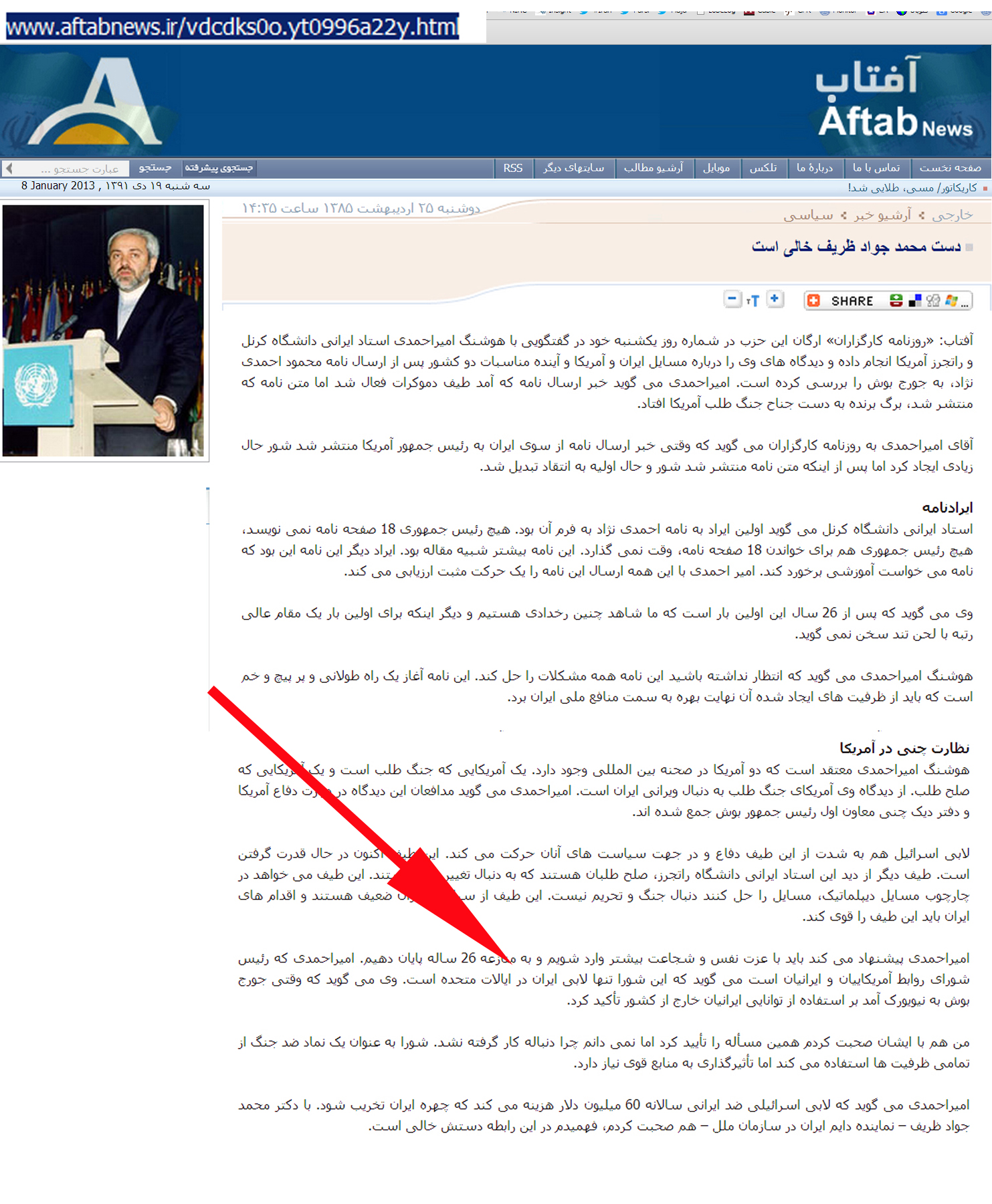
This campaign was also supported by the Iranian regime and as a result, Hooshang Amirahmadi, a University of Rutgers professor who had previously worked with Iranian government, launched a series of “Iran-US conferences” to promote friendship between the two countries. (See pictures here and here)
Amirahmadi told an Iranian newspaper that he coordinated this initiative with theIranian ambassador to the UN.
Amirahmadi’s main partner in this campaign was Gary Sick, a former White House staffer who launched his “Gulf 2000” project in 1993 to improve US-Iran relations.
Sick’s project was funded by US oil corporations, and Amirahmadi also reported in his CV that he received $350.000 between 1993 to 1996 from Oil companies to organize these conferences.
This anti-sanction campaign by Amirahmadi and Sick took on a new dimension in 1997 when US corporations launched a large-scale lobbying campaign to lift US sanctions against Iran.
1997 creation of USA*Engage
In 1997 the so-called reformist Mohammad Khatami became president and Iran launched a charm offensive to soften Western attitudes toward Iran and reduce the pressure and sanctions.
The American business interests grasped this golden opportunity. TheNational Foreign Trade Council (NFTC), representing large US corporations, launched its lobbying arm called USA*Engage and begun a large scale lobbying campaign to change US policy with Iran and remove sanctions.
In an interview in 1997, Gary Sick explained this new lobbying campaign:
Q: Do you think business groups like USA Engage will be able to have an impact on removing these sanctions?
A: I think in the beginning, the business community was not going to challenge these laws because first of all they did not have much of an economic impact, and secondly they did not want to be seen as questioning U.S. national security interests.
But now, there are so many laws and such huge economic losses that businesses have begun to organize. USA Engage now includes not all but most major U.S. corporations and in time they will have an impact. They are already backing bills in Congress which demand that before any new sanctions are imposed, there must be a detailed cost-benefit study to see if it’s worth going ahead.
Q: Just a couple of years ago you were among the very few who believed in rebuilding relations with Iran. But now it seems all top U.S. foreign policy experts agree with you, most recently Kissinger.
A: A huge array of experts and former officials, republican and democrat, now believe that U.S. policy toward Iran should change. I would like to think that I and a few others brought about this new thinking, but it’s not true. These individuals have done their own studies independently and come to this conclusion. A lot of them are consultants for major oil interests in Central Asia and elsewhere in the region.
American Iranian Council (AIC)
The American Iranian Council (AIC) is a pro-Tehran and anti-sanction advocacy organization that was founded in 1997 and remained influential until 2001. AIC is a revealing example of the tacit collaboration between US oil corporations and the Iranian regime unified in their goal to lift economic sanctions and influence US foreign policy toward Iran.
AIC’s board has included former US diplomats and senior executives from oil sector including Halliburton, Chevron, Exxon Mobile, and other corporations. At the same time, AIC’s president Hooshang Amirahmadi has received political and financial support from Tehran and he has publicly called AIC a lobby organization on behalf of Iran. (Amirahmadi’s interviews with government controlled newspaper in Iran here and here)
In its mission to garner friendlier policies with Iran, the AIC introduced a series of Congressional briefings and conferences with extensive media coverage(see AIC report). At the same time Khatami, the new Iranian President,was talking about the “dialogue of civilizations” and promising a pragmatic Iranian foreign policy that would end hostilities toward the West.
The Clinton administration was charmed by Khatami and the AIC’s campaign found receptive ears in Washington. Between 1997 and 2001, the AIC became the center of gravity on Iran issues in Washington. Pundits, experts, politicians and lobbyists met to promote the Iranian charm offensive and change US policy toward Tehran.
Kenneth Pollack, a member of the National Security staff in the White House during President Clinton, explained the US attitude toward Iran: “In the Clinton Administration in 1999 and 2000, we tried, very hard, to put the grand bargain on the table. And we tried. We made 12 separate gestures to Iran to try to demonstrate to them that we really meant it, and we were really willing to go the full nine yards and put all of these big carrots on the table if the Iranians were willing to give us what we needed.” (Brookings Institutions, Saban Center, conference on November 23, 2004)
The AIC’s activities culminated in March 2001. Secretary of State Madeleine Albright spoke at an AIC reception and extended a friendly US hand to Iran when she apologized for US involvement in the military coup that toppled Mossadegh’s government in 1953.
See also AIC’s reports obtained during the defamation lawsuit: 1 – 2– 3
AIC’s funding
TheAIC and Amirahmadi have received financial support from US oil corporations and theIranian regime. Amirahmadi’s own CV and its updated short version that was posted recently, reflect the numerous and generous donations from various US oil corporations and the Iranian regime’s New York-based Alvavi In Foundation.
In 2009 US authorities seized some assets of theAlavi Foundation which owns properties and spends millions of dollars each year to support universities, religious and cultural centers around the US. According to court documents, the Iranian ambassador to the UN supervised the allocation of Alavi’s funds to the grantees.
The AIC’s 2000 annual report declared, “[t]he organization initially depended on contributions by it’s Board members and a few corporations, predominantly in the oil sector” (p. 32).
Trital Parsi who currently serves as the president of NIAC, another pro-Tehran advocacy organization, was the development director of the AIC in 2001. In a series of documents obtained during a defamation lawsuit involving Parsi, We receive insight into the AIC’s status and funding.
In a memo written by Parsi in 2002 and sent to a Washington lobbyist, he declared:
“American Iranian Council has been the most prominent Iranian-American group in US politics for the last five years. But the organization has lost most of its credibility due to the Amirahmadi’s close relations with the conservative camp in Tehran. He has lost the support he enjoyed from US oil companies and his attempts to court the Iranian-American community has been futile.
Iranian Trade association (ITA)
TheIranian Trade Association (ITA) was another Iranian-American anti-sanction organization created in 1997 to help the lobbying campaign by US corporations. ITA was founded by Shahriar Afshar, a city employee in San Diego, who received support from Conoco oil and other US corporations. ITA ceased its activities in 2003 but itsweb archive reveals how US corporations helped create these so-called “Iranian-American” lobbying groups.
On its advocacy page, ITA declared: “ITA’s prime directive is to put an end to the U.S. unilateral and extra-territorial trade sanctions on Iran. ITA is a proud supporter of USA ENGAGE, a growing coalition of American companies speaking out for U.S. engagement overseas.”
In one article posted on website, we read:
Shahriar Afshar, the founder of the Iranian Trade Association, is spearheading a nationwide effort to lift most of the sanctions on his native land… He has picked up some impressive support for his cause. Conoco Oil joined his fledgling association in February. Next week Afshar will fly to Washington, D.C., for closed-door talks with lobbyists from Caterpillar, Unocal, Motorola, Mobil and other companies that are lobbying against the sanctions. Next month, he’ll take the campaign to London.
In another article, the partnership between US corporations and these “Iranian” organizations is underlined:
The San Diego-based Iranian Trade Association has attracted more than 20 corporate sponsors to its campaign against sanctions, said Afshar, a 30-year-old former worker in that city’s trade office. Among his sponsors is Conoco, which had a $1 billion oil-field project in Iran blocked by
the U.S. government in 1995. Gary Marfin, Conoco’s manager for government affairs, said the company’s alliance with Iranian-Americans is part of its general opposition to economic sanctions. ‘About the only impact sanctions do have is lost business and lost job opportunities in the U.S.,’ Marfin said.
In addition to writing articles and organizing policy conferences, ITA tried to use Iranian Americans in a Grassroots lobbying campaign. Afshar’s private consulting company worked with Conoco and organized aworkshop on grassroots lobbying.
During a defamation lawsuit that NIAC lost in 2012, one interesting document was released that shows the business nature of these “Iranian-American” organizations. This document is a 2002 memo by Trita Parsi to a Washington lobbyist in which he evaluated the Iranian Trade Association. Parsi wrote:
“Iranian Trade Association is headed by Shahriar Afshar in San Diego, this organization was quite visible in the late 1990’s but has since lost its momentum. Focusing entirely on trade issues turned out to be a weakness rather than strength—trade does not inspire people to get active and Afshar was never able to expand the group’s support base beyond a few oil companies. After the axis of evil comment, the oil companies too have abandoned ITA.”
Iranians for international cooperation (IIC)
The third Iranian organization created in 1997 to bolster the anti-sanction campaign was the “Iranians for International Cooperation” (IIC) founded by Trita Parsi at the time a student living in Sweden.
IIC planned to use its few Washington members to carry grassroots lobbyingand send petitions and letters to Congress members. IIC ceased its activities in 2002 but its web archive shows some grassroots lobbying activities and posted press releases to oppose US sanctions on Iran.
In a document written by Parsi, he explained IIC’s activities and goals: (document obtained during the defamation lawsuit)
“IIC was founded in August 1997 by Trita Parsi, the present President … our agenda is topped by the removal of US economic and political sanctions against Iran… IIC is capable of organizing the grassroots and pressure US lawmakers to pose a more Iran friendly position.”
Trita Parsi’s main partner in Washington was the corrupted Congressman Bob Ney who was caught by the justice system and sent to prison.
In another document written by Parsi, we can see how he coordinated with Ney to advance IIC’s grassroots lobbying. Parsi asked Ney to help him draft an anti-sanction petition to be sent by IIC members to the Congress. Parsi wrote :
Dear Robert (Bob Ney):
Thank you for the conversation we had on the phone just now. Below you will find a first draft of a letter we plan to send out to our members and Iranian-American webpages. We would appreciate if you gave comments on what else could be included in or excluded from the letter.
We are mostly interested in comments regarding the amendment itself, and perhaps arguments you wish to emphasize. We would also appreciate if we could continue this communication so that we can adapt our activities to the developments in Congress.
At this stage, we believe that a fax/telephone/letter/email campaign will be more effective than a petition. But if you believe that a petition would be useful, we can launch one over the net.
Ney was a strong supporter of anti-sanction lobbying activitiesby IIC and its two other partners, American Iranian Council (AIC) and Iranian Trade Association (ITA). In an interview arranged by Trita Parsi for Bob Ney that waspublished by a Tehran based journal, Ney explained the lobbyingactivities by “Iranian-American” organizations in Washington and declared: (Court document)
Q: There is a belief among Iranian circles that certain powerful lobbies are pushing Congress to keep away from ameliorating ties with Tehran and that often Washington is forced to pursue the interests of another nation, rather than that of the United States. Can you shed some light on how the lobbies affect the way Congress deals with Iran?
Ney: Over the past years, yes, there have been a select few lobbying organizations that lobby against Iran. However, recently there are many organizations forming to pursue the interest of Iran and Iranian-Americans. I believe you will see evidence of these groups this Congress and hopefully have a favorable affect on upcomring legislation.
Q: The number of Iranians in the US is quite significant. By the estimates of the Iranian government, there are between 1-1.5 million Iranians in the United States, a considerable number of whom are now US citizens. Have these Iranian-Americans had any role as force to pressure the anti-Iran camp in Congress? Do you see this group as a potential lobby for the interests of Iran in the United States?
Ney: As I have seen and met with, many Iranian-Americans are getting motivated after their silence for over 20 years. Today, the majority of Iranian-Americans are pressuring their Representatives in Congress to initiate a dialog with Tehran and to lift the sanctions. Many groups have been formed, such as Iranian Trade Association, American Iranian Council and Iranians for International Cooperation. This is a very positive development, as most
Congressmen previously have had no access to the views of the Iranian-American community. If the Iranian-American groups continue these organizations and their involvement in politics, they will be able to exert political pressure on Congress and influence the future direction of US-Iran relations.
One example of anti-sanction Lobby in practice
In 1998 the Iranian government sent an offer to buy $500 million of US grain. A lobbying campaign was launched to lift the ban on the sale of grain to Iran. This episode showed how the Iranian regime’s trusted men in Washington, the US farm lobby and Congress members lobbied together for a common cause.
According to the press report (see here and here), in the summer of 1998, Yahya Fiuzi an Iranian-American close to the government in Tehran and a Washington lobbyist called Richard Bliss and the two men formed a company called Niki Trading Co. In December, Niki received an offer from the Iranian government buy $500 million of American grain. Selling grain to Iran was restricted by US sanctions.
Bliss said that his company was created specifically to negotiate and carry out the proposed grain deal after receiving “some encouragement” from both American farmers and the Iranian government earlier in 1998.
Bliss said that the request had been approved “at the highest levels of the Iranian government” and that he believed Iran was seeking to use the purchase to begin improving ties with Washington. A similar view was expressed by Jim Miller, the National Association of Wheat Growers’ vice president for governmental affairs, who described it as “an Iranian overture to a more normal relationship between the two countries.”
On Dec. 14, Bliss submitted to the Treasury Department’s Office of Foreign Assets Control for a “special license” that would allow a waiver on U.S. sanctions. Describing it as a “one-time cash transaction,” Bliss argued that the sale would be “of significant benefit to United States farmers” and also a “dramatic gesture of goodwill to the Iranian people.”
Two days later, 10 agricultural trade associations sent a letter to President Clinton strongly endorsing the deal. The same day, a bipartisan group of 15 Senators and 17 House members also wrote Presidnet Clinton to support the purchase. At least six bills, two of them sponsored by Senator Lugar, were presented in the House and Senate to weaken economic sanctions on foreign countries.
Simultaneously, the “Iranian-American” organizations like ITA (Afshar) and IIC (Trita Parsi) launched a grassroots lobbying campaign, conferences and a media campaign. ITA held a conference in Washington in which Senator Chuck Hagel and several farm lobbyists spoke against the sanctions.
Another ITA conference on Capitol Hill, hosted Senator Pat Roberts and wheat lobbyists to endorse the lifting of sanctions.
Then, Trita Parsi’s lobby organization started its grassroots campaign by sending petitions and letters to the members of Congress members arguing that the Iranian community supports the wheat deal.
In April 1999, the Clinton administration lifted the ban on the sale of food and medicine to Iran, Libya and Sudan and paved the way for the sale of grain to Iran.
Finally, Iran decided to pass on the deal and bought the grain from its traditional suppliers in Canada and Europe but for the Iranian regime, the year-long lobbying in Washington against US sanctions was politically much more profitable than a wheat deal. Iran was presented as a party that seeks economic ties with the US and “the request to buy US grain was the Iranian overture to a more normal relationship between the two countries.”
2001, Bush victory intensified anti-sanction lobby
In 2000, George W. Bush and Dick Cheney Filled the Republican Presidential ticket and this seemed like a promising outlook for the US business lobby, and notably the oil sector. This combination seemed to fortell sucess for the AIC and their allies because Bush was close to the oil corportaions, Cheney was the chairman of Halliburton and both had previously opposed US sanctions against Iran.
In an article entitled: “better for business“, Gary Sick detailed Cheney’s previous statements aginst sanctions and argued that a Bush-Cheney presidency would ease such sanctions against Iran
In 2001, after Bush’s victory, the Iran Lybia Sanctions Act (ILSA) came before Congress either to be renewed for five years or to be terminated. Supported by the White House, the oil lobby intensified the anti-sanction campaign to prevent ILSA’s renewal.
In 2000, AIC’s president Amirahmadi arranged a meeting betwenn the speaker of Iranian parliament and top executives from Exxon Mobil, Chevron Corp and Conoco in New York.
In 2000 and 2001, several CEOs from oil corporations including Conoco travelled to Iran. It was during this period of time the anti-sanction lobby reached its apogee.
Peter H. Stone detailed these efforts in an article published by National Journal in April 2001:
Red Cavaney, the president of the American Petroleum Institute and his allies are in the midst of a lobbying campaign aimed at persuading members of Congress and Administration officials to relax sanctions against investments in Iran and Libya.
Oil behemoths such as Chevron Corp., Conoco, ExxonMobil Corp., and Phillips Petroleum Co. have been working aggressively alongside big business coalitions, such as USA*Engage, a group of 670 U.S. companies, to fight unilateral sanctions. Industry lobbyists want Congress to resist appeals from the American Israel Public Affairs Committee for a five-year renewal of the Iran-Libya Sanctions Act, which is aimed at curbing foreign energy investments in those two countries.
Industry lobbyists say they have been heartened by statements critical of sanctions by Secretary of State Colin Powell and Cheney, the former chief executive of Halliburton Co. who chairs the Administration’s energy task force.
USA*Engage lobbyists have had meetings with top Bush Administration officials, including Lewis Libby, Cheney’s chief of staff, Richard Haass, the State Department’s director of policy and planning, and Ted Kassinger, the general counsel at the Commerce Department, to press their concerns. USA*Engage and the National Foreign Trade Council, another large business coalition seeking to end the sanctions, have visited about 50 congressional offices since early March to make their case. “Our overall philosophy is that being engaged with a country is better than running away,” says Deline, who also lobbies for Halliburton. USA*Engage is also weighing whether to launch advertising efforts in some key congressional districts. The coalition is using the Fratelli Group, a public affairs firm, to help get its message out to the media.
Prominent oil industry executives, such as Archie Dunham, the chief executive officer of Houston-based Conoco, have also weighed in. On March 21, Dunham visited Washington to meet with Cheney… Conoco and two other oil companies recently hired the Duberstein Group to help make the case for lifting the Libya sanctions.
The fight against the Iran-Libya sanctions has also garnered support from an ex-member of Congress who sits on Chevron’s board. J. Bennett Johnston, a Louisiana Democrat who used to chair the Senate Energy Committee and was part of a Chevron contingent that visited Iran earlier this year, says the sanctions are counterproductive.
(National Journal, 27 April 2001 and also see: See also USA*Engage journal archive)
Extension of ILSA
In June 2001, the US Congress unanimously extended the Iran Lybia Sanctions Act (ILSA) for five more years. Less than ten members of Congress opposed the extension. This was primarily due to the Iranian’s failure to reciprocate President Clinton’s unilateral goodwill gesture and change its radical foreign policy in the Middle East.
Trita Parsi posted a press release and claimed that the majority of lawmakers voted against their true wills. In a tone apologetic to Tehran, he expressed his hope that the Iranian regime understood that he and his colleagues had worked hard to prevent this result:
“Hopefully, Tehran will recognize that an honest attempt was made to defeat or at least weaken the sanctions. The call for a review and Speaker Hastert’s pledge to insist on Congressional action based on the review must also be interpreted by Tehran as a step in the right direction.”
The National Iranian American Council (NIAC)
The National Iranian American Council (NIAC) is a Washington-based grassroots lobbying organization that was founded by its president Trita Parsi in 2002. NIAC lobbies for a friendlier policy with Iran and opposes economic sanctions. NIAC maintains an active presence in Washington D.C., particularly working to influence members of Congress and the White House on their opinions about Iran.
NIAC’s creation was planned in 1999 by Trita Parsi and Siamak Namazi, director of Tehran-based Atieh Bahar, which is part of Atieh Group a company that has multiple ties to the regime and helps foreign corporations do business in Iran.
Creation of NIAC: 1999, Cypress conference and roadmap for creation of lobby
In 1999, while the anti-sanction lobbying campaign by US corporations continued in Washington, Hossein Alikhani, an Iranian oil businessman living in Cypress organized a conference to discuss how to improve US-Iran relations and remove sanctions. Alikhani had been previously arrested by the FBI in 1991 and jailed in the US for violating the sanctions against Libya.In 2005, in a show of support to Alikhani, a court in Tehran demanded that the US embassy compound in Tehran be sold and the fundsbegiven to him.(See documents)
Among the participants in the 1999 conference were Richard Sawaya, chief lobbyist at Oil giant Arco, Farrokh Mostofi representing the Shell oil company in Iran and Bijan Khajehpour, chairman and founder of Tehran-based Atieh Group.
Siamak Namazi (Atieh’s partner and managing director of Atieh Bahar consulting) was present at the Cypress conference and together with Trita Parsi, he presented a roadmap and argued that an Iranian-American lobby should be created to influence US policy with Iran and eventually remove sanctions. In that report, they explained how the Israeli lobby, AIPAC, operates in Washington and argued that: “An Iranian-American lobby (which is different from a lobby group purely pursuing the interests of the Islamic Republic of Iran) is needed in order to create a balance between the competing Middle Eastern lobbies. Without it, Iran-bashing may become popular in Congress again.”
Parsi and Namazi outlined three recommendations:
1. Seminars in lobbying for Iranian-American youth and intern opportunities in Washington DC.
2. Increased awareness amongst Iranian-Americans and Americans about the effects of sanctions, both at home and in Iran.
3. The taboo of working for a new approach on Iran must be further legitimized.
Atieh Group, part of Iran’s economic Mafia
What is the Atieh Group and why were its owners and directors interested in creating a lobbying organization in the US to remove sanctions against Iran?
Atieh Group is a business conglomerate founded in Tehran in 1993 with diverse activities. Its consulting firm is Atieh Bahar, it HR firm is Atieh Roshan and the legal arm is Atieh Associates, altogether they help foreign companies do business in Iran, acts as intermediary between the company and the government, maintains close ties with the regime and has multiple joint ventures with the government. Atieh is part of the inner circle of the Iranian regime’s economic mafia.
Some of the Atieh’s old website screen shots are compiled here and show close ties between this company and the Iranian regime. For example, Bijan Khajehpour the founder and chairman of Atieh is also the director of another comapny called “Azar Energy”, an oil and gas joint venture with the Iranian government.
Atieh Dadehpardaz provides web and IT services to parliament, government ministries, military and security institutions This is just one example of close relationship to the Iranian regime enjoyed by the Atieh and the high level of trust the government places in the company.
A simple review of “project samples” posted on Atieh website shows the close relationship between Atieh and the regime. For example, Atieh’s legal department helped theIranian government obtain $1.4 billion to finance the purchase of 12 oil carriers.
Atieh’s CFO, Albrecht Frieschenschlager and his other consulting company helped the government to secure finance for this purchase.
In this document we see some examples of international oil conferences that Atieh Bahar co-organized in which Iranian government ministers participated.
2001: Parsi was hired as the development director of AIC and moved to US
TheAmerican Iranian Council (AIC) is a pro-engagement advocacy organization based in Washington. AIC is supported by large US corporations notably oil giants that seek business with Iran.
In 2001, Parsi was hired by AIC as thedevelopment director and moved to Washington. (See Parsi’s CV) He worked less than a year for AIC but this was a good professional experience for him to know the anti-sanction lobby groups build his network of donors and sponsors and prepare the creation of NIAC. (See also, AIC president Amirahmadi’sletter and Parsi’s report to AIC board members)
June 2001: Parsi began consultations for the creation of NIAC
In June 2001, three month before the launch of NIAC, Trita Parsi and some of his lobby partners discussed the creation of a lobbying organization to remove sanctions against Iran.
They discussed if a new lobbying organization should first target the lifting of sanctions on Iranian NGOs and later ask for the removal of all sanctions, or if it would be better for the organization to begin withopposing sanctions altogether. Parsi favored this approach and argued that his lobby’s partners in Congress were not interested in NGO issues.
In October 2001, Parsi and four friends held the first NIAC board meeting. In early 2002, NIAC was officially registered as a 501c organization.
NIAC’s lobby
During the June discussion, Parsi and his partners discussed the legal structure of the organization that could permit lobbying activities:
“All parties expressed concerns regarding the legality of 501 C3s getting involved in lobbying. Mr. Oliner pointed out that 501 C3 are not allowed to influence legislation, whether it be a complete lifting of sanctions or getting an exemption to NGOs through law. Mr. Parsi had in the email dated June 17, 2001 pointed out that one solution was to incorporate a new and legally and financially separate organization.”
After NIAC was created in early 2002, Parsi worked with two Washington lobbyists Roy Coffee and Davis Disrafano to create this new organization that would undertake the lobbying activities of NIAC. The collaboration between Parsi and two lobbyists was partly revealed in 2006 during the Jack Abramoff scandal as the lobbyist Coffee sent aletter to the Dallas Morning News and explained his collaboration with Trita Parsi. But NIAC’s internal documents released during a defamation lawsuit, clarified this affair. (See Documents)
Among these documents is Parsi’s memo to Roy Coffee, entitled “Towards the creation of an Iranian-American lobby”, in which he detailed his plan to create this parallel organization. This organization was to be called “the National Association of Iranian Americans” (NAIA).
In his memo Parsi explained that the real mission of this lobby should be to improve US-Iran relation and open up trade opportunities . He emphasized that the lobby’s main partners and financial supporters are US corporations:
Iranian-American organizations have in the past targeted the oil companies for financial support. This strategy has been a two-egged sword. On the one hand, the oil companies have been relatively dedicated to the cause and have been generous supporters of groups such as AIC. On the other hand, oil companies have a bad reputation among Iranian-Americans and are easily depicted as greedy and insensitive to human rights concerns in the media.
It would be a wise strategy of the proposed lobby to seek limited support from US oil companies. Oil companies should not be the initial sponsors of the lobby and their share of the lobby’s budget should perhaps not exceed 10 per cent. Diversification is the key.
The lobby should target business with positive images that have a strategic interest in trade with Iran. These companies include Motorola, who would benefit greatly from the 70 million strong Iranian telecom market, IT companies who could benefit from Iran’s cheap yet highly skilled labor (just as they do in India), construction and irrigation companies, soft drink companies (displeasure with US policies in the Middle East has allowed Iranian soft drink companies to grab market shares from Coca Cola and Pepsi in many Persian Gulf countries) and fast food chains.
Parsi’s collaboration with two lobbyists to launch NIAC’s lobby failed because the Iranian Americans ignored NIAC and the organization lacked necessary recruits for its grassroots lobby. Moreover, the extension of Iran Libya Sanctions Act (ILSA) in 2001 by the Congress discouraged the US corporations to continue their large scale lobby to lift the Iran sanctions and as a result, their support to Iranian-American organizations like NIAC diminished.
But the situation changed in 2005-2005 and the US trade lobby re-launched its lobbying campaign and revived their collaboration with NIAC.
Trita Parsi and Atieh Group’s officers from Tehran coordinated anti-sanction lobby in Washington
A series of email exchange between Parsi and Siamak Namazi were obtained during the lawsuit and show the close coordination between them to advance NIAC’s anti-sanction lobby in Washington.
These emails show that Parsi, who has had access to US government and Congressional offices, was collaborating with people inside Iran who worked with Iranian government.
NIAC started its large-scale lobbying at the end of 2005 and from the beginning, Namazi was helping Trita Parsi to advance his lobby, connect to influential people and get support for his lobbying activities.
Together they planned to meet with the US Deputy Secretary of State, and in their email exchange they discussed their “game plan” to influence the US government.
Namazi took Parsi to meet with Julia Nanay of the Petroleum Finance Company, the Italian Ambassador and other influential people in Washington.
Parsi regularly reported his lobby to Namazi in Tehran, they exchanged information, and Namzi briefed him on Iran’s political situation.
Namazi prepared talking points and policy briefs for Parsi to be used by him in his meetings in Washington.
NIAC and Atieh today
NIAC’s collaboration with Atieh Group continues. Bijan Khakehpour is mostly in Vienna, Austria where he leads the newly launched office of Atieh in Europe. He regularly comes to the US to participate in NIAC’s Congressional and policy meetings and he has recently co-authored with Trita Parsi a new anti-sanction report that was presented during a conference in Washington. Khajehpour and his wife Pari Namazi are listed as key speakers in NIAC’s leadership conference in October 2013.
NIAC joint lobby with US Corporations
Trita Prasi’s memo to Washington lobbyist Roy Coffee explaining the nature of NIAC lobby, Oct. 2002:
Although the mission of the proposed lobby should be to improve relations between the US and Iran and open up opportunities for trade… and despite its predominantly business oriented constituency, it is essential that the lobby creates a “human face” for its aims and goals. AIPAC successfully painted the opponents of the Iran Libya Sanctions Act as “greedy businessmen who had no scruples when it came to doing business with terrorist regimes.” The oil companies failed to characterize their campaign with “human concern for the well-being of innocent Iranians stuck with a dictatorial regime” or “support for the poor mid-Western family father who lost his job due the sanctions.” The human element is essential both when it comes to attracting support among Iranian-Americans and when it comes to winning the debate and the votes on the Hill.
NIAC’s main lobby partner in US has been USA*Engage that was created in 1997 when the so-called reformist Mohammad Khatami became president and Iran launched a charm offensive to soften Western attitudes toward Iran and reduce the pressure and sanctions.
The American business interests grasped this golden opportunity. The National Foreign Trade Council (NFTC), representing large US corporations, launched its lobbying arm called USA*Engage and begun a large scale lobbying campaign to change US policy with Iran and remove sanctions.
NIAC joint lobby with USA*Engage started in 2007. Some of NIAC’s internal emails released during the defamationlawsuit show the nature and extent of this joint lobby. These emails are compiled here.
The emails show how the US trade lobby is using NIAC to legitimize its anti-sanction lobby. NIAC presents itself as the representative of the “Iranian-American” community, frames the anti-sanction campaign as being the concern of Iranian-Americans and consequently humanizes the campaign. The review of email exchanges between NIAC and USA*Engage are revealing in this regard. For example, Jake Colvin, the director of USA*Engage wrote to Parsi in April 2007:
“We hear that the attached re-draft of HR 957 – one of the Iran sanctions bills – is headed towards the suspension calendar, possibly very soon… we are concerned with Section 2 for the reasons described below. You may wish to touch base with your contacts on the House side.”
Upon Colvin’s request, NIAC’s chief lobbyist in 2007 Babak Talebi, contacted Congressional offices and asked for meetings to discuss the sanction bill. In Talebi’s email to Jake Colvin, he wrote:
“Below you will find the list of suggested Republican members that we may wish to target based on relevant committee assignments and their neutral to positive positions on our issues. If any of you have specific suggestions on members to add or strike from this list, please let us know.”
In his request to Congressional offices, Talebi wrote:
“Dear Mrs. Sutton, I am writing on behalf of a group of organizations that are deeply concerned about the path of US-Iran relations and the policy choices and issues facing the 110th Congress. We would like to meet with you to discuss Representative Roskam’s positions on these policy issues and would appreciate an opportunity to visit with your office on Thursday June 14th.”
Two months later in July, Jake Colvin asked NIAC to profit from the summer and arrange more meetings with Congress members. In his email, Colvin wrote: “Are we going to start up more meetings on the hill in the coming weeks? August might be spotty with schedules (theirs and ours) but also might be a good time to catch up with staffers who are around.”
Quickly, Talebi started to schedule new meetings in Congress but he needed more advice from Colvin and asked: “I can coordinate our next set of meetings for August – but I would like to get your input on which committees to target for August.”
Colvin responded: “I’d recommend targeting, in this order: Senate: Banking, Foreign Relations, Finance – House: Foreign affairs, Financial services, Ways and Means.”
A few months later in October, several states planned to adopt legislations that allowed them to dissociate from companies that do business with Iran. Colvin sent an email to NIAC and asked them to launch a campaign against these bills. Colvin’s email seems more like an order than a request:
“All, There are a number of Iran divestment bills moving in the States, including a couple that have not been formally introduced yet (MA, MI, PA). Does it make sense to put something together on this? An update for a broad coalition, an op-ed, reaching out to legislators or grassroots, something else?”
As these emails show, NIAC acts as the face of anti-sanction lobbies in Congress. NIAC’s use of its “Iranian” credentials to serve the interests of trade lobby was not limited to US corporations. Another email shows the foreign companies were also served by NIAC. In a September 2007 email, NIAC’s new chief lobbyist Emily Blout wrote to Parsi, her boss:
“Trita, Simon Weber of the Organization for International Investment (OFII) asked to meet with us to discuss HR 1400 and the prospect of working together on the bill, presumably when it goes into conference. OFII represents over 160 U.S. subsidiaries of companies headquartered abroad and is particularly interested in provisions that would hurt these companies and damage US standing with its allies. I thought Babak and I could meet with Simon and another staff member on Monday. I suggest it be a quick preliminary meeting during which we can gage the benefits of collaborating with OFII further. Let me know what you think.”
After their meetings, Blout wrote to Simon Weber: “Hi Simon, It was great meeting with you today. Babak will be in touch with you about allies on the sanctions issue and I will keep you up to date on the developments with the Smith Amendment. I look forward to working with you in the future!”
In response, Simon Weber offered to help NIAC organize a briefing in the Senate: “When was the last time you did a briefing on the Senate side? It might be a worthwhile exercise to do some education. FYI — I have heard Smith’s S.970 might be moving in the fall.”
Campaign for New American Policy on Iran (CNAPI) 2007-2010
NIAC collaboration with USA*Engage was also carried through a coalition of two dozen groups that was formed after 2008 and was called the Campaign for New American Policy on Iran (CNAPI). The US anti-war movement was the main component of this coalition. (See documents)
Following the US invasion of Iraq in 2003, the anti-war movement and opposition to George Bush’s policy in the Middle East gained support in the US. In 2005, after Ahmadinejad became president, Iran resumed its nuclear activities and the hostilities between Iran and the West increased. As a result, the US anti-war movement feared a new war in the region and voiced its concern and criticized US animosity toward Iran.
As the anti-war movement’s opposition to US policy toward Iran became more vocal, the Iranian regime, its American proxies and US corporations decided to use this popular movement in their lobbying activities and further their political agenda. (see the report titled: “Relation and cooperation between Iranian regime and American anti-war groups”)
After 2005, some of peace groups came together and worked together to prevent a war with Iran. NIAC joined them and the CNAPI was officially formed. In 2008, NIAC took control of this coalition, asked USA*Engage to join them and morphed this coalition to a strong lobbying force to oppose US sanctions against Iran.
During the defamation lawsuit , A report written by Parsi in 2007 and sent to his Tehran based lobby partner Siamak Namazi was released in which he explained the activities of anti war coalition and how it could be morphed to an anti-sanction lobby. Parsi’s report is titled the “lobby groups”:
As of early 2005, Washington’s heated rhetoric over Iran has attracted the attention of a variety of interest groups eager to prevent the escalation of tensions in the Middle East and the prospects of a war between the US and Iran. These groups have managed to build unprecedented support in Congress in favor of dialogue and against military action among progressive Democrats as well as conservative Republicans on Capitol Hill.
This coalition of pro-dialogue and anti-war entities consists of a diverse group of organizations ranging from arms control organizations, to Iranian American organizations, to religious groups. Key players in this coalition are the Center for Arms Control and Nonproliferation, which coordinates a coalition of approximately 50 organizations, MoveOn and the National Iranian American Council.
While these groups have focused extensively on passing measures to reduce the risk for war with Iran, little attention has been paid to efforts to intensify sanctions against Iran. Furthermore, while a momentum exists for anti-war measures, no comparable opportunity exists currently for an anti-sanctions campaign. Nor is the coalition of disarmament, religious and progressive groups best suited to take on this issue. Here, the absence of pro-business interests on Capitol Hill active constitutes a key point of advantage for AIPAC.
In his report, Parsi explained the importance of bringing in the pro-trade lobby group and notably USA*Engage:
Pro-Business groups
With the exception of USA Engage, American businesses and oil companies have after September 11 next to eliminated their efforts on Capitol Hill in favor of greater trade and contacts with Iran.
USA Engage is a coalition of approximately 500 major US companies which has retained a distant interest in the Iran issue, though the coalition has devoted little resources towards promoting trade or preventing new sanctions from being imposed. In particular, the recently imposed UN sanctions have granted the sanctions track with Iran new legitimacy and made efforts to oppose such measures on trade grounds more difficult.
However, initial efforts are currently being made to make align the trade groups with the pro-dialogue coalition and frame sanctions an initial step that invariably will lead to war. If such a coalition of pro-trade and pro-dialogue groups can be formed, the current momentum for sanctions may be significantly hampered.
Conclusion
The balance of power on Capitol Hill is currently shifted in favor of sanctions on Iran but against military action. AIPAC continues to seek both military strikes against Iran and draconian sanctions and has benefited from the absence of active lobbying by pro-trade groups. A change in heart by pro-trade coalitions may significantly hamper efforts to have Congress impose new draconian sanctions on Iran. This is great significance since Congressional sanctions are far more difficult to undo than those imposed by the Executive Branch.
A year later in 2008, NIAC became the coordinator of this coalition, it was named CNAPI, USA*Engage joined it and their focus turned toward lobbying against sanctions. Some of the coalition meeting notes and relevant documents has been posted here and the review of these documents gives a basic understanding about the coalition’s work and its agenda.
CNAPI was very influential between 2008 and 2010 and effectively shaped US policy with Iran. In their December 18, 2008 meeting, NIAC representative declared that the coalition was the “center of gravity on Iran issue” in the Congress. (see also the report that explains how CNAPI lobbied against nomination of Dennis Ross)
The CNAPI format ceased its activities in 2010 but the collaboration between NIAC, USA*Engage and anti-war groups continues and they work together to influence US policy with Iran.
İraniansforoum