Home Blog Page 483

Hezbollah says Israel wants to drag U.S. into war on Iran, attack will set Mideast ablaze

0


An Israeli attack on Iran’s nuclear program would set the Middle East ablaze, possibly drag in the United States and unleash a conflict beyond the Jewish state’s control, the deputy head of Lebanon’s pro-Iranian Hezbollah movement said.

World oil prices have risen to 10-month highs on escalating tensions between the West and Iran. The United States and Israel have not ruled out a military strike on Iran to halt its nuclear program, which Israel believes is intended to build atomic weapons and Tehran says is for producing energy.

“America knows that if there is a war on Iran, this means that the whole region will be set alight, with no limit to the fires,” Hezbollah deputy Sheikh Naim Qassem told Reuters.

Qassem also said the movement’s fighters, estimated to number several thousand, were better trained and equipped to retaliate against Israel than in 2006, when the Jewish state fought a month-long war in southern Lebanon.

“Gone are the days when Israel decides to strike, and the people are silent,” he said.

“Israel could start a war … but it does not know the scale of the consequences and it is incapable of controlling them.”

The Hezbollah deputy said he believed Israel would try to drag a reluctant United States into confrontation with Tehran because it could not inflict sufficient losses on Iran alone.

U.S. officials have said that non-military pressure such as sanctions on Iran should be given time to work, while Israel has hinted it could launch a pre-emptive strike on Tehran.

But he expected Israel might try to overcome U.S. concerns about military action and drag it into conflict with Tehran.

“Israel does not have the capability nor the courage to wage war by itself on Iran, while America has reservations because of the dangers of this war and because of the upcoming (presidential) election,” Qassem said.

“Who will win?”

“Who will win? The Israeli pressure to drag in America or America’s constraint of Israel?”

Hezbollah was set up 30 years ago with the help of Iranian Revolutionary Guards to fight Israeli forces that invaded Lebanon in 1982 and still enjoys financial and military backing from Tehran and Syria.

Qassem also said he expected Bashar al-Assad to remain president of Syria despite 11 months of protest in which the United Nations says more than 7,500 people have been killed.

Qassem spoke to a team of Reuters journalists at an undisclosed location in Beirut’s teeming, impoverished Shi’ite southern suburbs. The group was driven in a car with blacked-out windows for some distance, then into an underground car park to access a lift up to a meeting room with covered windows.

The elaborate security precautions, which included removing all watches, communications and recording devices before the journey, were intended to protect the Hezbollah leadership from possible attack. Israel killed a previous Hezbollah leader with a missile strike in 1992.

Dressed in grey clerical robes with a white turban and speaking slowly and deliberately in Arabic, Qassem appeared relaxed and unhurried during the conversation. At times he smiled and was at pains to ensure he had been fully understood.

Asked whether the militant Shi’ite group, which fought a 34-day war with Israel six years ago, would attack Israel in response to any strike on Iran, Qassem said Iran could defend itself but that such an attack would “ignite the entire region”.

Hezbollah, he said, had a defensive rather than an offensive position against Israel but “is always preparing itself and it won’t stop preparing itself for a single second because of its conviction that Israel is always preparing to attack”.

Qassem said Washington believed any conflict with Iran would put its forces and allies in the region at risk, and would deepen the global economic crisis by pushing oil prices higher.

Expectations of war

Hezbollah was “in an even better position than we were in 2006”, when it fought Israel to a standstill in a conflict that cost 1,200 lives in Lebanon and 159 in Israel, he said.

Despite U.N. resolutions and a U.N. peacekeeping force near Lebanon’s southern border with Israel, Hezbollah has since rearmed, although Qassem declined to give any details on the group’s arsenal of rockets and other weapons.

“We have learnt from the 2006 experience and increased our training, our resources and our equipment in accordance with our expectations of the next war, if it happens,” he said.

Hezbollah backs Assad despite supporting popular uprisings elsewhere in the Arab world.

Qassem praised the “Arab Spring” revolts which overthrew the leaders of Egypt and Tunisia last year, but said that the United States was “trying day and night to hijack those revolutions”.

He said the uprisings in Libya and Yemen had started out as popular movements but were pushed off course militarily and politically by the West.

“We hope that popular forces can put an end to foreign exploitation and political exploitation of this movement, he said. “America’s criteria in relation to the Arab revolutions are not uniform and have nothing to do with human rights or democracy.”

Hezbollah says Syrian leader Assad, who comes from the minority Alawite sect which derives from Shia Islam, has introduced reforms in response to demonstrators’ demands including Sunday’s referendum on a new constitution.

It believes that the collapse of Assad’s rule would lead to the country fragmenting on sectarian lines.

Hezbollah officials also believe there is no credible leadership-in-waiting among the divided Syrian opposition that could control the country, and that Sunni Islamists would impose their agenda after Assad’s departure.

Qassem said the upheaval was largely the work of the United States, which had been “inciting unrest in Syria and providing financial and military aid for use in the violence and killing inside Syria”.

“…I believe that President Assad will overcome this period and will remain the president of Syria,” he said.

 Source: alarabiya

Iranian Kurdish groups call for boycott of elections

0


Four Iranian Kurdish political parties at a gathering in Soleymanieh have called on the people of Kurdistan and Iran to boycott the parliamentary elections and stay home on Friday March 2.

The Islamic Republic’s elections for the ninth Islamic Parliament are scheduled for March 2.

Radio Zamaneh has been informed that the Democratic Party Iranian Kurdistan, Iran’s Komalah Party, the Kurdistan Freedom Party (PAK) and the Iranian Kurdistan’s Revolutionary Khabat Organization met in Soleymanieh on Tuesday February 28, issuing a unanimous plea to the Iranian public to shun the elections.

The upcoming ninth parliamentary elections in Iran have been boycotted by numerous groups, including the reformists, who had set out conditions for their participation: the release of the opposition leaders and all political prisoners, and a guarantee of transparent elections.

The presidential election of 2009 drew a large voter turnout but it later led to mass street protests against the alleged vote fraud in the victory of Mahmoud Ahmadinejad. The government has fiercely cracked down on election protesters.

Source: radiozamaneh

Is Hezbollah Preparing Itself to Fight on Behalf of Iran?


Hossein Alizadeh


Iran Briefing : It is clear that Hezbollah, a militant group based in Lebanon, is a military wing of the Quds force of the Revolutionary Guard. Due to lack of a straight route between Iran and Lebanon, Hezbollah receives its logistic support from Tehran via Syria. Despite this fact, all three parties, Iran, Syria and Hezbollah, deny that there is an organized tie between them in funding and arming Hezbollah, and they claim that Hezbollah receives only spiritual support from Tehran.

However, with the pressures ramping up against the Islamic Republic, Iran’s Supreme Leader, Ayatollah Ali Khamenei, has recently said that Tehran has been providing Hezbollah with both spiritual and material supports. He said, “As a result of our interference, Hezbollah was able to win the 33-day and the 22-day wars with Israel.”

He was indeed alluding to the following story:

Fighting On Behalf:

In spite of Israel’s military superiority over Hezbollah, it failed to defeat Hezbollah in the 2006 war which lasted for 33 days. The war began when Hezbollah’s forces crossed into Israel’s territory and killed three Israeli soldiers and abducted two others who were later transferred to Lebanon.

Hezbollah’s victory over the sophisticated army of Israel encouraged Khamenei to send a congratulatory message on August 16, 2006, to Sayyed Hassan Nasrollah, Secretary General of Hezbollah, who was called by Khamenei as “dear and mujahed brother.”

In his letter, Khamenei said, “What you have brought to the Islamic nations with your marvelous jihad and resistance is beyond explanation.”

The Supreme Leader was joyful because Hezbollah was regarded as a symbol of Iran’s power and strength against Israel. In other word, Hezbollah’s victory or defeat could have been considered as victory or defeat of the Islamic Republic itself.  That is why the 33-day war was called by observers as “Fighting on Behalf,” in which Hezbollah fought against Israel for 33 days on behalf of the Islamic Republic.

It was as if the Islamic Republic itself was fighting with Israel. The speed of reconstructing the ruined parts of southern Lebanon, which has been done by the Islamic Republic’s financial support, shows that Hezbollah fought against Israel on behalf of the Islamic Republic.  However, both Iran and Hezbollah were unwilling to disclose the secrecy over Iran’s financial supports to Hezbollah.

While tension is decreasing between Hamas and Israel, Hassan Nasrollah announces, “We used to keep silence about the Islamic Republic’s financial aid to Hezbollah, and we were only talking about the Islamic Republic’s spiritual support of Hezbollah. We used to talk about the Islamic Republic’s political and spiritual supports, but when we were asked about the Islamic Republic’s financial aid, we preferred to remain silent. However, when the Islamic Republic’s highest authority, the Supreme Leader, clearly talked about financial support to Hezbollah, we shall no longer be silent. Yes, we have been receiving moral, political and material supports in all possible forms from the Islamic Republic of Iran since 1982. Hezbollah’s victory against Israel in the 33-day war was not possible without the Islamic Republic’s support. Of course, Syria’s role was important too.”

Belated Confession

What has been occurring in the region that has persuaded both the Islamic Republic’s Supreme Leader and Hezbollah’s leaders to make such confessions?

Probably, recent pressures exerted by the US and its western allies on Tehran are the reasons behind the Islamic Republic’s confession.

The installation of the NATO defense shield on Turkish territory along with sanctions imposed by the US and the EU on Iran’s Central Bank and oil sector were compelling enough for the Islamic Republic to show off its military strength.

To display its power and as a reaction to the oil embargo, the Islamic Republic had previously threatened to seal off the Strait of Hormoz. To that purpose, the Islamic Republic even held war games in the Persian Gulf, and brazenly warned that  “closure of the Strait of Hormoz is as easy as drinking a glass of water for the Islamic Republic.”

Iran’s Supreme Leader, Ayatollah Ali Khamenei, long ago proclaimed the Threat-with-Threat strategy as the Containment strategy. He had stated that “We are not a nation to sit back and watch the materialistic, corrupted and rotten powers threaten the strong and dignified Iranian nation. We will threaten as a response to any threat.”

Since the containment strategy, i.e., the closure of the Strait of Hormoz, opted by the regime, was more a defensive reaction that offensive one, recent statements made by the Supreme Leader of Iran regarding the Islamic Republic’s all-out support of Hezbollah, must be regarded as a show of the Islamic Republic’s offensive capabilities which can go even beyond its borders. The Islamic Republic wanted to show that, in addition to closing the Strait of Hormoz, it has the ability to fight with Israel in southern borders of Lebanon in spite of the presence of the NATO defense shield which might be disturbing to the regime in Tehran.

In November 2011, Hassan Nasrollah warned the US and Israel that war against either Iran or Syria would not be limited to these two countries, and it would have the potential to spread across the region. However, Nasrollah’s recent remark, in which he had lauded the Islamic Republic’s military power and its supreme leader, who was described by Nasrollah as an outstanding leader who replies a strike with two, must be interpreted in line with the Islamic Republic’s offensive strategy and reaction.

The measures taken by the Islamic Republic (closing the Strait of Hormoz and using Hezbollah as its proxy) show that the Islamic Republic has begun to feel that it is gradually fading away due the severity of the sanctions, or possible war which might result from closing the Strait of Hormoz. That is why it is seeking to use its military wing in Lebanon, Hezbollah.

Will Hezbollah Act Independently?

Taking into account Hezbollah’s close association with the Islamic Republic to the extent that it fought 33 days against Israel on behalf of Iran, will it once against fight against Israel on behalf of the Islamic Republic?

Hassan Nasrollah himself has answered the question. He has said that “the Islamic Republic’s leaders will not ask for Hezbollah’s help, should its nuclear infrastructures be attacked. We ourselves have to decide how and what to react.”

Regardless whether the Islamic Republic would seek help from Hamas in case it is attacked by Israel, what would be Hamas’ position and what decision it is going to make?

The question is important, keeping in mind the fact that Hamas has defined itself as a resistance movement which is tasked with liberation of the occupied territories, and not military wing of a foreign country.

Therefore, it is against the core values of Hamas, should it fight against Israel on behalf of Iran. In case Hamas refuses to fight on behalf of Iran, it would leave Iran, a very significant financial source for Hamas, alone in the life and death situation. It seems that Hamas will opt for the second option, and it will decide not to fight on behalf of the Islamic Republic. Because today it is very much known that the Quds force is not at all concerned about liberating the occupied territories, but it is looking for a bulwark against the Israel’s possible aggression. Hamas in Lebanon is assigned to play this role for the Quds force.


Iran turns the screws on dissidents ahead of elections, report finds

0


Iran has escalated its crackdown on freedom of expression ahead of this week’s parliamentary election, Amnesty International said in a report published on Tuesday.

“In Iran today you put yourself at risk if you do anything that might fall outside the increasingly narrow confines of what the authorities deem socially or politically acceptable,” said Ann Harrison, interim deputy director of Amnesty’s Middle East and North Africa programme.

“Anything from setting up a social group on the Internet, forming or joining a NGO, or expressing your opposition to the status quo can land you in prison,” she said.

The report entitled “We are ordered to crush you: Expanding Repression of Dissent in Iran” details repressive acts by the Iranian authorities since February 2011, including a wave of arrests.

Cyber army hacks into former president’s websites


Iranian media report that two reformist websites have been hacked into by the so-called Hezbollah Cyber Army.

The two targeted websites belong to the Association of Combatant Clerics, a reformist organization under the leadership of former Iranian president Mohammad Khatami, and the Baran Foundation, another organization linked to Khatami.

An attempt to access these websites will link users directly to the website of the Hezbollah Cyber Army. The so-called Hezbollah Cyber Army warns that it will not allow people to damage Iran’s Islamic values by spreading “childish” ideas online.

Mohammad Khatami and other Iranian reformist figures have been sidelined for the past two years, ever since the mass protests against Mahmoud Ahmadinejad’s disputed election victory in 2009. Reformists are accused of playing into the hands of the Islamic Republic’s enemies and harming the system.

Khatami has announced that reformists will not participate in the coming parliamentary elections without the release of all political prisoners, including the opposition leaders under house arrest, and without guarantees that the elections will be free and transparent.

Since none of these conditions has been met, several reformist groups have boycotted the elections.

In 2009, Defense Tech, a U.S. military and security organization, reported that the Iran’s Cyber Army is an offshoot of the Revolutionary Guards of Iran and one of the five most powerful cyber forces in the world.

Iranian security and military forces treat the cyber-presence of opposition groups as a direct threat to the Islamic Republic regime.

Source: radiozamaneh

Iran’s Parliamentary Elections, Part II: The Role of the Military

0


As discussed in part I of this series, practically every reformist and democratic group in Iran has called for a boycott of the Majles elections to be held this Friday, March 2. This leaves only the conservatives and hardliners to compete. But the remaining factions, despite being virtually identical ideologically, are far from unified — in fact, they are deeply split. At the same time, although the elections will be a sham by ordinary democratic standards, the stakes are very high and the vote’s outcome will have a major impact, at least in the short term.

Who are the main players in the upcoming elections? There are four primary factions:

One is Jebheh Mottahed-e Osoolgaraayaan (JMO, or United Front of Principlists). The JMO consists of supporters of Supreme Leader Ali Khamenei, as well as those who believe that, in order to advance their agenda, they still need his authority for the time being. Officially, the JMO is led byAyatollah Mohammad Reza Mahdavi Kani, chairman of the Assembly of Experts, and the Assembly’s deputy chairman, Ayatollah Mohammad Yazdi, former chief of the judiciary, who is utterly reactionary and reputedly corrupt cleric. As described below, however, the JMO is actually led by several former officers and commanders of the Islamic Revolutionary Guard Corps.

The second faction, which consists of followers of the reactionary cleric Mohammad Taghi Mesbah Yazdi, is called Jebheh Paaydaari-e Enghlelab-e Eslami (JPEE, or Durable Front of the Islamic Revolution). Mesbah, as he is referred to in Iran, was a fierce supporter of President Mahmoud Ahmadinejad, who professed his loyalty to the cleric many times. But after the deep rift between Ahmadinejad and Khamenei came into the open — especially after Ahmadinejad and Esfandiar Rahim Mashaei, his chief of staff and close confidant, spoke openly about how they were linked directly to Imam Mahdi rather than through Khamenei, whose supporters promote him as the Imam’s deputy — Mesbah Yazdi publicly distanced himself from the president. The truth is that the JPEE consists entirely of Ahmadinejad supporters and its members include many who served as officials under him since he first rose to prominence as Tehran’s mayor in 2002. In fact, the JPEE has made it clear that its members still support Ahmadinejad, though not Rahim Mashaei.

The third faction is led by Mohsen Rezaei, the retired major general and Islamic Revolutionary Guard Corps chief between 1981 and 1997, who is currently the secretary-general of the Expediency Discernment Council, which arbitrates disputes between the Majles and the Guardian Council and acts as an advisory board to Khamenei. It is called Jebheh Eistaadegi Enghelab-e Eslami (JEEE, or Resistance Front of the Islamic Revolution). It does not have wide support among the conservatives and hardliners, but Rezaei has always tried to position himself as an acceptable alternative to both the JPEE and JMO. In fact, anyone who wanted to be recognized as a JEEE candidate had to sign a written oath of loyalty to Rezaei.

The fourth major faction consists of conservatives and hardliners who were not supported by either of the top two groups. It is led by Majles deputies Ali Motahari and Hamid Reza Katouzian, two leading critics of Ahmadinejad. Their faction is variously known as Jebheh Montaghedan-e Dolat (JMD, or Government Critics Front) and Jebheh Sedaa-ye Mellat (Voice of the Nation). In addition to these four groups, there are also several smaller ones.

The JMO

The JMO was formed ostensibly because Khamenei urged his supporters to run in the elections as a unified force. The first time that there were public discussions about the founding of the JMO was after the the third nationwide city council elections in the fall of 2006. Ahmadinejad and his supporters had formed a group called Raayeheh Khosh-e Khedmat (RKK, or Sweet Scent of Service). Their refusal to ally the RKK with any of the other conservative and hardline organizations alarmed Khamenei. As I have emphasized repeatedly, in contrast to the view of the Supreme Leader and his circle, Ahmadinejad and his supporters really believed — and still believe — that they have vast popular support. Knowing that he still needed Khamenei’s favor for the 2009 presidential election, Ahmadinejad invited the representatives of various conservative and hardline factions to discuss the campaign for the Eighth Majles in March 2008. Several meetings took place and a central committee was elected that consisted of Sadegh Mahsouli — the “billionaire minister,” Ahmadinejad’s long-time friend and former interior minister — and Minister of Intelligence Heydar Moslehi, an ally of the president at the time, who represented the RKK; Asadollah Badamchian and Shahabeddin Sadr (a doctor whose qualifications for the upcoming elections were rejected by the Guardian Council), who represented Jebheh Peyrovaan-e Khat-e Emam va Rahbari (Front of Followers of the Imam [Ayatollah Ruhollah Khomeini] and Leader [Khamenei]), a coalition of 15 groups allied with the conservative Islamic Coalition Party, which represents the interests of the bazaar; and Hossein Fadaei and Alireza Zakani, two former Guard officers, who respectively led the Guard-linked political organizations Jameiyat-e Eisaargaraan-e Enghelab-e Eslami (Society of Islamic Revolution Devotees) — known simply as Eisaargaraan (Devotees) — and Jameiyat-e Rahpooyaan-e Enghlelab-e Eslami (Society of Supporters of Islamic Revolution). They were unable to reach an agreement for the 2008 elections, and the JMO was dissolved.

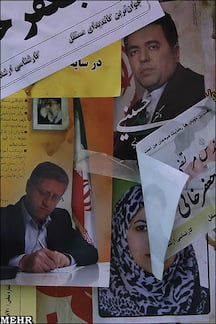
CampaignPosters5Mehr.jpg

Early last year, the JMO was revived, except without Ahmadinejad’s supporters, because they rejected many who, in the aftermath of the 2009 election, were silent or failed to condemn Mir Hossein Mousavi and Mehdi Karroubi with sufficient vigor. The coalition was revived at the urging of Khamenei, Society of Militant Clergy of Tehran led by Mahdavi Kani, and Society of Teachers of Qom Seminary, led by Mohammad Yazdi. Up until a month ago, its leadership group was known as the 7+8 Committee — seven members acting as arbitrators and eight representing the various conservative and hardline groups. The JMO has candidates in every district in Iran, but its most important list is for Greater Tehran — the capital and three nearby towns, Shemiranat, Rey, and Eslamabad.

The list is headed by Gholam Ali Haddad Adel, father-in-law of Khamenei’s second son, Mojtaba, followed by Seyyed Mohammad Hassan Aboutorabi Fard, a deputy parliament speaker who effectively represents Majles Speaker Ali Larijani, who is a candidate from Qom. There are only four clerics in the list. The big loser is Jebheh Peyrovaan, which has only three candidates, Deputy Speaker Mohammad Reza Bahonar; Mohammad Nabi Habibi, secretary-general of the Islamic Coalition Party); and Badamchain, whereas before Ahmadinejad was elected president in 2005, the Islamic Coalition Party dominated the conservative and hardline faction.

The most important feature of the list is that it is dominated by Guard- and Basij-linked candidates: Zakani, Fadaei, Elias Naderan, Masoud Mir Kazemi, Esmail Kosari, Parviz Sarvari, Mojtaba Rahmandoost, Hossein Nejabat, Hossein Mozaffar, Ahmad Tavakkoli, and Mohammad Nabi Roodaki are all former Guard officers. Aboutorabi Fard and another cleric candidate, Mohammad Hassan Ebrahimi, have been active in the armed forces ever since the 1979 Revolution. Five women are among the 30 candidates, two of whom, Zohreh Elahian and Fatemeh Rahbar, are former Basij university students. Another candidate, Mehrdad Bazrpash, a former ally of Ahmadinejad, is also a former Basij militia member at Sharif University. Thus, 16 out of 30 are linked with the Guards and Basij. The JMO’s list in other cities and town is dominated even more strongly by Guard and Basij members. In effect, under the nominal leadership of Mahdavi Kani and Yazdi, the Revolutionary Guards are trying to dominate the Majles.

The Guard candidates in the Greater Tehran district have been heavily promoting Haddad Adel — see here, here, here, and here for four examples from just the past few days. Basij commander Brigadier General Mohammad Reza Naghdi, for instance, declared that it will bring dishonor to Khamenei if Haddad Adel does not receive the highest number of votes in Tehran. The Guards are thus making the elections in Tehran an indirect referendum on Khamenei.

The JPEE

The JPEE was formally founded on July 26, 2011, although speculation about its formation began much earlier. Morteza Agha Tehrani, who used to be the “morality teacher” of Ahmadinejad’s cabinet, is its secretary-general, while Ahmadinejad’s former Minister of Health Kamran Baqeri Lankarani is its spokesman. The main financial backer of the JPEE is Mahsouli. The JPEE claims that its members are the true Principlists. Although Mesbah Yazdi has declared that he is not the leader of the JPE, no one believes him. Other prominent JPEE members include Gholam Hossein Elham, currently Ahmadinejad’s adviser for legal affairs, and hardline clerics Hamid Rasaei and Ruhollah Hosseinian, the latter of whom has been accused of involvement in the infamous Chain Murders in the 1990s. Hassan Abbasi, who has presented himself as the leading theoretician among Iran’s hardliners, supports the group.

CampaignPosters2Mehr.jpg

The JPEE has been accused by many of having secret links with the “perverted group” — Rahim Mashaei and his inner circle; see, for example, here, here, here, and here. Motahari has warned, “If the JPEE takes control of the country, Iran will be destroyed. The views of the JPEE are very dangerous. It is a tool in the hands of Ahmadinejad and Rahim Mashaei.” Fadaei has said that 600 candidates of the “perverted group” were rejectedby the Guardian Council.

Quietly, Mesbah has set up many other organizations in order to spread his influence. The Haghani Seminary in Qom used to be his base of power, and many of its graduates have held important positions within the political system, including five out of six intelligence ministers after the Revolution. His other power bases include the Baqir ul-Uloom Cultural Foundation, the Imam Khomeini Educational and Research Organization and its alumni organization, the Office for Cultural Research, the Toloo Society, and the Ammar Cultural Headquarters. The magazine Parto Sokhan is published by Mesbah’s disciple Ghasem Ravanbakhsh. If the JPEE manages to win a significant number of Majles seats, Mesbah’s positions among the hardliners will be strengthened.

Like the JMO, the JPEE has supported candidates in every constituency in the country and has announced a list of 30 candidates for the Greater Tehran district. It includes six of the candidates on the JMO list: Haddad Adel, Mir Kazemi, Fatemeh Alia, Zohreh Tabibzadeh, Kosari, and Alireza Marandi. Other candidates include current hardline Majles deputies, Hosseinian, Rasaei, Mehdi Koochakzadeh, Bijan Nobaveh, and Esmail Kosari. The list, headed by Agha Tehrani, includes at least 12 Guard and Basij candidates and four women. The JPEE published an 80-page bulletin in which it strongly criticized the JMO. It has formed an affiliate group, Hamian-e Mardomi-e JPEE (People’s Supporters of the JPEE), for the express purpose of attacking the JMO.

The JEEE

The JEEE was founded almost a year ago and consists of nine small conservative groups that have supported Mohsen Rezaei for the past several years. Its secretary-general is cleric Yadollah Habibi, former head of the armed forces’ ideological and political directorate. It has announced candidates in at least 18 provinces, and is promoting a list of 30 candidates for the Greater Tehran district, some of whom are also backed by the JMO and JPEE. The list is headed by Aboutorabi Fard, and includes Motahari, Katouzian, former Higher Education Minister Hassan Ghafouri Fard, and Mohsen Rezaei’s brother Omidvar Rezaei. Like the JMO and JPEE list, the JEEE list also includes many former Guard officers. Interestingly, the Guardian Council rejected the qualifications of a clerical JEEE member, Seyyed Mahmoud Alavi, who holds a seat in the Assembly of Experts. How someone can be a member of the body responsible for appointing the Supreme Leader, but unqualified to be a Majles deputy is not clear.

The JMD

This group consists of opponents of Ahmadinejad, both current Majles deputies and others in the regime. In the initial screening of candidates by the Ministry of Interior, their qualifications were rejected, though they were subsequently restored later by the Guardian Council. Significantly overlapping with the JEEE, its list They include JMD leaders Motahari and Katouzian, other legislators such as Ghafouri Fard, Omidvar Rezaei, and Ali Abbaspour, and conservative labor activist Alireza Mahjoob. Aligning himself with the group, leading Ahmadinejad critic Ahmad Tavakoli said, “My spirit is with Sedaa-ye Mellat.” Though it attracted wide attention when it announced its formation, the group has not been able to build on its initial publicity and has remained a minor factor in the elections. It is supporting 16 candidates for the Greater Tehran district. The group has announcedthat although it opposes the Ahmadinejad administration, it will not form a coalition with those candidates who are nominally reformist.

Motahari has long been a controversial figure. At one time a radical conservative, he continuously attacked the reformists and former President Mohammad Khatami when he was in office. He has moderated his views over the years, becoming a strong critic of Ahmadinejad. Motahari has even implicitly rejected Velaayat-e Faghih, the doctrine of rule by the Islamic jurist by which Khamenei wields dictatorial power, saying, “Velaayat-e Faghih cannot violate freedom.”

CampaignPosters3Mehr.jpg

Other groups

There are over 230 political groups altogether, many of which exist only on paper or consist of a few like-minded friends and colleagues. Eighteen different groups are supported lists of candidates for Tehran. Although one is supposedly “reformist,” in fact all are composed of conservatives and hardliners. One of the better-known ones is the Coalition of Independent Candidates, which is supporting several otherwise unaligned candidates, as its name suggests, as well as candidates listed by other major groups. The Great Coalition of the Principlists was backing 30 Tehran candidates, but announced that it had dissolved itself because it did not want Mahdavi Kani and Yazdi to worry about the elections.

Turnout

What the extent of the turnout for the elections will be is anyone’s guess. Some analysts, including hardliners, predict a turnout of 15-17 percent of eligible voters in Tehran, though even that may be optimistic. The turnout in smaller cities, towns, and villages may be higher, as local political issues and demographic factors, including ethnic and family rivalries, play a relatively greater role.

To summarize, from the perspective of the universally accepted criteria for democratic elections, the upcoming Majles vote will be a sham. Despite this, due to the deepening fissures in the ranks of the conservatives and hardliners, and in particular between the supporters of Ahmadinejad and Khamenei, these elections are still important and will have a significant influence on political developments in Iran, at least between now and the next presidential election, which will take place in June 2013.


Source: pbs

Amnesty International: Iran publicly executed 4 times as many people in a year of crackdown

0


Iran put to death more than twice as many people in 2011 as it did the year before, Amnesty International said Monday in a new report. The rights group said that the rate of executions in public increased even more dramatically, in an apparent bid to suppress political dissent and promote a climate of fear among those who might defy harsh Iranian law.

“Casting a shadow over all those who fall foul of Iran’s unjust justice system is the mounting toll of people sentenced to death and executed,” said the 70-page report, released in the run-up to Iran’s parliamentary elections on March 2.

“There were around four times as many public executions in 2011 than in 2010, and hundreds of people are believed to have been sentenced to death in the past year,” it said. In Iran, prisoners are usually executed by hanging.

The report said the heightened pace of executions “may be a strategy to spread fear among the population and to deter protests. As the repression of dissenters widens, the risk of further death sentences and executions cannot be excluded.”

Amnesty’s report interprets the increase in public hangings, and an overall crackdown on dissent and freedom of the press — particularly Internet-based communication — as a harsh response to the public protests that erupted after President Mahmoud Ahmadinejad’s disputed 2009 re-election.

Calls left at the Iranian Mission to the United Nations seeking comment were not returned by Monday evening.

“Since the 2009 crackdown, the authorities have steadily cranked up repression in law and practice, and tightened their grip on the media,” Amnesty said in the report.

The fear even reaches overseas. Earlier this month, the BBC said family members of employees of its Persian language service — which is banned in Iran — had been subjected to harassment, including one who was arrested in January and held in solitary confinement in Tehran’s notorious Evin prison. Others had their passports confiscated.

“They have stopped public protests using articles of Iran’s Penal Code that make demonstrations, public debate and the formation of groups and associations deemed a threat to ‘national security’ punishable by long prison sentences or even death,” Amnesty said.

The report noted that Iran does not provide official statistics on their use of the death penalty, and said there is credible evidence that many people are put to death in secret.

Amnesty’s Iran specialist Elise Auerbach told The Associated Press that there were 50 officially acknowledged public executions in 2011, compared to 14 such executions in 2010.

“In a couple of photographs of hangings, I’ve seen little boys and girls watching executions,” Auerbach told the AP. “It’s degrading and demeaning.”

The total number of executions reported in Iranian state media, meanwhile, increased from 253 to 600. She said both figures were the minimum known, and stressed that “the true number was quite a bit higher.”

Among those on death row in Iran is a former U.S. Marine interpreter arrested while on a trip to visit his Iranian grandmothers.

Arizona-born Amir Mirzaei Hekmati was sentenced to death in January as a CIA spy, the first time an American citizen has been condemned in Iran since the 1979 Islamic Revolution, according to the International Campaign for Human Rights in Iran, a New York-based group.

Amnesty International’s report, and the United Nations, also pointed to Iran’s adoption of capital punishment for drug offenses beginning in 2011 as another factor behind the increase in executions.

“There was a noticeable increase in the application of the death penalty, including in public, since the beginning of 2011. The execution of political prisoners and juvenile offenders was also reported,” U.N. Secretary-General Ban Ki-moon said in a report to the General Assembly in September.

About 80 percent of the executions involved drug offenses, Auerbach told the AP. Some death penalty cases involved rapists and murderers, but she said the expanding use of capital punishment “desensitizes the public” and paves the way for wider use of the death penalty in politically motivated cases, or on religious grounds such as apostasy or “enmity against God.”

Last year, a report on the death penalty worldwide by Amnesty International found that China was the most prolific user of the death penalty, with executions believed to number in the thousands in 2010. Iran ranked second with 253. North Korea executed 60 people in 2010; Yemen executed at least 53; and the United States executed 46 prisoners that year.


Source: insideofiran

Rights group denounces surge of crackdown in Iran

0


Amnesty International says Iran’s crackdown on its opposition has surged in the week leading up to the parliamentary elections.

In a report published today, Tuesday February 28, the rights group indicates that the “wave of arrests has targeted a range of groups, including lawyers, students, journalists, political activists and their relatives, religious and ethnic minorities, filmmakers, and people with international connections, particularly to media.”

According to Amnesty International, the situation has become exacerbated as the Islamic Republic approaches the March 2 parliamentary elections.

Amnesty International especially refers to the clampdown on electronic media and “the harassment, arrest and imprisonment of human rights defenders.”

The rights group goes on to urge that the international community not to be distracted from Iran’s human rights situation by the country’s headline-grabbing nuclear disputes.

It also calls on the UN Human Rights Council to extend the mandate of Ahmad Shaheed, the Special Rapporteur on Iran.

Source: radiozamaneh

Iranian regime shuts down 3 websites

0


Access has been denied to the news websites Sarat News, Bak News and 598 from this morning for unknown reasons. According to reports, these websites were filtered on judicial orders. The heads of these three websites have to be present at the Culture and Media court on Sunday to be formally charged.


Source: freedomessenger

Iran’s Supreme Leader ‘orders Revolutionary Guards’ to guarantee election

0


Iran’s Supreme Leader has called on the Revolutionary Guards to ensure that his supporters emerge triumphant in this week’s parliamentary elections, according to opposition sources.

At a meeting called last week by Ayatollah Ali Khamenei, the Supreme Leader of Iran’s Islamic Revolution, the leaders of the Revolutionary Guards and the volunteer Basij militia were urged to use the same tactics employed during the controversial 2009 presidential election contest.

On that occasion widespread vote-rigging led to Iranian President Mahmoud Ahmadinejad being elected to serve a second four year term, a result that produced nationwide anti-government protests.

Mr Khamenei has since fallen out with Mr Ahmadinejad in a bitter dispute over the future role of the presidency in Iranian politics.

As a consequence Mr Khamenei is now urging the Revolutionary Guards to ensure his Conservative Front wins the majority of seats in Friday’s parliamentary seats at the expense of Mr Ahmadinejad’s supporters.

During the meeting, which was attended by Ali Larijani, the chairman of the Iranian parliament and a close ally of the Supreme Leader, Mr Khamenei repeatedly referred to the president’s followers as the “deviant movement”, and insisted that they take all necessary measures to prevent Mr Ahmadinejad’s followers from winning the elections.

According to Iranian opposition sources, Mr Khamenei warned that his supporters also needed to maintain a constant check on the activities of the leaders of Iran’s Green Movement, Mir Hossein Moussavi and Mehdi Kharroubi, who unsuccessfully stood against Mr Ahmadinejad in the 2009 presidential election.

Opposition activists claim Mr Khamenei told his supporters that they needed to be on their guard against the possibility that pro-democracy forces unleashed by the recent wave of Arab revolts could spread to Iran. “The regime is up to all its old tricks and is trying to rig the election,” said an Iranian activist.

Iran’s parliamentary elections are taking place against a backdrop of mounting international pressure over Iran’s controversial nuclear programme. Last week officials at the International Atomic Energy Agency in Vienna said Iran had failed to cooperate with a team of nuclear inspectors sent to Tehran to clear up questions about possible military aspects of its nuclear programme.

Mr Khamenei and his advisors believe this week’s parliamentary elections will provide the regime with greater legitimacy in its stand-off with the West over its nuclear programme, and for that reason they are anxious to ensure that there is both a high turn out for the elections and a comprehensive factory for the Conservative Front.

The Council of Guards, the body controlled by Mr Khamenei which is responsible for safe-guarding the principles of Iran’s Islamic Revolution, has already vetted the names of all those putting themselves forward for election to ensure that only regime loyalists are approved.

The Revolutionary Guards and Basij have now been tasked with making sure that Iranians only vote for those candidates who support Mr Khamenei, and not Mr Ahmadinejad.

But with the regime firmly controlling all aspects of the election campaign there are fears that many Iranians will simply boycott the election as a way of registering a protest vote. This includes the millions of Iranians who supporter Iran’s Green Movement, which has been brutally suppressed since the disputed 2009 election, with many of the movement’s leaders either being killed or imprisoned.

Source: telegraph