Home Blog Page 484

Thai police quiz three more Iranians over bomb plot

0


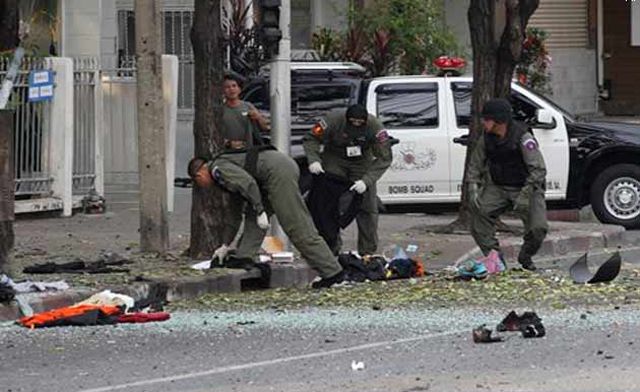
Thai police said on Monday they were questioning three more Iranians in connection with an alleged plot to kill Israeli diplomats in Bangkok.

“We have information that they may have links to the blasts,” Police Major General Piya Utayo told AFP, referring to a series of botched explosions that shook a residential district of the Thai capital on Feb. 14.

He said no charges had been laid against the trio. One was detained under immigration law for overstaying his visa.

“We are checking the other two people’s backgrounds,” Piya added.

According to Thai media, mobile telephone call logs showed that one of the suspects had been in regular contact with two Iranians now in custody, one of whom had his legs blown off as he hurled a bomb at police while fleeing.

The new suspects were picked up in a raid Sunday on two rooms in an apartment tower in eastern Bangkok.

Another suspect was detained earlier this month in Malaysia, while arrest warrants have been issued for two more Iranians believed to have left the country.

Israel has blamed Iran over the Bangkok blasts, as well as attacks on Israeli embassy staff in India and Georgia a day earlier.

Tehran has rejected accusations that it is behind a terror campaign against the Jewish state.

Thai police have said they believe that Israeli diplomats were the intended target of the botched plot but have yet to produce hard evidence.

Last week Tehran said it was ready to help identify those responsible.

Bangkok has been on alert since mid-January when police arrested a Lebanese man with alleged links to Hezbollah on suspicion he was planning an attack, following a U.S. warning that tourists might be targeted.

The safety scares dealt a new blow to the kingdom’s tourism industry, still recovering from the fallout of months of devastating floods last year, as well as several rounds of political unrest in recent years.

Source: alarabiya

Khamenei’s Son Sought Mousavi’s Help Out of Crisis


The pro-Green Movement news site, is reporting that Supreme Leader Ali Khamenei’s son, Mojtaba Khamenei met with Mir Hossein Mousavi and his wife, Dr. Zahra Rahnavard, in an undisclosed location where the couple have been under house arrest since last February 14. The meeting apparently took place about a month ago. Jaras says it delayed the publication of the news for two weeks in order to check its accuracy.

As noted earlier by Tehran Bureau, during a brief conversation the couple had with their three daughters not too long ago, Mousavi emphasized that he stands by his views, that “nothing has changed,” and that the authorities may no longer allow the family members occasional brief phone conversations. It now appears that Mousavi and Rahnavard were sending signals about the news that was to come.

According to the Jaras report, Mojtaba Khamenei, who many Iranians believe has been groomed by his father for succession, told Mousavi, “I have come here to consult with you.” Mousavi reportedly responded, “I have nothing to offer as advice.” At the end of the conversation, the younger Khamenei reportedly told Mousavi, “Giive up [your demands]. The country is in a very critical condition.”

It’s not clear whether Mojtaba Khamenei took the initiative for the meeting himself, or at the behest of his father. It also remains unclear what the younger Khamenei told Mousavi. But according to Jaras, Mousavi had a couple of demands: “First, I will directly respond to the Leader about what I hear [from you], if there is no camera and eavesdropping taking place and if no one else attends our meeting. Second, [the government] should give me the opportunity to speak to the nation through a live television broadcast.” It was after this meeting that the phone conversation between Mousavi, Rahnavard, and their daughters took place.

Mousavi has had virtually no contact with the outside world for over a year. His response appears to be a demand to meet with the Supreme Leader face to face, in order to prevent any abuse of the exchange that might take place. Mousavi’s demand to speak to the nation in a live broadcast would give him an important platform to explain his views and also represent a public acknowledgment by the ruling hardline factions that he is key to helping pull the country out of its post-2009 crisis.

It is surely significant to the Iranian people that he and his wife are unwilling to negotiate even though they remain in captivity. As he emphasized to his daughters, he remains steadfast in his views, and signaling anything different about his position is false.


Source: pbs

Detained Iranian blogger’s fate remains unknown

0


The fate of Nama Jafari, the editor of the 35anj website, remains unknown more than 10 days after his arrest, according to reports from Iran.

Jafari, an Iranian poet and blogger, was arrested by security forces in Tehran on February 14.

Jafari had compiled a series of protest poems and other writings about the post-election protests of 2009 under the title “Gathering at the Solitary Cell.” He is also reportedly suffering from cancer and is in need of immediate medical treatment.

The opposition group the Coordination Council for the Green Path of Hope had issued a rally call to Iranians to join a silent march on February 14, marking last year’s protests on this day and also one year of house arrest for Iranian opposition leaders MirHosein Mousavi, Zahra Rahnavard and Mehdi Karroubi.

Security forces lined the streets of Tehran and other major cities on February 14, trying to prevent people from joining the demonstrations. Despite all efforts, some people managed to join scattered gatherings, and an unknown number of protesters were arrested.

A report indicates that 10 of the detainees from that day have begun a hunger strike to protest their situation in prison.

Source: radiozamaneh

Regime: Burning White House will compensate for burning of Quran

0


An Iranian commander has added his voice to the condemnation of the U.S. military actions in burning copies of the Quran in Afghanistan.
Brigadier General Mohammad Reza Naqdi, Commander of Iran’s Basij force, said “Nothing but burning the White House can relieve the wound of us, the Muslims, caused by the Burning of Quran in the US. Their apology can be accepted only by hanging their commanders; hanging their commanders means an apology” FARS Iranian news agency reported. The commander attributed the real reason for the burning of the Quran to “the heavy slap it (U.S.) has been given by Islam.” He also stressed that U.S. apologies cannot be accepted by Muslims as it makes so many mistakes. According to Alarabiya, Friday’s prayer leader in Tehran, Ayatollah Ahmad Khatami, told worshippers the U.S. burning of the Quran was intentional. He said “Based on reports by reporters, this was an intentional move prompted by the hatred of American statement for Islam. I announced with a loud voice, the world should know that the U.S. administration is hostile to Islam; Americans’ insult was not a mistake, rather deliberately because Washington rulers are hostile to Islam.” Gen. John Allen, commander of ISAF and U.S. forces in Afghanistan, has called for calm in the midst of violent protests against the U.S. military, as he urged “Now is not the time for vengeance.” CNN reported he called on troops to “show the Afghan people that as bad as that act was at Bagram, it was unintentional, and Americans and ISAF soldiers do not stand for this. We stand for something greater than that.” The words of the two influential Iranians, the military commander Naqdi and Ayatollah Khatami, adds to the rhetoric that constantly emanates from Iran in calls for death to Americans, often amounting to little more than an expected formula position.

Warnings to Security and Intelligence Leaders: Concerns Over Differences in the Armed Forces

0


Bahram Rafiei

As differences and dissatisfaction among members of Iran’s armed services have been growing, particularly after such events as the disputed tenth presidential elections in 2009, new international sanctions and serious military threats, the head of Iran’s military justice organization expressed his concerns on this and issued a warning.

Speaking at a seminar on “Security and Intelligence” organized by the judiciary of the armed forces, cleric Mohammad-Kazem Bahrami said that “differences and division” were  among the most serious security threats. “Espionage and overthrow are not the only issues that hurt the security of the country. Differences most certainly have an even more destructive impact,” he said.

He supported his argument by presenting instances and quotes from the Quran and imam Ali, the highest Shia leader.

Bahrami’s name was recently added to EU’s sanctions list on people who have violated human rights. While saying that “interference in the personal and family affairs of individuals, including other issues unrelated to work, are not justified, all the concerns and actions of a security officer should be to protect the organization and the staff to prevent any harm to them.”

These remarks come as various reports have surfaced during the last two years, indicating divisions and differences among the armed forces of Iran, particularly after the 2009 presidential elections and the numerous protests over its announced results. These differences have been growing and are more visible because of other major events such as the differences between Mahmoud Ahmadinejad and ayatollah Ali Khamenei, newer international sanctions against Iran, and the public military threats against the country.

But even under circumstances in which differences among the armed forces are not expressly published because of specific security directives and institutional structures, some senior authorities inside the Revolutionary Guards (IRGC), the Basij, the police and the military have implicitly confirmed the existence of growing differences among security and military services.

Mohammad Ali Jaafari, the commander in chief of the IRGC for example in July/August 2010 confirmed the existence of support for Mir-Hossein Mousavi and the Green Movement in his force and their displeasure of the IRGC’s measures in 2009. He specifically said that the IRGC had made efforts to “convince” these critics and added, “Many of the ambiguities (meaning differences) have been resolved and they have become convinced that the events were wrong. This is more important than physically confronting them or eliminating them.” A year after that, conservative cleric ayatollah Mohammad Taghi Mesbah Yazdi, pounced on a group of IRGC commanders and authorities and said, “What is the problem with you for having contacts with these swindlers who are outside and for consulting with them, even as you claim to do so to understand them?”

In October/November too, cleric Mohammad Hajizadeh, the representative of the supreme leader in the Bushehr province IRGC force said at a commencement ceremony in Bushehr, “Many of our valuable forces were distracted and derailed because of recent deviations and the 2009 sedition events because they had not acquired sufficient  wisdom and were thus lost.”

These differences are not confined to the IRGC and exist in the Basij force as well. In September/October of 2010 Hossein Hamedani, the then commander of Tehran’s  Mohammad Rasool Allah IRGC force told Khabar Online website, “Some security officers at a time had wavered in confronting the sedition of 2009 (this is the term Iranian officials use for the protests against the disputed 2009 presidential elections), or they acted badly and presented a bad image of the Basij.” In the same talk, Hamedani preached about divine purpose for power.

Another force that played a role in the violent and brutal crackdown of post-election protestors was the police. The commander of the police, Ismail Ahmadi-Moghadam, also spoke of this issue. Speaking to his forces on October 2, 2010 he alluded to disorderly conduct of some of his officers in following the orders of their commanders regarding clashing with the protestors. “Police officers should not be confused about who is right on this issue,” he said, a reference to the protests and the role of the police in confronting it.

The armed forces of Iran too have had similar issues. General Attaollah Salehi, the supreme commander on December 5, 2011 said, “When we went to the barracks and saw photographs of the leaders of the leaders of the sedition in some quarters, we did not tell them to tear up the photos but told their commanders to change their sentiments so that the soldiers themselves would tear up the photos.”

These differences have in some situations resulted in dismissals from the force. On February 15, 2012, minister of defense Ahmad Vahidi who is also a senior commander of the IRGC spoke of the silence of some leaders of Jihad over the actions of the seditionists and criticized them.

Ali Shamkhani, another former IRGC commander who was the minister of defense in Mohammad Khatami’s presidency and who is the current president of the Defense Policy Research Center also spoke about “dismissal because of criticism” and while referencing the criticism of some former commanders over the conditions in the country issued a warning saying, “How could someone who was a supporter of the revolution not support it today?” He also criticized the propaganda against the former leaders of the Jihad and martyrdom.

Another indication that some IRGC commanders were sympathetic to the cause of the Green Movement is the fact that while ayatollah Khamenei had always sent condolence messages to the family of those commanders who died during the last two years, there are at least four instances when such condolences were not sent to the families of commanders who had died, while others such as Ali Akbar Hashemi Rafsanjani, who has publicly criticized the government’s actions against the 2009-2010 protestors, did send them his condolences.

Source: roozonline

Senior cleric decries “damaged” state of Islamic Republic

0


Ayatollah Dastgheib, the Iranian senior cleric and a member of the Assembly of Experts, says: “The essence of the regime is now under question; the people have distanced themselves from religion and God and are now completely pessimistic about it.”

In a letter on his website, dated February 26 and addressed to the members of the Assembly of Experts, Ayatollah Dastgheib writes: “Before the elections of 2005, there were no critical issues and no one’s rights had been openly violated, but after the 2005 elections, because of the mismanagement and the rule of an unprofessional group, the system is now damaged.”

In 2005, Mahmoud Ahmadinejad took the helm at the presidency for the first time.

Dastgheib is also critical of the Assembly of Experts, saying: “Currently, a number of the assembly’s members are not approved of by the senior members of the clergy and they have merely entered the Assembly of Experts through political and ideological lobbies, and Sources of Emulation and top members of the clergy will never approve of them. Similarly they won’t approve of the system as they will not approve the violation of Islamic laws.”

The Assembly of Experts is a government body in the Islamic Republic with representatives from various parts of the country. The body is charged with overseeing the actions of the Supreme Leader and establishing that he is worthy of his position at the helm of the country.

Dastgheib writes, however, that any assembly members who make the slightest criticism against the leader are pushed aside. He added that all the top bodies have lost their independence, and everything has been passed on to the Revolutionary Guards, who now interfere in every affair.

The opposition has been particularly critical of interference by the Revolutionary Guards Corps in political matters, especially in recent years.

Ayatollah Dastgheib maintains that the assembly must continue to closely scrutinize every detail of the Supreme Leader’s actions, and any claim otherwise would indicate “a lack of expertise in Islamic laws… logic and God’s commandments.”

Recently, clergy member Abbas Nabavi announced that Ayatollah Khamenei, Iran’s Supreme Leader, has forbidden the Assembly of Experts from interfering in the details of his actions.

Ayatollah Dastgheib also points to reports of “coerced confessions” from detainees and “the intimidation of families of detainees” as well as “a lack of adherence to the letter of the constitution,” stating: “If such things are happening in the country, we can no longer call it an Islamic country, and if it is not Islamic, then an Assembly of Experts is meaningless, and the statements of its members are worthless.”

Ayatollah Dastgheib has been severely critical of the government crackdown on protesters over the past two and a half years.

Source: insideofiran

Iran: There Are ‘Secret Weapons Yet Unknown to the West’

0

Next Attack Will Be Much More Devastating Than Terror Attacks in India and Bangkok, Iran Warns A Fars News Agency analysis said Saturday that if the U.S. is drawn in militarily, Iran will counterattack against U.S. bases in the region and interests worldwide. Fars News Agency, a media outlet of the Revolutionary Guards of Iran, has the imprimatur of the Iranian government.

The analysis, titled “The Secret War Against Iran’s Nuclear Program Will No Longer Be Unanswered,” quotes the Islamic regime’s supreme leader, Khamenei, who said in his Iranian New Year message last week that while Iran does not want a nuclear bomb, any attack on Iranian nuclear sites will spark the same level of force against the attacking country.  That statement is in line with what Iran’s defense minister, Ahmad Vahidi, said recently — that Iran has “secret weapons yet unknown to the West that will be used in response to any attack on Iran.” Vahidi is on Interpol’s most-wanted list for the Jewish community center bombing in Buenos Aires in 1994 that killed 85 people and injured hundreds more.

Source: insideofiran

Protesting student at Yasouj University, Daruish Jalali detained

0


This university student had sewn his lips and shackled himself to the university gates in protest when security agents arrested him and transferred him to an unknown location.

According to a report by Jaras website, Dariush Jalali, a materials engineering university student, staged a protest by sewing his lips and shackling himself to the university gates. Security agents violently arrested him and beat him up before taking him to an undisclosed location.

Jalali had been arrested last year during 24 Bahman protests and was held behind bars for 3 months. Since his release, security agents at the university harassed him and placed this student under consistent threats, maltreatment and abuse. Jalali was so abused he saw no other alternative but to show his protest by sewing his lips and shackling himself to the university gates.

There is still no news about this student’s condition or whereabouts.

Source: rahana

Pressure on Sahameddin Bourghani to make a televised confession

0


According to Jaras, journalist Sahameddin Bourghani was the previous director of Iranian Diplomacy website, which has no affiliation with the BBC network. He has been subjected to intense pressures due to his friendship with a number of journalists who had worked for publications within the country and later worked with BBC. Bourghani has been badgered and harassed in order to obtain a false confession against his old friends, which he has refused to do.

According to this report, the interrogating agents have lied to Bourghani and deceived him by asserting he would be released, then claiming his wife and friends had granted interviews to BBC about his arrest.

This prisoner’s grandfather is the father of Ahmad Bourghani and martyr Amir Bourghani. After going to Evin prison to visit his grandson, he was hospitalized due to the mental duress he was subject to and having to go up the multitude of stairs leading to the prison.

Sahameddin Bourghani was detained at his home and transferred to Evin prison on January 15, 2012. During his arrest, security agents raided and ransacked his home before escorting him away to prison. He is being held in Ward 2A of Evin prison which is under the supervision of the Revolutionary Guards.

Appellate court upheld 3-year prison sentence for Maryam Ghorbanifar

0


Tehran’s court of appeals issued ruling upholding the 3-year prison sentence for human rights activist Maryam Ghorbanifar.

On August 28, 2011, Judge Moghiseh presiding over Branch 28 of the Revolutionary Court handed down the 3-year prison sentence for blogger and women’s rights activist Maryam Ghorbanifar. The sentence of 3 years behind bars stemmed from the charges of “acting against national security” and “gathering and collusion against the regime.”

Maryam Ghorbanifar was detained on March 4, 2011 and transferred to ward 209 of Evin prison. She was kept in solitary confinement until March 28, 2011 and subjected to intense pressure during her interrogations before being released on bail.

Source: rahana