Play on top IRGC commander Borunesi to go on stage at City Theater Complex
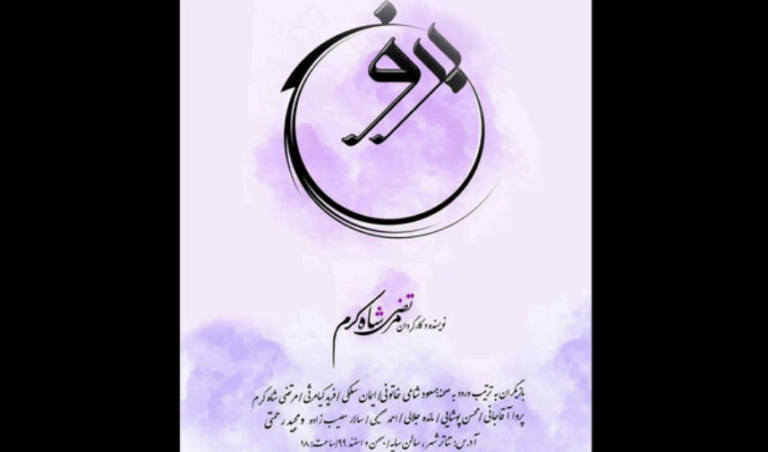
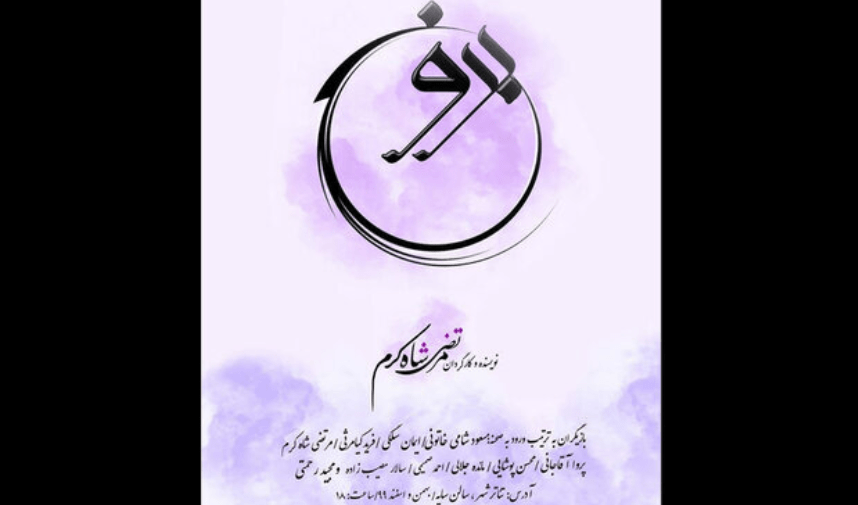
A play about the life story of Abdolhossein Borunesi, a senior commander of the Islamic Revolutionary Guard Corps, will go on stage at the Sayeh Hall of Tehran’s City Theater Complex on Thursday.
Brunei was martyred during the 1980-1988 Iran-Iraq war.
His military life as a soldier during the reign of Mohammad Reza Shah and his activities during the Islamic Revolution and post-revolution life will be shown in the play, which will be directed by Morteza Shahkaram.
A major part of the play will portray Borunesi as the commander of Javad ul-Aemah (AS) Brigade 18, an IRGC combat unit that took part in Operation Badr in March 1985. Brunei was martyred during the operation and his soldiers failed to return his remains. However, some of his personal effects, including his ID tag, were excavated 27 years after his death along with a skeleton in the area where the operation had been carried out. Mohsen Pushai, Masud Shami-Khatuni, Parva Aqajani, Farid Kiamarsi, Iman Solgi, Ahmad Samimi, Sala Mosayyebzadeh, Majid Rahmati, and Shahkaram himself are the members of the cast. The play is from a collection of plays on Iranian veterans martyred during the Iran-Iraq war, which was unveiled by the General Office for Dramatic Arts of the Ministry of Culture and Islamic Guidance at Tehran’s City Theater Complex in February 2020. The collection titled “The Bright Pen” contains four books, each of which is comprised of two plays. Book one contains “Or Not Being” by Kamran Shahlai and “All My Brothers” by Reza Goshtasb. The second book has “Heliborne” by Mohsen Azimi and “Season of Red Sapphire” by Neda Sabeti.
US Has ‘Urgent’ Responsibility To Ensure Iran Doesn’t Acquire Nuclear Weapon: Biden’s State Department Pick
The United States has an “urgent” responsibility to ensure that Iran does not acquire a nuclear weapon, said state secretary nominee Antony Blinken, adding that the upcoming Biden administration is “a long way” from executing its plan to return to the Iran nuclear deal.
At his confirmation hearing before the Senate Foreign Relations Committee, Blinken said: “An Iran with a nuclear weapon … would be an Iran that will be even more dangerous than it already is.”
“We are a long way from there,” said Antony Blinken, US President-elect Joe Biden’s choice for secretary of state, when asked about the next administration’s plan to return to the 2015 Iran nuclear deal.
Asserting that there was a need to include regional allies in any future nuclear talks, he said: “We have an urgent responsibility to do what we can.”
The United States has an “urgent” responsibility to ensure that Iran does not acquire a nuclear weapon, said state secretary nominee Antony Blinken, adding that the upcoming Biden administration is “a long way” from executing its plan to return to the Iran nuclear deal. At his confirmation hearing before the Senate Foreign Relations Committee, Blinken said: “An Iran with a nuclear weapon … would be an Iran that will be even more dangerous than it already is.” “We are a long way from there,” said Antony Blinken, US President-elect Joe Biden’s choice for secretary of state, when asked about the next administration’s plan to return to the 2015 Iran nuclear deal. Asserting that there was a need to include regional allies in any future nuclear talks, he said: “We have an urgent responsibility to do what we can.” Asserting that there was a need to include regional allies in any future nuclear talks, he said: “We have an urgent responsibility to do what we can.”
International Community Should Take Firm Action Against Iran’s Regime, as IRGC Unveils New Missiles
The Revolutionary Guards (IRGC) unveiled its new missiles and drones during its recent maneuver in central Iran on Friday. Unveiling ballistic missiles and suicide drones confirm the regime’s persistence on terrorism and how the mullahs waste Iran’s national wealth to achieve their malign goals.
This military exhibition once again debunks bogus claims of the regime and its apologists that Iran’s economic crisis is due to international sanctions.
The IRGC bragged about its military capabilities two weeks after the deadly drone attack on Aden airport, where at least 26 people died. Yemeni authorities accused Iran-backed Houthis of conducting this attack. Yemeni Prime Minister Maeen Abdul Malik Saeed said the regime’s experts plotted this attack.
Exporting terrorism and chaos abroad is part of the regime’s survival strategy. The regime has been directly conducting terrorist attacks or indirectly spreading terrorism by funding and arming terrorist proxy groups such as Lebanese Hezbollah and Yemen’s Houthis. Also, the regime has been propping up Bashar-al Assad’s dictatorship in Syria since 2011. While many regime officials, such as Foreign Minister Mohammad Javad Zarif, have tried to justify Tehran’s presence in Syria under the banner of “fighting ISIS,” the regime’s forces led by Qassem Soleimani, the eliminated chief of the IRGC Quds Force, went to Syria only to keep Assad in power.
The Revolutionary Guards (IRGC) unveiled its new missiles and drones during its recent maneuver in central Iran on Friday. Unveiling ballistic missiles and suicide drones confirm the regime’s persistence on terrorism and how the mullahs waste Iran’s national wealth to achieve their malign goals. The IRGC bragged about its military capabilities two weeks after the deadly drone attack on Aden airport, where at least 26 people died. Yemeni authorities accused Iran-backed Houthis of conducting this attack. Yemeni Prime Minister Maeen Abdul Malik Saeed said the regime’s experts plotted this attack. International Community International Community International Community
Islamic Revolution Guards Corps (IRGC) Commander Major General Hossein Salami said that the recent wargames staged by the Iranian Armed Forces were aimed at displaying the country’s deterrent power and dissuade hostile moves by enemies.
“These drills are an important part of the Iranian nation’s deterrence policy to not allow enemy make miscalculations,” General Salami told reporters in Tehran on Tuesday.
He added that the wargames give self-confidence and peace of mind to the Iranian nation and send this message to the enemies that the country is serious about defending its honor and is always ready for defense.
Elsewhere, General Salami referred to the recent incidents at the US Congress and said today the enemy has focused on protecting the Congress which indicates that the US administration has been rotten.
In relevant remarks on Monday, Chief of Staff of Iran’s Armed Forces Major General Mohammad Hossein Baqeri noted the United States’ weakness in sarcastic remarks, saying that the US that intended to overthrow the Islamic Republic is now in such turmoil that its Armed Forces have been put on alert for the new president’s inaugural ceremony.
“They wanted the Islamic Republic not to see the 40th anniversary of its revolution but the building of their own Congress came under siege.
Their officials voiced concern that their prestige is being spoiled before the eyes of the world people, and now the US Armed Forces are on alert in the society for the swearing-in ceremony of the new president,” General Baqeri said, addressing a ceremony in Tehran.
“We are at the peak (of power) today as enemies are collapsing,” he added.
General Baqeri also referred to the recent massive drills staged by the Iranian Armed Forces, saying that the country could hold the maneuvers in 3 days instead of 20 days which shows the Iranian forces’ high preparedness.
Human Rights Must Be Front and Center in Europe’s Iran Policy
Hamid Noury, a former Iranian regime official, has been incarcerated in Sweden since November 2019. He had traveled to Sweden for personal reasons but was arrested on charges of torture and crimes against humanity back in Iran.
Noury’s provisional incarceration term is renewed every month by a judge to allow the investigation into his past to take its course.
Hamid Noury is known in Iran for his role in the gruesome massacre of political prisoners in 1988 on the orders of Ruhollah Khomeini, Iran’s then-supreme leader. Based on a fatwa (religious decree) issued by Khomeini, at least 30,000 political prisoners who were already serving time on sentences announced years earlier were summarily executed. They faced show trials that last several minutes and were asked if they still supported a prominent opposition group. Many answered yes and were executed.
The interrogation sessions, referred to in Iran as “death commissions,” barely lasted more than a few minutes, and the prisoners overwhelmingly revealed their sympathy for the opposition movement.
Hamid Noury, a former Iranian regime official, has been incarcerated in Sweden since November 2019. He had traveled to Sweden for personal reasons but was arrested on charges of torture and crimes against humanity back in Iran. Noury’s provisional incarceration term is renewed every month by a judge to allow the investigation into his past to take its course. Hamid Noury is known in Iran for his role in the gruesome massacre of political prisoners in 1988 on the orders of Ruhollah Khomeini, Iran’s then-supreme leader. Based on a fatwa (religious decree) issued by Khomeini, at least 30,000 political prisoners who were already serving time on sentences announced years earlier were summarily executed. They faced show trials that last several minutes and were asked if they still supported a prominent opposition group. Many answered yes and were executed. Europe’s Iran Policy Europe’s Iran Policy Europe’s Iran Policy
The FBI is warning that an Iranian-linked cyber operation called “Enemies of the People” continues to threaten federal and state officials as well U.S. civilians.
When the FBI and the U.S. Cybersecurity and Infrastructure Security Agency issued their initial warning about the Enemies of the People site in December 2020, the agencies noted that the main site – enemiesofthepeople.org – was disabled. The latest alert, however, notes that the campaign is active again and using other methods to spread their messages.
“The Iranian cyber actors have sought to intimidate some of the officials with direct threats, including an image of an apparent text communication between the [Enemies of the People] actors and an unidentified individual in the United States purportedly supporting the operation,” according to the new FBI alert.
The Iranian-linked threat actors are sending threatening emails and text messages to American citizens that can contain personal information as well as photographs, the FBI reports.
The FBI is warning that an Iranian-linked cyber operation called “Enemies of the People” continues to threaten federal and state officials as well U.S. civilians. When the FBI and the U.S. Cybersecurity and Infrastructure Security Agency issued their initial warning about the Enemies of the People site in December 2020, the agencies noted that the main site – enemiesofthepeople.org – was disabled. The latest alert, however, notes that the campaign is active again and using other methods to spread their messages. “The Iranian cyber actors have sought to intimidate some of the officials with direct threats, including an image of an apparent text communication between the [Enemies of the People] actors and an unidentified individual in the United States purportedly supporting the operation,” according to the new FBI alert. The Iranian-linked threat actors are sending threatening emails and text messages to American citizens that can contain personal information as well as photographs, the FBI reports.
How the IRGC is gearing up for more control in Iran
Most executive institutions in Iran are somehow under the control and supervision of the Velayat-e Faqih, aka the Supreme Leader, Ali Khamenei.
However, town and village council elections are the only vote in Iran that are held without the direct supervision of the Guardian Council.
Therefore, efforts have been made to control and monitor these elections in various ways.
For example, on January 13, Ali Haddadi, a spokesman for the Iranian parliament’s internal affairs commission, said Parliament was considering a plan to employ the intelligence services of the IRGC in the approval process of town and village council candidates.
Ali Haddadi said the plan “aims to prevent councils from deviating, to monitor their performance and to form an efficient council”.
By implementing this plan, the IRGC can approve or reject the qualifications of candidates before the elections without any legal impediments.
There have been several instances where town and village council members have drawn the ire of various ruling establishments because of their remarks, or by simply taking a stance on policies or getting involved in matters beyond their jurisdiction.
For example, Mehdi Hajati, a member of the Shiraz City Council, spoke out against the arrest of two Baha’i citizens and criticized officials’ actions regarding the COVID-19 pandemic.
He was expelled from the council, under the pretext of “unjustified absence” from council meetings for two months and was arrested himself.
Another example is Mohammad Parham, a member of the Borujerd city council, who posted a video comparing the leaders of Iran and Finland last January.
He was arrested and charged for insulting the leadership. By implementing this new system of supervision on the election process of town and village councils, Khamenei can effectively eliminate those not affiliated with him through the IRGC.
Top IRGC top commander: Rain of ballistic missiles awaiting hostile warships
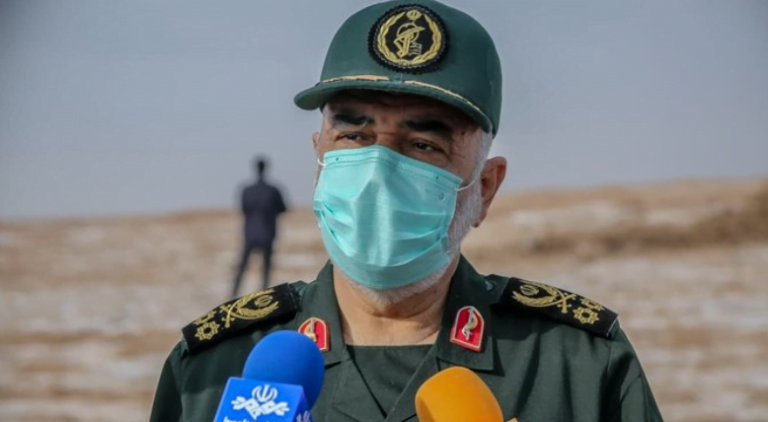
The commander of the Islamic Revolution Guards Corps (IRGC), Major General Hossein Salami, said on Saturday that targeting aircraft carriers and warships by long-range ballistic missiles is part of Iran’s defense strategy.
Speaking at the final stage of the Great Prophet 15 military drill on Saturday, Salami said, “One of our most important goals in defense policies and strategies is to reach the ability to hit enemy weaponry, including aircraft carriers and warships, using long-range ballistic missiles.
It is usual to hit moving targets in the sea by low-speed cruise missiles, but using long-range missiles is a great defense breakthrough for us because we can hit moving targets in the ocean from the heart of our land,” according to the Tasnim news agency.
The IRGC carried out the final stage of the drills on Saturday with strategic operations of long-range ballistic missiles that successfully hit the mock enemy’s vessels 1,800 kilometers away in the Northern Indian Ocean.
Armed Forces Chief of Staff Major General Mohammad Hossein Bagheri, Major General Salami, IRGC Aerospace Commander Brigadier General Amir Ali Hajizadeh, and a number of the top brass were present during the last stage of the drill.
After detection of the hypothetical enemy ships’ position by the IRGC Aerospace reconnaissance systems, long-range ballistic missiles of various classes were fired from Iran’s central deserts and successfully hit and destroyed all targets in the Northern Indian Ocean some 1,800 kilometers away.
The IRGC started the first phase of the drills on Friday morning, during which the ground-to-ground ballistic missiles were fired and offensive drone bomber operations were put into action in the public area of Iran’s central desert.
During this stage of the wargames, after the attack of the IRGC Aerospace’s offensive bomber drones from all sides to the missile shield of the hypothetical enemy.
A high-ranking IRGC commander says the combination of different capabilities with artificial intelligence has led to the creation of new military power for Iran.
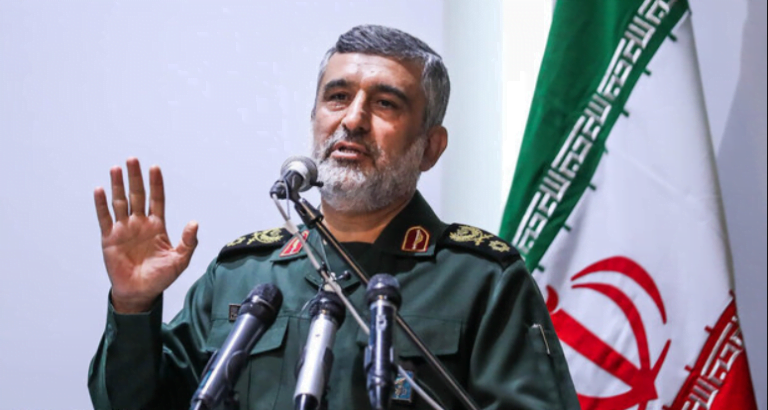
Speaking on the sideline of Payambar-e Azam 15 (The Great Prophet 15) military drill, that kicked off Friday in central Iranian deserts, IRGC Aerospace Force Commander Brigadier General Amirali Hajizadeh pointed to the achievements of the force in the drill.
The first stage of the drill was a simulator for attacking the enemy’s strengths and defensive lines, he said, adding that this stage was carried out using a combination of drones and missiles. First, drone units attacked the defensive systems of the hypothetical enemy, and then, ballistic missiles destroyed the main assets and sections of the enemy’s base, the Brigadier General said. The tactic used in this war game is the result of experiences earned from operations and drills carried out in previous years, he said. Missiles used in this stage of the drill are a new generation of ballistic missiles equipped with detachable warheads and low RCS, he noted, adding that the time span for preparing these missiles has been decreased by 90%. “These missiles are operational and can be launched in less than five minutes after being established.”Attacking the enemy from all directions and altitudes, hampering defense of the enemy, infiltrating into the air defense of the enemy using detachable warheads, and using equipment designed and produced by domestic experts are among features of this drill, he said, adding, “By a combination of these new capabilities with drone operation and using the artificial intelligence, a new power was born in IRGC.”Attacking the enemy from all directions and altitudes, hampering defense of the enemy, infiltrating into the air defense of the enemy using detachable warheads.
Iran to boost uranium enrichment to 20 percent ‘as soon as possible’
Iran announced on Saturday that it intends to enrich uranium up to 20 percent at its underground nuclear facility at Fordow, in accordance with a law passed in November by the Iranian parliament.
“We are like soldiers, and our fingers are on the triggers. The commander should command, and we shoot. We are ready for this and will produce [20 percent enriched uranium] as soon as possible,” said Atomic Energy Organization of Iran director Ali Akbar Salehi, according to the AP.
The Iranian legislation consists of nine articles, among which is the requirement to produce 120 kilograms (265 pounds) of 20 percent enriched uranium a year. The law also requires the activation of 1,000 IR-2M centrifuges in the underground section of the Natanz nuclear facility, the installation and activation by April 2021 of 1,000 advanced IR-6 centrifuges at Fordow and the immediate reactivation of the IR-40 Arak heavy-water reactor facility.
Iran announced on Saturday that it intends to enrich uranium up to 20 percent at its underground nuclear facility at Fordow, in accordance with a law passed in November by the Iranian parliament. “We are like soldiers, and our fingers are on the triggers. The commander should command, and we shoot. We are ready for this and will produce [20 percent enriched uranium] as soon as possible,” said Atomic Energy Organization of Iran director Ali Akbar Salehi, according to the AP. The Iranian legislation consists of nine articles, among which is the requirement to produce 120 kilograms (265 pounds) of 20 percent enriched uranium a year. The law also requires the activation of 1,000 IR-2M centrifuges in the underground section of the Natanz nuclear facility, the installation and activation by April 2021 of 1,000 advanced IR-6 centrifuges at Fordow and the immediate reactivation of the IR-40 Arak heavy-water reactor facility. Iran announced on Saturday that it intends to enrich uranium up to 20 percent at its underground nuclear facility at Fordow. boost uranium boost uranium boost uranium