

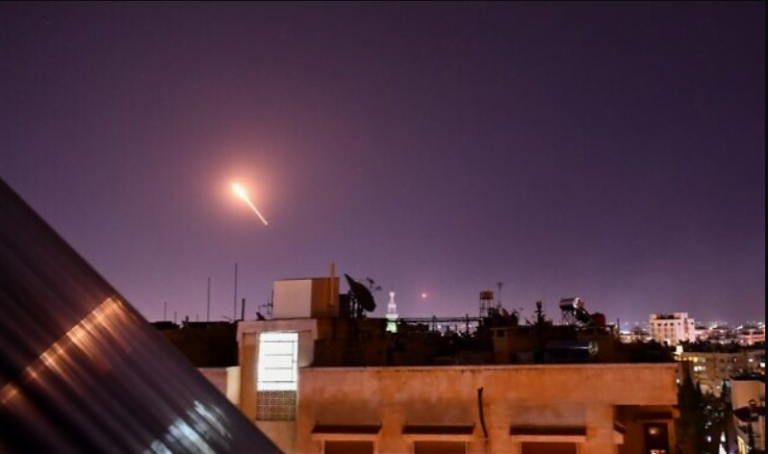

Why Is Iran Talking About Intercontinental Ballistic Missiles Now?
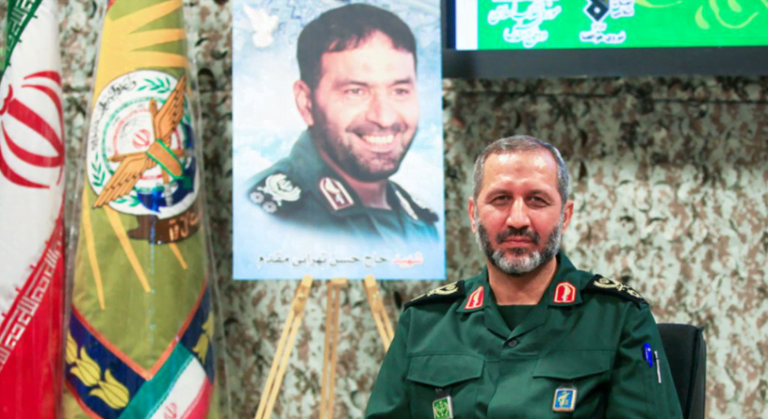

In recent years, barely a week has passed without a media appearance of Amirali Hajizadeh, the media-savvy commander of the IRGC Aerospace Force.
Charming, gregarious, and always wearing a smile, Hajizadeh doesn’t miss any opportunity to talk about drones, domestic car production, and the rapid growth of Iran’s missile force while carefully ignoring more inconvenient topics such as the downing of Flight 752.
It came as a bit of a surprise, then, when on November 11, his deputy Seyyed Majid Mousavi attended in his absence the presentation of two new missile-related books published on the anniversary of the martyrdom of Hassan Tehrani Moghaddam, the founder of Iran’s missile force.
Some immediately tied the presence of Musavi to swirling rumors about Hajizadeh’s health and alleged COVID-19 infection, as reported by the web site Event24.
However, over the course of the presser, Mousavi delivered remarks that might be more consequential than any health rumors related to IRGC top brass.
In what at first seemed like standard phrasing, Mousavi boasted about Iran now possessing a full range of missile capabilities including “medium-range, long-range and short-range.”
However, when his remarks were paraphrased by an IRIB news broadcast, another word appeared, “intercontinental.”
The same term was used in a Mehr News article describing the event. Closer examination of the original footage of Musavi’s remarks reveals that he indeed uttered another term after “short-range” that was subsequently edited out and replaced with a sneeze from the audience.
The mention of an Iranian intercontinental ballistic missile (ICBM) capability is a stunning reversal from Iran’s previous official line.
So far, Iran has committed to voluntarily restrict the range of its missiles to 2000km, far short of the 5500km that constitute the lower threshold of ICBM ranges.
Read the complete article at NewsNow.com
Also Read: Trump Sought Options for Attacking Iran to Stop Its Growing Nuclear Program
Trump Sought Options for Attacking Iran to Stop Its Growing Nuclear Program

Trump Sought Options for Attacking Iran to Stop Its Growing Nuclear Program
Trump Sought Options for Attacking Iran to Stop Its Growing Nuclear Program
President Trump asked senior advisers in an Oval Office meeting on Thursday whether he had options to take action against Iran’s main nuclear site in the coming weeks. The meeting occurred a day after international inspectors reported a significant increase in the country’s stockpile of nuclear material, four current and former U.S. officials said on Monday.
IRGC pounds terrorist positions across Iran’s northwestern borders
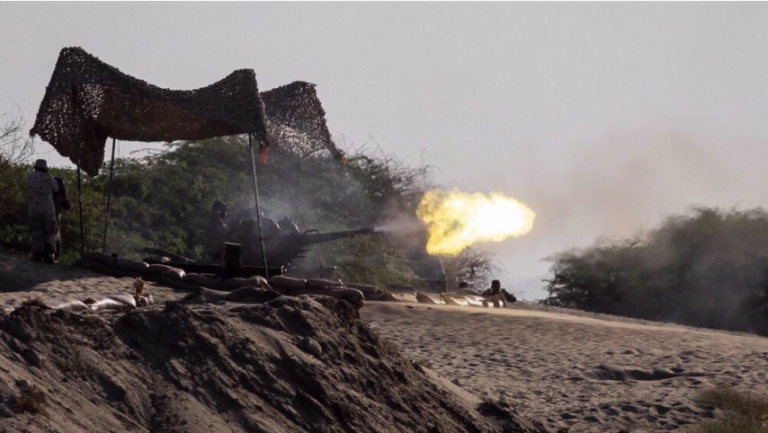

The Islamic Revolution Guards Corps (IRGC) announced on Saturday that it has targeted positions of terrorist groups across the country’s northwestern borders.
“The forces of the Guards’ Ground Force targeted this morning the positions of anti-Revolution terrorist groups across the country’s northwestern borders, and inflicted heavy losses on the anti-Revolution elements,” the statement read, according to Mashregh news.
“As it has repeatedly been declared, maintaining national security, peace and comfort of the Iranian nation, especially the people living in border provinces, is the red line of the country’s Armed Forces, especially the Guards’ Ground Force,” it added.
It came after three Iranian border guards were martyred and two others were injured on Friday during a clash with terrorists in Iran’s northwest region, according to a report by Iran’s police.
Read the complete article at NewsNow.com
Also Read: IRGC chief vows to avenge Soleimani killing ‘in the field’
The incident took place in the district of Targavar in West Azarbaijan Province, ILNA reported. According to the report, the attack also caused major losses to the anti-Islamic Republic elements.“With the dispatch of backup forces to the area and the border guards’ resistance as well as their courage and self-sacrifice, the attack by the terrorists was repelled and their penetration into the holy land of the Islamic Republic was prevented,” the report said. Due to its borders with Iraq and Turkey, Iran’s West Azarbaijan Province has been witnessing numerous clashes with elements of PJAK, which is closely affiliated to the PKK terrorist group. Forces of the Islamic Revolution Guards Corps (IRGC) regularly engage in clashes with terrorists attempting to infiltrate the Iranian borders in order to carry out acts of sabotage across the country. The IRGC forces recently destroyed a team of terrorists in the vicinity of the northwestern Iranian city of Maku in West Azarbaijan Province.
IRGC chief vows to avenge Soleimani killing ‘in the field’
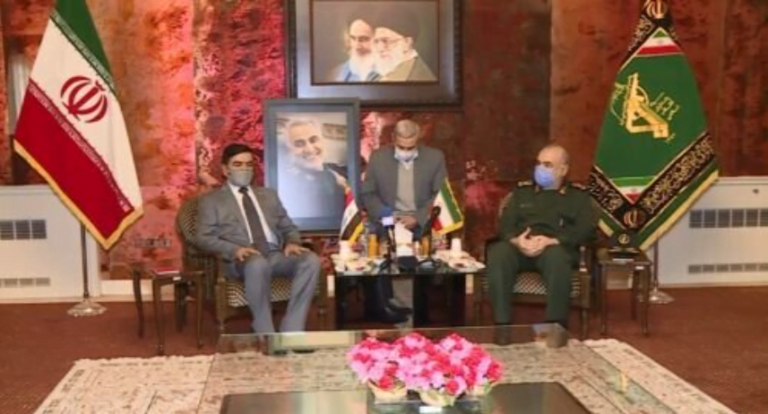

Chief of the Islamic Revolution Guards Corps (IRGC) Major General Hossein Salami has vowed to avenge the cold blood killing of Iran’s top anti-terror general Qassem Soleimani “in the field”.
“We will definitely avenge the blood of martyred Lieutenant General Haj Qassem Soleimani in the field,” Salami said in a meeting with Iraqi Minister of Defense Juma Inad Saadoun in Tehran on Sunday.
He said the revenge is not related to Iran’s legal proceedings of the killing through international bodies.
“We are certain that the children of great Iraq will also avenge the blood of their respected general, Abu Mahdi al-Muhandis,” he added.
On January 3, U.S. President Donald Trump ordered drone strikes that martyred General Soleimani, chief of the IRGC Quds Force, and al-Muhandis, the deputy commander of Iraq’s Popular Mobilization Units (PMU), near the Iraqi capital of Baghdad.
In the early hours of January 8, the IRGC attacked Ain al-Assad airbase in western Iraq, where U.S. forces were stationed, as part of its promised “tough revenge” for the U.S. terror attack. Iran has asserted that taking revenge for the assassination is not over.
Salami said the two martyrs played the most significant role in the defeat of Daesh (ISIS) and the defeat of plots hatched by the Zionists and the Americans in the region.
Read the complete article at NewsNow.com
Also Read: Israeli ambassador says Biden should not return to Iran nuclear deal
“Martyr Soleimani began the defeat of Daesh from Iraq,” he said, stressing that the Americans were envious of such grandeur and decided to kill him.The Iranian commander pointed to the expulsion of the Americans from Iraq, saying such a move, which is a demand of the Iraqi people, should be done through the Arab country’s parliament.He also said the preservation of Iraq’s integrity, unity, and territorial integrity.
Israeli ambassador says Biden should not return to Iran nuclear deal
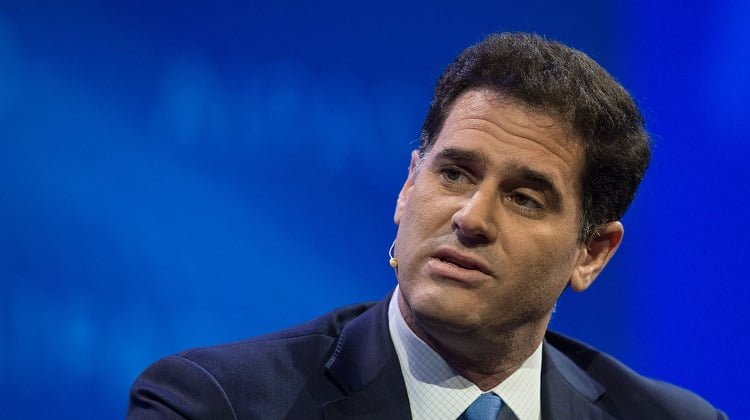
Israeli ambassador says Biden should not return to Iran nuclear deal
Israeli ambassador says Biden should not return to Iran nuclear deal
Israeli ambassador to Washington Ron Dermer said today the incoming Biden administration would be making a mistake if it returned to the 2015 nuclear deal with Iran.
Why it matters: President-elect Biden plans to re-enter the deal if Iran returns to compliance, but he will clearly face opposition from Israel. Dermer is Prime Minister Benjamin Netanyahu’s closest adviser and his comment reflects Netanyahu’s thinking.
Dermer spoke in a panel together with the ambassadors of the United Arab Emirates and Bahrain. The Bahraini ambassador, who spoke after Dermer, seemed to agree with him.
Why he’s saying: Dermer said the Biden administration needs to look at the reality in the Middle East and see how it can continue the process of getting Israel and the Arab world closer together instead of returning to the Iran deal.
- “Sit with your allies in the region. Talk to us in order to get to a common position on Iran. Not only on the nuclear issue but also about the Iranian aggression in the region. It will put the U.S. in a much better position to deal with Iran,” Dermer said.
Where things stand: Biden’s team believes President Trump’s withdrawal from the Iran deal was a catastrophic mistake, but recognizes that it won’t be easy to put the deal back together in a way that can last.
What’s next: At a press conference today, Netanyahu said he would speak with Biden soon. Asked about Trump’s claims that he won the election, Netanyahu said, “we have enough politics of our own here.”
Read more at: Axios
Iran Briefing | News Press Focus on Human Rights Violation by IRGC, Iran Human Rights
Intelligence Ministry Launches New Wave of Arrests to Fend off Iran Protests

Intelligence Ministry Launches New Wave of Arrests to Fend off Iran Protests
Intelligence Ministry Launches New Wave of Arrests to Fend off Iran Protests
The clerical regime’s Intelligence Ministry has launched a new wave of arrests in Iran to fend off the outbreak of a spate of protests. A number of political prisoners were re-arrested or summoned over the past week. One of those arrested is a young man suffering from blood cancer and detention would pose greater risk to his health.
IRGC artillery attacks positions of counter-revolutionary groups

Islamic Revolution Guards Corps (IRGC) on Saturday announced an artillery attacks on counter-revolutionary groups’ positions beyond the borders.
Public Relations Department of Hamzeh Seyyed Al-Shohada (AS) Headquarters of IRGC’s Ground Forces in a statement added that on Saturday morning.
Also Read: IRGC says Intelligence deputy dies of COVID-19
The IRGC ground forces targeted the positions of the counter-revolutionary terrorist groups on the other side of the northwestern borders of our country, inflicting heavy losses and casualties on them. The statement also warned that as it has been stated many times, national security and maintaining the peace and comfort of the Iranian nation, especially the people of the border provinces, is the red line of the country’s armed forces, especially the ground forces of the Islamic Revolutionary Guard Corps and does not know any considerations or boundaries in this regard. It will punish the terrorists in every hole they crawl. West Azerbaijan province shares a 967-kilometer border with three countries. Islamic Revolution Guards Corps (IRGC) on Saturday announced an artillery attack on counter-revolutionary groups’ positions beyond the borders. Public Relations Department of Hamzeh Seyyed Al-Shohada (AS) Headquarters of IRGC’s Ground Forces in a statement added that on Saturday morning, the IRGC ground forces targeted the positions of the counter-revolutionary terrorist groups on the other side of the northwestern borders of our country, inflicting heavy losses and casualties on them. The statement also warned that as it has been stated many times, national security and maintaining the peace and comfort of the Iranian nation, especially the people of the border provinces, is the red line of the country’s armed forces, especially the ground forces of the Islamic Revolutionary Guard Corps and does not know any considerations or boundaries in this regard.
IRGC says Intelligence deputy dies of COVID-19

Islamic Revolutionary Guard Corps Intelligence Organization (IRGC-IO) deputy Hamid Mirza’i died of COVID-19 on Oct. 31, according to a statement by the IRGC.
The IRGC praised his years of service in “various trenches of serving the sacred Islamic Republic system especially in intelligence fields.”
Mirza’s marks the loss of the most senior Guard Corps commander to the virus, according to open source. In March, Brigadier General Second Class Naser Sha’bani also died of COVID-19, but he reportedly already retired.
Read the complete article at NewsNow.com
Also Read: The Radicalization of the Shia Community in Italy: A Threat That Should Be Addressed