
Home Blog Page 173

Beyond Borders: the Expansionist Ideology of Iran’s Islamic Revolutionary Guard Corps

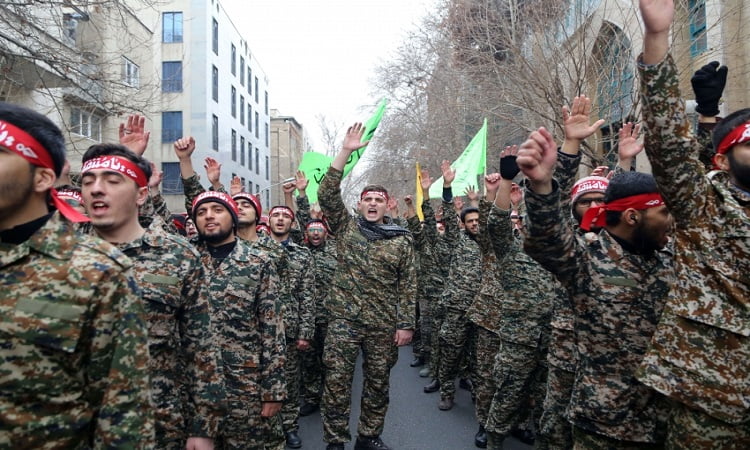
Unlike the Iranian army that protects Iran’s borders, the Islamic Revolutionary Guard Corps (IRGC) is mandated by Iran’s constitution to pursue “an ideological mission of jihad in God’s way; that is extending sovereignty of God’s law throughout the world.”
 

Beyond Borders: the Expansionist Ideology of Iran’s Islamic Revolutionary Guard Corps


Unlike the Iranian army that protects Iran’s borders, the Islamic Revolutionary Guard Corps (IRGC) is mandated by Iran’s constitution to pursue “an ideological mission of jihad in God’s way; that is extending sovereignty of God’s law throughout the world.”1 Since the inception of this paramilitary force in 1979, the Guard has emerged as the principal organisation driving the Iranian regime’s revolutionary Shia Islamist ideology, within and beyond the regime’s borders. Over these 40 years, it has been linked to terrorist attacks, hostage-takings, maritime piracy, political assassinations, human rights violations and the crushing of domestic dissent across Iran, most recently with the bloodshed on the Iranian streets in November 2019, leaving 1,500 people dead in less than two weeks.2  

Today, the IRGC remains Lebanese Hizbullah’s prime benefactor, with the Guard known to be providing arms, training and funding to sustain the group’s hostile presence against Israel and its grip on Lebanese society, and key operational assistance that has resulted in attacks on civilians stretching from Argentina, Bulgaria to Thailand. Modelled on its support for Hizbullah, the IRGC has prepared an estimated 200,000 fighters–from Lebanon, Syria, Iraq, Yemen, Pakistan and Afghanistan–to rise in support of a cause that is built on a perceived existential threat to the Shia Muslim identity and a hostility towards global powers and their allies.3  

There is no shortage of concern about the growing influence and operational capacity the IRGC now represents, although its goals are long standing and consistent. Drawing from internal IRGC documents used to train an incoming generation of Guardsmen, this report lays out the Guard’s core objectives and the key aspects of its well-established worldview, placing the IRGC’s current activities in the Middle East region into much-needed context. The findings of this report show that within the IRGC ranks alone, the Iranian regime has prepared and invested in an elaborate programme of indoctrination that first set and then defined its course of action, long before the Guard’s actions gained momentum as it has today. First published in 2011, these documents have been subsequently reprinted, and the latest, published between 2012 and 2016, form the basis of this report.


Read more …

Iran Briefing | News Press Focus on Human Rights Violation by IRGC, Iran Human Rights


IRGC Quds Force Chief: No Shift in Policy on Palestine

0

The new commander of the Quds Force of the Islamic Revolution Guards Corps (IRGC) has given an assurance that Iran’s support for the Palestinian resistance forces will continue unabated after the US assassination of his predecessor.IRGC Quds Force Chief

 
IRGC Quds Force Chief: No Shift in Policy on Palestine


In a telephone conversation with Secretary-General of the Palestinian Islamic Jihad movement Ziyad al-Nakhalah, IRGC Quds Force Commander Brigadier General Esmaeil Qa’ani reaffirmed the Islamic Republic’s commitment to supporting the Palestinian nation and cause.

There has been no change in the Islamic Republic of Iran’s policies towards the Palestinian resistance forces following the US assassination of late commander of IRGC Quds Force Lt. General Qassem Soleimani, Qa’ani told Nakhalah.

The commander further emphasized that Iran will keep supporting the Palestinian people in their battle against the hostile plots that have targeted their historic rights and in confrontation with the US-initiated deal of the century, al-Elam al-Harbi reported.

Brigadier General Qa’ani also noted that the American move to assassinate Lt. General Soleimani was a measure in preparing the ground for the announcement of deal of the century.

Nakhalah, for his part, expressed gratitude to Iran for supporting Palestine, noting that the Palestinian people and resistance groups will shatter the American deal of the century and thwart any plot seeking to deprive the Palestinians of their historic rights.

In a telephone conversation with Secretary-General of the Palestinian Islamic Jihad movement Ziyad al-Nakhalah, IRGC Quds Force Commander Brigadier General Esmaeil Qa’ani reaffirmed the Islamic Republic’s commitment to supporting the Palestinian nation and cause.In a telephone conversation with Secretary-General of the Palestinian Islamic Jihad movement Ziyad al-Nakhalah, IRGC Quds Force Commander Brigadier General Esmaeil Qa’ani reaffirmed the Islamic Republic’s commitment to supporting the Palestinian nation and cause.

Read more … 

Iran Briefing | News Press Focus on Human Rights Violation by IRGC, Iran Human Rights


Iran Approves Death Sentence for ‘CIA Spy’

Iran Approves Death Sentence for ‘CIA Spy’

Iran Approves Death Sentence for ‘CIA Spy’

“Amir Rahimpour, who was the CIA spy and received huge money to give part of the information of Iran’s nuclear program to the intelligence service of America, had already been sentenced to death and it was recently approved by the country’s Supreme National court.”

How Does the Iranian Revolutionary Guards (IRGC) Make Money?

0

“So, look at how the IRGC generates funds. The IRGC detains a spy like Jason Rezaian. The U.S. pleads for him to be released. We say: no, you have to pay for him.


How Does the Iranian Revolutionary Guards (IRGC) Make Money?


Our government gets paid $1.7 billion to hand over this spy. Thus, by detaining just one spy, the IRGC earns the equivalents of the $1-2 billion it was supposed to receive from the government budget.” (Hassan Abbasi, state-run website Asr Iran, 23 January 2020)

These were the sentences of the former IRGC commander Hassan Abbasi, who was responsible for the development of the Revolutionary Guards Navy and a member of the Central Council of IRGC’s Ammar base. A number of government media, including the Asr Iran website, cited Hassan Abbasi’s remarks on the manner in which the Iranian Revolutionary Guards were held hostage to earning money on 23 January 2020. A terrorist approach by the IRGC to threaten, blackmail and extort Western countries under the policy of appeasement of Western countries to advance the policy of exporting terrorism by the mullah’s regime.

But is this confession confined to Abbasi alone?

“… The other thing is that the Americans have to know that there is no military action against Iran. If the Americans want to have a bad eye on Iran, think of a military attack, be sure that we capture the first thousand Americans at the first week, and at that time to set them free they must pay billions of dollars, and of course, many of our economic problems may still be solved, so we recommend getting the idea out of the way. (Sabzali (Mohsen) Rezaei, former chief of the Revolutionary Guards, Iran’s state television, 13 July 2015)

The famous terrorist, Anis Nakash, one of the Lebanese mercenaries of the mullahs ‘regime and close associates of Mohsen Rezaee and Mohsen Rafiqdoust, who had spent ten years in French prisons for murder and assassination, also revealed a portion of the Revolutionary Guards’ ransom policy with the use of hostage tacking and said:


Read more …

Iran Briefing | News Press Focus on Human Rights Violation by IRGC, Iran Human Rights


Iran’s Regime Further Harasses Families of Downed Ukrainian Airliner Victims

0

Iran’s Regime Further Harasses Families of Downed Ukrainian Airliner Victims

Iran’s Regime Further Harasses Families of Downed Ukrainian Airliner Victims

Reports from Iran indicate that the Iranian regime’s officials have harassed the family members of the crashed Ukrainian airliner. The regime’s officials have prevented families from attending the funeral of their loved ones in Canada.

Post-Soleimani, Iran is a Major Cyber Threat to the U.S., Europe, and the Middle East

0

Civil unrest in Iran has been mounting for the past several months. Sparked by an increase in fuel prices on November 15, 2019, demonstrations grew into nationwide anti-government protests. The regime’s response to protestors was brutally violent. The United Nations reported that at least 208 people were killed, including 12 children.Post-Soleimani

Post-Soleimani, Iran is a Major Cyber Threat to the U.S., Europe, and the Middle East


Additionally, at least 7,000 protesters have been arrested. Amidst the crackdown, the Iranian government cut off internet access for almost a week, probably in an attempt to prevent the global dissemination of information and videos of the civilian protests and (or) the human rights abuse by the government. This may indicate the degree to which the Iranian government was in a panic by deciding to shut down the internet and its access for its people. However, with complete disregard for its own economic slowdown, the head of Iran’s Islamic Revolutionary Guard Corps threatened the U.S. and its allies, including Middle Eastern nations, while addressing a demonstration denouncing the anti-government protests that took place in November 2019. However, anti-government protests were further gained further traction after Iran shot down “mistakenly” a Ukrainian passenger jet, killing all on board.

In general, setting aside the Islamic Republic’s nuclear ambitions, the Iranian threat have always been present to the U.S., EU and, the majority of Arab Middle Eastern states, especially with the Iranian involvement and proxy roles that it orchestrated in Syria, Yemen, Lebanon, and Iraq. However, amid the civil unrest that Iran experienced recently, the Iranian threat has been getting more imminent. The recent U.S. targeted operation that eliminated General Qasem Soleimani and Abu Mahdi al-Muhandis can be viewed as a strategic countermeasure to the rising Iranian threat or as a deterrence against further Iranian aggression. Soleimani was considered to be Iran’s most powerful military general and was the leading commander of the Quds force, the Islamic Revolutionary Guard Corps (IRGC) unit responsible for extraterritorial operations.


Read more …

Iran Briefing | News Press Focus on Human Rights Violation by IRGC, Iran Human Rights


Iran Prepared To Defeat ‘Deal Of Century’, Qods Force Commander Tells Gaza Leaders

0

Iran Prepared To Defeat ‘Deal Of Century’, Qods Force Commander Tells Gaza Leaders

Iran Prepared To Defeat ‘Deal Of Century’, Qods Force Commander Tells Gaza Leaders

The new commander of Iran’s Qods Force has told HAMAS and Islamic Jihad leaders that “The Islamic Republic is prepared to defeat President Donald Trump’s latest proposal to solve the Israeli-Palestinian issue, Iranian agencies reported on Sunday February 2.

IRGC Commander Responds To Threats Against New Qods Force Chief: ‘No One Will Be Safe!’

0

The commander of Iran’s Revolutionary Guard, IRGC, General Hossein Salami, has responded with a counter-threat to U.S. Special Representative for Iran Brian Hook who said if Iran’s new Qods (Quds) Force Commander follows the same path of killing Americans, he will face the fate of his predecessor.


IRGC Commander Responds To Threats Against New Qods Force Chief: 'No One Will Be Safe!'
IRGC Commander Responds To Threats Against New Qods Force Chief: ‘No One Will Be Safe!’


Former Qods Force Commander Qassem Soleimani, was killed in a U.S. drone attack in Baghdad on January 3 and subsequently, Brigadier General Esmail Qaani has been appointed as his successor.

Salami said in a 27 January interview with the IRGC’s Sepah News website, “Those who have threatened our commanders with assassination, will have to regret what they said, if they remain alive.”

Salami further warned: “Let U.S., the Israelis and others know that none of their commanders will be safe if they threaten Iranian commanders to assassination.”

He said “Our enemies have seen part of the consequences of the assassination of General Soleimani and have realized that they will have to face constant pounding responses if they do such moves once again.”

Salami said that Iran’s response will be “different from the past” and will come “in a larger scale,” adding that “They will face a new situation they cannot control. So, we warn them to withdraw” from this stance.

He said the reason why Americans make such threats is that they find themselves incapable in other arenas. “They resort to assassination when they fail in other areas. For instance, when they failed in their attempts to deprive Iran from nuclear technology, they assassinated our nuclear scientists,” Sepah News quoted him as saying.

Hook made his comment in a 23 January interview with London-based Asharq Al-Awsat ​ on the sidelines of Davos Conference. The interview was published on 25 January.


Read more …

Iran Briefing | News Press Focus on Human Rights Violation by IRGC, Iran Human Rights

After Soleimani Strike, Iran-Backed Militias Threaten Iraq’s Stability

0

Iraq’s “Popular Mobilization Forces” (PMFs), or Hashd al-Sha’abi, were thrust onto the world stage this month, when the United States launched a series of strikes against Kata’ib Hezbollah, a militia group that operates under the Hashd al-Sha’abi umbrella organization, prompting a retaliatory storming of the U.S. Embassy in Baghdad.Soleimani Strike


After Soleimani Strike, Iran-Backed Militias Threaten Iraq’s Stability


Just days later, a further U.S. strike killed Iranian Quds Force General Qassem Soleimani, along with Kata’ib Hezbollah commander Abu Mahdi al-Muhandis. Iran responded with a barrage of missiles against U.S. forces in Iraq, while Shi’ite militia groups around the region issued threats against the United States and allies.

All of this has played out in the context of increasing protest movements and unrest in both Iraq and in Iran against their respective governments. But the boiling over of Iran’s shadow war with the United States has served to invigorate a counter-protest backlash in support of Iranian interests. Both countries are now increasingly volatile, and in Iraq, clashes between groups of protesters and with security forces are darkly reminiscent of the buildup to previous rounds of sectarian unrest. And another rocket attack on the U.S. Embassy in Baghdad on Jan. 26, this time resulting in injury, illustrates the persistent threat to the U.S. presence in Iraq as well.

Observers, policymakers, and Iraqis should rightly be wondering what might happen next. Regardless of how the situation unfolds, the Hashd al-Sha’abi militias are playing a key role in events on the ground and will greatly influence Iraq’s future. There is a real risk that Iran-backed militias are now driving Iraq back towards conflict. And the power of these problematic armed groups is greatly enhanced by their legal status as organs of the Iraqi state, a result of legislation passed in 2016. This legal status must be reviewed if Iraq is to maintain stability and avoid becoming an Iranian client state.

What is the Hashd al-Sha’abi? 

In short, the Hashd al-Sha’abi is a coalition of Iraqi militia groups operating in Iraq and (more controversially) Syria. The militias formed in 2014 to counter the Islamic State (ISIS) after it routed the regular Iraqi army in northern Iraq. The militia groups quickly became a key pillar of the counter-ISIS forces, growing in popularity and political power, and today wielding significant political influence.


Read more …

Iran Briefing | News Press Focus on Human Rights Violation by IRGC, Iran Human Rights


Iran is experiencing the fatal symptoms of a decaying regime

0

Amid an unprecedented crisis after the downfall of the Ukrainian airliner, Iran’s supreme leader Ayatollah Ali Khamenei performed Friday prayers on January 17 by himself, for the first time in eight years.Iran


Iran is experiencing the fatal symptoms of a decaying regime


Jahan-e San’at, one of the newspapers founded by the regime, described Khamenei’s presence as:

“An attempt to psychologically rebuild the society,” adding “There was a high level of stress among people (…); mental rehabilitation was the leader’s main goal”.

However, the implicit meaning of this speech is the rebuilding of the disintegrating moral of the regime’s forces.

“Today, trust between the government and the people has reached its lowest point. If such an unprecedented event (regarding the shot down of the Ukrainian plane) had occurred anywhere else in the world, there would be many officers detained, while others of high rank would have already resigned from their positions”, published the official paper Arman, on January 18th.

Incredibly, forty minutes after his Friday prayer’s speech, Khamenei referred to this enormous tragedy of international interest just as “the little issue” that shook the whole world. He did not apologize for commanding the target of the Ukrainian flight with two missiles, which resulted in the death of 176 passengers and crew. Nor did he assume any responsibility for this “human error”.

With a regime out of cash, uprisings against the Rouhani party are fated

Instead, he praised the Islamic Revolutionary Guard Corps (IRGC) commanders for “explaining to the people how the things went and telling the truth”. Regarding the performance of the forces under his command, he accused the “enemy” of “challenging the IRGC” by addressing this issue, when the IRGC’s main responsibility is to maintain Iran’s religious fascism.

The reason why the supreme leader does not mention those responsible for shooting the plane down is the extreme weakness and vulnerability of the regime. There is no room to dismiss or publicly reprimand a senior IRGC officer. The Iranian religious dictatorship is so insecure that it could not even consider this under the fear that any demonstration of weakness would end up increasing the bravery of the young people. Encouraging the popular opposition.


Read more …

Iran Briefing | News Press Focus on Human Rights Violation by IRGC, Iran Human Rights