It Is Immoral and Illogical to Blame the US for Iranian Aggression
It Is Immoral and Illogical to Blame the US for Iranian Aggression
Many critics of the Trump administration have made the argument that the U.S. decision to remove itself from the Joint Comprehensive Plan Of Action (JCPOA) and to reimpose sanctions on Iran has unnecessarily provoked Iran.
“A nasty, brutal fight”: what a US-Iran war would look like
The bottom line: It’d be hell on earth.
A deadly opening attack. Nearly untraceable, ruthless proxies spreading chaos on multiple continents. Costly miscalculations. And thousands — perhaps hundreds of thousands — killed in a conflict that would dwarf the war in Iraq.
Welcome to the US-Iran war, which has the potential to be one of the worst conflicts in history.
Washington and Tehran remain locked in a months-long standoff with no end in sight. The US has imposed crushing sanctions on Iran’s economy over its support for terrorism and its growing missile program, among other things, after withdrawing from the 2015 nuclear deal last year; Iran has fought back by violating parts of the nuclear agreement and downing an American military drone.
To hear President Donald Trump tell it, that last incident brought the US within 10 minutes of launching warplanes and dropping bombs on Iran. Had Trump gone through with the planned strike, it’s possible both nations would now be engaged in a much more violent, much bloodier struggle.
Importantly, both country’s leaders say they don’t want a war. But the possibility of one breaking out anyway shouldn’t be discounted, especially since an Iranian insult directed at Trump last month led him to threaten the Islamic Republic’s “obliteration” for an attack on “anything American.” In other words, Tehran doesn’t have to kill any US troops, diplomats, or citizens to warrant a military response — it just has to try.
Which means the standstill between the US and Iran teeters on a knife edge, and it won’t take much to knock it off. So to understand how bad it could get, I asked eight current and former White House, Pentagon, and intelligence officials, as well as Middle East experts, how a war between the US and Iran might play out.
The bottom line: It would be hell on earth.
“This would be a violent convulsion similar to chaos of the Arab Spring inflicted on the region for years,” said Ilan Goldenberg, the Defense Department’s Iran team chief from 2009 to 2012, with the potential for it to get “so much worse than Iraq.”
How the US-Iran war starts
US-imposed sanctions have tanked Iran’s economy, and Tehran desperately wants them lifted. But with few options to compel the Trump administration to change course, Iranian leaders may choose a more violent tactic to make their point.
Iranian forces could bomb an American oil tanker traveling through the Strait of Hormuz, a vital waterway for the global energy trade aggressively patrolled by Tehran’s forces, causing loss of life or a catastrophic oil spill. The country’s skillful hackers could launch a major cyberattack on regional allies like Saudi Arabia or the United Arab Emirates.
That last option is particularly likely, experts say. After all, Iran bombed US Marine barracks in Lebanon in 1983 and killed more than 600 US troops during the Iraq War. Taking this step may seem extreme, but “Iran could convince itself that it could do this,” Goldenberg, now at the Center for a New American Security think tank in Washington, told me.
At that point, it’d be nearly impossible for the Trump administration not to respond in kind. The recommendations given to the president would correspond to whatever action Iran took.
If Tehran destroyed an oil tanker, killing people and causing an oil spill, the US might destroy some of Iran’s ships. If Iran took out another US military drone, the US might take out some of Iran’s air defenses. And if Iranian-backed militants killed Americans in Iraq, then US troops stationed there could retaliate, killing militia fighters and targeting their bases of operation in return. The US could even bomb certain training grounds inside Iran.
It’s at this point that both sides would need to communicate their red lines to each other and how not to cross them. The problem is there are no direct channels between the two countries and they don’t particularly trust each other. So the situation could easily spiral out of control.
Messaging “is often more important than physical action,” Jasmine El-Gamal, formerly a Middle East adviser at the Pentagon, told me. “Action without corresponding messaging, public or private, could most certainly lead to escalation because the other side is free to interpret the action as they wish.”
Which means the initial tit-for-tat would serve as the precursor to much more bloodshed.
“What are we going to be wrong about?”
You may have heard the phrase “the fog of war.” It refers to how hard it is for opposing sides to know what’s going on in the heat of battle. It’s particularly difficult when they don’t talk to one another, as is the case with the US and Iran.
Which means that the way the US and Iran interpret each other’s next moves would mainly come down to guesswork.
Eric Brewer, who spent years in the intelligence community before joining Trump’s National Security Council to work on Iran, told me that’s when the Pentagon and other parts of the government rely heavily on their best-laid plans.
The problem, he noted, is that wars rarely play out as even the smartest officials think they will. A guiding question for him, then, is “what are we going to be wrong about?”
Here’s one scenario in which the US might get something wrong — and open up the door to chaos: After America launches its first set of retaliatory strikes, Iran decides to scatter its missiles to different parts of the country.
Now the Trump administration has to figure out why Iran did that. Some people in the administration might think it’s because Tehran plans to attack US embassies, troops, or allies in the region and is moving its missiles into position to do so. Others might believe that it was merely for defensive reasons, with Iran essentially trying to protect its missile arsenal from being taken out by future US strikes.
Without a clear answer, which interpretation wins out comes down to which camp in the Trump administration is the most persuasive. And if the camp that believes Iran is about to launch missile strikes wins, they could convince the president to take preemptive action against Iran.
That could be a good thing if they were right; after all, they’d have made sure Iran couldn’t carry out those planned attacks. But what if they were wrong? What if the other camp guessed correctly that Iran was merely moving its missiles around because it was scared the US would strike once more? In that case, the US would have bombed Iran again, this time for essentially no reason — thus looking like the aggressor.
That could cause Iran to retaliate with a bigger attack, setting off a spiral that could end in full-scale war.
Iran could make a grave error too. Imagine Trump sends thousands of troops, say 25,000, along with advanced warplanes to the Middle East in the hope that they’ll deter Iran from escalating the conflict any further.
Tehran could just as easily read that buildup as preparation for a US invasion. If that’s the case, Iranian forces could choose to strike first in an effort to complicate the perceived incursion.
Of course, cooler heads could prevail in those moments. But experts say the political pressures on both Washington and Tehran not to be attacked first — and not to be embarrassed or look weak — might be too strong for the countries’ leaders to ignore.
“Unintended civilian casualties or other collateral damage is always possible, and it is not clear that this administration — or any administration — understands what Iran’s own red lines are,” El-Gamal, now at the Atlantic Council think tank in Washington, told me. “As such, the greatest risk of a full-blown war comes from one side miscalculating the other’s tolerance” for conflict.
If that proves true, and the US and Iran officially escalate their fighting to more than a few one-off attacks, it’s war.
What the US-Iran war might look like
At this point, it’s hard to be very precise about a hypothetical full-blown conflict. We know it would feature a series of moves and countermoves, we know it’d be very messy and confusing, and we know it’d be extremely deadly.
But unlike with the path to war, it’s less useful to offer a play-by-play of what could happen. So with that in mind, it’s better to look at what the US and Iranian war plans would likely be — to better understand the devastation each could exact.
How the US might try to win the war
The US strategy would almost certainly involve using overwhelming air and naval power to beat Iran into submission early on. “You don’t poke the beehive, you take the whole thing down,” Goldenberg said.
The US military would bomb Iranian ships, parked warplanes, missile sites, nuclear facilities, and training grounds, as well as launch cyberattacks on much of the country’s military infrastructure. The goal would be to degrade Iran’s conventional forces within the first few days and weeks, making it even harder for Tehran to resist American strength.
That plan definitely makes sense as an opening salvo, experts say, but it will come nowhere close to winning the war.
“It’s very unlikely that the Iranians would capitulate,” Michael Hanna, a Middle East expert at the Century Foundation in New York, told me. “It’s almost impossible to imagine that a massive air campaign will produce the desired result. It’s only going to produce escalation, not surrender.”
It won’t help that a sustained barrage of airstrikes will likely lead to hundreds of Iranians dead, among them innocent civilians. That, among other things, could galvanize Iranian society against the US and put it firmly behind the regime, even though it has in many ways treated the population horribly over decades in power.
There’s another risk: A 2002 war game showed that Iran could sink an American ship and kill US sailors, even though the US Navy is far more powerful. If the Islamic Republic’s forces succeeded in doing that, it could provide a searing image that could serve as a propaganda coup for the Iranians. Washington won’t garner the same amount of enthusiasm for destroying Iranian warships — that’s what’s supposed to happen.
Trump has already signaled he doesn’t want to send ground troops into Iran or even spend a long time fighting the country. That tracks with his own inclinations to keep the US out of foreign wars, particularly in the Middle East. But with hawkish aides at his side, like National Security Adviser John Bolton and Secretary of State Mike Pompeo, there’s a chance they could convince him not to look weak and to go all-in and grasp victory.
But the options facing the president at that point will be extremely problematic, experts say.
The riskiest one — by far — would be to invade Iran. The logistics alone boggle the mind, and any attempt to try it would be seen from miles away. “There’s no surprise invasion of Iran,” Brewer, who is now at the Center for Strategic and International Studies think tank in Washington, told me.
The geography is also treacherous. It has small mountain ranges along some of its borders. Entering from the Afghanistan side in the east would mean traversing two deserts. Trying to get in from the west could also prove difficult even with Turkey — a NATO ally — as a bordering nation. After all, Ankara wouldn’t let the US use Turkey to invade Iraq, and its relations with Washington have only soured since.
“IT’S ALMOST IMPOSSIBLE TO IMAGINE THAT A MASSIVE AIR CAMPAIGN WILL PRODUCE THE DESIRED RESULT. IT’S ONLY GOING TO PRODUCE ESCALATION, NOT SURRENDER.” —MICHAEL HANNA, A MIDDLE EAST EXPERT AT THE CENTURY FOUNDATION
The US could try to enter Iran the way Saddam Hussein did during the Iran-Iraq war, near a water pass bordering Iran’s southwest. But it’s swampy — the Tigris and Euphrates rivers meet there — and relatively easy to protect. Plus, an invading force would run up against the Zagros Mountains after passing through, just like Saddam’s forces did.
It’s for these reasons that the private intelligence firm Stratfor called Iran a “fortress” back in 2011. If Trump chose to launch an incursion, he’d likely need around 1.6 million troops to take control of the capital and country, a force so big it would overwhelm America’s ability to host them in regional bases. By contrast, America never had more than 180,000 service members in Iraq.
And there’s the human cost. A US-Iran war would likely lead to thousands or hundreds of thousands of dead. Trying to forcibly remove the country’s leadership, experts say, might drive that total into the millions.
That helps explain why nations in the region hope they won’t see a fight. Goldenberg, who traveled last month to meet with officials in the Gulf, said that none of them wanted a US-Iran war. European nations will also worry greatly about millions of refugees streaming into the continent, which would put immense pressure on governments already dealing with the fallout of the Syrian refugee crisis. Israel also would worry about Iranian proxies targeting it (more on that below).
Meanwhile, countries like Russia and China — both friendly to Iran — would try to curtail the fighting and exploit it at the same time, the Century Foundation’s Hanna told me. China depends heavily on its goods traveling through the Strait of Hormuz, so it would probably call for calm and for Tehran not to close down the waterway. Russia would likely demand restraint as well, but use the opportunity to solidify its ties with the Islamic Republic.
And since both countries have veto power on the UN Security Council, they could ruin any political legitimacy for the war that the US may aim to gain through that body.
The hope for the Trump administration would therefore be that the conflict ends soon after the opening salvos begin. If it doesn’t, and Iran resists, all that’d really be left are a slew of bad options to make a horrid situation much, much worse.
How Iran might try to win the war
Retired Marine Lt. Gen. Vincent Stewart left his post as the No. 2 at US Cyber Command earlier this year, ending a decorated four-decade career. Toward the end of it, he spent his time at the forefront of the military intelligence and cybersecurity communities.
If anyone has the most up-to-date information on how Iran may fight the US, then, it’s Stewart.
“The Iranian strategy would be to avoid, where possible, direct conventional force-on-force operations,” he wrote for the Cipher Brief on July 2. “They would attempt to impose cost on a global scale, striking at US interests through cyber operations and targeted terrorism with the intent of expanding the conflict, while encouraging the international community to restrain America’s actions.”
In other words, Tehran can’t match Washington’s firepower. But it can spread chaos in the Middle East and around the world, hoping that a war-weary US public, an intervention-skeptical president, and an angered international community cause America to stand down.
That may seem like a huge task — and it is — but experts believe the Islamic Republic has the capability, knowhow, and will to pull off such an ambitious campaign. “The Iranians can escalate the situation in a lot of different ways and in a lot of different places,” Hanna told me. “They have the capacity to do a lot of damage.”
Take what it could do in the Middle East. Iran’s vast network of proxies and elite units — like the Islamic Revolutionary Guard Corps — could be activated to kill American troops, diplomats, and citizens throughout the region. US troops in Syria are poorly defended and have little support, making them easy targets, experts say. America also has thousands of civilians, troops, and contractors in Iraq, many of whom work in areas near where Iranian militias operate within the country.
US allies would also be prime targets. Hezbollah, an Iran-backed terrorist group in Lebanon, might attack Israel with rockets and start its own brutal fight. We’ve heard this story before: In 2006, they battled in a month-long war where the militant group fired more than 4,000 rockets into Israel, and Israeli forces fired around 7,000 bombs and missiles into Lebanon.
About 160 Israelis troops and civilians died, according to the Israel Ministry of Foreign Affairs, and about 1,100 Lebanese — most of them civilians — perished, per Human Rights Watch, a US-headquartered advocacy organization. It also reports about 4,400 Lebanese were injured, and around 1 million people were displaced.
But that’s not all. Iran could encourage terrorist organizations or other proxies to strike inside Saudi Arabia, the United Arab Emirates, and other Gulf nations. Its support for Houthis rebels in Yemen would mostly certainly increase, offering them more weapons and funds to attack Saudi Arabia’s airports, military bases, and energy plants.
Experts note that the Islamic Republic surely has sleeper cells in Europe and Latin America, and they could resurface in dramatic and violent ways. In 1994, for example, Iranian-linked terrorists bombed the hub of the Jewish community in Argentina’s capital, Buenos Aires, killing 85 people and injuring roughly 300 more.
That remains the largest terrorist attack in Latin America’s history, and the possibility for an even bigger one exists. Last year, Argentina arrested two men suspected of having ties with Hezbollah.
But Chris Musselman, formerly the National Security Council’s counterterrorism director under Trump, told me the US and its allies may have the most trouble containing the proxy swarm in Western Africa.
“We could see a conflict that spread quickly to places the US may not be able to protect people, and it’s a fight that we are grossly unprepared for,” he told me, adding that there’s a strong Hezbollah presence in the region and American embassy security there isn’t great. Making matters worse, he continued, the US isn’t particularly good at collecting intelligence there, meaning some militants could operate relatively under the radar.
“This isn’t really a law enforcement function that US can take on a global scale,” he said. It would require that countries unwittingly hosting proxies to lead on defeating the Iranian-linked fighters, with US support when needed.
The chaos would also extend into the cyber realm. Iran is a major threat to the US in cyberspace. Starting in 2011, Iran attacked more than 40 American banks, including JPMorgan Chase and Bank of America. The attack made it so the banks had trouble serving its customers and customers had trouble using the bank’s services.
In 2012, Iran released malware into the networks of Saudi Aramco, a major oil company, which erased documents, emails, and other files on around 75 percent of the company’s computers — replacing them with an image of a burning American flag.
In the middle of a war, one could imagine Tehran’s hackers wreaking even more havoc.
“I would expect them to have begun selected targeting through socially-engineered phishing activities focused on the oil and gas sector, the financial sector and the electric power grid in that order,” Stewart wrote. “There may be instances now where they already have some persistent access. If they do, I expect they would use it, or risk losing the access and employ that capability early in the escalation of the crisis.”
Recent reports indicate that Iranian cyberwarriors have stepped up their online operations, with a particular emphasis on preparing to attack US firms. Among other moves, they’re aiming to trick employees at major businesses to hand over passwords and other vital information, giving them greater access to a firm’s networks.
“When you combine this increase with past destructive attacks launched by Iranian-linked actors, we’re concerned enough about the potential for new destructive attacks to continue sounding the alarm,” Christopher Krebs, a top cybersecurity official at the Department of Homeland Security, told Foreign Policy on July 1.
“WE COULD SEE A CONFLICT THAT SPREAD QUICKLY TO PLACES THE US MAY NOT BE ABLE TO PROTECT PEOPLE, AND IT’S A FIGHT THAT WE ARE GROSSLY UNPREPARED FOR” —CHRIS MUSSELMAN, FORMERLY THE NATIONAL SECURITY COUNCIL’S COUNTERTERRORISM DIRECTOR UNDER TRUMP
All of this — proxies striking around the world, cyberattacks on enterprise — would happen while Iran continued to resist conventional American forces.
In the Strait of Hormuz, for instance, Iranian sailors could use speedboats to place bombs on oil tankers or place mines in the water to destroy US warships. The Islamic Republic’s submarines would also play a huge part in trying to sink an American vessel. And the nation’s anti-ship missiles and drones could prove constant and deadly nuisances.
Should US troops try to enter Iranian territory on land, Iranian ground forces would also push back on them fiercely using insurgent-like tactics while the US painfully marches toward Tehran.
Put together, Brewer notes succinctly, a US-Iran war would be “a nasty, brutal fight.”
Aftermath: “The worst-case scenarios here are quite serious”
Imagine, as we already have, that the earlier stages of strife escalate to a major war. That’s already bad enough. But assume for a moment not only that the fighting takes place, but that the US does the unlikely and near impossible: It invades and overthrows the Iranian regime (which National Security Adviser Bolton, at least, has openly called for in the past).
If that happens, it’s worth keeping two things in mind.
First, experts say upward of a million people — troops from both sides as well as Iranian men, women, and children, and American diplomats and contractors — likely will have died by that point. Cities will burn and smolder. Those who survived the conflict will mainly live in a state of economic devastation for years and some, perhaps, will pick up arms and form insurgent groups to fight the invading US force.
Second, power abhors a vacuum. With no entrenched regime in place, multiple authority figures from Iran’s clerical and military circles, among others, will jockey for control. Those sides could split into violent factions, initiating a civil war that would bring more carnage to the country. Millions more refugees might flock out of the country, overwhelming already taxed nations nearby, and ungoverned pockets will give terrorist groups new safe havens from which to operate.
Iran would be on the verge of being a failed state, if it wasn’t already by that point, and the US would be the main reason why. To turn the tide, America may feel compelled to help rebuild the country at the cost of billions of dollars, years of effort, and likely more dead. It could also choose to withdraw, leaving behind a gaping wound in the center of the Middle East.
In some ways, then, what comes after the war could be worse than the war itself. It should therefore not be lost on anyone: A US-Iran war would be a bloody hell during and after the fighting. It’s a good thing neither Trump nor Iran’s leadership currently wants a conflict. But if they change their minds, only carnage follows.
“The worst-case scenarios here are quite serious,” Hanna told me.
Iran breaking monopoly of communication technologies: IRGC commander
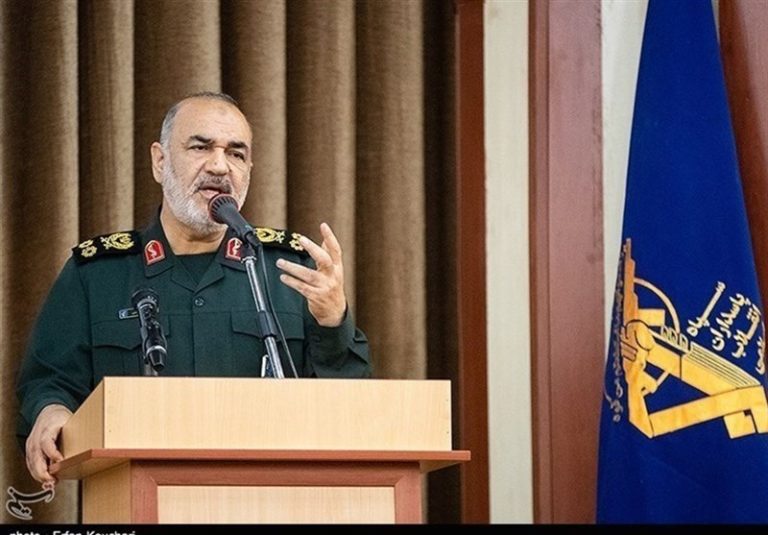
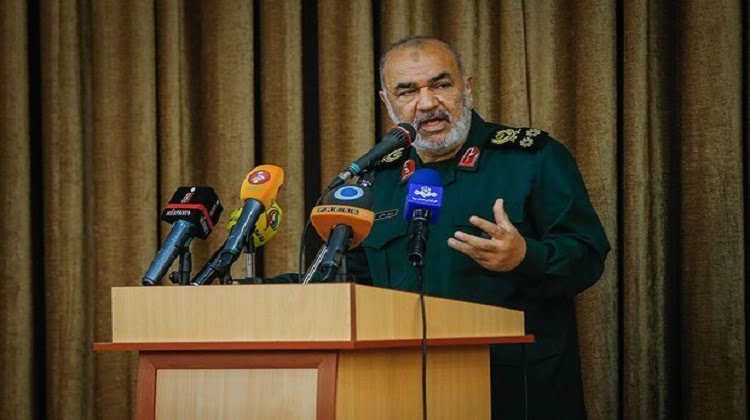
Islamic Revolution Guards Corps (IRGC) Commander Major General Hossein Salami praised Iran’s recent achievements in the defense sector and said the country has been able to break world powers’ monopoly of advanced communication technologies.
According to Tasnim news agency, speaking at a ceremony in Tehran on Sunday to unveil a domestically made military communication system, dubbed “Sepehr-110”, Major General Salami described the role of communications in various areas as “significant and strategic” and said, “Communications are known as the brain and nerves of the armed forces.”
The ability to link all the components of a defense system and transmit messages instantaneously can be reached by “communications”, he said.
The process of commanding, managing and controlling different levels of tactics, operations, and strategies can be facilitated through communications, the commander added.
He further described the communications as “one of the most essential tools of the armed forces” and said, “we are breaking the major powers’ monopoly of advanced communication technologies.”
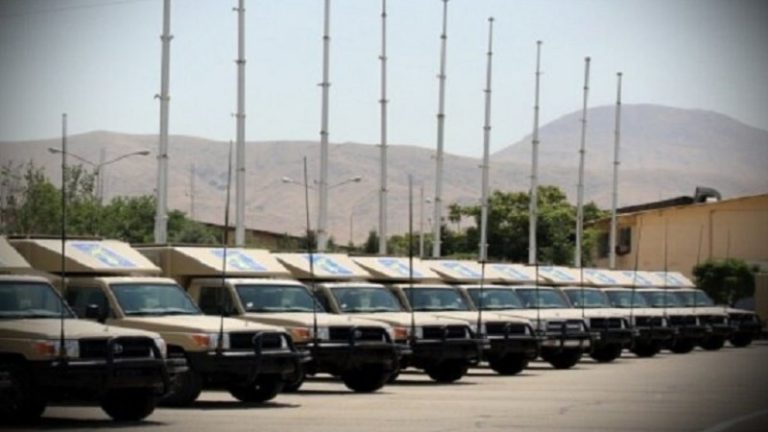
Developed by IRGC experts, the ‘Sepehr-110’ is expected to enhance the mobility of command and control systems used by the IRGC forces.
The communication system can be mounted on various military equipment on the ground, in the sea and in the air, particularly in offensive operations.
The locally-manufactured system can fulfill commanders’ communication requirements in strategic, tactical or battle operations, in offense or defense, and in contingencies.
Using a wide range of technologies for digital communication in various circumstances, ‘Sepeher-110’ can work on different bandwidths to transmit voice, images, and data.
The Iranian system is also invulnerable to hacks, eavesdropping, radio jamming, and electromagnetic disturbance.
Iranian military experts and technicians have in recent years made great headways in manufacturing a broad range of indigenous equipment, making the armed forces self-sufficient in the defense sphere.
Iran maintains that its military might poses no threat to regional countries, stressing that the Islamic Republic’s defense doctrine is entirely based on deterrence.
IRGC unveiled ‘Sepehr 110’ tactical communications system for voice and data transmission in the presence of its Commander Major General Hossein Salami and other IRGC high ranking officials on Sunday.
Iran Press/Iran news: Domestically designed and manufactured, ‘Sepehr 110’ tactical communications system is expected to enhance the mobility of command and control systems used by IRGC forces.
The system is meant to meet the communication needs of commanders at different strategic, operational, tactical and martial levels and in various defensive or offensive conditions as well as in crises and unexpected incidents, Mehr News Agency reported.
Sepeher-110 can be mounted on various military equipment on the ground, in the sea, and in the air, particularly in offense operations and can work on different bandwidths to transmit voice, images, and data.
The Iranian system is also invulnerable to hacks, eavesdropping, radio jamming, and electromagnetic pulse (EMP).
An Iranian Revolutionary Guards commander threatened on Friday to seize a British ship in retaliation for the capture of an Iranian supertanker by Royal Marines in Gibraltar.
“If Britain does not release the Iranian oil tanker, it is the authorities’ duty to seize a British oil tanker,” Mohsen Rezai said on Twitter.
The Gibraltar government said the crew on board the supertanker Grace 1 were being interviewed as witnesses, not criminal suspects, in an effort to establish the nature of the cargo and its ultimate destination.
U.S. President Donald Trump, while not specifically mentioning the supertanker incident, repeated a warning to Tehran: “We’ll see what happens with Iran. Iran has to be very, very careful,” he told reporters at the White House.
British Royal Marines boarded the ship off the coast of the British territory on Thursday and seized it over accusations it was breaking sanctions by taking oil to Syria. They landed a helicopter on the moving vessel in pitch darkness.
The move escalates a confrontation between Iran and the West just weeks after the United States called off air strikes on Iran minutes before impact, and draws Washington’s close ally into a crisis in which European powers had striven to appear neutral.
A U.S. State Department spokeswoman said, “We welcome international partners’ resolve in upholding and enforcing these sanctions.”
Tehran summoned the British ambassador on Thursday to voice “its very strong objection to the illegal and unacceptable seizure” of its ship, a move that also eliminated doubt about the ownership of the vessel.
Foreign Ministry spokesman Abbas Mousavi said the crude oil cargo was from Iran. The ship’s paperwork had said the oil was from neighboring Iraq, but tracking data reviewed by Reuters suggested it had loaded at an Iranian port.
How Iraqi-Iranian militias’ arms trafficking networks bypass US sanctions
How Iraqi-Iranian militias’ arms trafficking networks bypass US sanctions
US sanctions on Iran’s exports in petro-products and industrial minerals are not working, and sanctions continue to be circumvented via money laundering and weapons smuggling
Iran’s Most Powerful Weapon Against America: Meet the IRGC
Iran’s Most Powerful Weapon Against America: Meet the IRGC4
No other branch of the Iranian military can claim the notoriety that the Islamic Revolutionary Guard Corps (IRGC) has earned for itself over the last several decades
ROUHANI: IRAN WILL INCREASE URANIUM ENRICHMENT TO WHATEVER LEVELS NEEDED
ROUHANI: IRAN WILL INCREASE URANIUM ENRICHMENT TO WHATEVER LEVELS NEEDED
Iran will increase its level of uranium enrichment after July 7 to whatever levels it needs beyond the 3.67% cap set in the landmark 2015 nuclear deal, Iran’s President Hassan Rouhani said on Wednesday, according to the IRIB news agency.
IRGC chief: Iran destroyed Washington’s fictitious grandeur in world
IRGC chief: Iran destroyed Washington’s fictitious grandeur in world
Commander of the Islamic Revolution Guards Corps (IRGC) said on Wednesday that Iran has managed to destroy the United States’ fictitious and artificial grandeur in the world
Iran is opening a new regional front in Iraq, the US must act
Iran is opening a new regional front in Iraq, the US must act
The US must act after Iran opened a new front in its regional war, exploiting American weakness in Iraq to use the country as a base to target the Kingdom of Saudi Arabia and threaten US interests in the region