Iran’s Emergence as a Cyber Power – Iran is a country of 80 million people, educated and dynamic. It sits astride a crucial part of the world. It cannot be sanctioned and pressed down forever. It is the last great civilization to sit outside the global order.
Iran’s Emergence as a Cyber Power
As international scrutiny remains focused on the Islamic Republic of Iran’s nuclear program, a capability is developing in the shadows inside Iran that could pose an even greater threat to the United States. The 2010 National Security Strategy discusses Iran in the context of its nuclear program, support of terrorism, its influence in regional activities, and its internal problems. There was no mention of Iran’s cyber capability or of that ability to pose a threat to U.S. interests. This is understandable, considering Iran has not been a major concern in the cyber realm. Furthermore, Russia and China’s cyber activities have justifiably garnered a majority of attention and been widely reported in the media over the past decade. Iran’s cyber capabilities have been considered third-tier at best. That is rapidly changing. This report discusses the growing cyber capability of Iran and why it poses a new threat to U.S. national interests.
Iran in a Cyber Context.
Just as computing power grows exponentially each year, so can an adversary’s cyber capabilities. When one considers the origins of world-class cyber threats to the United States, two countries immediately come to mind—Russia and China. Yet with its growing cyber capabilities and intent to use them, Iran is rapidly striving to earn a position among the ranks of this nefariously elite group. For decades, the U.S. Government has publicly acknowledged concern over Iran’s efforts to develop a nuclear program to counter U.S. military capabilities. Recently, the 2014 Quadrennial Defense Review stated that, “Over the past 5 years, a top Administration priority in the Middle East has been preventing Iran from acquiring a nuclear weapon.” This focus on Iran’s nuclear ambitions has distracted many from Iran’s other developing capability. In the last few years, Iran’s cyber proficiency has garnered the attention of a select few government officials and private industry leaders. In late-2011, the executive chairman of Google stated, “The Iranians are unusually talented in cyber war for some reason we don’t fully understand.” Stopping a cyber adversary from disrupting activity or stealing intellectual property has been the primary concern of government and private sector organizations, but in the military and intelligence communities, there are other concerns about Iran.
Few countries (or nonstate actors) can come close to matching or opposing U.S. military capabilities without taking an asymmetric warfare approach. As U.S.-led sanctions and international isolation impact Iran, the regime continues to seek ways to counter this threat and send a message. “The past year [2012] has seen the Iranian regime evolve significantly in its exploitation of cyberspace as a tool of internal repression…Iran has also demonstrated a growing ability to hold Western targets at risk in cyberspace, amplifying a new dimension in asymmetric conflict.” In the global community, few countries are on par with the cyber capabilities of the United States, Russia, and China. The ability to attack another country or target an adversary’s leaders, population, or infrastructure via the cyber domain, causing significant harm, disability, or damage to key facilities such as electric power grids or financial institutions has been the province of an elite group of countries. Iran, considered a third tier cyber power compared to the United States, is rapidly becoming a world-class cyber threat. During a recent subcommittee hearing, U.S. Representative Peter Hoekstra (R-Michigan) stated that, “Iran has boosted its cyber capabilities in a surprisingly short amount of time and possesses the ability to launch successful cyber attacks on American financial markets and its infrastructure.”
Iran’s Cyber Evolution.
Any mention of the Islamic Republic of Iran immediately invokes thoughts of veiled nuclear programs and support for terrorism, as well as ways (primarily military) to counter these threats. However, understanding Iran’s perspective is vital to knowing what is behind its cyber development. First and foremost in importance to the Islamic Republic is its regime survival, followed by its right to a nuclear program and other national interests. Prior to 2009, much of Iran’s cyber efforts were focused internally on countering government dissidence. The influential Iranian Revolutionary Guard Corp (IRGC) proposed the development of an Iranian Cyber Army in 2005 to combat internal threats. It sought out professional hackers through voluntary means or by using blackmail and threats to boost its ranks.
Although the 2007 Russian cyber attacks against the government websites of Estonia and Georgia may have been the first such shots in cyberspace, the Stuxnet attack that targeted Iran’s nuclear infrastructure was the catalyst that changed the entire dynamic of Iranian cyber development. Publicly revealed in July 2010, it is considered the most advanced cyber weapon of its kind to date. Stuxnet insidiously compromised centrifuge operations at the Natanz nuclear power plant critical to Iran’s uranium enrichment efforts, causing delays to Iran’s nuclear program. Ironically, Stuxnet also served as the watershed event that spurred the Islamic Republic to make Iran’s cyber capability a priority. From an Iranian perspective, Stuxnet was like the famous bifurcated sword called Dhu al-Fiqar or Zolfaqar in Persian that, among Shia Muslims, is believed to have been given by the Islamic prophet Muhammad on his death bed to his son-in-law Ali as his successor. Stuxnet confirmed that the Islamic Republic’s interests were under attack, but it also served as the forcing function needed to formalize and expand its cyber capability.
In early March 2012, Supreme Leader of Iran Ayatollah Ali Khameni publicly announced to state media the creation by decree of a new Supreme Council of Cyberspace charged “to oversee the defense of the Islamic Republic’s computer networks and develop new ways of infiltrating or attacking the computer networks of its enemies.” It included heads of intelligence, militia, security, media chiefs, and the IRGC. It has its own budget and offices along with the power to enact laws. Additionally, the IRGC stated that a secure internal network for high-level command and control called “Basir” (Persian for perceptive) was created to counter outside threats to online activities.However, it is clear from its actions against opposition influences and dissident groups that the regime continues internal censorship and monitoring as well. Furthermore, Reporters Without Borders, in its 2012 annual report of countries that restrict internet access, filter content, and imprison bloggers, “ranked Iran the number one enemy of the Internet…ahead of 11 other countries—including Saudi Arabia, Bahrain, Syria, China, and Belarus.”
Today, Iran as a cyber power is the elephant in the room that everyone is finally beginning to notice. The Iranian government was originally believed to have budgeted approximately $76 million annually to its fledgling cyber force. However, in late-2011, Iran invested at least $1 billion dollars in cyber technology, infrastructure, and expertise. In March 2012, the IRGC claimed it had recruited around 120,000 personnel over the past 3 years to combat “a soft cyber war against Iran.” In early-2013, an IRGC general publically claimed Iran had the “fourth biggest cyber power among the world’s cyber armies.”Regardless of the numbers, the fact is that Iran’s cyber capability continues to mature. The IRGC has its own Cyber Defense Command which recruits and trains cyber warriors to spy on dissidents on the internet and spread Iranian government propaganda. The IRGC also now owns and controls Iran’s largest communication company and manages the skilled cyber technicians and specialists of Iran’s Cyber Army trained to hack into opposition websites and conduct other types of offensive cyber operations. On the law enforcement side, the FETA police (in Persian it literally means Police of the Space of Creating and Exchanging Information) handle typical internet crimes as well as more opaque enforcement activities such as political and security crimes. There are other Iranian organizations and companies recruited and/or affiliated with Iran’s cyber capabilities, either knowingly or by loose association.
On February 12, 2013, during a discussion about Iran’s cyber development at the Center for National Security at Fordham Law, former Iranian Ambassador and visiting current research scholar at Princeton University Seyed Hossein Mousavian stated, “The U.S., or Israel, or the Europeans, or all of them together, started war…Iran decided to establish a cyber army, and today, after 4 or 5 years, Iran has one of the most powerful cyber armies in the world…it’s exaggerating the present capabilities but it’s working toward the future.”While Iran’s overall cyber capabilities may be inflated there is little doubt it is serious about becoming a dominant future cyber power. That future may be closer than initially anticipated. General William Shelton, head of the U.S. Air Force Space Command, said “Iran’s developing ability to launch cyber attacks will make it a force to be reckoned with. Iran poses a risk because of the potential capabilities that they will develop over the years and the potential threat that will represent to the U.S.”
Iran’s Cyber Capability as a Threat.
While Iran has not yet graduated to full membership as a world-class cyber power on par with the United States, China, and Russia, “it is the intensity, variety, and destructiveness of Iran-linked cyber intrusions over the past 5 years” that has accelerated its ranking as a cyber threat. The evolution of Iranian cyber capability did not just occur overnight or in a vacuum. It was cultivated over the years in a crucible of real-world activity and consolidated in lessons learned from dealing with internal attacks against the government by dissidents, external attacks against its nuclear infrastructure, and through efforts to create and educate its own technical force. What Iran currently lacks in technological know-how, it more than makes up for in ambition. To reinforce this point and show Iran’s intent, the commander of Iran’s information technology and communication department of the General Staff of the Iranian Armed Forces stated that “one of the options on the table of the U.S. and its allies is a cyber war against Iran…but we are fully prepared to fight cyber warfare.”
The sophistication of attacks like Stuxnet proved successful in delaying Iran’s nuclear program development, but it also served as an opening salvo in the escalation of cyber warfare. “Iran represents a qualitatively different cyber actor…[t]hey’re not stealing our intellectual property en masse like China, or using cyberspace as a black market like the Russians do…what Iran does use cyber for, including elevating its retaliatory capabilities abroad, makes it a serious threat.” Iran understands it cannot match the United States and its allies directly and therefore must strengthen its asymmetric toolset to counterbalance this gap. So as not to rely exclusively on foreign technology, in late December 2013, the IRGC publically revealed indigenously developed cyber defense products including secure: cell phones; operating system; navigation system; telecommunications optical transmission system; anti-malware; cyber threats recognition and identification system; security operations center; a high-speed and high-capacity firewall and a software firewall. Although the technology is likely not as advanced as U.S. equipment, this proves that the Islamic Republic is tenaciously working to address its concerns and close the gap.
Iran is actively seeking increased offensive cyber capabilities that could also increase its asymmetric position. It has shown its ability to use cyber attacks to infiltrate and take down targets. In 2011, it infiltrated a Dutch company and stole digital certificates for secure communications that it later used internally to hack Iranian citizens’ communications and email. In 2012, Iran was suspected of launching malware that wreaked havoc on 30,000 computers at the Saudi oil company Aramco. This attack was followed later in the year by another against Qatari energy company, RasGas. In late-2012, a significant Distributed Denial of Service (DDOS) attack was executed against websites of major U.S. banks. Iran was suspected, but what was even more disconcerting to the United States, was the magnitude of traffic flow which was greater than anything previously seen from a DDOS attack up to that point. This indicated a remarkable degree of sophistication. In late-2013, Iran’s infiltration of the U.S. Navy’s internet network garnered much attention because it indicated Iran’s capability had advanced. It not only showed Iran could get into a U.S. Department of Defense system, but it highlighted the ability to stay in it for several months. An example of this improved knowledge was initially suggested back in May 2012 when Morteza Rezaei, an Iranian cyber engineer with NEDA Industrial Group in Tehran, published his analysis of how to defend against Stuxnet. What was more disturbing was he wrote it in Control Global, a U.S. publication, to show just how far Iran’s cyber knowledge had come.
Iran is no doubt working hard to elevate its standing as a world-class cyber power. It is taking full advantage of U.S. foreign policy issues to foster relationships with U.S. adversaries such as China and Russia that will help advance Iran’s cyber capabilities. General Martin Dempsey, Chairman of the Joint Chiefs of Staff, stated in an interview in January 2013 that, “there are reports that destructive cyber tools have been used against Iran…whoever’s using those can’t assume that they’re the only smart people in the world.”Maybe a more imminent U.S. concern regarding Iran should be the danger the Islamic Republic poses if it becomes a world-class cyber power. All indications show this is likely to happen sooner than later.
Iran Fighting Enemies at Their Doors – Islamic Revolution Guards Corps (IRGC) Navy Commander Rear Admiral Ali Fadavi reiterated the failure of enemies in hitting a blow to the Islamic Revolution using different plots and attempts, and said Iran is now fighting them at their doors.
Iran Fighting Enemies at Their Doors
“Thanks to the martyrs’ blood and presence of Supreme Leader of the Islamic Revolution Ayatollah Khamenei, today, the Islamic Revolution is fighting the enemy at borders highly far from the center of the Islamic Revolution which can be interpreted as fighting the enemies in their homes,” Fadavi said, addressing the IRGC personnel and forces in the Northern province of Golestan on Tuesday.
He described the Americans’ attacks on Afghanistan and Iraq and the Zionists’ aggression against Lebanon and the Palestinians as nothing but failure, and said, “The American and Zionist sources have themselves admitted that the conditions of their fronts before and after these attacks are not comparable, and that all their actions have ended in the interest of the righteous front.”
In relevant remarks last month, IRGC Lieutenant Commander Brigadier General Hossein Salami underlined that the US has lost its role as a main player in the Middle East due to Iran’s stronger role and clout in the region.
“The US has become marginalized from a major player in the region and instead the Islamic Republic of Iran has become the sensitive region’s most important administrator,” General Salami said, addressing a group of people in Isfahan city, Central Iran.
He pointed to the efforts by the arrogant powers to prevent the formation of new powers that went against their interests throughout history, and said, “They applied the most severe type of these measures in the case of Iran in the past three decades.”
The IRGC commander reiterated that Iran has no fear of global powers, and said, “We have lined up our might in the face of their excessive demands.”
Police Documents Reveal ‘Hezbollah Ties’ to Brazil’s PCC – Police documents reportedly revealed links between Hezbollah and a Brazilian prison gang, providing further fodder for claims that the Islamic militia group has ties to criminal organizations in Latin America.
Police Documents Reveal ‘Hezbollah Ties’ to Brazil’s PCC
According to federal police documents obtained by O Globo, Lebanese traffickers linked to Hezbollah — who are based where the Brazilian, Paraguayan, and Argentine frontiers meet — have helped Brazilian prison gang the First Capital Command (PCC) obtain weapons. In exchange for protecting prisoners of Lebanese origin detained in Brazil, the Lebanese traffickers reportedly provide the PCC with access to international arms smuggling channels. Additionally, the documents reportedly said that the Lebanese traffickers helped sell C4 explosives that the PCC allegedly stole in Paraguay.
According to O Globo, the documents indicated that the association between Lebanese traffickers and the PCC began in 2006, but was only discovered by police in 2008.
InSight Crime Analysis
Allegations that Hezbollah has ties to criminals operating in the tri-border region date back to at least 2006, when the US Treasury Department identified nine individuals in the area accused of providing Hezbollah with financial and logistical support. Several of the individuals on the list were identified as drug traffickers and arms dealers, but according to the Treasury Department their support of Hezbollah was limited mainly to operating a fundraising network.
The Brazilian government has never officially confirmed the US Treasury Department’s assertions, but the documents obtained by O Globo indicate that the country’s police have also uncovered evidence linking Hezbollah to Brazilian groups. Allegations that Lebanese traffickers with ties to Hezbollah have helped the PCC obtain weapons and sell explosives are especially troubling, as they indicate that the Islamic group’s links in the country may go far beyond fundraising.
There have been other reports of Hezbollah working with criminal groups in Latin America, but most appear to be largely unsubstantiated. In 2011, US authorities revealed an alleged plot by Iran’s Islamic Revolutionary Guards to pay Zetas members to assassinate the Saudi Arabian ambassador to Washington DC, although as InSight Crime has previously noted, the story is not very convincing. US authorities have also accused a Lebanese man of selling cocaine to the Zetas and sending the profits to Hezbollah, and Israeli media reported in 2012 that the Islamic militia group had set up a training base in Nicaragua.
New law charges Basij force with enforcing dress code – The Iranian regime’s parliament approved a bill on Sunday officially putting the members of the Basij paramilitary force in charge of enforcing dress code in Iran and harassing and repressing women and youth in public under the pretext of “Promotion of Virtue and the Prevention of Vice”.
New law charges Basij force with enforcing dress code
Article 19 of the bill approved states that members of the Basij Organization are required to verbally ‘promote virtue and prevent vice’.
The law which passed with a majority would institutionalize the work of members of the Basij paramilitaries that often patrol streets to enforce dress code and other behavior prescribed under the clerical regime’s misogynist laws.
The new law bolsters the work of Basij members that often patrol streets, and stop cars to interrogate couples about their relationships, to the resentment of many Iranians.
Furthermore, according to Article 20 of the bill, it requires all executive offices, institutions, privately owned companies and public service centers to obey this law.
The bill was approved by a majority of 237 lawmakers, with only 12 member opposing it.
The new law comes at the time that the Iranian people continue to protest against the recent wave of acid attacks in Iran carried out by state-sponsored gangs.
Acid attacks that targeted many young women and girls left them with severe burns and injuries, with some losing their eyesight and at least one person reported killed, began after the Iranian regime’s parliament began reviewing bills empowering the Basij paramilitaries.
Meanwhile, in a conference in Paris on Saturday, Mrs. Maryam Rajavi, the President-elect of the National Council of the Resistance of Iran, reviewing the despicable human rights record of the Iranian regime during the presidency of Hassan Rouhani, including the wave of acid-attacks against women, said that this regime cannot survive without them executing the youth and suppressing women since it is very fragile and fearful of popular uprising.
Mrs. Rajavi reiterated that Western governments’ silence on escalating human rights violations in Iran and the mullahs’ exportation of mass terror in the region in order to obtain the clerical regime’s agreement in the talks has only resulted in emboldening the Iranian regime.
Narges Mohammadi has been summoned to revolutionary court in Tehran – On Wednesday, November 5, lawyer and activist Narges Mohammadi received a summons by branch two of Tehran’s revolutionary court. She is summoned for interrogation on Saturday November 8 at the “holy martyr prosecutor’s office” located in Tehran’s Evin prison.
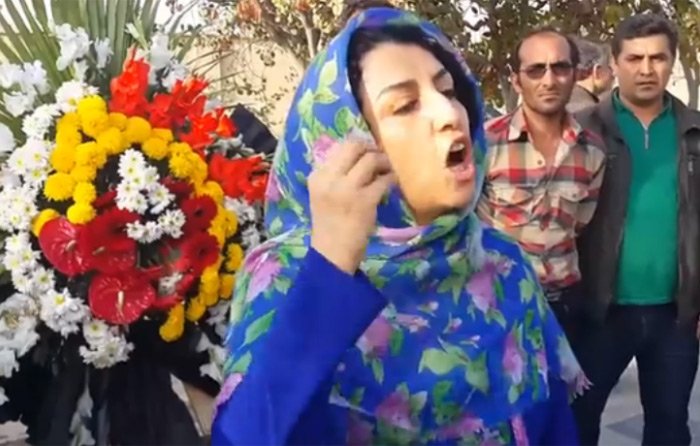
On October 30, Ms. Narges Mohammadi at the memorial ceremony of Sattar Beheshti, worker and blogger who was killed two years ago under torture in the regime’s detention center, said: “How is it that the MPs in Majlis (parliament) have tabled the proposal of ‘promotion of virtue and prevention of vice’, whilst Sattar’s mother has been crying over his grave, calling Sattar, Sattar… and no preventer of vice raised any voice so far?”
Narges Mohammadi has been summoned to revolutionary court in Tehran
She also reiterated: “Is there a greater evil than killing innocent people like Sattar Beheshti, like Homa Saber, like Haleh Sahabi, like Neda Agh Sultan, like Sohrab Aerabi, and 1,000 & 1,000 others? Has a society experienced greater evil than this? So why don’t you prevent it? Why do the courts address these killings? Which one of these cases has been resolved?”
Ms. Mohammadi and a number of civil activists also participated in a gathering on October 22 in front of the Iranian regime’s parliament to protest against acid attacks on Iranian women and girls in Isfahan where most acid attacks occurred.
She received a warning from Iranian regime authorities on April 30 after she met with Catherine Ashton, the European Union foreign policy chief at the time. Her passport was revoked back then and she was barred from leaving the country. She has also been accused of working and propagating against the mullahs’ theocracy.
Catherine Ashton, in her trip to Iran on March 8, on the occasion of International Women’s Day met with a number of women’s rights activists including Narges Mohammadi and Gohar Eshghi (mother of Sattar Beheshti) in the Austrian embassy in Tehran.
Part of Ms. Mohammadi’s speech at Sattar Beheshti’s memorial ceremony is as follows:
… and Sattar’s torturer, in the presence of Sattar’s mother, and his lawyer, Mrs. Poorfazel, who is here, and the judge dealing with his case, confessed that he killed Sattar under torture. “Sattar was laughing and I was beating him. I beat him so much that he died.” This must be recorded in history. In a court where the torturer confesses: “I beat him so much until he died beneath my hands”. Have you ever seen a criminal case being so explicit that the torturer confesses “I beat him to death”? And say this at the presence of his mother! They don’t understand the meaning of motherhood. They do not understand a mother’s love and do not know what they have done to this mother to the last moment of her life. Instances of Sattar’s torture had been noted in his dossier and all of it was read to his mother. And the mother is being tormented with each and every second of Sattar’s torture.
So what is the outcome of these few sentences of mine? I ask you all friends, is there in fact a greater sin than that? Whether you have a faith or haven’t, whether you are religious or not, you are a human being after all. Is there a greater sin than killing a human being? As mentioned in the text of Holy Quran, if an individual is killed unjustly it is as if the whole of human society is being killed. Is the slaying of society and the cruel slaying of Sattar a sin that can be ignored? If not, then what have these “promoters of virtue and preventers of vice” done in the past two years?
How is it that the MPs in Majlis, have tabled the proposal of “promotion of virtue and prevention of vice”, whilst this mother has been crying over this grave, calling Sattar, Sattar… and no vice preventer raised any voice so far? Why are those MPs planning to support vice-preventers who are forming the authority? But, no one defended the voice of this mother, as a vice-preventer, preventing the evil of murdering a human being under torture? Which vice are you going to prevent, which virtue are you going to promote? Is there a greater evil than killing innocent people like Sattar Beheshti, like Homa Saber, like Haleh Sahabi, like Neda Agh Sultan, like Sohrab Aerabi, and 1,000 & 1,000 others? Has a society experienced greater evil than this? So why don’t you prevent it? Why do the courts address these killings? Which one of these cases has been resolved?
They have looted a nation’s wealth, embezzlements that even the journalists cannot write about, or the ears unable to hear them. Is there a greater vice than looting a nation’s wealth? Why don’t you prohibit it? Why have none of these lawsuits been resolved? Is my hair as evil as an Iranian woman that all of you rallied together? Why 4,000 motorcyclists should plan to mobilize in the streets of Tehran to combat mal-veiling? Is this because my mal-veiling is a vice? But where these 4,000 were, when the moaning of murdered mothers rose out of their chest.
Brothers and Sisters, (parallel to) these days, (Imam) Hussein is heading to (the city of) Karbala for a great promotion of virtue. Hussein is an enjoiner, who revolted against a regime, that regime was a tyrannical regime. Hussein used “promotion of virtue and prevention of vice” against the regime not against his family and his nation. There are plenty of vices in this society. We are all aware of that. But we have not witnessed any of these vices being sanctioned to have people judgments or courts judgments against it or the authorities having placed in their agenda.
Today is the second anniversary of the death of Sattar Beheshti under torture. I express both my condolences and congratulations to his mother. Sattar had pure blood, like the blood of Hussein, like Siavosh’s blood that is running along the entire history. I congratulate her for raising such a son with all the suffering of an Iranian mother and bestowing him on the society. But I express my condolence, a condolence that is addressed to us in the first place, for keeping quiet against such flaws and I request forgiveness from Sattar’s mother.
Free Woman in Sports Protest Case – Iran’s judiciary should quash the conviction of Ghoncheh Ghavami for “propaganda against the state” and immediately release her since the charge is on its face a punishment for peaceful speech and protest, Human Rights Watch said today. Ghavami, a dual Iranian-British national, was arrested June 30, 2014 after protesting a ban on women attending volleyball matches. She began a hunger strike on November 2 to protest her detention, her brother Iman Ghavami told Human Rights Watch.
The International Volleyball Federation (FIVB) has called on the Iranian government to release Ghavami, and affirmed its commitment to “inclusivity and the right of women to participate in sport on an equal basis.” Nevertheless, on November 2, the Asian Volleyball Confederation reportedly announced that it had selected Iran to co-host the 2015 Asian Men’s Volleyball Championships. Ghavami’s conviction and Iran’s continuing ban on women spectators should prompt the FIVB to step up its actions on her behalf and for equal access to sporting events, Human Rights Watch said.
Free Woman in Sports Protest Case
“The list of people Iran has jailed for demanding their rights is a long one,” said Minky Worden, director of global initiatives. “To that list we can now add a courageous voice for women’s right to watch a sporting event.”
A Tehran revolutionary court convicted Ghavami in a closed trial on October 14. On November 1, her lawyer, Mahmoud Alizadeh Tabatabaei, told the Iranian Labour News Agency that the court had yet to issue the written judgment, which would explain the basis for the guilty verdict. Tabatabaei said that Iranian law requires courts to issue their written verdicts within one week of a trial’s conclusion. The delay in this case has fueled fears that authorities may bring additional charges against Ghavami, a family friend following the case, told Human Rights Watch.
Tabatabaei said that he was not able to meet with his client except on October 14, the day of the trial.
Security authorities initially arrested Ghavami and about 20 others on June 20 after they protested a ban preventing women from entering the Azadi Sports Complex to watch a match between Iran and Italy. The protesters were taken to Tehran’s Vozara Detention Center, where women arrested for breaches of the Islamic dress code are often held. Officials released Ghavami after several hours, but re-arrested her on June 30, when she returned to the detention facility to collect her phone.
Iman Ghavami said that security officials then searched his sister’s home, confiscated her laptop and other possessions, and transferred her to Evin prison, where she remains. Ghavami spent her first 41 days in solitary confinement in section 2A of Evin prison , he said. It is believed that Section 2A is controlled by Iran’s Revolutionary Guards.
On September 22, Iran’s judiciary spokesperson said that Ghavami’s arrest was for national security reasons and “has nothing to do with sports.” However, no judiciary or other state officials has disclosed any of the evidence used to convict Ghavami.
The male-only policy for spectators at volleyball matches dates to 2012, when the Sports and Youth Affairs Ministry extended the existing policy on soccer matches to cover volleyball. Iranian officials claim that mixed attendance at sports events is un-Islamic, threatens public order, and exposes women to crude behavior by male fans.
Human Rights Watch urged the FIVB in a September 29 letter to raise Ghavami’s case with the Iranian government and to ensure that “the FIVB will not, in the future, authorize games in venues where the entry policy or national laws violate the principle of non-discrimination on gender and other prohibited grounds.”
The FIVB responded that it had sent a letter to President Hassan Rouhani urging him to reconsider the decision to keep Ghavami under arrest. In an October 21 meeting with Human Rights Watch staff, the FIVB affirmed its commitment to inclusivity and the right of women to participate in sports and said that Iran would not be able to host a world championship or any international event until this problem is solved.
On November 1, at the FIVB World Congress in Cagliari, Italy, Dr. Ary S. Graça, the body’s president, publicly called for the release of Ghavami and declared, “[W]omen throughout the world should be allowed to watch and participate in volleyball on an equal basis.” The Asian Volleyball Confederation’s announcement came the next day.
“Sports associations have no business bringing events to countries where women will not be welcome as spectators – or where they could get attacked or arrested for cheering a team,” Worden said. “Sporting bodies and leaders need to agree that they will not back mega-sporting event host countries that violate the sport’s fundamental commitment to equality.”
Human Rights Watch has called on organizers of international sporting events to include non-discrimination clauses in their host city contracts, following the decision by the International Olympic Committee (IOC) in September to include that requirement. The IOC has informed the finalists bidding for the 2022 Winter Games of this requirement.
“The FIVB took a positive stand for the principle of gender non-discrimination in sports – a principle that Ghoncheh Ghavami is paying an enormous price for,” Worden said. “Countries that discriminate against women who want to play or watch sports should quite simply be denied the chance to host international competitions until they change their policies and play by the rules.”
Iran to reclaim its role as regional leader – Most commentary on the Islamic State (ISIS) point to the challenges it presents to the Middle East. Sectarian tensions may have been a fact of life in the region. But ISIS has made it the number one threat to the political order – it cost Iraq’s Prime Minister Nouri al-Maliki his job.
Iran to reclaim its role as regional leader
The implications of the scourge of sectarianism are far reaching for Iran too. As a constitutionally Shia Muslim state, Iran is mindful of the restricting framework of sectarianism. Since its inception, the Islamic Republic of Iran has been eager to project an image that transcends sectarian differences. This has been a key pillar of Iran’s regional policy. Speaking to the Muslim masses and voicing popular angst against the Israeli occupation of Palestinian lands, or against US arrogance and political domination of the international order, have been at the heart of Iran’s message to its neighbourhood. Of course, this has antagonised neighbouring regimes, which accuse Tehran of destabilising the region.
Saudi Arabia was quite vocal in protesting against Iran’s message following the 1979 revolution. But Tehran turned such criticism to its advantage. By supporting Hamas and Hezbollah in an apparent attempt to challenge Israel, which it calls the “Zionist entity”, by proxy it gained political credibility on the Arab street. Having Hamas in this alliance was very important, as it offered Iran an example of an inter-sectarian alliance against a common enemy.
Trans-sectarian policy
The notion of the “axis of resistance” applied to the political congruity of Iran, Syria, Hezbollah and Hamas, was celebrated in Iran as a successful case of its trans-sectarian policy, emphasising the political unity of all Muslims. Iran clearly saw itself as the champion of all Muslims and with the sprouting Arab Spring, the Iranian leadership was self-congratulatory for providing a model for the Muslim world to follow, even though the Muslim Brotherhood of Egypt appeared very reluctant to follow the Iranian model.
But the Arab Spring has now turned to winter and given rise to devastating carnage in Syria and Iraq. ISIS has galvanised the international community to act. The US-led aerial bombardment of ISIS assets have offered the Kurdish Peshmerga and the Iraqi forces some reprieve.
Ironically, the common threat of ISIS has put old foes on the same side of the fence. Iran and the US have an enemy in ISIS. So why is Iran not part of the international coalition?
The Iranian leadership operates in its own political and psychological sphere, and responds to a range of factors beyond the geo-strategic needs of the day. The parameters of this sphere dictate that Iran cannot afford to be seen as a minor player in a US-led operation. Iran sees itself as an equal player, and in many ways a more critical player because of its geographical location. While this does not rule out ad hoc contact between the two sides on practical issues, it does make entering into a military alliance with the US highly problematic for Iran’s sense of its own regional role.
Suspicions
The Iranian leadership is also suspicious of US intentions and sincerity in the fight against ISIS. The US is accused of sponsoring rebel groups in Syria, and having a hand in the emergence of what Iran calls “takfiris” (apostate groups). A recent statement by US Secretary of State John Kerry about the role of Saudi Arabia, UAE and Turkey in the rise of ISIS seemed to vindicate Iranian cynicism. Saudi Arabia is now part of the international coalition to stop the ISIS land grab. The Iranian authorities, especially the conservatives, see this as disingenuous. Indeed, Washington’s continued commitment to deposing Bashar al-Assad in Syria, which is at war with ISIS, is seen as evidence of its deceit.
Instead, Iran sees its ties with the central government in Baghdad and the Kurdistan Regional Government (KRG) as leverage in the push against ISIS. Iranian authorities celebrate what they see as Tehran’s immediate response to aid Iraq against ISIS, and have published images of General Qasem Soleimani, the Commander of Quds Forces, in Kurdistan.
From Iran’s point of view, history is on its side: Once all is said and done, once US troops return home, Iran maintains the most battle-ready military force to offset regional challenges, buttressed with strong political ties with Iraq, Syria and Hezbollah. The Iranian leadership remains confident that this alliance will allow Tehran to shift the focus back on Israel, and allow Iran to reclaim its role as regional leader.
Obama penned secret letter – U.S. President Barack Obama wrote a top secret letter to the Islamic Republic of Iran’s Supreme Leader Ayatollah Khamenei sometime in the middle of October.
The letter reportedly included issues dealing with the fight against Islamic State (ISIS) militants in Syria and Iraq, including a guarantee that the United States would not target the Assad regime in Syria. Another primary focus of the letter revolved around the United States’ ongoing nuclear negotiations with the Shiite theocracy, The Wall Street Journal reported.
Obama penned secret letter to Iran Supreme Leader Ayatollah Khamenei
In his appeal, President Obama urged the Iranian dictator to strike an agreement regarding Iran’s nuclear program by November 24th. He also allegedly stated that should Iran agree to a deal, the U.S. was willing to work with Tehran against the Islamic State.
The Wall Street Journal reported that the President’s appeal marks at least the fourth time that he has written directly to the Ayatollah.
Some on both sides of the aisle in Congress have expressed discontent with the ongoing Iran negotiations.
“The best way to prevent Iran from getting a nuclear weapon is to quickly pass the bipartisan Menendez-Kirk legislation–not to give the Iranians more time to build a bomb,” Senator Mark Kirk (R-IL) told WSJ Wednesday.
House Speaker John Boehner (R-OH) commented, “I don’t trust the Iranians. I don’t think we need to bring them into this.” Boehner added that he had serious doubts about the seriousness of the ongoing negotiations.
The Obama administration had previously said there is no connection between the nuclear negotiations and the fight against ISIS. According to Armin Rosen of Business Insider, on September 26th, a senior White House official said regarding ISIS and Iran, “These are two separate issues.” However, Mr. Obama’s letter shows that the White House has tied the two issues together.
The Iranian Ayatollah reportedly has not directly responded to any of Obama’s several appeals. Instead, he has openly called for the destruction of America.
Battle and jihad are endless because evil and its front continue to exist. … This battle will only end when the society can get rid of the oppressors’ front with America at the head of it, which has expanded its claws on human mind, body and thought. … This requires a difficult and lengthy struggle and need for great strides.
Iran is widely seen as the world’s foremost promulgator of Shia Islamic terror, aiding and abetting organizations such as Lebanese terror group Hezbollah, Bashar al-Assad’s regime in Syria, and Hamas in Gaza.
Iran is also one of only four states that the United States considers a State Sponsor of Terrorism. The State Department said of Iran in its 2013 country report:
Iran continued its terrorist-related activity, including support for Palestinian terrorist groups in Gaza, and for Hizballah. It has also increased its presence in Africa and attempted to smuggle arms to Houthi separatists in Yemen and Shia oppositionists in Bahrain. Iran used the Islamic Revolutionary Guard Corps-Qods Force (IRGC-QF) and its regional proxy groups to implement foreign policy goals, provide cover for intelligence operations, and create instability in the Middle East. The IRGC-QF is the regime’s primary mechanism for cultivating and supporting terrorists abroad.
Iran building new Hezbollah in Syria – Iran is working to unite Shiite foreign militias fighting in Syria under one organization that could serve as a “parallel army” to that of Bashar al-Assad’s regime, pro-opposition news website Siraj Press reported on Wednesday.
The new organization, described as similar to the highly organized and well-armed Lebanese Hezbollah group, would bring together Afghan and Iraqi mercenaries under one military command.
Iran building new Hezbollah in Syria
“This army would resemble Hezbollah in Lebanon… and will gradually work on recruiting Syrians,” Siraj Press quoted a source as saying.
The organization would then be well-armed and trained to be an independent force for long-term presence in Syria, even if the regime of President Assad collapses.
The Iranian move coincided with Damascus’ decision to recruit thousands of Syrian youth to join military service.
Jordanian Maj. Gen Fayez al-Doueiri suggested that Iranian Gen. Qasem Soleimani, the commander of Qods Force, was behind the new Iranian project.
“The decision maker in Syria is General Qassem Suleimani, commander of the Quds force,” Gen. al-Doueiri said during an interview on Al Arabiya’s sister channel Al Hadath.
Gen. Doueiri noted that it was Suleimani’s idea to send Iran’s Basij brigades to Syria in the early months of the Syrian civil war. He explained how Suleimani reportedly used Iraq as a training ground for foreign Shiite militias who desired to join the Syrian civil war.
Tehran, the longtime supporter of the Assad’s regime, could be re-adjusting its strategy in Syria following the rise of the militant Islamic State of Iraq and Syria (ISIS) group and the ongoing U.S.-led military campaign, according to Gen. Doueiri.
He suggested that Tehran no longer sees Assad’s tattered army as reliable to safeguard its interests in the country; so it needs a “parallel army” for long-term service.
The new army would provide field support for the Assad’s army, which has reportedly lost more than 200,000 fighters since the civil war began in 2011.
Iran considers the war in Syria as critical for its geo-political influence in the region and a crucial battleground in its conflict against the U.S. and Western powers.
Syria provides a strategic bridge between Iran and Hezbollah, its proxy militia in Lebanon. The fall of Syria to the liberal, pro-West opposition means that Hezbollah could be isolated and Iran’s strategic reach could be diminished.
Propose lashes for dog walkers – Dog owners in Iran could face severe penalties for walking their pets in public, under plans proposed by a group of hardline MPs, it’s been reported.
Propose lashes for dog walkers
Thirty-two MPs have submitted a bill to parliament which proposes a punishment of 74 lashes for people caught playing with, stroking or exercising their dogs outdoors, The bill says such activities “harm the Islamic culture and the safety and peace of mind of other people, especially women and children”. Anyone who ignores police warnings could also be fined up to 100m rials ($3,740 – £2,350) under the plans, as well as having their animal taken away. The MPs say confiscated pets should be moved to “a zoo, forest or desert”, and that owners would have to foot the bill for the transfer. Some notable exceptions are mentioned in the bill, including for farmers, shepherds and licensed hunters.
Over the past few years Iranian police have been cracking down on dog walking, and some owners have been arrested, because under Iran’s Islamic laws the animals are considered “unclean”. But dog ownership is a growing trend in the country, particularly among the urban middle and upper classes in major cities like Tehran.