Iran’s human rights record remains poor – When Hassan Rouhani was campaigning for president in spring 2013, he chose a key as the overarching symbol of his electoral platform and vision for a new Iran. That key, he vowed, would open up the country’s tightly sealed political sphere and unlock the path to basic civil rights and human rights.
Iran’s human rights record remains poor
One year into Rouhani’s tenure, the key has emerged as rich fodder for caricaturists, who have shown it to be alternately lost, blunted or mismatched to its lock. Today, the president finds himself presiding over a roughly unchanged Iran.
The lawlessness and arbitrary detentions that overshadowed the era of Mahmoud Ahmadinejad have continued unabated. The state regularly arrests civil society activists and journalists, and executes scores of prisoners without fair trial. Iran’s once-vibrant NGO and media climate remains intimidated and quiet, and the political bullying that pushed reformist politicians and other critics to the margins of public life remains firmly in place.
The sameness has been so evident that United Nations Secretary-General Ban Ki-moon chastised Rouhani’s government in March for not having “changed its approach” to the death penalty or the protection of free expression.
Since the start of this year, the state has executed nearly 400 prisoners, many of whom human rights groups believe were activists for ethnic minority rights spuriously charged with criminal offenses. Authorities have also imprisoned at least 30 journalists and technology specialists, Human rights activities and in a particularly aggressive move in July, arrested the Washington Post’s Tehran correspondent.
Not only have Rouhani’s most notable electoral pledges about bringing Iranians digital freedom, dignity as citizens, and respect in private life remained elusive, the state has revitalized its efforts to enforce Islamic dress codes and limit women’s access to public spaces. Parliament recently held a session on the moral threat posed by leggings, and authorities forbade women from watching volleyball matches in Tehran’s Azadi Stadium.
The Rouhani government’s scorecard on human rights and civil society is now widely discussed even within his administration as its most alarming and public failure. The president’s allies argue that he must focus first on securing a nuclear deal, and then use the political capital such a victory would garner to push forward more contentious social and political reforms. But that strategy risks losing the Iranian public – who are seeing neither a spike in living standards nor greater freedom – along the way.
The sheer scope of violations under Rouhani’s watch has overshadowed the small measures his government has sought to enact. These include releasing a number of political prisoners and issuing press permits to previously banned publications such as Iran-e Farda and Zanan-e Emrouz, which in their respective eras had been crucial to the debate and coverage of women’s and democracy issues. Both outlets were the sort of platforms where controversial state moves such as the ban on vasectomies and promotion of larger families would have been discussed and carefully skewered. More about Zana-e Emrouz
Rouhani’s allies argue that the executions, arrests and lingering Ahmadinejad hangover on civil society and the press are the work of the hard-line judiciary. They say that blame should be placed on the pole of the establishment that is responsible.
His allies would also note that Rouhani has pushed back against hard-liners far more forcefully than Mohammad Khatami, the last president who tried and failed to moderate Iran. Rouhani warned hard-liners and follow human rights, in regard to securing Iranians free access to the Internet, that the “era of the one-way pulpit” is over. In response to his opponents’ protestations about the erosion of Islamic culture, he said with exasperation, “You can’t drag people into heaven with whips.”
But ordinary Iranians, and indeed the international community, do not pause to make flowcharts of power distribution in the Islamic Republic before weighing Rouhani’s record. For them, the “nezam,” or state, is inseparable from the executive. A profound disillusionment is seeping into the youthful ranks of those who voted Rouhani into office. In their eyes, it is no great feat that Rouhani and his diplomats are on their way to securing a nuclear deal. The supreme leader, Ayatollah Ali Khamenei, has backed those endeavors, leaving the dirty work for the negotiating tables of Europe, not the political backrooms of Tehran.
For those expecting the Rouhani key to open at least a few doors, the president’s first year has been a disappointing one. Rouhani’s Iran is as lawless and intellectually cowed as the one he inherited, a country where a muscular intelligence apparatus makes the political decisions, not the politicians Iranians voted into office.
US and Zionism Main Obstacles to Islamic Civilization – Commander of Iran’s Basij (volunteer) force Brigadier General Mohammad Reza Naqdi described the US and the Zionists as the main stumbling block standing on the way of the Islamic civilization, and called on the world Muslims to take action to remove these barriers.
Basij Commander: US and Zionism Main Obstacles to Islamic Civilization
“Today, the materialization of the Islamic civilization is our great cause and the biggest obstacle standing on this path is the US and the Zionists and therefore, there needs to be a serious stream created to move and exclude this obstacle,” Naqdi said, addressing Basij and the Islamic Revolution Guards Corps (IRGC) public relations officials in Tehran.
He underlined that all the protest rallies which are being held in Pakistan and Yemen should change the direction of their protests from Islamabad and Sana’a to the holy Quds since the root cause of all the regional problems and divisive plots is the usurper Zionist regime, stressing that the Muslim countries can talk to each other to annihilate this regime and settle their problems.
In relevant remarks in June, Iranian President’s Deputy Chief of Staff Hamid Aboutalebi also deplored the US as the root cause of insecurity in the Middle East due to its contradictory foreign policy.
“The US cannot adopt contradictory policies in the Middle East; to support war in Syria and peace in Iraq or be on the side of terrorists in Syria and against them in Iraq,” Aboutalebi wrote on his Twitter account.
Also yesterday, Chairman of the Iranian parliament’s National Security and Foreign Policy Commission Alaeddin Boroujerdi took the US responsible for the formation of the Islamic State of Iraq and the Levant (ISIL) and other terrorist Takfiri groups in the region.
“No doubt the Americans should be blamed for the creation of the ISIL and Takfiri terrorists and they have announced many times that they are supplying these people with training and weapons,” Boroujerdi said, addressing a forum of Students’ Islamic Association in Tehran on Monday.
“The Americans do not care for the beheading of thousands of people who are killed defenselessly (by the ISIL) and this is a crime which will be recorded in the history of humanity,” he added.
Boroujerdi predicted that the ISIL which is now committing crimes in a number of Arab states will certainly be annihilated soon.
Iran claims responsibility for region’s security – Iranian parliament speaker, Ali Larijani says that Iran feels responsibility to uphold region’s security.
Iranian parliament speaker, Ali Larijani: Iran claims responsibility for region’s security
“We feel a responsibility to maintain regional security,” Larijani said while addressing to a meeting of Basij organization in Tehran.
Basij is a conservative volunteer militia that is a branch of the Islamic Revolutionary Guards Corps (IRGC).
Larijani went on to note that the West is disturbed by Iran’s active role in global issues.
The Iranian speaker also accused western countries and their regional allies of supporting terrorist groups in Afghanistan and Iraq.
“If the US wants to confront terrorism, occupying countries and aerial bombardment will not be a solution,” Larijani said, calling that humiliation of the Muslims by the United States. Earlier Larijani said that the U.S. airstrikes will not destroy the Islamic State (IS) militants in Iraq and Syria. He stressed that the IS not only would not be destroyed by the U.S. airstrikes, but will even be strengthened.
The IS militants have taken several towns since they intensified their attacks in Iraq in mid-June. The group reportedly has been committing crimes in those areas, including the mass execution of civilians as well as army troops and officers.
The IS fighters have been bombarded since Aug. 8 by U.S. air strikes in northern Iraq, allowing Iraqi army and Kurdish Peshmerga forces to claw back a limited amount of lost territory.
Some Kurdish media have underscored the significant role of Iranian forces in fighting against the IS. The media reports say Iranian forces have a decisive presence on the battlefield of the fight.
A spokesman with Iran’s interior ministry has dismissed reports which claim Abdul Rauf Rigi, leader of Baluch Jaish al-Nasr group was killed by Iran.
Iran rejects killing leader of Baluch Jaish al-Nasr
Hossein Ali Amiri, the spokesman of the interior ministry said that Rigi was killed as a result of rebel Baluchi groups’ internal conflict, Iran’s Mehr news agency reported Sept. 2.
Iran’s Baluchi group, Jaish al-Adl who is accused of killing Rigi claimed that Rigi was killed by the Islamic Republic in a statement published on its Facebook page.
Jaish al-Adl also said that the persons who were involved in killing Rigi were detained by the group.
Iranian media outlets reported on Aug. 29 that Rigi, whose brother Abdolmalek was hanged by the Islamic Republic, was killed in Pakistan.
Abdul Rauf and his nephew Abu Bakr Rigi were killed in an attack by the Jaish al-Adl group in the city of Dalbandin, Iran’s official IRNA news agency reported.
Jaish al-Adl group kidnapped five Iranian border guards on Feb. 6 in the country’s south eastern province of Sistan and Balouchestan.
On March 23, the group tweeted that it had hanged Jamshid Danayeefar, one of the five kidnapped guards. The other guards were released later on April 4.
Jaish al-Nasr group was founded by Rigi after differences over the hanging of Danayeefar, according to Al Arabiya. However Iranian media outlets claim that controlling financial resource was behind the internal differences in Jaish al-Adl, which led to founding the new Jaish al-Nasr group.
Both Iran and Pakistan have declared Jaish al-Adl a terrorist group. The group’s former leader, Abdolmalek Rigi was captured by Iranian security forces and executed in 2010 on charges of “armed robbery, assassination attempts, armed attacks on the army and police and on ordinary people, and murder.”
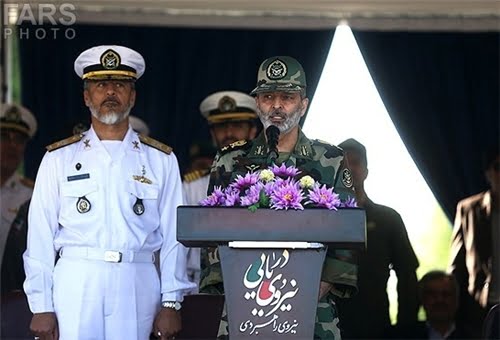
Intruders Should Pay Heavy Price – Lieutenant Commander of the Islamic Republic Army Brigadier General Abdulrahim Moussavi said Iranian air defense can even monitor moves across and beyond the country’s borders, and any aggressor who dares to violate Iran’s airspace will pay a heavy price.
General Abdulrahim Moussavi said, Intruders Should Pay Heavy Price
“Today, the enemy has come into the conclusion that the price of intruding Iranian skies will be high,” Moussavi said, addressing a ceremony on the occasion of the Air Defense Day in Iran on Monday.
He referred to the recent downing of an Israeli spy drone by the country’s air defense shield, and said, “This shows the full preparedness of the air defense and today 6 years after the establishment of an independent air defense base, all equipment, including strategic radars, have been built despite the sanctions (imposed by the West against Iran), which can monitor the enemies’ moves beyond the borders.”
Last Sunday, the Islamic Revolution Guards Corps (IRGC) announced in a statement that it had shot down an Israeli drone near the highly sensitive nuclear enrichment facility in Natanz in Central Iran.
The IRGC Public Relations Department said in the statement that the Israeli pilotless aircraft was a radar-evading, stealth drone with the mission to spy on Iran’s Natanz nuclear enrichment plant.
The IRGC also pointed out in its statement that the Israeli hostile aircraft had been targeted by a surface-to-air missile.
The IRGC then warned that it “reserves the right of response and retaliation for itself”.
A few hours later last Sunday, Director of the IRGC’s Public Relations Department General Ramezan Sharif told FNA that some of the parts of the downed aircraft are working, “and our experts are studying the information and intelligence of these parts”.
“We are now analyzing the information of this plane,” he added.
Then, Commander of the IRGC Aerospace Force Brigadier General Amir Ali Hajizadeh announced on Monday that “the downed spy drone is Hermes and made in Israel”.
He said the operational range of Hermes drones is 800 kilometers, adding that the aircraft can fly 1,600 kilometers by refueling once.
The General said parts of the aircraft have burnt out after it was targeted by the ground-to-air missiles and after its fuel tank blast, yet “some parts of this drone are intact and we are now analyzing the information and intel of these parts”.
Elaborating on the details of the down Israeli aircraft, the commander further stated that the drone, which is 5.5 meters wide in wings, is equipped with two cameras which can take high-quality photos.
“There was no prior information available about the aircraft and the only one of this type had been downed in Syria, but this one is more advanced,” General Hajizadeh said.
On Friday, Esmayeeli announced that the country’s home-made Shahab radar system played a major role in tracing the Israeli spy drone, adding that the aircraft was intercepted at an altitude of 3,700 meters (over 11,000ft).
“The Israeli spy drone, which enjoyed one of their most advanced technologies, was destroyed at the altitude of 3,700m,” Gen. Esmayeeli said.
He further underlined full operational harmony between the army and the Islamic Revolution Guards Corps in hunting the Israeli pilotless plane, and said, “This drone was targeted by firing only one missile, (and it is much precious because) otherwise it could have been dangerous to the Iranian aircraft flying through this or nearby corridors.”
“We allowed the drone to reach our desired zone because if it had been targeted at the borders, we could have lost its debris and the information of its cameras,” the Gen. added.
Also on Saturday, Chief of Staff of Armed Forces General Hassan Firouzabadi said Iran will target and destroy any enemy aircraft flying over its airspace.
“We will destroy any enemy aircraft which violates our country’s airspace,” Firouzabadi told FNA.
“The Israelis pursue spying policies and they have repeatedly shown that they are after spying on our country” in a bid to display that Iran’s nuclear program has a non-peaceful drive, while Iran has always been committed to international laws and pursues peaceful purposes in its nuclear activities.
“Hence, they move in line with this goal and use drones and other spying devices” to this end, Firouzabadi added.
Shahla Sherkat will be put on trial by Iran’s Press Court – A newly launched women’s monthly run by a prominent female editor has irked Iranian hard-liners, who have accused her of promoting “obsolete” feminist views and ideas that are un-Islamic.
Shahla Sherkat will be put on trial by Iran’s Press Court
Iran’s semi-official Fars news agency reported last week that Shahla Sherkat , editor of “Zanan-e Emruz,” will be put on trial by Iran’s Press Court on September 7. Fars, said to be close to the Islamic Revolutionary Guards Corps (IRGC), did not provide details about the charges against Sherkat.
The report has led to concern that action could be taken to shut down the monthly devoted to women’s issues.
Sherkat, whose previous publication was shut down under the administration of former President Mahmud Ahmadinejad, has not publicly commented on the report.
A Tehran-based journalist who used to work with “Zanan-e Emruz” confirmed in an interview with RFE/RL that the Fars report was accurate.
The journalist, who requested anonymity, said that the case against Sherkat appears to be based on a complaint related to the monthly’s first issue, which came out in May.
Previously, Sherkat published Iran’s leading women’s magazine “Zanan” (” Women”) for 16 years
Previously, Sherkat published Iran’s leading women’s magazine “Zanan” (” Women”) for 16 years. Authorities revoked the magazine’s license in 2008 for offering “a somber picture of the Islamic republic” and publishing “morally questionable information.”
In a 2009 piece, Sherkat wrote that the work of “Zanan” journalists reflected the problems and needs of women, with the aim of trying to build awareness and find solutions.
“To prevent our revelations about women and their issues from disturbing the public’s consciousness, ‘Zanan’ was closed,” she wrote.
Sherkat has been accused by hard-liners of continuing her work through “Zanan-e Emruz” and of spreading feminist ideas, which they believe are contrary to Islamic principles.
Even before it hit the newsstands on May 28, the monthly came under criticism from conservative websites and media outlets, which blasted its existence as a “failure” by the government of President Hassan Rohani.
Rohani has called for gender equality and promised Iranians more freedom, and the publishing of “Zanan-e Emrouz” had created hope for women’s rights advocates in the Islamic republic.
“While feminist views are in clear opposition to the Koran, the government has given license for the renewed publishing of a banned feminist magazine under a new name,”
When “Zanan-e Emruz” was launched, Iran’s state-controlled television asked whether granting a publishing license to Sherkat was in line with Iran’s interests, given her “background and deviant views.”
“Seven years after the closing down of the ‘Zanan’ magazine managed by a woman with feminist and Western views, a magazine with a different title yet run by the same woman has today been authorized for publication,” said the state television report.
‘Assault’ On Women’s Rights
The attacks by hard-line media have continued, including by the influential “Kayhan” daily, which claimed Sherkat works on feminist issues with groups opposed to the Islamic establishment.
Another conservative outlet, mashreghnews.ir, said Sherkat’s background and past work is the main reason for the objections to “Zanan-e Emrouz.”
The report said the worldview of Sherkat and other editors of “Zanan” were shaped by Western views of women, which, the website said, differ significantly from Islamic teachings.
“Because of the influence from feminist movements in the West, religion is being cited as one of the obstacles to achievement of women’s rights,” the June 3 report said.
The website also published an old photo of Sherkat sitting next to self-exiled Iran’s Nobel Peace Prize winner Shirin Ebadi, who’s come under fire from hard-liners for her human-rights activities.
Susan Tahmasebi, a well-known Iranian women’s rights activist, says Sherkat has always been very mindful of the many red lines in the Islamic republic, especially with regard to female civil liberties, which have always been a sensitive issue.
She says “Zanan-e Emrouz” covers the issues and problems of concern to women in a “moderate manner.”
“‘Zana-e Emruz’ has become a space for Iranian women to discuss and reflect on women’s issues,” she says. “It reflects the concerns of half of the country’s population.”
Tahmasebi believes the outcry over Sherkat and her publication are “an assault” on women’s rights.
“The men who try to stifle her or others similar to her should really keep in mind that these are demands and issues that their family members, their wives, their mothers, their sisters, and their daughters are dealing with, and just suppressing them is not going to make them go away,” said Tahmasebi, who lives in the United States.
Among stories the monthly has covered since its launch are an interview with Indian American novelist Jhumpa Lahiri, a discussion with Iranian author Goli Taraghi, a report about Iran’s ban preventing women from entering sports stadiums, and an interview with prominent human-rights defender Emad Baghi regarding a campaign to end executions.
Name of IRGC intimidating enemies, reassuring friends – Prominent cleric Seyyed Ahamd Khatami on Sunday said that the enemies are so scared about the Islamic Republic Guards Corpse (IRGC) that they don’t dare to utter its name.
Prominent cleric Seyyed Ahamd Khatami: Name of IRGC intimidating enemies, reassuring friends
Khatami, who serves as Tehran’s substitute Friday prayer leader, praised the IRGC for its relentless efforts in preserving the values and teachings of the Islamic revolution.
“Today, the name of IRGC is intimidating and distressing to the enemies and reassuring for our friends and allies,” Khatami told a gathering of lecturers and students in Imam Hussein University in Tehran.
“The force has successfully played its role in various stages of the revolution, including the eight-year imposed war on Iran and the unrest after the 2009 presidential election in which IRGC’s position was improved and stabilized,” he stated.
Iran’s Summer Massacre of 1988 – 26 years ago around this time, the most horrific crime was committed by the Islamic regime in Iran and thousands of political prisoners were executed during the month of July. The massacre went on in several prisons around the counry but Evin and Gohardasht prisons particularly witnessed massacre in a much bigger scale.
Iran’s Summer Massacre of 1988
Around the first week of July in 1988 in Evin , as in Gohardasht, the television was taken away. Those newspapers approved for the prisoners were stopped, all visits to the infirmary were cancelled and any official calling of prisoners ceased. All visits by relatives, usually fortnightly, were cancelled. In fact, all the blocks were put on a ‘quarantine footing’. No one could enter. No one could leave.” Prisoners did not know what was happening and what was awaiting them.
Late in July 1988, Ayatollah Khomeini had to reluctantly accept the UN ceasefire to end the war with Iraq. Regime was well aware of the fact that when war is finished they will face mass protests by people who have suffered eight years during the war and were being forced by the regime to sacrifice thousands of lives and bear economic meltdown. Regime could no longer use the excuse of war to legitimize the unbearable social and economic living condition of millions of people, and it was in danger of facing mass unrests.
The massacre of political prisoners in 1988 was deliberately planned to remove the potential political opposition, terrorize the general public and prevent further protests and unrests in Iran. They started executing thousands of political prisoners including those who served their sentences but refused to comply with the Islamic regime.
In the summer of 1988, when the massacre started, every day prisoners were taken to the “Death Committees” which were established in each prison and were consist of 3 or 4 of the most notorious prison and intelligent service officials. Prisoners were kept in an brutal conditions, tortured and then were put on 1-2 minutes military style “trial“ without being able to defend themselves. Meanwhile, all communications to and from prison, including visit from families, were halt. Geoffrey Robertson QC and human rights barrister describes this massacre: “Thousands of prisoners were blindfolded and paraded before the death committee which directed them to a conga line leading straight to the gallows. They were hung from cranes, four at a time, or in group of six from ropes hanging from the stage of the prison assembly hall. Their bodies were doused with disinfectant, packed in refrigerates trucks and buried by night in mass graves the locations of which were (and still are) withheld from their families”.
Many executed prisoners were buried in mass graves in one part of Khavaran Cemetery
The families of prisoners were not told where their loved ones were buried; they were even banned from mourning for their loved ones. Many executed prisoners were buried in mass graves in one part of Khavaran Cemetery which is called “The Place of the Damned” by the Islamic regime.
26 years have passed and the families of executed political prisoners still do not know where their loved one are buried. Every year, families attend Khavaran Cemetery to commemorate their executed children, even though these gatherings are not tolerated by the regime and they are often attacked by revolutionary guards.
Around 5000 political prisoner were tortured and executed in a period of month in 1988.
Israel May Never Gain Victory Again – Iranian Defense Minister Brigadier General Hossein Dehqan pointed to the recent “humiliating” defeat of Israel in the war against the Palestinians, and said the Zionist regime will never again taste victory in any war in future.
Iranian Defense Minister: Israel May Never Gain Victory Again
“The usurper Zionist regime will no more win any war and it doesn’t even have the power to take a decision about entering a new war and their threatening rhetoric is also no more than a political bluff,” Dehqan said, addressing the meeting of the defense ministry’s strategic council in Tehran on Monday.
He described the “humiliating” defeat of the Zionist regime in the recent Gaza war as the failure of the US policies in the region, and said it is now the time for the Americans to accept the regional realities and rescue themselves from the whirlpool created by the Zionists by stopping their interference and support for Zionism and terrorism.
“Today the resistance enjoys the capabilities which can confront any threat of the Zionist regime with even an upper hand and materialize its goals and demands,” Dehqan said.
Last week, joyous Palestinians streamed into the streets of Gaza and celebrated victory after seven weeks of resistance against the Israeli offensive.
On Tuesday, Palestinian groups and Egyptian mediators confirmed that the Cairo-based talks ended in truce.
Palestinian and Egyptian officials said the deal calls for an indefinite halt to the war, the immediate opening of Gaza’s blockaded crossings with Israel and Egypt and a widening of the territory’s fishing zone in the Mediterranean.
Under a second stage of the truce that would begin a month later, Israel and the Palestinians would discuss the construction of a Gaza sea port and Israel’s release of Hamas prisoners in the occupied West Bank.
The Guardian– Persian paranoia: America’s fear of Iranian cyber power.
Months of research into Iranian networks uncovered at least 16,000 systems controlled by Iran outside of its borders
When Israel stepped up Operation Protective Edge in Gaza in July, a crew of hackers going under the name of the Izz ad-Din al-Qassam Cyber Fighters readied their attack tools to show support for their Palestinian brothers.
They attempted to flood a core piece of Israel’s internet infrastructure, the Domain Name System that acts as the web’s phone book for the country. They also tried to take down websites for the national stock exchange and Mossad, the intelligence and special operations body.
Thanks to Israel’s capable cyber defence systems, the attacks caused little trouble, though security firm iSight Partners says the websites were briefly out of action.
Their attacks previously knocked out the websites of top US banks, under the moniker Operation Ababil, but the Cyber Fighters’ gaze has shifted to events closer to home in recent months.
What makes them especially fascinating to the West, however, is that they are almost certainly sponsored by the Iranian government, according to various sources with knowledge of the matter, speaking with the promise of anonymity to the Guardian.
The group, which has compromised large numbers of websites by exploiting vulnerabilities in tools like WordPress, pooling their resources to launch their Distributed Denial of Service (DDoS) strikes, is just one of many actors that form part of Iran’s growing cyber capability, according to US firms.
Indeed, there is a rising anxiety amongst US public and private sector mandarins surrounding Iran’s apparent digital prowess, as evinced by research the Guardian was briefed on ahead of its September release.
‘The groups are allowed to operate on financial crimes…’
Rather than large, singular groups of digital spies, Iran has quietly built up a secret, disparate army of “mercenaries”, each separate from one another but with similar aims, according to the authors of the report, which will be published soon by Silicon Valley security company Norse.
Months of research into Iranian networks uncovered at least 16,000 systems controlled by Iran outside of its borders, 2,000 of which were infected machines of businesses in the US, Israel and other nations of interest, claims Norse chief technology officer and co-founder Tommy Stiansen.
Caption. Screenshot: Norse
Many of the Internet Protocol addresses (IPs) of those machines are hosting .ir websites – domains that are being used as platforms for attacks. In many cases, visitors to those sites are subsequently infected with malware – software designed specifically for surveillance and to siphon off valuable data from target organisations, according to the firm.
These Iranian mercenaries were ostensibly hacking foreign businesses both for their own gain and for the benefit of their country, says Stiansen. “Cybercrime is tied to the same people doing cyber warfare in Iran,” he adds. “The groups are allowed to operate on financial crimes as well as state sponsored crimes… They don’t have a military machine for their cyber warfare programme.”
Most targets are based in the US, though attacks have also hit the UK, Israel, Germany and Canada, amongst others, Stiansen says, claiming successful attacks were taking place “every week”.
“In US there is a huge infiltration of Iranian activity,” he adds, noting the attacks were “geopolitically tuned”. Critical infrastructure bodies, including utilities and internet service providers, and government bodies are among those on the hit lists of Iran’s online soldiers of fortune.
Various US and European hosting companies have been abused by too. Cloud and hosting services of industry giants like Amazon and GoDaddy are being used to launch the attacks, Norse’s research indicates.
Kurt Stammberger, senior vice president at the firm, suggests Iran’s digital hirelings have used external hosting firms as they “don’t necessarily have access to [the technology] inside of the country to launch attacks”. “They’re using western infrastructure to launch attacks against western infrastructure.”
‘We’ve got telescopes where others don’t…’
Norse believes previous research into Iranian activity may have included false assumptions about the actors involved, as Iran has been adept at creating disinformation, using more than 5,000 fake social networking profiles to trick onlookers into following tracks that led to nobody and nowhere.
iSight released a report in May, claiming these fake profiles were being used to spy on military leaders and political staff from across the world. The company told the Guardian it had seen the so-called Newscaster team target Iraqi ambassadors in recent months.
In its own research, Norse set up fake systems that appeared to belong to businesses and critical infrastructure providers that would have proven attractive to attackers. They then collected data on subsequent attacks, tracing a large number back to Iran. Norse also relied on “millions of sensors dropped all over the world” and analysis tools to connect the dots.
Meanwhile, it has mapped networks throughout the Middle Eastern nation to gain a good understanding of the nation’s cyber capability, uncovering various malicious hackers operating within Iran. “We’ve got telescopes where others don’t,” adds Stammberger.
Stiansen also believes he has evidence indicating Turkish and Iranian collaboration on cyber issues. In exchange for oil and other goods Turkey reportedly helped Iran circumvent US and European sanctions, implemented in response to the country’s nuclear programmes. Stiansen suspects there may also be digital deals on the table.
“There was a huge surge of attacks coming out of Turkey once they started cooperating. Believes there is a correlation with Iran’s cyber warfare programme. We will be looking at how Turkey’s cyber programme is being infused with knowledge from Iran probably in exchange for violating sanctions in Iran.”
Neither the Turkish nor Iranian embassies in London responded to requests for comment from The Guardian.
The company plans to release its full ‘Pistachio Harvest’ research in September with two Washington D.C.-based think tanks. Stammberger says the firm will share the most sensitive information with the relevant intelligence agencies, but the rest will be made public.
Security consultants the Guardian contacted on Norse’s claims aren’t entirely sure there is enough proof of Iranian involvement. Some of the systems identified by Norse were hosting all kinds of malicious activity and the use of .ir domains was not enough to confirm the Iranian government backed the attacks, according to researchers from security companies Rapid7 and AlienVault Labs.
“The fact of .ir domains being in there does not lead to any attribution by itself,” says Rapid7’s Mark Schloesser. But Norse believes it has enough evidence to substantiate its claims, which it will soon detail in full.
“When you start seeing this pattern of thousands, tens of thousands of sites that all are controlled by Iranian nationals, that are all located in the West, then you start to think: this seems like more of a programme that has been thought out, that is sophisticated and is directed at a higher level,” Stammberger adds.
‘Recent college graduates who are very technically proficient…’
Though Norse itself is unsure about previous research into Iran, it couldn’t rule out the claims of a rival firm, CrowdStrike, which says it is tracking four different Iranian groups it calls Kittens. Each Kitten is separate from the other and has its own modus operandi and target list, says Dmitri Alperovitch, CTO and co-founder at CrowdStrike.
Flying Kitten, also known as the Ajax hacking team, is focused on gathering intelligence on foreign governments and corporations of interest. Magic Kitten targets dissidents within Iran, whilst Charming Kitten uses social networking platforms to attack various targets. Finally, there’s Cutting Kitten. “This is a group that has produced a lot of website penetration tools that we see used by Iranian intrusion teams,” Alperovitch says.
CrowdStrike is also tracking a number of individuals – “young individuals, recent college graduates who are very technically proficient”. Alperovitch believes these hackers are likely to strike if the extended negotiations between Iran and the US over the former’s nuclear programme come to nought.
The US is hopeful it can strike a deal which would see sanctions lifted if Iran agrees to limit its activities and turns stores of its enriched uranium into fuel rather than weapons. In July, the deadline for an agreement was extended by four months and moved to November.
“We are very concerned about what is going to happen over the next four months as we wrap up the negotiations. If things don’t go well, we expect to see some of these [Kittens] supported by the regime lashing out to send a message to the West that they’re a power to be reckoned with,” Alperovitch adds.
Iran was the victim of what remains the most infamous act of nation state-sponsored cyber activity: Stuxnet. In 2010, it emerged the Stuxnet malware was used to infect an Iranian nuclear plant in order to upset the nation’s uranium development. Reports later suggested the US and Israel orchestrated the attacks, though neither has confirmed nor denied the claims.
‘We have seen a few cases that had a big impact…’
Iran has been suspected of various documented attacks since then, including the Shamoon event of 2012, which saw 30,000 PCs at oil giant Saudi Aramco infected and wiped.
The DDoS attacks of Operation Ababil knocked out websites of some of US’ top banks, from Bank of America to Wells Fargo. And according to DefenseTech, the Iran Islamic Revolution Guards Corps (IRGC) has a budget of $76m to spend on its cyber efforts.
All this has led to understandable anxiety in the US over Iran’s ability to disrupt American infrastructure at a critical time in relations between the two nations. Iran is certainly a cyber power to watch in this arena, adds Alperovitch.
“The Iranians have gotten a lot more proficient in recent years. They used to be a third tier cyber power in our estimation and they’ve rapidly moved up to second tier,” he says. “They’ve invested a lot of resources into offensive and defensive cyber measures.”
Though it would be easy to accuse American firms of hyping up the threat, the US and others appear to have good reason to be paranoid about Iran’s digital capability. “While some of the campaigns coming from Iran are not very sophisticated we have seen a few cases that had a big impact and were far more sophisticated,” says Jaime Blasco, director of AlienVault Labs.
Professor Ian Brown, associate director of Oxford University’s Cyber Security Centre, says given the past attacks on Iran, it’s highly likely to be shovelling vast sums into offensive technologies.
“Obviously, many other countries will be developing their own capabilities, even if they are unlikely to get to the scale of the Five Eyes. And given Iran was the target of the most sophisticated cyberweapon that is publicly known to date (Stuxnet), I would be surprised if they were not investing in their own capabilities,” Brown adds.
Whatever the truth about the nature of the attackers, and whatever their levels of skill and power, Iran certainly has the attention of the digital defenders of the Western world.