Home Blog Page 358

Six Sunni prisoners were interrogated and threatened in IRGC ward

0


HRANA News Agency – Six Sunni prisoners in Rajaie Shahr prison of Karaj were summoned to IRGC ward in this prison, interrogated and threatened.rajaii

According to the report of Human Rights Activists News Agency in Iran (HRANA), on December 10, six of Sunni prisoners of Hall No. 10 of Rajaie Shahr prison were summoned to ward 8 -IRGC ward- and were interrogated for hours.

Hossein Ghaderi and Azad Saqqezi are from Javanrood, Yousef Moradi, Yasin Mohammadi and Arkan Sarpoli from Sarpol Zahab and Ma’az Hakimi from Paveh are the six prisoners who were summoned to IRGC ward.

A source told HRANA reporter “They were interrogated and threatened in IRGC ward for hours.They were questioned about their phone calls with their relatives, mosques’ Imams and as well the leaked news about the other Sunni prisoners of Rajaie Shahr prison.”

Iran committed to making a deal

0

(Ebrahim Noroozi/AP) - Iran's Foreign Minister Mohammad Javad Zarif holds a joint press conference with his Russian counterpart Sergey Lavrov in Tehran, Iran, Wednesday, Dec. 11, 2013. Lavrov arrived in Tehran late on Tuesday, for meetings with Iranian officials about a nuclear deal, and the ongoing crisis in Syria. (AP Photo/Ebrahim Noroozi)
(Ebrahim Noroozi/AP) – Iran’s Foreign Minister Mohammad Javad Zarif holds a joint press conference with his Russian counterpart Sergey Lavrov in Tehran, Iran, Wednesday, Dec. 11, 2013. Lavrov arrived in Tehran late on Tuesday, for meetings with Iranian officials about a nuclear deal, and the ongoing crisis in Syria. (AP Photo/Ebrahim Noroozi)

By David Ignatius, Published: December 15 E-mail the writer

TEHRANIranian Foreign Minister Mohammad Javad Zarif said that despite hitting a “snag” in nuclear negotiations last week, Iran is  committed “100 percent” to reaching a comprehensive final agreement. But he voiced tough positions on key issues and said “it’s going to be a bumpy road,” with difficult bargaining ahead.

Zarif, who is Iran’s top chief negotiator, outlined his views in an hour-long interview at the foreign ministry here Sunday. He said that his country would continue the talks, despite what he called the “extremely counterproductive” U.S. Treasury Department announcement last week ofnew steps to enforce existing sanctions.

Iranian concern was eased, Zarif said, after his contacts last week with Secretary of State John Kerry, Russian Foreign Minister Sergei Lavrov and the chief European Union negotiator, Lady Catherine Ashton. “What I have heard from Secretary Kerry and Lady Ashton is that they are committed to an early finalization of the Geneva process with a view to reaching a comprehensive agreement. I share that objective.”Dressed in a diplomat’s blue pinstripe suit and speaking fluent, American-educated English, Zarif presented Iran’s case on nuclear and regional issues. He was frank about his disagreements with leaders of the Iranian Revolutionary Guard Corps and said Iran was ready to play a more active role in ending the war in Syria and in providing greater security in the Persian Gulf.

Zarif, seen by critics as the leader of Iran’s “charm offensive,” has become the most visible international face of a regime seeking a deal that would end punishing economic sanctions. He helped negotiate the breakthrough interim agreement reached last month in Geneva to freeze Iran’s nuclear program for six months. He said that in a follow-on comprehensive agreement, Iran would affirm its commitment to a peaceful nuclear program. But he didn’t provide specific responses to administration concerns about activities the U.S. argues aren’t consistent with a civilian program.

On enrichment, for example, Zarif insisted that Iran could continue its domestic program with some limits and greater transparency. “We do not see any reason now that we have put so much time and effort in it, and brought [the West] to the point of abandoning the illusion of zero enrichment in Iran, why should we accept anything less.”

As for Iran’s heavy-water reactor at Arak that would produce plutonium that could be reprocessed as nuclear fuel, Zarif explained: “We cannot roll back the clock 20 years and ask Iran to simply get rid of a project that has been the subject of a great deal of human and materiel investment. However, there are various ways of making sure that this reactor will remain exclusively peaceful.”

Asked about a U.S. demand to close the enrichment facility at Fordow, built into a mountainside, Zarif said: “If you sit in Iran, and you see people having concerns about Fordow, the only conclusion you can draw is that they want to attack you.”

Zarif said he didn’t want to negotiate in public, and he argued that acceptable compromises could be found on such issues. But President Obama, pressed by Israel, has said he wouldreject an agreement that doesn’t reverse the Iranian program and ensure that it will be restricted to civilian uses only.

“We do not follow a policy of ambiguity; this is not our intention. We follow a policy of clarity — that we do not seek nuclear weapons,” Zarif said. “But we’re not going to accept diktats.”

Zarif acknowledged his recent public dispute with Maj. Gen. Mohammad Ali Jafari, the head of the Iranian Revolutionary Guard Corps, about what Zarif said were Iran’s limited military capabilities. “I respect Gen. Jafari’s remarks, his views, and I expect him to have differences of views with me,” he said. He also noted that some hard-liners in Iran who oppose a deal with the West “have asked for my removal.”

But Zarif insisted that he and President Hassan Rouhani lead a consensual process in all areas of foreign policy, including regional issues such as Syria. “Iran believes there is no military solution for Syria,” Zarif said, noting that he is ready to attend a so-called Geneva 2conference to seek a political settlement, so long as there are no preconditions for the removal of President Bashar al-Assad.

“We’re living at a crossroad,” the Iranian foreign minister said. But he rejected former U.S. Secretary of State Henry Kissinger’s argument that Iran must become “a nation rather than a cause.” He argued that, like America, Iran wanted to press both its values and its interests. America isn’t alone in seeing itself as an “extraordinary nation,” Zarif said: “We do, too.”

Washıngton Post

IRGC forces arrest music distributors, pressure them to confess on television


IRGC intelligence arrested musician Mehdi Rajabian, his brother, and Yousef Emadi, who managed BargMusic on October 12 in the northern city of Sari.  The prisoners were Arresttransferred to IRGC’s Ward 2-A inside Tehran’s Evin Prison. The three were involved in the production, distribution, and promotion of Iranian underground music and they are being pressured  to confess on television. The arrests appear to be part of a larger crackdown on Internet and IT professionals and musicians. Last week, popular Iranian musician Amir Tataloo was arrested and detained for several days before being released on bail awaiting trial.

irandailybrief

Iran’s Revolutionary Guards Commander Criticizes His Government Over Western Influence


Iran's Revolutionary Guards commander Mohammad Ali Jafari looks on while attending Friday prayers in Tehran February 10, 2012. CREDIT: REUTERS/MORTEZA NIKOUBAZL
Iran’s Revolutionary Guards commander Mohammad Ali Jafari looks on while attending Friday prayers in Tehran February 10, 2012.
CREDIT: REUTERS/MORTEZA NIKOUBAZL

(Reuters) – The commander of Iran’s elite Revolutionary Guard force has criticized the government of President Hassan Rouhani as being under the influence of Western ideas, a sign of the growing tensions between the competing power centers.

Major General Mohammad Jafari’s comments are some of the sharpest to be made by a senior official in public since the moderate Rouhani took office in August pledging to improve Iran’s relations with regional countries and the West.

The government’s diplomatic initiative led to an agreement with six world powers last month under which Iran is to curb its disputed nuclear program in return for limited relief from sanctions that have squeezed its economy.

The interim accord has been widely welcomed by Iranians but hardliners are irked by the foreign policy shift and apprehensive that they are losing influence over Iran’s most powerful man, Supreme Leader Ayatollah Ali Khamenei.

“The military, systems and procedures governing the administrative system of the country are the same as before, (but it) has been slightly modified and unfortunately infected by Western doctrine, and a fundamental change must occur,” Fars news agency quoted Jafari as saying on Tuesday.

The comments by Jafari – the commander-in-chief of the Islamic Revolutionary Guard Corps (IRGC) – underline the changing circumstances since hardline president Mahmoud Ahmadinejad left office after two terms.

During those eight years, the IRGC was able to strengthen its involvement in economic and political affairs of the country, a role Rouhani is intent on reversing.

Jafari also appeared to dismiss calls by Rouhani and Khamenei for the force to stay out of politics, saying its duty was to protect the Islamic Revolution.

“The main threat to the revolution is in the political arena and the Guards cannot remain silent in the face of that,” he said.

“TURF WAR”

Siavush Ranjbar-Daemi, a lecturer in Iranian politics at Manchester University in Britain said: “From the moment this presidency started Rouhani has been trying to redefine the IRGC presence in politics. He sees them as an obstacles to the nuclear agreement”.

“He’s trying to acquire as much influence as possible over Khamenei. Clearly the relationship between Rouhani and the Guards is not good. There will be a lot of adjustments and turf war.”

Rouhani’s policies have so far gained the endorsement of Khamenei, who has the final say in Iran’s foreign and security policies but who holds a deep distrust of Western countries and their motives against Iran.

Jafari also chastised Foreign Minister Mohammad Javad Zarif for a comment he was said to have made indicating Iran was militarily weak.

Zarif was quoted by local media last week as saying the West had little fear of Iran’s military defenses and could destroy them if it wished, although Zarif has said his statement was skewed and taken out of context.

“We consider him an experienced diplomat, but he has no experience in the military field,” Fars news agency reported Jafari as saying on Tuesday, without naming Zarif.

Jafari was answering a question about whether U.S. forces could destroy Iran’s military capability with just a few bombs.

“It’s not like that at all. He has no military experience or expertise,” Jafari said during a visit to Tehran’s Imam Sadiq University.

Iran’s hardline factions are struggling to come to terms with Rouhani’s technocratic ministers such as Zarif who speak English, boast western educations and regularly use social media to get their messages out.

They also fear being marginalized by Rouhani on issues of national security, such as Syria. Jafari was explicit in saying Iran would not halt its support of its Arab ally, Syrian President Bashar al-Assad.

Iran has provided vital military and economic help to Assad in the Syrian civil war which has helped him reverse gains made by the rebels.

“We have announced before that we have specialist forces to transfer experience and training in Syria who work as advisers and this is public knowledge,” Jafari said.

“We will do whatever we can and is necessary to protect Syria because Syria is the front line of the Islamic Revolution”.

(Editing by Angus MacSwan)

Head of Iran Revolutionary Guards: Sanctions increase regime’s support


Maj.-Gen. Muhammad Ali Jafari, the commander of Iran’s Revolutionary Guards, said on Sunday that sanctions have only increased the peoples’ support of the regime.Sardar_Jafari

“They suppose that they can force the Iranian nation to surrender by doing so, but the outcome of all these sanctions has been the massive presence of the people in the rallies and at the ballot boxes as well as [their growing] support for the Islamic establishment and its noble objectives,” he said according to a report in Iran’s Fars News Agency.

“The enemies are orchestrating many plots against Iran, and they are trying to meddle in the country’s affairs through political and security issues in a bid to divert the revolution from its path, and because their [previous] moves in doing so have failed to make any success,” he said.

Meanwhile, the head of Iran’s Basij forces, Brig.-Gen. Muhammad Reza Naqdi, said that the US claim that all options are on the table is a bluff.

Referring to US President Barack Obama’s comment that a military option is still possible against Iran, he said: “These are just boastful remarks and bluffing, because the US army and its economy are weak and their people do not accept to go to [another] war.

“The US does not have a strong logic and reasoning, and it is thus forced to always resort to the language of force,” he said.

The major P5+1 powers (the five permanent UN Security Council members plus Germany) will continue negotiating with Iran over its nuclear weapons program later this week.

JP

Iran, UAE Close to Deal on Hormuz Islands

0


By AWAD MUSTAFA
 Monday Dec 9, 2013

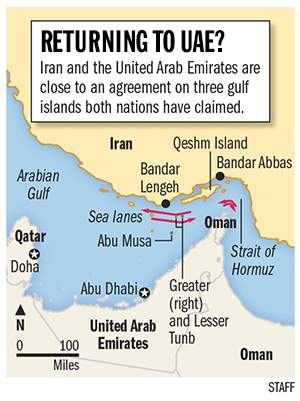
Iran and the United Arab Emirates (UAE) are close to reaching a deal on returning three Iranian-occupied islands in the Arabian Gulf to the UAE.map

Sources close to the negotiations have stated that a deal for the return of the strategic islands to the UAE was laid out during the recent visit of UAE Foreign Minister Sheikh Abdullah bin Zayed al Nahyan to Tehran, and a response was presented during last week’s return visit by his Iranian counterpart, Mohammed Javad Zarif.

Theodore Karasik, director of research and development at the Institute for Near East and Gulf Military Analysis, confirmed that the two countries are on the verge of a breakthrough.

“Sheikh Abdullah’s visit to Tehran focused on the islands issue, and the Iranian side reacted positively,” he said. “Iranian Foreign Minister Zarif quickly came to Abu Dhabi to meet with President Sheikh Khalifa bin Zayed Al Nahyan and meet with other senior leaders to further cement a workable agreement for the transfer of the islands to the UAE while Iran retains the seabed rights.”

The strategically located islands of Abu Musa and the Greater and Lesser Tunbs are close to the Strait of Hormuz, the world’s most important oil chokepoint. The islands were occupied by Iran’s Shah Mohammad Reza Pehlavi less than 48 hours before the declaration in 1971 of the establishment of the United Arab Emirates.

The largest of the three Islands, Abu Musa, had been under the administration of the emirate of Sharjah, while the Greater and Lesser Tunbs belonged to the emirate of Ras al Khaimah, according to official UAE records.

Last year, the Iranian Revolutionary Guard Command (IRGC) inaugurated a naval base on Abu Musa. Karasik said the naval base housed hundreds of short-range missiles “for Tehran’s security purposes over the Strait of Hormuz.”

During Zayed’s visit to Tehran, the first breakthrough was Iran’s acceptance to start discussions on Abu Musa. However, Zarif was quick to reiterate Iran’s sovereignty over them, and said in a press statement released on state news agency Fars that Tehran is ready to hold talks with the UAE only to remove possible misunderstandings over one of these islands.

“We are ready for talks with the UAE on the misunderstandings [on the implementation of the 1971 Memorandum of Understanding] on Abu Musa,” Zarif wrote on his Facebook page on Dec. 3.

Last week, Iranian President Hassan Rouhani extended an invitation to Khalifa and Vice President Sheikh Mohammed bin Rashid to visit Iran.

“The situation is a win-win because the Islamic Republic wants to put aside this contentious issue while the UAE can claim its historical rights to the islands,” Karasik said.

In addition to the strategic benefits, a deal could mean large economic benefits for both countries, he added, “given Dubai’s economic linkages with Iran, and the fact that they both stand to benefit from the lifting of the sanctions.”

Before sanctions were imposed in 2007, trade between the UAE and Iran focused on consumer goods, foodstuffs and livestock. The estimated value of annual trade was between 36.7 billion dirhams and 44.1 billion dirhams (US $10 billion to $12 billion), said the Iranian Business Council.

After the 2007 sanctions, the value of direct exports from Dubai to Iran, according to the city’s Department of Economic Development, was 1.8 billion dirhams.

US Secretary of State John Kerry acknowledged the financial strain that the sanctions have brought to gulf countries during his recent visit to Abu Dhabi, noting that after the introduction of tougher sanctions in 2012, trade has dropped to a record low of $4 billion.

“I know that many nations, especially the United Arab Emirates, have suffered from the Iranian sanctions,” Kerry said. “Just today, I have learned that trade with Iran has dropped from $23 billion to just $4 billion. That’s a huge sacrifice.

“We have real partners in the UAE, and this affects them,” he said. “This is something that Congress and others need to take note of as we think about where we are going in the future.”

Abdel Khaleq Abdullah, a United Arab Emirates University political science professor, said if a deal on the islands emerges, it will be a watershed in gulf-Iranian relations.

“This has been a 40-plus years dispute between Iran and the UAE, and any solution to this dispute is a good solution as long as both parties agree to it,” he said. “Putting an end to this dispute is not only a huge step for the UAE and Iran, but it also proves a major improvement in relations between Iran and the [Gulf Cooperation Council] leading to the lessening of tensions in the gulf. If it’s true, it is a cause for celebration.”

Abdullah said talks have been on and off during the past 40 years.

Taufiq Rahim, a strategy adviser and political analyst based here, agreed that something is in the works.

“Definitely, there are negotiations ongoing, and the UAE is the first country Iran wants to make overtures to,” he said. “The best way to do that is reaching an agreement on the islands.”

Rahim added that when Khalifa visits Iran, he expects an announcement to be made.

Defense News

Will Iran’s Covert War Continue?


They say old habits die hard. For Iran’s elite Quds Force, the secretive external branch of the Revolutionary Guard, the habits of subversion and mafia-style revenge against the irankurd948Islamic Republic’s adversaries may never die at all. The actions of these self-described promoters of the Islamic Revolution may just determine whether the smiles, handshakes, and twitter posts of President Rouhani signal an end to Iran’s destabilizing meddling in the Middle East — or are a mere diversion from the unrelenting sectarian aims of the regime’s true power brokers.

With the eyes of the world still sharply focused on Iran’s behavior following the clinching of an interim nuclear agreement with the P5+1, the restraint of the Quds Force is already being tested.

On November 19, just as Tehran’s negotiating team arrived in Geneva to hammer out the last details of that agreement, the Iranian embassy in southern Beirut was hit by a devastating double suicide bombing attack. Twenty-three people were killed, including Iran’s cultural attaché and several other nationals whose identities and affiliations have not been disclosed.

On the surface, the attack could be construed as part of an ongoing campaign by Syrian rebel sympathizers to target pro-Assad regime elements in Lebanon, preceded by two other indiscriminant bombings in Hezbollah-dominated suburbs of the city in recent months.

But both Hezbollah and Iranian officials red-flagged this attack for its notable sophistication, indicating the hand of a far more capable foreign power. According to their claims, the attackers knew the location of the ambassador’s office and his itinerary that day, with the second bomber using sophisticated explosives meant to detonate upwards rather than horizontally in order to collapse the building.

Since then, Hezbollah and Iran have spared no effort in implicating their arch-sectarian nemesis in the region — Saudi Arabia. Officially, no concrete link has been proven between the attackers, a Palestinian and Lebanese each tied to anti-Assad jihadists, to the Saudi government. But if anyone were to have a motive to provoke the Iranians as they negotiate the end to their long-standing isolation, it would be Saudi Arabia’s powerful intelligence chief Prince Bandar Bin Sultan. Prince Bandar has been at the center of a deepening row in Saudi-U.S. relations, enraged over the Obama administration’s refusal to intervene in Syria and more so at the thought of Western rapprochement with the Islamic Republic. Bandar is also known for his intimate and hands-on relationship with an array of Syrian rebel groups.

For Bandar or anyone else seeking to punish Iran, its Beirut embassy was the perfect target. It doubles as a nerve center for Revolutionary Guard operations in the eastern Mediterranean, tasked with funneling arms to Hezbollah and is also a key command-and-control hub for Iranian support for Syria’s Assad regime.

Before Rouhani’s foreign policy overhaul, the Quds Force would have had free reign in seeking eye-for-an-eye punishment for the embassy attack, similar to those often handed down to common criminals at home. In recent years, the Quds Force has been blamed for plots targeting Israeli diplomats in India, Thailand, Georgia, and Armenia in response to sabotage attempts against its nuclear program, allegedly orchestrated by the Mossad. The Saudis as well have also been targeted for opposing Iran. In December 2012, the state-owned Aramco oil firm was hit with an unprecedented cyber attack, while a particularly reckless plot to assassinate the Saudi Ambassador in Washington DC was thwarted in October 2011.

The Quds Force and their deceivingly humble leader Qassim Solemani don’t answer to Rouhani, but they are fiercely loyal to the Supreme Leader — who knows full well that any overt response against Saudi Arabia or any other adversary would risk reversing Iran’s now rapidly unraveling isolation.

While the Quds Force may have their hands tied for now, their influence has become so entrenched in Shiite communities throughout the region that they may not need to strike back personally. In their stead are dozens of devoted proxies based in Iraq, Syria, Lebanon, the Palestinian territories, Yemen, Bahrain, Saudi Arabia, and anywhere else in the region where neglected Shiite communities or anti-Western extremists can be found. Chief among them are the religiously devout and increasingly aggressive Shiite militias in Iraq and Lebanon, who have now become the most crucial cog in the Assad regime’s killing machine under Iranian direction, with little objection from the international community.

It is thus no surprise that Saudi Arabia has warned its nationals to leave Lebanon amidst a flurry of threats against its Beirut embassy. It is also no coincidence that an Iranian-loyal, Iraqi-based Shiite militia took responsibility for a rare rocket attack on a Saudi border post on November 22, just three days after the Beirut attack. There is no telling what else these groups may do to attack Saudi Arabia or its allies under the banner of defending their financial, ideological, and military patrons in Tehran.

One thing, however, is certain. The Quds Force is not one to forgive or forget — and their worldwide, state-funded network of operatives can be counted on to return the favor for the Beirut bombings, even if it requires patiently waiting for the world to turn its eyes away from the Iranian nuclear crisis.

Amidst the flurry of debate over Iran’s trustworthiness and willingness to transform itself into a responsible regional power, the destabilizing presence of the Quds Force cannot be ignored. Rapprochement with Iran cannot go hand-in-hand with ignoring the promotion of violent Shiite Islamic extremism. Anyone who allows Iran to enrich uranium without demanding that Tehran reign in the Quds Force will be complicit in placing the tentacles of terrorism within arm’s reach of the world’s most dangerous weapons.


huffingtonpost

Iran’s “Wipe Israel Off the Map” Calls are Diversionary


The politically correct west’s misreading of the Iranian’s true intentions led to a bad agreement that allows Iran’s grand design to move forward.

Dr. Avi Perry Dr. Avi Perry, talk show host at Paltalk News Network (PNN), is the author of "Fundamentals of Voice Quality Engineering in Wireless Networks," and more recently, "72 Virgins," a thriller about the covert war on Islamic terror. He was a VP at NMS Communications, a Bell Laboratories - distinguished staff member and manager, as well as a delegate of the US and Lucent Technologies to the ITU—the UN International Standards body in Geneva, a professor at Northwestern University and Intelligence expert for the Israeli Government. He may be reached through his web site www.aviperry.org
Dr. Avi Perry
Dr. Avi Perry, talk show host at Paltalk News Network (PNN), is the author of “Fundamentals of Voice Quality Engineering in Wireless Networks,” and more recently, “72 Virgins,” a thriller about the covert war on Islamic terror. He was a VP at NMS Communications, a Bell Laboratories – distinguished staff member and manager, as well as a delegate of the US and Lucent Technologies to the ITU—the UN International Standards body in Geneva, a professor at Northwestern University and Intelligence expert for the Israeli Government. He may be reached through his web site www.aviperry.org
The agreement does not cover what the West does not know about the Iranian nuclear program.

One of the major anxieties concerning the Iranian nuclear program is the Israeli angle. Iran’s repeated calls for the destruction of Israel and its Zionist population gave rise to a strong suspicion that its “peaceful” nuclear project is aimed at producing nuclear bombs, the first and foremost target of which is Israel.

Although this suspicion should not be ruled out, it is my opinion that Iran has other designs involving a blend of religious hostility combined with ambitions for economic hegemony and political super powers.

It is no secret that Sunni/Shiites hatred among Muslims is as fierce as Arabs’ hostility towards Israel. The civil wars in Syria and in Iraq are sectarian in nature where Sunnis and Shiites kill innocent civilians of the other Islamic sect. Shiite Iran and Sunni Saudi Arabia are historic adversaries; their rivalry intensified following the Iranian revolution in 1979, replacing the secular Shah with an Islamic fundamentalist, Ayatollah Khomeini and his gangs of religious extremists.

The new Iran, controlled by Ayatollah Khamenei, Mohammad Ali Jafari, the head of the elite Islamic Revolution Guards Corps (IRGC) and their would be successors is much more extreme and exceedingly aggressive in pursuing its ambitious goal involving dominance over the oil-rich, Persian Gulf region.

Iran’s strategy comprises three phases, at the end of which it would be in control of 28% of the world oil supply. Iran would be able to set prices, blackmail, dominate and influence world politics, impose its will and brand of religion on a significant part of the world. And its leaders would become the ruling Caliphs of the latest Islamic Caliphate.

The first phase of this grand design has already been embarked on. Parts of the western coast of the Persian Gulf is dominated by Sunni leaders ruling over a Shiite majority in Bahrain and Saudi Arabia, or a large Shiite minority in the UAE, (which has started cleansing their territory by deporting Shiite residents for no apparent reason other than sectarian). Iran has been using their Shiite brothers in fomenting unrest, engaging in insurgency and undermining authority in these territories and beyond. Eventually this Shiite population would facilitate an uprising intended to overthrow of the existing government and replace it with an Iranian proxy.

The second phase would comprise the fabrication of a nuclear weapon. It would be used as the main tool for bullying Iran’s neighbors and imposing Iran’s hegemony over the Persian Gulf and its oil rich resources. Iran would try to call the shots concerning OPEC’s strategy with regard to prices and quotas; it would use its nuclear clout to bully its neighbors and dominate the economic discussion and its conclusions.

Once Iran encounters resistance it would defer to the third phase—a full invasion of Saudi’s oil-rich Eastern coast, evoking memories of Saddam Hussein’s invasion of Kuwait. This time, however, Iran would feel shielded due to its possession of a nuclear deterrent in addition to local backing of the majority Shiite population in the occupied areas.

Iran’s calls for “Wiping Israel off the Map” are an attempt to cover up their grander design. By focusing on Israel, Iran is trying to sedate its neighbors, have them support or, as a minimum, trim down their criticism and opposition to its nuclear ambitions.

Saudi Arabia has been anxious ahead of the signing ceremony in Geneva, calling for a slowdown in Iran’s progress on the road to a nuclear bomb in lieu of relaxation of some sanctions. Nevertheless, the Saudis have seemed to have succumbed to the agreement’s conclusions. They seem eager to believe that the interim agreement struck in Geneva brought about a pause in the Iranian action, and that the P5+1 interpretation of what the agreement entailed was the proper understanding of what would take place on the ground for the next six months before a final agreement, which would effect a reversal and a full cessation of Iran’s nuclear ambitions.

Not so. The Iranians deception and cover up of their real intent has been effective. Iran is intent on pursuing their agenda as outlined above. They already interpret the Geneva agreement differently from the P5+1. They continue to claim – in contradiction to the P5+1’s understanding – that theagreement they have signed acknowledges their right to continue enriching Uranium to the 3.5% level.

Like a diver running out for air before passing out under water, the sanctions relief obtained by Iran in return for minor, mostly cosmetic, concessions on their nuclear program, felt to them like a lifesaving lungful of fresh air. It let the Iranians break their rapid dash on the road to an economic catastrophe.

It gave them time to reload and continue to foment unrest, engage in insurgency, undermine authority in Saudi, Bahrain, in Eastern Arabia, Yemen, and continue to commit terrorist acts around the world. What’s more, the agreement did not address Iran’s buildup of an aggressive military capacity including ballistic missiles capable of carrying nuclear war heads.

The agreement does not cover what the West does not know about the Iranian nuclear program. Even if new information may be forthcoming due to closer inspection by the IAEA, this new information will only be dealt with during the next phase of negotiations, but that new phase will find the Iranians less flexible since some of the sanctions pressure has been lifted and the economic pressure that drew them to the table in the first place has been alleviated.

The universal consensus among most intelligence agencies is that the present Iranian enrichment capacity—even after dishing out the stockpile of the existing 20% enriched uranium and exclusive of additional centrifuges—is capable of attaining a nuclear breakout in less than two months. This time window is shorter than the time it would take to revive the sanctions. And in general, there is a considerable lag between sanctions imposition and their associated impact due to the fact that the Iranians, like most other nations, maintain reserves of economic resources.

The best (and maybe the only) way to undermine the Iranian design of domination over the oil-rich Persian Gulf is to facilitate a regime change in that country. A choking economic pressure, considerably more severe than the present level of sanctions, could have yielded that goal. The nuclear question helped in unifying the world against Iran, but the unspoken (regime change) true goal should have been even more compelling. It should have guided the US and the EU in their pursuit of a better world.

Unfortunately, the politically correct west (they could not go in for a regime-change agenda in the open) and their misreading of the Iranian’s true intentions led to a bad agreement. It relieved pressure at the wrong time; it saved the Ayatollah and his militant IRGC from a potential implosion. It let Iran continue to carry out its grand scheme. And it failed to realize the monumental mistake they have made in letting the present Iranian regime off the hook

israelnationalnews

Iran forces drill near the Strait of Hormuz


Revolutionary Guards conduct military exercises on island Overlooking strategic oil shipping lanes in the Persian GulfIRGC: Rape, Sex, Drug, Terrorism, and Moral Decay

TEHRAN, Iran — An Iranian news agency says paramilitary forces have wrapped up maneuvers on an island near the strategic oil tanker shipping lanes through the Strait of Hormuz.Thursday’s report by the semiofficial Fars news agency says the two-day drills on Qeshm Island included hundreds of Basij forces, the paramilitary wing of the powerful Revolutionary Guard. Qeshm overlooks the Strait of Hormuz at the mouth of the Persian Gulf, the route for one-fifth of the world’s oil tanker traffic.In past years, Iran had threatened to block the waterway in retaliation for international sanctions, but no longer issues such warnings.

Similar military exercises were held in other areas across Iran, which regularly holds maneuvers for its armed forces.

Copyright 2013 The Associated Press

Iran’s Revolutionary Guard arrest engineers at popular website

0


According to staff at Narejni (Orange) website, Ali Asghar Honarmand, Abbas Vahedi, Alireza Vaziri, Nasim Nikmehr, Malihe Nakhayi, Mohammad Hussein Mussazadeh and sepah slider(19)Sarah Sajadpour were arrested on Tuesday and taken to an unknown location by the Guard members.

Iranian opposition sources have said the arrests are part of a wider crackdown on individuals and organisations involved in cyber activities in Iran.

Nareji website has been a popular portal among many Iranian youths for its stories about the latest Western technologies and cultural trends news.

Last year the website was awarded the prize for best informative portal in Iran’s third annual Cyber Festival.

In recent weeks Iran’s security forces have arrested an unknown number of bloggers and website developers in an attempt to limit the public’s access to social networks.

cdi-iran