Home Blog Page 377

IRGC Missiles Killing Syrian Children

0

Iran Briefing (Exclusive) – The issue of supporting Bahsar Assad by IRGC is not new and IRGC commanders reportedly have announced that Syria is the frontline. Within the last two years of Syrian revolution and suppression and killing of more than 70,000 Syrians by Assad Regime, many documents provided by Syrian Opposition show military presence of IRGC and Hezbollah.

Falaq surface-to-surface missiles of Khamenei’s IRGC force are killing children in Syria. Barzeh neighborhood in center of Damascus was shelled with more than 16 surface-to-surface missiles for the first time in the last two years, which are presumed to be Falaq Iranian missiles.

Shelling somehow quite neighborhoods like Barzeh is considered to be a new development in the current events and an indicator to the collapse of the Syrian regime.

The Photo shows testing of FALAQ-2 in Iran (right) and Assad forces (probably led by IRGC and Hezbollah forces) who are shelling rebels’ controlled area and civilians (left).

A video posted on Youtube by Syrian activists shows recent victims, Syrian children’s body under rubble killed by these missiles in Barzeh, Damascus, on Apr 4, 2013.

Please click here to watch the video:

Pulling Out Children’s Bodies From Under the Rubble 

 TYPE FALAQ-2 333 MM ARTILLERY ROCKET

Max. Range at Sea Level (km): 10.8
Max. Flight Altitude (km): 3.2
Length (mm): 1820
Calibre (mm): 333
Packing Dimensions (mm): 528 x 430 x 1820
Overal Weight (kg): 255
Warhead Weight (kg): 120
Warhead Charge Weight (kg): 60
Packing (rd in wooden box): 1
Stabilizing Type: Spin stabilized
Propellant type: Double base

Mustafa Rahmani

No vacation for the 60 years old political prisoner

0

Mohammad Ghavi Del the political prisoner of the section 350 of the Evin prison is forbidden from having vacation for 3 years despite his age.

According to a report by Human Rights Activists News Agency, Mohammad Ghavi Del the Turkman citizen is charged with “gathering and conspiring against state security” and sentenced to 5 years of prison by the branch 5 of the revolutionary court.

Source: HRANA

Iran opens new uranium mines and yellowcake plant

0

Iran, under international sanctions for its nuclear enrichment programme, has opened new uranium mines and a yellowcake production plant, according to state media.

The country opened the Saghand 1 and 2 uranium mines in the central city of Yazd and the Shahid Rezaeinejad yellow cake factory, capable of producing 60 tonnes of yellow cake annually, to mark Iran’s National Nuclear Technology Day, official news agency IRNA said.

The two mines in the city of Saghand in central Iran operate 1,150 feet underground, and are within 75 miles of the yellowcake production facility in the city of Ardakan, in Yazd province, state television said.

Yellowcake is the impure state of uranium oxide later used in enrichment facilities.

Iran’s enrichment activities, which it says are aimed at feeding a peaceful energy programme, are the focus of international concerns, with Western powers and Israel fearing Tehran is developing an atom bomb.

The announcements, on the occasion of Iran’s national Atomic Energy Technology day, come shortly after talks between Iran and six world powers on Tehran’s nuclear ambitions failed to achieve a breakthrough.

Naghdi: We Expect Suspicious Murders

As Iranians returned to work after the new Persian calendar year began some two weeks ago, the June 14 presidential election is the main subject of the talk among the country’s media and officials. And since the country’s leader ayatollah Khamenei labeled this year to be the “year of the political epic,” most authorities try to use the term as much as possible in their public talks, indicating their loyalty to the regime and its leadership.

Among them is Mohammad-Reza Naghdi, the commander of the Basij para-military force who is a very close associate of Khamenei and who has been widely held responsible for the many atrocities committed in the unrest that followed the controversial 2009 presidential election that returned Mahmoud Ahmadinejad to the presidency.

Naghdi made these remarks during a speech he gave last week to Basij members from Khuzestan province. But he went beyond merely quoting Khamenei’s words and announced that he expected “suspicious murders” to take place on the eve of the June voting, remarks that immediately brought forth alarms in the country’s political circles and sites close to the Green Movement which was born in the aftermath of the 2009 elections and whose leaders are still either in prison, under house arrest, or have fled the country.

His remarks were a contrast to the pacifying image that the government media and state officials are continuously spreading to convey the message that the presidential race and voting which is to take place in about 10 weeks will be very secure, safe and peaceful. Security and intelligence officials in Iran, including the commander of the law enforcement forces, have been boasting that they have enacted policies that would bring forth such a secure environment for the elections. But the measures that have been enacted so far tell a different story. More restrictions have been imposed for accessing sites in the country’s blogosphere as more independent journalists have been arrested in the past few weeks and months.

According to Iran’s ISNA student news agency Naghdi has said, in his latest comments, that “The enemy has included suspicious murders in its plans with the purpose of disrupting the upcoming elections. It has devised extensive psychological plans to prevent the political epic from taking place for which it has also mobilized all its media and political organizations. It has used psychological warfare and has even taken advantage of the atmosphere that has been created over the current nuclear talks. It has devised plans for suspicious murders such as those that took place during the 2009 sedition and it is utilizing all its power to disrupt the election, or to dissuade participation as much as possible.” Sedition is the term Iran’s rulers use to refer to the massive protests against the official announced results of the 2009 elections.

In his talk, Naghdi also mentioned the “weakest candidate” in the election and claimed that at the least, “the enemy” wanted to isolate the best candidate while promoting the weakest. “The enemy’s goal is for the weakest candidate to win the election in the hope that they can overwhelm him in the political and economic battles. But our big political epic event is to hold secure, peaceful and grand elections with the maximum number of participants,” he said.

News sites close to Ahmadinejad’s government, which has in recent years built its own foes inside the regime, interpreted these remarks as preparations for the assassination of Isfandiar Rahim Mashai, the president’s 52-year-old chief of staff. Mashai is viewed by some to be the core of the dispute between president Ahmadinejad and the conservative establishment in the country because of his views, which contain elements of nationalism, not something that the religious establishment favors.

Roshanai website, for example, reported on Naghdi’s speech and wrote, “When a military commander speaks of an inclined candidate and then about suspicious murders, one must realize that an event is on its way. But this event shall pass like the lie they announced on the thirteen day of the New Year. On that day they sent text messages announcing the assassination and death of the man of spring.”

The reference is to a news announcement on April 2nd, a national holiday in Iran, but which was later withdrawn. According to Baztab website a blogger on that day wrote that “Radio Javan had announced that Isfandiar Rahim Mashai had been assassinated on his way to the presidency and had died on the way to the hospital. Iran’s State radio and television has not yet confirmed the news.” Baztab wrote that the news was either the work of the Ahmadinejad-Mashai faction to remain in the limelight or a new game by Israel.”

Naghdi’s comments have created anxiety in Iran’s social media over the fate of Mir-Hossein Mousavi and Mehdi Karoubi, Green Leaders who have been under house arrest since early 2011. Supporters of former president Mohammad Khatami who may run in June viewed the rumors similar to the famous editorial that Kayhan published in 2001 during Khatami’s campaign for his second term which also had written about him having been assassinated.

But this new anxiety was not limited to what Naghdi said about the possibility of an assassination or a “suspicious murder.” Kalameh website affiliated with the reformists, has reported that another representative of ayatollah Khamenei in the Basij cleric Toosarkani has openly thrown his support for a specific political faction and has told Basij militiamen, “The Basij must not only play the greatest role in creating this epic, but it must also act effectively in creating a new wave. The heavy responsibility of creating a political and economic epic lies with the Basij and its militiamen. The Basij must be at the center in the creation of the political epic. That the enemy wants the Basij to be neutral, something that even some people in the country are also towing, is a betrayal to the previous Imam (i.e. ayatollah Khomeini), the current Imam (ayatollah Khamenei) and also the revolution. We are the Basij and proudly announce that we support principlism. Principlism is different from the principlists. Principlism means belief and practical commitment to Islam, the constitution, the ideals of the Imam, the martyrs and a practical commitment to the velayate faghih (i.e., rule of the clerics).” In his talk, he also claimed that the Basij had not engaged in supporting any political faction but that it merely “broadcasts the words of the revered Imam and the current Imam. “If we explain the values advanced by the velayat (i.e., supreme clerical authority), such as the strengths of the current administration and not advance its weaknesses, then the grounds for electing the best by the people will have been prepared.”

Source: Roozonline

The authorities refuse to release Mohammad Seyfzadeh

0

Although Mohammad Seyfzadeh has served the sentence of 2 years imprisonment, the authorities of the Rajai Shahr prison are refusing to release this imprisoned lawyer and are making a new case for him.

According to a report by the Kalameh website, although the 2 years imprisonment sentence of Mohammad Seyfzadeh, the lawyer and a member of the Human rights defenders center is finished last March, this human rights activist who suffers from several diseases is still kept in prison.

He has been sentenced to 6 years of prison for complaining and not taking part in the Revolutionary court, which is not definitive yet.

He didn’t recognize the revolutionary court because of the lack of independency and not keeping the due process which caused the irritation of the judiciary authorities and his exile to the Rajai Shahr prison.

Seyfzadeh suffers from Kidney, colitis, colon, liver and spine diseases and the lack of nutrient and health requirements in the Rajai Shahr prison has put him in a critical condition.

Source: HRANA

Fars News Agency; More than 10 Years Service for Human Rights Violators in Iran

Iran Briefing (Exclusive) – It’s more than 10 years that Fars News Agency has been established. Although this News Agency has mentioned “Independent News Agency” in its “About Us”, but it’s famous as dependent on IRGC. However, Fars began its activity with independent people from the beginning, but gradually, IRGC and security related people and conservative reporters were hired and independent people were omitted.

According to Tabnak Website’s report in 2008, a website related to Mohsen Rezaie, IRGC’s ex-commander and the current secretary of the Expediency Council, the budget of Fars is provided by IRGC and most of its managers have IRGC records.

The climax of omitting independent employees was before 2009 election. Hamidreza Moghadam, former CEO of Fars News informed about the beginning of Tavana learning club of journalism by this institute to absorb and train youth in journalism. But, those kind of youth that he meant were Basijis, IRGC forces and related people. After a period of one to two months education, they were replaced in Fars News.
According to the Association of Iranian Journalists – that its members are from the International Federation of Journalists- in the first week after 2009 election, 39 employees of Fars news were fired or had been made to abdicate due to their protests to the managers about the news policies. International Federation of Journalists (IFJ) also announced it is worry about the situation of journalists in Iran.

Since the beginning, Fars News has showed its policies in a way which got famous as the tribune of regime’s conservatives and IRGC. Although in its constitution has been mentioned: “this news agency is to protect national interests, people’s interests and believes as its duty and will monitor the news in favor of people”, but in practice, Fars is acting against people’s interests and is serving a minority who are in power. It has falsified and censored the news in favor of regime.

Boycotting the news of protests in Tehran and also ethnic minorities, sabotage of politicians and civil activist who are criticizing the regime, especially the Supreme Leader, supporting Ahmadinejad in his two periods of presidential election, relating the sabotages and killing of people in 2009 post election protests to oppositions and western countries which were done by IRGC and Basij, hiding the realities of Syria and Palestine, appreciating IRGC, Basij and organizations close to Supreme Leader, sabotage of characteristic of Ahmadinejad’s allies after his divergence with IRGC and Ali Khamenei and calling them “deviant”, enlarging the regime’s achievements and hiding the problems of the society and so on, are some of Fars News’ activities in favor of the regime.

This News Agency has always been the tribune of governmental organizations and those who are the Human Rights violators in Iran. In 2009 post election courts, it was not impartial and had defended the regime’s suppression of political activists, accused them to such charges as being connected to the foreigners, enemies and anti-regime countries which were far away from truth. While witnesses and independent sources reported that Neda Agha Soltan was killed by regime’s security forces, Fars news agency denied her killing at all, then related it to the enemy’s agents (US and Israel) and called it a planned conspiracy.

In first months of 2013 and in the new wave of critic journalists’ arrest, this news agency was an important tribune for human rights violators in Iran such as Intelligence Ministry and Judiciary System to publish their statements and journalists’ fake charges. With fake and untrue analysis, Fars News made fake characters of journalists as they are dependent on western media such as BBC. This kind of spreading lies was because of that regime was to make a way to suppress independent journalists, critics of regime, political activists and dissidents of the society by the support of a media which has an important role to deceive the public.

Totally, according to the last 10 years activities of Fars News, it can be concluded that this institute is serving human rights violators in Iran such as Intelligence Ministry, IRGC, Basij, Police, Military organizations, Judiciary System and so on which are being monitored and managed by Supreme Leader. This News Agency is helping the regime in the frame of ideological goals of regime and violating human rights via censorship, deceiving the public, hiding the truth, spreading lies, boycotting and deviating news.

Activists arrested in run-up to Iranian election

Political activist Hossein Kiani was arrested on Sunday April 8 in Amol, Mazandaran.

The opposition website Kaleme reports that Kiani was summoned on Sunday to the Amol office of the Ministry of Intelligence, where he was arrested.

Kiani’s family has been unable to get information about the official charges against him. Kaleme reports, however, that his friends have indicated that his arrest is related to his activities on Facebook.

The source indicates that he might be transferred to the ministry’s Mazandaran office, and recent reports indicate that in the past week several reformist activists in Babol, Sari, Amol and Behshahr have been summoned to Intelligence Ministry offices across Mazandaran Province and told that “reformists should not participate in the elections.”

Iran’s presidential elections are slated for June 2013, and the reformists have not decided whether they will endorse a candidate or not.

Source: Radiozamaneh

Dervish on hunger strike interrogated and violently beaten

Kasra Nouri who is in 75th days of hunger strike was transferred to detention center of Shiraz Etela’at known as No. 100, beaten and interrogated as well.

According to a report HRANA, quoted from Majzooban Noor, on April 1st of 2013 Kasra Nouri who is in hunger strike for 75 days with Sale Moradi together, was transferred to Shiraz Etela’at, interrogated and beaten for a few hours to force him to end his hunger strike which Dervishes protest in front of detention center of Shiraz Etela’at forced Etela’at to transfer Kasra to Adelabad prison again.

In No. 100 -Detention center of Shiraz Etela’at- the agents were trying to interrogate Kasra Nouri said to them “You have not the right to interrogate me and my dossier is not in a condition to let you interrogate me.”

Etela’at interrogators offered Kasra to provide bail to be released temporarily but Kasra refused their offering.

Right after refusing the offering by Kasra Nouri, Etela’at agents intimidated and tortured Kasra to force him to end the hunger strike but this Gonabadi dervish did not give up again and the agents transferred him to solitaire cell with insulting and beaten.

A bit later Gonabadi dervishes gathered in front of detention center of Etela’at and with their protest the Etela’at agents were scared of the consequences of their illegal act and transferred Kasra Nouri to Adelabad prison of Shiraz again.

At the same day Kasra’s mother Shokoufeh Yadollahi was met judge Rashidi who is in charge of Kasra’s dossier process in Shiraz revolutionary court. Judge Rashidi asked Kasra’s mother to provide bail to release her son.

But Mrs. Yadollahi refused this request and claimed that “The only way that makes imprisoned dervishes in Shiraz and Tehran free is to release them without any restriction and we do not accept to even provide one Rial bail for Kasra’s freedom.”

Saleh Moradi and Kasra Nouri are imprisoned in Adelabad prison of Shiraz for 19 and 15 months. Also since January 16th of 2013 after illegal transferring of seven dervishes rights lawyers and Majzooban website administrators to ward 209 which ordered by judge Salevati, Kasra and Saleh started hunger strike in protest to this illegal act.

Still the dossier of these two imprisoned dervishes are in process in Shiraz revolutionary court after months of being imprisoned.

nevertheless their imprisonment is more than usual even with the accusations they faced with, still their detention is illegal.

Source: HRANA

Iranian soldiers are fighting alongside Assad army: captured soldier tells Al Arabiya

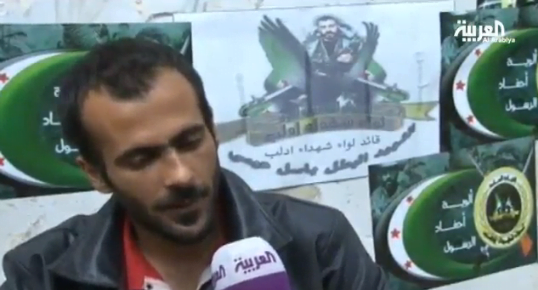
A man, who is reportedly an Iranian officer in the custody of the rebel Free Syrian Army, spoke to Al Arabiya Thursday and said he used to train snipers for the regime of Syrian President Bashar al-Assad.

He said that he used to train the men in the western province of Idlib, in which – he added – he stayed for months.

“My name is Hamid Wothouq, and I’m from Shiraz city. I stayed in al-Fouaa and Kafriya for five month to work with snipers. In Iran, I worked for the Basij [Iranian paramilitary organization]. I want help from the Islamic republic,” he told Al Arabiya’s cameras.

Wothouq allegedly entered Syria from Turkey and said there were Iranian soldiers spread in the country to help the Assad regime in fighting rebels.

“In al-Fouaa and Kafriya, Bousra, Tartous and Damascus, there are Iranian soldiers fighting alongside the Assad army.”

Rebel Free Syrian Army leaders described Wothouq’s capture as a “precious find” and formidable proof against the Syrian regime’s claim that no Iranian soldiers or members of Lebanon’s Shiite movement, Hezbollah, were present in the country.

Source: Alarabiya

IHR Publishes Annual Death Penalty Report: Highest Numbers in 15 Years

Iran Human Rights (IHR) has stated in its most recent annual death penalty report that the real number of executions in Iran in 2012 was among the highest in more than 15 years.

IHR reported on the possibility of hundreds of executions in Vakilabad, a prison in Mashhad. However, due to a lack of access to information and due process, most of these executions could not be declared official.

Since October 2012, IHR has received reports of weekly executions in Vakilabad, where approximately several hundred prisoners have been executed so far. “IHR characterizes mass executions in Vakilabad Prison as a massacre and has urged the United Nations to send a fact-finding mission to Iran to investigate these executions,” says Mahmood Amiry-Moghaddam, the executive director and international spokesperson of IHR.

With the approach of the presidential elections in June, IHR has expressed concern that Iranian authorities may further use the death penalty as a tool for intimidation and political repression. “We urge the international community to pay more attention to Iran as we expect an increase in the number of executions,” says Amiry-Moghaddam. IHR’s report states that Iranian authorities are aware that the outcome of new protests in June 2013 may be even worse than previous years, thus they are taking extreme preventative measures. “Spreading fear through society is the Iranian authorities’ main oppressive strategy, and their most powerful instrument is the death penalty,” says Amiry-Moghaddam.

Source: Insideofiran