Home Blog Page 378

Iran lines up behind North Korea, warns the US of “great losses”

Tehran’s intercession in the Korean crisis on the side of its ally in Pyongyang was predictable, even though the US preferrs to ignore the close interrelations between the two allies.

On Friday, April 5, Deputy Chief of Staff of Iran’s Armed Forces Brig. Gen. Masoud Jazayeri stepped forward to point the finger at Washington:
[“The presence of the Americans in [South] Korea has been the root cause of tensions in this sensitive region in the past and present. The US and its allies will suffer great losses if a war breaks out in this region,” he said, adding for good measure: “Independent countries will not submit to the US mischief. The time for Washington’s bullying and extortion is long past.”

DEBKAfile’s Iranian sources: The second part of the statement was a perfect fit for Ayatollah Ali Khamenei’s flat refusal to accept US demands on Iran’s nuclear program. The Korean crisis gave the Iranians the opportunity to kill two birds with one stone.
As Kim Jong-Un moved two intermediate missiles to the east coast of North Korea, Gen. Jazayeri’s rhetoric landed on the latest round of talks the six powers were holding with Iran in Amaty, Kazhakstan for a diplomatic resolution of Iran’s nuclear challenge.

Washington hoped to spread some cheer over a diplomatic process that had long past proven futile by planting advance reports that Khamenei had ordered a slowdown of Iran’s nuclear program up to the June presidential election to avoid crossing a red line that would trigger a military response.
But when the parties came to the table, Iran’s senior negotiator Saeed Jalili refused outright to respond to the proposals put before Tehran in the previous session.
He seemed to have taken his cue from Kim Jong-Un, who too has stuck to his father’s rejectionism in the face of every American proposal for dismantling North Korea’s nuclear program.

DEBKAfile: The inevitable convergence of the Korean and Iranian crises confronts America’s three top officials, President Barack Obama, Secretary of State John Kerry and Defense Secretary Chuck Hagel, with their most challenging international test.

Kerry would be well advised to take a break from his Sisyphean efforts to crack the latest of umpteen Israel-Palestinian disputes, call off his weekend appointments with Israeli and Palestinians leaders and instead fly to Moscow and Beijing.
There, he could start bargaining with Russian and Chinese rulers for preliminary understandings with Washington on Iran and Syria that would make it worth their while to use their leverage for bringing the out-of-control North Korean firebrand to heel.

So long as the Obama administration sticks to its current separate policies on Syria and Iran, Iran and Korea, Moscow and Beijing won’t lift a finger to apply the brakes to Kim Jong-Un before he drives the world to catastrophe.

Source: DEBKA

Lebanese Suspect ‘Most Dangerous’ in Iranian Espionage Cell

Asharq Al-Awsat reveals new information about Iranian spy cell arrested in Saudi Arabia

Asharq Al-Awsat has obtained new information about the Iranian espionage cell detained while operating clandestinely on Saudi soil. The Saudi Interior Ministry initially announced that eighteen men—one Iranian national, one Lebanese national, and sixteen Saudi nationals—had been arrested while working for a “foreign” intelligence agency, before subsequently pointing the finger at Tehran.

Asharq Al-Awsat has obtained information revealing that the Iranian national is in his late thirties and is a PhD student at the Current Affairs department of the Islamic University of Medina. He is a media figure, known for his religious seminars on an as yet unnamed private satellite channel.

As for the Lebanese detainee, Asharq Al-Awsat learnt that he is a businessman who also holds a European passport. He is considered to be the central, and most dangerous, player within this spy network.

According to the information, the Iranian detainee obtained both a Bachelor’s and Master’s degree from the Islamic University, indicating that he spent a significant amount of time in the Kingdom prior to his arrest. This detainee, originally from the Shi’ite dominated Iran, was also revealed to be a Sunni.

Investigations are on-going into this individual’s background and it is not yet certain whether he was directly and consciously involved with the espionage cell, or whether this is part of an Iranian attempt to falsely implicate him.

Asharq Al-Awsat previously revealed that another one of the eighteen detainees worked in the main branch of a high-profile Riyadh bank and has over 35 years banking experience. In addition to this, another member of the cell was revealed to be a Riyadh university professor who had previously obtained a master’s degree and doctorate in the US in the field of education.

A third member of the cell was a physician, working in one of the major hospitals in the Saudi capital as a renal consultant in the children’s ward. He was allegedly able to take advantage of his position to provide information about important Saudi figures undergoing treatment in the same hospital.

On March 26 the Saudi Ministry of the Interior announced that the detainees had direct connections with Iran, in the first official accusation of Tehran’s involvement.

A report by the Saudi Press Agency (SPA) quoted Saudi Interior Ministry spokesman General Mansour Al-Turki as saying, “The preliminary investigations, the physical evidence that has been collected, and the statements made by the defendants in this case reveal direct links between the cell and the Iranian intelligence service.”

“These elements received financial sums, at regular intervals, in exchange for information and documents about important sites, as part of an espionage operation for the Iranian intelligence apparatus,” he added.

He had previously stressed that the eighteen men had been apprehended in the process of actively gathering information about vital national infrastructure which they were then sending to a foreign intelligence agency.

Iran has officially denied any involvement with this espionage cell.

These developments are part of a series of escalating Iranian espionage activities throughout the Gulf States. Last week in Bahrain, an appeals court upheld a ten-year prison sentence given to a man accused of spying for Iran. He was originally convicted in 2011 “of spying for the Iranian Revolutionary Guard from 2002 until April 2010 with the aim of damaging Bahrain’s national interests,” according to Bahraini media.

The UAE has likewise convicted one of its citizens on the grounds of spying for Iran. The individual pleaded guilty to the charges of providing a foreign state with secret military intelligence via a foreign consulate, and was sentenced to 7 years imprisonment.

Source: Insideofiran

Mehdi Khoukhian and Abbas Valizadeh Sentenced to Nine Year in Prison

Iran Briefing – Mehdi Khoukhian and Abbas Valizadeh, two civil activists in Azerbaijan were sentenced to one and eight year in prison, respectively. They were arrested in Malekan on Saturday, December 31, 2011 and trialed on Monday, March 12, 2012 at first branch of Maragheh Revolutionary Court. At first they were transferred to the intelligence and afterwards to the prison of Maragheh.

They were charged of “Propaganda against Islamic Republic” and their cases were sent to the public prosecutors and revolutionary court of Maragheh after indictment. The eight year in prison sentence of Abbas Valizadeh was explained by the court as one year for civil activities which is defined in Iranian regime as propaganda against system, five years for criticizing religious superstition and acting against it which was defined by the court as Blasphemy, two years for criticizing Ali Khamenei, religious leader of Iranian regime which was defined by the court as Insulting the Leader and unfairly these two civil activists were sentenced to nine year in prison, totally.

Koukhian and Valizade’s charges in summary were explained by the court as “Propaganda against system, Blasphemy, Insulting the Leader, in the cyber space, especially on Facebook.”

Naghi Mahmoudi, a lawyer, says evidences which Chief Judge of the Revolutionary Court of Maragheh, Judge Davrnya, relying on them, has issued such a harsh sentence, have no legal status. For example, insulting Imam Jom’e (a post that Islamic Republic gives to the pro-regime Mullahs in every city to hold religious ceremony of Friday Prayer, but these Mullahs have political power more than any authority in the city) of Malekan city, was for criticizing Imam Jom’e for he opposed to name two streets “Ata” and “Ana” (Turkish names means father and mother) and writhing a critic issue about the refugees of Azerbaijan’s earthquake and their situations, sharing a cartoon of Ahmadinejad and Khamenei on Facebook, publishing a photo of an Azerbaijani detainee and asking for his freedom, Blasphemy was for criticizing and insulting eulogy on the Muharram mourning and rituals and so on. They were convicted of such charges.

Their lawyer was Mrs. Fatemeh Sattari.


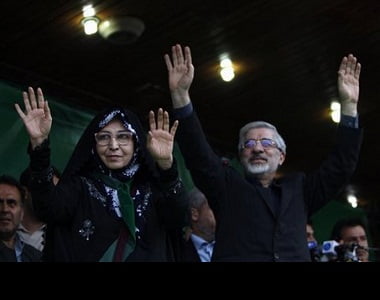
Mousavi and Rahnavard are prevented from any telephone contact or meeting

After meeting their daughters on the 21stMarch 2013, Mir Hossein Mousavi and Zahra Rahnavard had no meeting or telephone contact with any of their family members.

According to a report published by the Kalameh website, the security forces not only don’t allow them to meet or call their daughters but also haven’t allowed Rahnavard to meet her mother.

Therefore all days since the beginning of the new Iranian year has passed under the house arrest and in total silence and isolation with no contact with outer world for them.

Mousavi’s daughters met their parents on 20th March 2013 for the last time, a meeting in the presence of security forces in a building near by Mousavi and Rahnavard’s apartment.

This is the third Newruz that Mousavi and Rahnavard are spending under house arrest. The authorities neither charge them and put them in a trial nor release them according to their legal and legitimate rights and even don’t declare their basic rights as a prisoner.

Source: HRANA

Oligarchy of IRGC and Mullahs: Two Parties in Need of Each Other

Iran Briefing (Exclusive) – In current time, Islamic Republic of Iran is the government of IRGC and Mullahs. IRGC men and Mullahs are holding most of the key posts in the government. IRGC is a major political force in the political structure of nowadays Iran. The financial, media, propaganda and military-security power of IRGC as an organization and every Senior Commander of it, in political situation of nowadays Iran, is much further than Mullahs system and every Mullah which IRGC was supposed to protect their power. In the aspect of resources, incomes and wealth, only the Leader’s system is placed above of IRGC and its commanders. The government’s incomes also are being intake by two large ducts: IRGC and Leader’s system. IRGC is the only revolutionary institution founded after 1979 which gained such a power.

Constitution and political structure of Islamic Republic is based on oligarchy of Mullahs. Mullahs as the group in power have the main sticks of power in their hands and like a political party have an extended presence in organizations and institutions of Islamic Republic. Mullahs suppose the government as their monopolized area. According to the constitution, political posts are in hands of Mullahs. Based on article 93 of constitution, “Parliament without the Guardian Council has no legal validity.”

The Supreme Leader is the center of power in Islamic Republic and presidential and parliamentary candidates, without the confirmation by Guardian Council – composed of Mullahs chosen by Supreme Leader- cannot be voted by people. Supreme leader’s agents are present at universities, army, IRGC and other organizations. The Judiciary is in the hands of Mullahs and their trials are in special courts. Head of the parliament, there had been a mullah until the sixth period.

The first use of IRGC in the Iranian society was protecting the Mullahs. IRGC was formed not for defending country or even the revolution, but to protect the men in power and Mullahs. First members of IRGC were the bodyguard of government’s mullahs and authorities in different parts of country. Those who didn’t know the real goals of IRGC and joined it, left it as soon as they found. The next use [of IRGC] was repression of those who opposed the government of Mullahs. In the frame of this mission, IRGC has hold the connection to this class of government; Mullahs as the Islamic ideology leaders. In the frame of this two-way connection, conservative Mullahs who are closed to the Supreme Leader have legalized the actions of IRGC and getting control of country’s recourses and in response, IRGC has hold them in power by repressing oppositions and those who criticize the system.

Since the beginning of the formation of Islamic Republic, IRGC has stood beside the Supreme Leader and has an old and strong joint with Supreme Leader, specially Ali Khamenei; the conservative and radical leader of Islamic Republic. Khamenei, for holding his power and Islamic Republic, has provided the situation for the presence of IRGC in political and financial structure of Islamic Republic. Those Mullahs, who confirm Khamenei and IRGC, will be protected by IRGC but those Mullahs who oppose or criticize this system will not be able to take a place in power. Even they will not be able to continue their religious activities and will be erased from political and social area by IRGC, commanded by Khamenei. Two solid example of these kind of Mullahs were Ayatollah Kazem Shari’atmadari and Ayatollah Hosseinali Montazeri who were not safe from repression machine of Velayat-e Faqih and passed their whole life in house-arrest. Right now, Mehdi Karoubi is one of the opposition Mullahs who is in house-arrest.

Mullahs’ deputy representative of the Supreme Leader in IRGC, Safar Ali Moradi, recently told: “IRGC’s Mullahs are the soldiers in the front line of soft-war of enemies.” Also Hossein Salami, deputy commander of IRGC in the security summit of IRGC’s Mullahs in 2011, Tehran, said about the connection between Mullahs and IRGC: “Mullahs are the spiritual commanders of IRGC. The basement of the IRGC which is contained of spirituality, belief, awakening and thought are formed by Mullahs.”

In recent years, IRGC is trying to weaken the situation of Mullahs in the society to use pro-khamenei Mullahs against critic Mullahs like Mohammad Khatami and Ali Akbar Rafsanjani. The project of “Making-Ayatollah” and giving upper ranks to the pro-Khamenei Mullahs are the actions in the frame of this scenario. Ahmad Khatami, Sadeq Larijani, Ali Saeedi are the Mullahs who got upper rank from Hujjat al-Islam to Ayatollah within a night by Supreme Leader and IRGC.

According to the contents above, it can be concluded that IRGC has the connection and supports those Mullahs who are pro-Khamenei and IRGC and in their public speeches praise Khamenei and maledict rivals. That is why IRGC has permeated into the Islamic Theological Seminaries to grow up Radical Mullahs to empower its ideological basements and act toward the goals of IRGC in the country. And also, by misusing this kind of Mullahs, IRGC wants to omit Supreme leader’s rivals and empower the situation of Supreme Leader. It also will fill the gap between Mullahs and Supreme Leader after 2009 election events. Insightful Ambassadors are the new generation of these Mullahs to achieve their goals.


Saeed Matinpour’s being imprisoned for the fourth spring deprived of his rights

Saeed Matinpour, the writer and Zanjani journalist is in ward 350 of Evin prison continuously for the fourth spring and deprived from the least rights as a prisoner.

According to a report, Saeed Matinpour sentenced to eight years imprisonment on charge of  connections with aliens and propaganda against regime, and he has imprisoned in Evin prison since July 11th of 2009 and deprived of furlough right.

This political prisoner was suffering of spine-ache and severe headache and his requests for transferring to hospital is ineffective till now.

Saeed Matinpur was arrested on May 25th of 2007 and was released on February 26th of 2009 by providing 500 million tomans bail after 278 days of temporal detention. He was sentenced during a closed trial to seven years imprisonment on charge of connections with foreigners and one year imprisonment on charge of propaganda against regime. The Tehran provincial appealed confirmed the verdict of this Azerbayjani activist in November 2008.

Matinpour is graduated from philosophy faculty in Tehran university, member of editorial board at Yarpagh and Moje Bidari weekly magazines, weblogger and civic activist who was accused to connections with aliens after his trip to Turkey.

Source: HRANA

Mehdi Farrahi was kept in solitaire cell for weeks

Mehdi Farrahi Shandiz, the labors and teachers union activist who is spending his 3 years imprisonment verdict i Evin prison, in the past few months was transferred to solitaire cell twice and totally more than two months.

According to a report, quoted from Emdad Khabar, Farrahi Shandiz is in ward 350 of Evin prison since December of 2011. After chanting slogans in prison he was transferred to solitaire cell for twenty days as a punishment and then instead of moving back to ward 350 which is the ward for political prisoners, he was moved to hall 10 which is the place for non-political prisoners.

The second time he was transferred to solitaire cell since early February and was kept there till late March.

According to the report, the main reason of punishing him was disobeying and protesting against prison rules which expressed as some slogans such as “Down with …”, “Viva freedom”, and “Down with dictator” and also disobeying to be present in prisoners presence checking.

Mehdi Farrahi is cousin of Mahmood Ahmadinejad’s wife A’zamosadat Farrahi. He was arrested in December of 2011 and transferred to Evin prison for spending his three years imprisonment verdict on charge of Insulting to Iranian Leader and disturbing public discipline. He was in solitaire cell in ward 240 in the beginning of his imprisoning too.

This political prisoner is holder of electricity engineering certification of Isfahan industrial university. Also he was in solitaire cell between April 2009 till January 2012 in ward 209 of Evin prison. He was arrested in relation to labor anniversary day. One more time he was arrested and imprisoned in 2006 during a protest in Laleh park in Tehran.

Despite of several times arresting the family relation between Mehdi Farrahi Shandiz and Mahmood Ahmadinejad’s wife was clandestine for a long time.

Source: HRANA

Commanders of Iran’s Guard were wounded in Damascus airport strike: FSA official

0

Alaa al-Basha, a spokesman for the opposition Syrian Military Council, said Friday a number of commanders belonging to the Iranian Revolutionary Guard were wounded in Thursday’s incident when the Free Syrian Army (FSA) destroyed a plane allegedly carrying arms from the Islamic republic.

The FSA hit the plane as it was landing in Damascus International Airport, the SANA Revolution Network reported on Thursday, adding that the Syrian regime had diverted all flights going to the Damascus airport to another in the Soueida area – around 15 kilometers away.

The state-run Syrian Arab News Agency denied the report, saying everything was “normal” at the airport.

“The media reports on the airport carried out by media outlets that are accomplices in Syrian bloodshed are not true,” SANA said.

However, a video posted by activists on YouTube showed a plane catching on fire as it tried to land at the airport.

According to various reports – which Al Arabiya cannot confirm – Iran transfers nearly five tons of arms shipment every week. The weapons are reportedly hidden in a special compartment in the aircraft’s cargo.

Iran has remained a steadfast ally of the Syrian regime, with much of its military aid being delivered by plane, usually over Iraq with its government’s compliance.

U.S. Secretary of State John Kerry visited Iraq last week, and pressed the government to stop allowing such flights, describing them as “problematic” and “helping to sustain” the Syrian regime.

For months, Washington has accused Baghdad of turning a blind eye to such flights, and has called on authorities to make random, unannounced inspections.

Source: Alarabiya
 

Iranian Ahwazi Arabs on hunger strike over death sentences

Five prisoners have been refusing food since start of March in protest at sentences and ill-treatment, says Amnesty.

Five members of Iran’s Ahwazi Arab minority sentenced to deathfollowing trials described by activists as grossly unfair are on hunger strike in protest at their conviction and ill-treatment in jail.

The men, Mohammad Ali Amouri, 34, teachers Hashem Sha’bani Amouri, 32, and Hadi Rashidi, 38, and two brothers Sayed Jaber Alboshoka, 27, and Sayed Mokhtar Alboshoka, 25, have refused to take food since the beginning of this month because of the supreme court’s decision to uphold their death sentences, Amnesty International said.

“Their hunger strike is also in protest against their torture and other ill-treatment in Karoun prison and the prison authorities’ refusal to grant them medical treatment for various ailments, including some which may have resulted from earlier torture or other ill-treatment,” Amnesty said in an urgent appeal issued on Tuesday. “They have not been examined by a doctor despite their repeated requests.”

They have all been found guilty of being linked to a terrorist organisation and involvement in shootings that authorities say occurred in and around the town of Ramshir (also known as Khalafabad) in Khuzestan province. But Amnesty has repeatedly warned that their trials were held behind closed doors and no evidence was made public supporting the allegations facing the convicts. Some of the charges against them include vague national security offences such as “enmity against God and corruption on earth”, “gathering and colluding against state security”, and “spreading propaganda against the system”.

Amnesty added: “In an apparent act of retaliation against the hunger strike, prison authorities initially barred all five men from making or receiving phone calls for five days.

“During a visit to the prison on 13 March, the men’s families persuaded them to end their dry hunger strike but all five now remain on a ‘wet’ hunger strike (refusing food).”

Ahwazi Arabs in Iran often face state discrimination in spheres including education, employment politics and culture. In recent years, many members of the community have taken to the streets in protest at the discrimination against them. Groups advocating a separate Arab state have also been demonstrating, but not all protesters have been separatists. Many Ahwazi Arabs have been put to death in recent years in Iran, including Abd al-Rahman Heidarian, Taha Heidarian and Jamshid Heidarian, who were executed in June 2012 after being sentenced to death in an unfair trial.

In February, Justice for Iran, a non-profit human rights organisation,released a thorough report studying the state persecution against the country’s Arab minority of many of its activists, in particular those belonging to the civil group, Al-Hiwar.

The report has highlighted many individual cases of Arab activists, including the cases of Fahimeh Esmaili Badawi, a female activist and her husband, Ali Matourzadeh. Justice for Iran reported: “They were arrested in 2005 when Fahimeh was eight months pregnant. She had to give birth to her baby in a solitary confinement cell while in the presence of interrogators.

“Ali had accepted the false charge of terrorism for the sake of his wife and newborn child. He was executed in 2006. Fahimeh was sentenced to 15 years in prison. She is currently serving her seventh year in prison.”

Source: Guardian

Mother of jailed activist fears for son’s health

Monavar Hashemi, the mother of jailed student activist Majid Dori, has expressed grave concern regarding her son’s condition in jail and she is urging the authorities to grant him sick leave.

Hashemi has told the Jaras website that her son has been suffering from severe migraine headaches that have been exacerbated in the past year, becoming more frequent and more intense.

She added that the family has put in an application for his sick leave, which remains unanswered.

Dori was arrested in July of 2009 and has not been given a furlough for the past four years. Dori, a student activist who is banned from continuing his education, has been sentenced to six years in jail, five of which must be spent in exile.

Monavar Hashemi reported that two days before Norooz, Dori’s father approached the prosecutor’s office in the hopes of getting him a furlough, but the authorities completely denied the request without providing any reason.

Hashemi describes the toll their son’s incarceration in exile has taken on them, adding that they are at their end of their rope.

Dori has written directly to Ahmad Shaheed, the UN special rapporteur on human rights conditions in Iran, protesting against the violation of his rights as an Iranian prisoner.

Source: Radiozamaneh