Home Blog Page 533

MP briefly arrested over bank fraud case

0


Alaeddin Boroujerdi, the head of National Security and Foreign Policy for Iran’s Parliament, was reportedly arrested last week on charges of “involvement in the bank fraud” that was uncovered last month.

Iranian media report that Boroujerdi was released after 24 hours through the mediation of Ali Larijani, the head of Parliament.

Larijani’s mediation has been criticized by allies of Mahmoud Ahmadinejad and by editorials published in the media.

Last month, the Iranian media published reports of a great bank fraud in which $3 billion was embezzled from eight Iranian banks through false letters of credit. The heaviest losses were sustained by the major banks Saderat and Melli.

Supporters of the Ahamdineajd administration accuse a number of MPs of being involved in the fraud and have recently published a letter that shows a number of Principalist and reformist MPs supporting Mahmoud Khavari, the head of the Melli Bank, who fled the country after the investigation of the case got underway.

Khavari, who also holds Canadian citizenship, is currently in Canada and has refused to return to Iran to respond to judicial investigators.

The presentation of the investigative findings in Parliament has been delayed over a number of disputes between MPs and the administration.

In the meantime, Ayatollah Khamenei has advised against creating too much media hype around the case.


Source

Seven members of the Baha’i community sentenced to a total of 30 years in prison

0


The Revolutionary Court has issued sentencings totaling 30 years imprisonment for 7 administrators and professors of the Baha’i Institute for Higher Education (BIHE).

Human Rights House of Iran reports that during the past days Judge Moghiseh presiding over branch 28 of the Revolutionary Court has handed down the verdicts for the seven citizens.

These seven educators were detained and handed down verdicts based on the charge of “membership in the Baha’i community.”
Ramin Zibaie, Mahmoud Badavam, Riaz Sobhani, Farhad Sedghi, and Noushin Khadem were each handed down a 4-year prison sentence; Vahid Mahmoudi and Kamran Mortezaei were each handed down a 5-year prison sentence.

These citizens have to date spent almost 5 months behind bars since the time of their detainment. On May 22, 2011, security forces raided the residences of scores of Baha’i citizens who are affiliated with the institution of higher learning. Their homes were searched and ransacked and many were arrested. Riaz Sobhani was arrested separately on June 15, 2011. Of the many who were detained, these 7 have remained behind bars and have now been issued lengthy prison sentences.

Last week on October 10th, Rain Zibayi, Mahmood Badavam, Riaz Sobhani, Farhad Sedghi, and Kamran Mortezaie were transferred from Evin’s ward 209 to Rajai Shahr prison in the city of Karaj. On Saturday Noushin Khadem was transferred from ward 209 to the women’s public ward in Evin prison.


Source

Authorities step up pressure on jailed lawyer


Jailed Iranian lawyer Javid Houtan Kian is being subjected to further pressure by being moved to the methadone section of Tabriz Prison, the Human Rights Activists News Agency reports.

According to HRANA, Houtan Kian has been under steady pressure from Islamic Republic authorities since he was arrested in connection with his defence of Sakineh Mohammadi Ashtiani, the Iranian woman sentenced to stoning over charges of adultery.

The methadone section of the prison is reportedly where addicts and prisoners suffering from infectious diseases are held, and prison authorities have forbidden Houtan Kian’s cellmates from establishing any sort of contact with him.

Houtan Kian was arrested in September 2010 at his office, together with two German journalists and Sajjad Ghaderi, the son of Sakineh Mohammadi.

The lawyer has been accused of acting against national security and, according to reports from human rights organizations, he has been tortured in order to force him to agree to a so-called televised confession.

Houtan Kian has been sentenced to 11 years in jail.


Source

Iran’s Power Struggle Goes Beyond Personalities to Future of Presidency Itself

0

WASHINGTON — An unusual proposal by Iran’s supreme leader to eliminate the position of president has highlighted an increasingly bitter struggle within the country’s political elite, as the leader and his allies continue to try to undercut the powers of Iran’s ambitious president, Mahmoud Ahmadinejad.

President Mahmoud Ahmadinejad of Iran holds an office that Ayatollah Ali Khamenei said could easily be eliminated.

Iran’s supreme leader, Ayatollah Ali Khamenei, said  “changing Iran into a parliamentary system” in which voters no longer elected a president would not be a problem.

The supreme leader, Ayatollah Ali Khamenei, told an academic gathering last week that “changing Iran into a parliamentary system” in which voters no longer elected a president would not be a problem. His words were widely seen as the latest blow in a battle that began in April when Mr. Ahmadinejad crossed a line by openly feuding with Ayatollah Khamenei — who has the final word in affairs of state — over cabinet appointments.

Some analysts see the power struggle as a legacy of the disputed 2009 presidential election, when accusations of rigging — and months of street protests — deepened rifts and reduced the supreme leader’s support among the public and the political elite. Although Mr. Ahmadinejad had the supreme leader’s support in both the 2009 and 2005 elections and the two men were long seen as ideological soul mates, the president has tried to build an independent power base, and many conservatives feel threatened by his vision of an Iran less dominated by clerics.

Ayatollah Khamenei’s veiled attack on the presidency has drawn sharply polarized responses. Ali Larijani, the speaker of Parliament and a rival to Mr. Ahmadinejad, endorsed the comments and called for a parliamentary system. A former president, Ali Akbar Hashemi Rafsanjani, who has at times sparred with the supreme leader, warned on Tuesday that eliminating the presidency would “be contrary to the Constitution and would weaken the people’s power of choice,” according to the centrist newspaper Aftab News. Other partisans have gone further, with one pro-Ahmadinejad daily newspaper, Iran, seeming to mock the supreme leader’s comments. (That article was soon taken off the paper’s Web site.)

“The fighting in Iran is very serious now,” said Seyed Mojtaba Vahedi, a former editor of Aftab-e Yazd, an influential reformist newspaper. “The supreme leader has wanted more control over the presidency for a long time, but he never expected to have such problems with Ahmadinejad.”

Eliminating the presidency would enhance the power of Ayatollah Khamenei, who was installed for life in 1989, by leaving him with one institution to control instead of two, Mr. Vahedi said. Under the parliamentary system that Ayatollah Khamenei sketched out, legislators would elect a prime minister from their ranks.

The supreme leader might not want to risk more tumult and confrontation by eliminating the presidency while Mr. Ahmadinejad is in office, some analysts said, and it is even possible that his comments were more of a rhetorical slap, aimed at taming the president, than a serious proposal.

But other analysts said they viewed the elimination of the presidency as a possibility by 2013, when the next presidential election is to take place, or soon thereafter.

“One of the reasons why they may decide to eliminate the presidential system is precisely to avoid another presidential election and all of the political uncertainty and opportunities for popular unrest that come with it,” said Karim Sadjadpour, an analyst at the Carnegie Endowment for International Peace in Washington.

Either way, Mr. Sadjadpour said, it seems clear that Ayatollah Khamenei will try to ensure that the next president or prime minister is a weak and trusted subordinate he can easily control. All three of Iran’s elected presidents since 1989 — Mr. Rafsanjani, Mohammad Khatami and Mr. Ahmadinejad — have had their own agendas and ambitions, and all became thorns in the supreme leader’s side to varying degrees.

In a sense, the current tensions can be traced to 1989, when Iran’s Constitution was modified to create a powerful presidency as a counterweight to the supreme leader. The last president before those changes was Ayatollah Khamenei himself, and the prime minister whose position was abolished at the same time was Mir Hussein Moussavi — the opposition leader who claimed the presidency had been stolen from him in 2009.

One measure of the struggle between Mr. Ahmadinejad and Ayatollah Khamenei is the banking scandal unfolding in Iran. The authorities have arrested dozens of people in what they call a wide-ranging $2.6 billion embezzlement scheme, and opponents of Mr. Ahmadinejad have repeatedly accused his close associates — including his chief of staff, Esfandiar Rahim Mashaei — of being linked to the lead suspect.

Corruption is rampant in Iran, and analysts say the supreme leader and his team must have long known of (and possibly profited from) such a large movement of money. “They are unveiling this now simply to attack Ahmadinejad and his allies,” said Mr. Vahedi, the former editor.

The bank scandal appears to be at least partly an effort to undermine the campaign war chest of Mr. Ahmadinejad and his allies, who hope to maintain their power by electing candidates in the 2012 parliamentary elections and the 2013 presidential race, analysts said. The broader conflict is mostly about power, but it also has an ideological component. Although intensely devout, Mr. Ahmadinejad is dismissive of Iran’s traditional clergy, and has said Muslims do not need the intercession of clerics to contact the Hidden Imam, a messianic figure in Shiite Islam. Conservatives have lambasted the president’s circle — often singling out Mr. Mashaei — as a “deviant current.”

The constant friction has polarized the political elite, and appears to be undermining the supreme leader’s traditional role as a broker, analysts say. Although Ayatollah Khamenei crushed the reformists and the opposition movement that led massive street protests in 2009, that crisis ruptured his relationship with members of the Islamic Republic’s old guard of founders, notably Mr. Rafsanjani.

“The machinery of government is increasingly breaking down,” said Ray Takeyh, a senior fellow at the Council on Foreign Relations. “Khamenei has lost the old guard, the economy is collapsing, and now he is more and more isolated internationally. Can he survive? It remains to be seen.”

source

Clinton warns Iran not to underestimate U.S. commitment to Iraq

0


By Christi Parsons, Washington BureauOctober 23, 2011, 9:30 a.m.

 
Reporting from Washington—

Secretary of State Hillary Clinton said Sunday the U.S. will maintain a strong military interest in the young Iraqi democracy even after the last combat troops leave this year, and she warned Iran not to try and take advantage of the pullout.

During a tour of the Sunday morning talk shows, Clinton said that no one, especially Iran, should underestimate America’s commitment to preserve the hard-fought gains of the last eight years.

“We have a lot of presence in that region,” Clinton said in an interview with CNN’s Candy Crowley. “No one, most particularly Iran, should miscalculate about our commitment . . . to the Iraqis.”

On the heels of an eventful week that saw the death of Libyan leader Moammar Kadafi, the United States also vowed partnership with the Libyan people as they build a new society – one that U.S. officials insist should begin with investigations into Kadafi’s death and with the imprisonment of the convicted Lockerbie bomber now living free in Libya.

With Libya’s Transitional National Council putting together a new government, Clinton conveyed those requests while visiting Libya and elsewhere in the region last week.

As the United States draws down its presence in one country and turns its attention to reconstruction of another, the Obama administration is trying to promote security and the rule of law over strong local and regional interests.

Republicans question whether the departure of the remaining 40,000 American troops from Iraq by the end of the year serves those ideals, especially given recent threats by the Iranian president to get involved in the training of Iraqi troops.

Though the U.S. departure announced by Obama is in keeping with a timeline laid out by the previous administration, GOP critics say the president is opening the door to Iranian involvement.

The withdrawal is a “serious mistake,” Sen. John McCain said in an interview from Jordan on ABC’s “This Week,” and is “viewed in the region as a victory for the Iranians.”

“Once the military is gone, embassy personnel will be targets,” McCain said. “The fact that we have other bases in the region would have very little impact on Iraq itself.”

But in four TV interviews Sunday, using nearly identical language, Clinton strongly suggested that the U.S. will maintain a military presence in the region as well as a willingness to respond to any Iranian threat.

The most direct question on the point was from NBC‘s David Gregory, who asked Clinton whether the U.S. would still have a “military commitment” to keep Iran out of Iraq.

“Iran should look at the region,” Clinton said. “We may not be leaving military bases in Iraq, but we have bases elsewhere. We have support and training assets elsewhere. We have a NATO ally in Turkey. … I don’t think anyone should be mistaken about America’s commitment to the new democracy in Iraq that we have sacrificed so much to help them achieve.”

Meanwhile, news reports and images from the region show the Libyan leader was apparently beaten and taunted by a crowd in his hometown of Surt before his death, raising questions about the government’s assertion that he was killed in crossfire.

Administration officials voiced concern about what the reports portend for the rule of law and the establishment of civil institutions in Libya. U.S. diplomats said over the weekend that they support the United Nations call for an independent investigation into the death of Kadafi.

On Sunday, Clinton made that position public and expressed support for the investigation the transitional council says it will conduct. Clinton also said she told Libyan officials that the U.S. wants to see Abdelbaset al-Megrahi, the convicted Lockerbie bomber, incarcerated to serve the rest of his life sentence. Megrahi was released from a Scottish prison two years ago on humanitarian grounds because he was suffering from cancer and said to have three months left to live.

Although the United States wants to see Megrahi returned to Scotland, Clinton said Sunday that Scotland was the “preferable” place for him to serve his sentence.

The new government in Libya must “start with the rule of law,” Clinton said on NBC, and with “accountability, unity and reconciliation.”

Kadafi loyalists should be safe in Libya and be included in the new government, she said, “as long as they don’t have blood on their hands.”

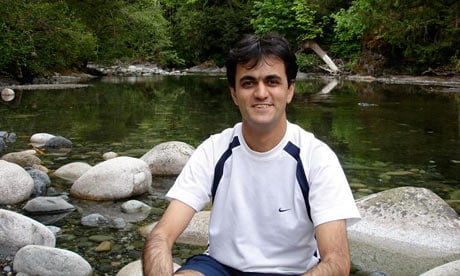
Saeed Malekpour again sentenced to death with an additional 7.5 years imprisonment


Rahana – The death sentence that had been struck down by the country’s Supreme Court has been reinstated by Branch 28 of the Revolutionary Court presided by Judge Moghiseh

Last Wednesday Saeed Malekpour was taken to Branch 28 of the Revolutionary Court and was handed down a death sentence from Judge Moghisheh for the second time. He also received an additional sentence of 7.5 years behind bars.

According to a trusted source that spoke to Human Rights House of Iran and asked to remain anonymous, this last court session took place in a very speedy manner. The source said, “During the court session at Branch 28 of the Revolutionary Court, five of Saeed Malekpour’s interrogators were present to testify against him along with another five individuals who were present as witnesses against him. Those five individuals who testified against him were people whose names had been on the Gerdab website as managers along with Saeed. The interrogators were supposedly there to answer technical questions but they had no knowledge whatsoever and were not able to answer questions posed by the defendant’s attorney. Saeed’s family and attorney made numerous requests for neutral judiciary-trusted IT experts to study and investigate his case and share their findings in court, but their requests were denied. The court handed down a verdict after two weeks.

Previously the country’s Supreme Court struck down the execution verdict that was handed down to Saeed stemming from charges of alleged involvement in obscene websites, and ordered a new trial to take place. Saeed’s court dossier was then returned to Branch 28 of the Revolutionary Court for review while he remained behind bars.

Saeed Malekpour, born in 1975, is a Material Science Engineer who received his undergraduate degree from the prestigious Sharif University. He worked in Iran at a research center and as an inspector. He was a resident of Canada before his arrest. He was accepted to Canada’s Victoria University and had moved there for his graduate studies.

Saeed travelled to Iran from Canada to visit his ailing father in 2008. While in Iran, plainclothes officials arrested him and he was kept at Evin prison in solitary confinement for almost a year without access to legal representation.

According to his family and lawyer, the charges against Saeed are false; he is an IT expert whose programs were used without his knowledge in adult websites. Saeed in a letter from prison explained the inaccuracy of the trumped up charges against him and said that if his programs were used by the specified websites, he had not been aware of it.

Saeed was transferred 9 months ago from the public ward 350 of Evin prison to the cells in ward 2A of the prison, which is under the supervision of Iran’s Revolutionary Guards Corps (IRGC). He has spent the past 9 months in this section, the same ward he was held in the first year of his incarceration.

Saeed’s mother, Akram Esmailzadeh spoke to Human Rights House of Iran.

“About 9 months ago, they transferred Saeed back to ward 2A. They said this was because of the letter he had written while behind bars in ward 350. This is why he has been transferred out of the public ward. But this time he is not in solitary confinement; he is in a cell with 4 other prisoners where the conditions and food is better than in solitary.”

Saeed Malekpour’s mother who is in not in good health and exibits deep worry for her son continued, “I am a tormented mother, during this long period that Saeed has spent behind bars I have endured intense hardships along with my other children, and my husband who passed away. Saeed’s father had cancer. About one year after Saeed’s arrest, his father lost his life. The physical condition of Saeed’s ailing father rapidly deteriorated as he agonized over his son’s incarceration.”

With tears streaming down, Esmailzadeh continued. “These are not characteristics of my son, I have not taught my son to lie. The charges against Saeed cannot possibly be true. My Saeed is a principled boy; he put his brother and sister through universities so now they have a college education. We have endured great hardships during this time. I am a mother. I can’t bare the thought of my Saeed being held in prison. I cannot believe that 4 years have gone by with Saeed behind bars in Evin prison. It is excruciating for us to tolerate this situation. I don’t know what I’m supposed to do.”

Saeed Malekpour’s mother spoke to Human Rights House of Iran regarding the recent sentencing and the verdict that is to be handed down to her son.

“I pray to god they don’t give him the death penalty again. I can’t bear this any longer. During this period I have written so many letters to so many places. I thank the legislators for responding to my letter, saying they will pursue this matter. I had written letters to others too; the presidency, to Mr. Khamenei, to judicial authorities. But I only heard back from the legislators and I thank them for that. We don’t have any issues with anyone. We are not a political family. I just want my son to be set free. I am a suffering mother. I raised my children under difficult conditions. Their father was sick and I worked hard so I could provide my children with an education. I am barely educated myself but I taught my children to never inflict pain on any human being. I taught them to be positive, contributing members of society.”

Akram Esmailzadeh spoke of her visitations with her son.

“It has become much better than it used to be. They allow us to see Saeed once every 2 months. At the beginning it was not good. I could only see him every 4 to 5 months. Now every once in a while the prison officials even allow him to make a short contact from jail. The encounters are good. They provide us a nice room for in-person visits and even serve us [tea]. They are nice to us and treat us with dignity. Saeed’s brother and sister visit him too, but I don’t take my other daughter to visit her brother. She suffers from severe depression stemming from Saeed’s incarceration and her condition worsens if she comes to the prison.”

Saeed Malekpour’s mother discussed the circumstances of her son’s arrest.

“He had just returned to Iran to visit his ailing father. On the day of his arrest he had gone to buy medicines for his sick father. We waited and waited but he never returned until nighttime. When he finally came home, several individuals who entered with him and started to search our home accompanied him. Their behavior was fine and they were not rude. They left with Saeed and took some of our personal items such as computers and even medicines and books, which were returned to us later. After 3 days Saeed called us in tears and said ‘please bless me.’ For months we had no idea where he was being held and for what reason he had been arrested. After 4 months the Revolutionary Court informed us that Saeed was being held in Evin prison and we were finally allowed to visit Saeed in prison.”

Saeed Malekpour moved to Canada in 2004 and travelled to Iran in 2008 in order to visit his ailing father. IRG forces arrested him and Saeed spent almost the entire first year of his incarceration behind bars in solitary confinement. His wife, Zahra Eftekhari wrote in a letter that was published about a year ago, in which she shared that when she visited her husband he had visible signs of torture on his body.

In a published letter that Saeed Malekpour wrote while behind bars, he relayed the severe torture he endured especially during the time he spent in ward 2A.

“Most of the times groups of interrogators would torture me at the same time. While I was blindfolded and handcuffed several individuals would kick me and beat me armed with cables, batons, whips, and their fists. They struck me all over my body including at times my face and neck. Their actions were aimed at forcing me to write what the interrogators were dictating, and to compel me to play a role in front of the camera based on their written scenarios. Sometimes they used electric shock, which was excruciatingly painful and for moments rendered me immobile. During a torture session in September 2008 while I was naked and blindfolded they threatened to rape me with a water bottle. During the interrogations the force of the lashes, the kicks and punches to my face were so fierce, my whole face had become severely swollen. I passed out from the intensity many times during these interrogations and they would pour water on my face to wake me up.”

Branch 28 of the Revolutionary Court sentenced Saeed Malekpour to death stemming from charges of “management of pornographic sites, insulting the clergy, insulting the leadership, insulting the president, affiliation with anti-government groups, and corruption on earth.”


Source

Isa Faridi sentenced to 5 yeas in prison


In a court session last week branch 15 of the Revolutionary Court presided by Judge Salavati handed down the verdict for Isa Farid. This citizen will face 5 years behind bars, plus a $40,000 fine and 30 lashes.

According to Kaleme, Faridi was arrested in June 2009 during the mass arrests and harsh crackdowns on citizens that took place following the protests against the disputed presidential elections. Faridi was detained at his office at work and transferred to Evin’ ward 2A, which is under the supervision of the Revolutionary Guards (IRCG).

Faridi endured 110 days in solitary confinement in the notoriously harsh 2A ward before he was released with a heavy bail of close to $310,000.

He was acquitted of some of the charges against him, and no decision was handed down on other charges that will up for review in the future.

Isa Faridi has been involved in various areas of commerce including construction and the Ministry of Oil.


Source

U.S. criticizes Iran leaders as hypocritical

0


WASHINGTON, Oct 27 (Reuters) – The United States on Thursday accused Iran’s leaders of hypocrisy and said it has taken actions that suggest it might not meet its international obligations.

White House spokesman Jay Carney made the comment in response to a question at a news briefing about Iran’s internal politics.

“The leadership in Iran is hypocritical with regards to the Arab Spring and has consistently taken actions that do not suggest that they will fulfill their international obligations and we are very mindful of that,” Carney said. (Reporting by Caren Bohan and Laura MacInnis; Editing by Eric Beech)


Source

Baha’i Student Farnod Jahangiri Expelled from Babolsar University

0

HRANA News Agency – Baha’i student Farnod Jahangiri was expelled from Babolsar University in Mazandaran Province on October 12, 2011.

According to a report by Population of Combat against Education Discrimination (PCED), Farnod Jahangiri is a resident of Hamadan and was studying English Language and Literature at Babolsar University.

During the last few months, a number of Baha’i students have been expelled from universities in Iran. Ruhollah Tashakor, Alborz Norani, Ava Tavakol, Mona Momeni, Arkideh Aghaie, Hananeh Kanaanie, Homan Rahmanian and Malika Vazirzadeh are amongst those students.

Furthermore, Iranian authorities have blocked the entrance of many Baha’i students into universities during the process when students choose their majors and receive the admission papers. Similar to past years, Baha’i students are told that their application files lack all the necessary documents. This excuse is particularly used in order to deny admission to Baha’i graduate students and political and social activists seeking to enter graduate schools.


Source

Washington Should Not Let the New Iran Crisis Go to Waste


Huffington Post – All the pieces in the puzzle of piling up pressure on Iran are coming together. Once completed, they will form a picture that could harbinger continued crisis or new opportunities.


The first piece of the puzzle fell in place when after a brief hiatus during the Arab Spring, an early October surprise catapulted Iran back into news headlines. Whether reckless adventurism or implausible entrapment, the alleged Iranian plot to assassinate a senior Saudi diplomat on American soil stirred up a diplomatic hornet’s nest from Washington to Tehran and Riyadh. Undoubtedly the ensuing lengthy legal process will hang as a Damocles Sword over Iran for a long time and will further ostracize the country on the international scene.


A few days later, the second piece was placed on the board when the United Nations’ Special Rapporteur, Ahmed Shaheed, published his report on Iran’s deplorable human rights record. Despite Tehran’s refusal to grant Mr. Shaheed permission to visit Iran, he has been able to compile a long roster of imprisoned students, abused intellectuals, tortured dissidents and executed minors. If the Iranian government fails to cooperate with the UN Human Rights Council, it could soon find itself on the accused docket at the International Criminal Court.


Two other pieces of the puzzle will be assembled when the US Congress begins the process of marking up twin bills designed to strengthen unilateral US sanctions on Iran and diminish the president’s prerogative in waving them. An embargo on the central bank of Iran is among the measures contrived to cripple the Iranian currency. Given exceptional bipartisan support, the proposed legislation will probably pass through the corridors of congress with flying colors.


The puzzle also comprises geopolitically significant pieces. The pillars of the Syrian regime, Iran’s staunch ally and regional partner, are tumbling in a popular uprising that has engulfed the country. To the detriment of Iran’s allies Hamas and Hezbollah, Assad’s eventual demise will undermine Tehran’s longstanding forward defense policy. Moreover, the rise of Turkey as a secular Muslim democracy and as a member of NATO has sidelined Iran as the region’s bellwether state.


The last piece of the puzzle is probably the most consequential one. The International Atomic Agency’s quarterly report, due in early November, will detail Iran’s efforts to develop a nuclear-weapon capability. Although the rhetoric of the upcoming report is likely to be harsher than previous ones,which usually ran the gamut of good and bad, it will almost certainly fall short of passing judgment on the military nature of Tehran’s nuclear ambitions. Nevertheless, the report could entice the agency’s board of governors to once again refer Iran to the Security Council, where more crippling sanctions are awaiting.


Thus, the Obama White House has brought more pressure to bear on Iran than any other administration in the past three decades. This success is partly due to apt exploitation of opportunities to demonstrate the dangerous trajectory Iran has adopted, but also the result of incipient overtures towards Tehran. Although penalizing Iran has become an election year imperative, mounting pressure and escalating tension provide new openings for a diplomatic breakthrough. The direct contact between US and Iranian officials at the UN headquarters in New York over the terror plot accusations was a step in the right direction.


For now, the rhetoric on both sides signals belligerence. Ayatollah Ali Khamenei, Iran’s supreme leader, has stated that the efforts to spread “Iranophobia” will once again force Americans “to taste the bitterness of failure.” President Obama has vowed to punish Iranian officials by pushing for the “toughest sanctions” to date. Yet, as in most human affairs, the laws of unanticipated consequences and unexpected outcomes could escalate the crisis to an unmanageable level. The true costs of a resulting conflict may be simply too great to fathom.


As a Nobel peace laureate, President Obama should do everything in his power to avoid another unnecessary war. If the president continues to substitute and not complement diplomacy with sanctions, he is further marching down the road towards the inevitable worst outcome. Sanctions have at best delayed Iran’s march towards becoming a virtual nuclear weapon state, but they may also have prompted explicit overtures from the Iranian side. Instead of categorically dismissing these openings out of hand, which was the modus operandi of the previous administration, the Obama administration should reap the fruits of its two-year endeavor and lever the heightened pressure to achieve diplomatic gains.


Tehran has already beckoned its preparedness to stop enriching uranium to the 20 percent level and demonstrated receptiveness to accepting enhanced safeguards on its nuclear activities. Washington should not let the opportunity to curtail Iran’s most perilous nuclear activity and the prospect of establishing more rigorous monitoring on Iranian nuclear facilities go to waste. This is a no-lose option since if diplomacy fails again; it will only strengthen the international consensus on applying more pressure — and if it succeeds it would bring real progress in preventing an Iranian bomb.


More than three decades of U.S. policy toward Iran clearly demonstrates that pressure without an open door is an exercise in futility. The time is now ripe for the president to venture beyond doing things right and do the right thing: negotiate.


Source