Home Blog Page 532

Parviz Shahpar, Mohammad Ghavami and Parviz Bakhshandeh Sentenced to Prison

0


Mohammad Ghavami and Parviz Bakhshandeh have been sentenced to one year of imprisonment suspended for 5 years and Parviz Shahpar has been sentenced to one year in prison.

Kurdish political activist Mohammad Ghavami has been sentenced to one year of imprisonment suspended for 5 years. In 2008, he was sentenced to 28 months in prison of which he served 1.5 years.

Labor Activist Kourosh Bakhshandeh has also been sentenecd to one year in prison suspended for 5 years. He has been sentenced for acting against national security by membership in a labor organization and anti-regime propaganda by collaberating with anti-regime groups.  He was tried in absentia and after objecting to it, the judge had stated that his address has not been found while he was detained at the same address.

In another case, Parviz Shahpar, a campaign activist for Karroubi, has been sentenced to one year in prison. He has been sentenced while the judge had requested that the Intelligence Ministry representative appear at court since there was not enough evidence against the defendant. The representative failed to attend the trial.


Source

Appeals court upheld 13-year prison sentence for cleric Ahmad Reza Ahmadpour

0


Ahmad Reza Ahmadpour, dissident cleric, blogger, former political prisoner and member of the Qom Hezbeh Mosharekat to be imprisoned for 13 years.

Ahmad Reza Ahmadpour is a cleric, member of the Qom Hezbeh Mosharekat (Participation Front), a blogger for Pezhak-e Khamoosh, and a researcher. Intelligence agents in the city of Qom arrested him on July 19, 2010 after which he spent almost a year in prison. The appeals court has now issued a verdict based on additional charges against this cleric.

According to Human Rights House of Iran, Ahmadpour was handed down a sentence of 3 years behind bars in Ahvaz prison and 10-years exile to the city of Izeh. He has now found out that this verdict has been upheld at the appellate court.

Ahmadpour faced the new charges stemming from a letter he wrote to the United Nations. Because of this letter he was convicted of “publishing lies for the intent of disturbing public opinion”, “propaganda against the regime” and “violating the dignity of the clergy.”

In 2009 Ahmadpour was convicted of “acting against national security”, “propaganda against the regime”, and “violating the dignity of the clergy.” At that time he was handed down a one-year sentence, which he served behind bars.

Ahmadpour is a war veteran [of the Iran-Iraq war] who suffers from physical disabilities due to being exposed to chemical weapons during the war. Even though per doctor’s orders it is imperative that Seyed Ahmadpour is under around the clock medical supervision, the courts have handed down this new verdict with plans of again putting this cleric behind bars.


Source

With Support from Ahmadinejad and Mesbah Yazdi: A Creeping Coup to Take the Majlis

0


Arash Bahmani:

As differences between the Steadfast Front (Jebhe Paydari Engelab Eslami) – established by a group of former cabinet ministers of Ahmadinejad’s administration and with support from conservative cleric Mesbah Yazdi – and Principlist Group of 7+8 (aka 7+8 Committee) – centered around Mahdavi Kani – continue, the media in Iran has reported that a second coalition has been created in support of Mahmoud Ahmadinejad which is centered around a group of current cabinet ministers.

As this group joins many others in resuming its activities, observers trace Mesbah Yazdi’s footsteps and Ahmadinejad’s hidden hand in their formation.

This new group called the Front for Iranian University Associates (Jebhe Daneshgahian Iran) resumed its activities with speeches by minister of Islamic guidance seyed Mohammad Hosseini, minister of science Kamran Daneshjoo, Majles speaker deputy Shahabedin Sadr, and Ahmadinejad’s legal advisor Gholam-Hossein Elham.

Although this group was originally founded in 2002, its first gathering took place 7 years later in 2009, in Pars hotel in the city of Mashhad. This year witnessed the third gathering of the front at Shahid Beheshti University. The leaders of the group visited Ahmadinejad on October 23 this year to reaffirm their commitment to him. The leadership members of the group are mostly senior managers and their deputies from two ministries of science and Islamic guidance.

The leaders of the group presented the views of the current Principlists (a group proclaiming to uphold the original principles of the 1979 revolution) regarding the upcoming elections in these words: “We accept the 7+8 Committee but disagree with its structure and some members. Some of its members currently lack the stature to be in this committee. The creation of this committee and the unification of Principlists through this group under the charter of principalism are accepted by this group but the composition of 7+8 must be reformed so that individuals per se are not members but that groups are represented in it and have a voice based on their weight.”

The positions of this group are very similar to the political views of the Steadfast Front which itself is one of the Principlist groups prepared to participate in the upcoming elections created with the blessings of Mesbah Yazdi and with the financial support of Sadegh Mahsooli. The members of this group too are former cabinet ministers and associates of Ahmadinejad and some Majlis deputies who have supported him. Roohollah Hosseinian, Morteza Agha-Tehrani, Gholam-Hossein Elham, Sadegh Mahsooli, Bagher Lankarani, Ali-Asqar Zarei, Hamid Rasai, Mehdi Kootchakzadeh, and Kowsari are among its founding members.

The membership of Sadegh Mahsooli in the 7+8 Committee and the departure of Ali Larijani and Mohammad-Bagher Qalibaf are among the conditions demanded by the Steadfast Front for its participation in the Principlist front. Mahdavai Kani did not accept these conditions resulting in the absence of cooperation between the members of the front with the 7+8 Committee.

Earlier, Gholam-Hossein Elham had called the Steadfast Front to be a “pro-government” front and had said, “In view of 7+8 Group, the Steadfast Front is considered a special potential force … in the eight Majlis, the Principlists along with the power and capabilities of the government led by Mr. Ahmadinejad managed to win the elections. Today, 7+8 group has set the government aside while the government continues to enjoy high ratings in election polls. If this potential and the power of the government is ignored by the Principlist front, then these opposing groups will face unusual circumstances.”

Members of the Steadfast Front who consider their opponents to be opposing Ahmadinejad’s administration and call them the “silent seditionist” (sedition is the term the Iranian rulers use for those who protested the 2009 presidential election that returned Ahmadinejad to the presidency) have said, “We will not succeed with defeated individuals.  Our elders must step aside and sacrifice themselves for the regime so that the management guard of the country changes hands.”

Looking at these groups one can see Mesbah Yazdi’s footsteps. He is the cleric who supported Ahmadinejad in the 2005 elections who is viewed as the “spiritual father” of the administration.

Nowadays, Yazdi is present in many political-cultural groups by either personally participating in them or using his supports and students to run the organizations. Moasese Amozeshi va Pajooheshi Imam Khomeini (Khomeini Educational and Research Institute), Anjomane Farogh-al-Tahsilane Moasese Amoozeshi va Pajooheshi Imam Khomeini (the alumni of the same group), Daftare Pajooheshhaye Farahangi (Office for Cultural Research), Kanoone Toloo (the Dawn Center), Garargahe Farhangie Ammar (Ammar Cultural Center), and now the Steadfast Front are among these groups where Yazdi runs the show.

Among individuals who are active in these groups one can name Morteza Agha-Tehrani, seyed Ahmad Rahnamai, Ghasem Ravanbakhsh, Mohammad-Nasser Saghai Biria, Hossein Jalali, Ali and Mojtaba Mesbah Yazdi, Mahmoud Dehghani, Abolhassan Haghani, seyed Mahmoud Nabavian and others. Parto publication is one of the media arms of this view. Alireza Panahian, Saeed Ghasemi, Vahid Jalili, Mohammad-Mehdi Mandegar, Mehdi Kootchakzadeh, Hamid Rasai, Nader Talabzadeh, Hossein Yekta, Hassan Abbasi, Ali Samari, Saeed Hadadian, Hossein Alahkaram, Hassan Abbasi, Gholam-Hossein Elham, Mohammad Bagher Zolnoor, Mehdi Taeb, among others, are among the activists in these groups.

Many of these groups are affiliated to the Khomeini Educational and Research Institute. All of their charters specifically say that all their decisions must be approved by the head of the institute (a post held by Yazdi).

With the creation of these groups, concerns by Principlist about the presence of Ahmadinejad’s associates in the upcoming elections have increased and have resulted in sharper and more intense verbal and media attacks by the two sides.

It should be noted that the creation of the Steadfast Front was met with criticism by the Principlists right from the beginning with some declaring that the new group was a dangerous front.

Mohsen Gharavian, a student of Mesbah Yazdi, has said that the views of the group are “extremist, harsh and hardline” while Hamid-Reza Katoozian, a Majlis member, called the front a “Mashai Front,” a reference to the controversial presidential aide Esfandiar Rahim Mashai. “The fact is that the Steadfast Front is Mashai’s group,” he said.

Earlier last week, Morteza Agha-Tehrani, the former ethics teacher of the administration and the secretary of the Steadfast Front, had told a group of Principlists, “If you really want a good person to go to the Majlis, do not steal votes, do not buy votes, and do not engage in electoral fraud. It is better to fail than for a liar to pass.”

Differences within the Principlist camp erupted over the dispute that ayatollah Khamenei and Mahmoud Ahmadinejad developed over the minister of intelligence Heidar Moslehi earlier this year.

Some Principlists had earlier said that Ahmadinejad and Mashai had planned to have at least 150 Majlis seats. Mesbahi Moghadam too had said, “The president had launched an indirect process to enter the elections whose purpose was to install pro-president representatives in the Majlis.”

Asadollah Badamchian, the number two man in the Motalefe Eslami (the Islamic Coalition Party) and a criticizing member of the Principlist faction had expressed his concerns saying, “It is possible that some associates of the government, such as governors, governor generals, and other executive appointees would engage in unlawful practices in the elections. The government and particularly those close to the president must refrain from activity that can influence the outcome of the upcoming ninth Majlis election.”

In fact, the recent changes in governors and governor generals in the provinces have been criticized to be election driven. All these concerns and events resulted last month in the creation of a special Majlis committee to watch on the government’s activities regarding the upcoming Majlis elections. But other than the announcement of the formation of this committee, no other news has been published about its activities, composition or plans.


Source

Incarcerated Attorney Mostafa Daneshjou Transferred to Evin Prison

0


Mostafa Daneshjou, the lawyer for Gonabadi dervishes, had been sentenced to 7 months in prison for libel and disturbing public opinion.

He has been transferred to Ward 209 of Evin Prison.


Source

Mousavi’s Campaign Activist Hossein Fayezi Arrested

0


Three security forces entered his house and detained after searching the place and taking his personal belongings.

His family has not heard from his for the past 15 days and their constant follow-ups have been unsuccessful.


Source

Peyman Aref and two other activists arrested during visit to Neda’s grave

0


Iranian security forces have arrested three civil rights activists, Peyman Aref, Asal Esmaeilzadeh, and Sharar Konoon Tabrizi. The incident occurred at Neda’s grave site in the Behesht Zahra cemetery. No charges were announced for the arrests.The activists were at the cemetery to pay their respects to Neda Agha Soltan, the young Iranian woman who was shot dead in a post-election Iranian protest, and, as a result, became the symbol of the Iranian people’s pro-democracy movement.

According to reports, Peyman, Asal, and Sharar Kanoon were taken to a security police station in Shahr-e Rey, where they will most likely spend the night. But, there is no telling what will happen to them tomorrow.

Peyman Aref, a journalist and a former student activist, was just released from prison two weeks ago for completing his one-year prison sentence. However,  before he was permitted to leave, the former student activist endured 74 brutal lashings as part of his sentence, for “insulting” Mahmoud Ahmadinejad. The next day, the courageous activist spoke out about the abuse to an Iranian opposition website.


Source

Shabnam Madadzadeh’s letter to Ahmed Shaheed: “All eyes are on you now”


Shabnam Madadzadeh is a 24-year old Iranian university student and activist who, for the past three years, has endured more than 1000 days behind bars. She is currently held in Tehran’s Evin prison. She is forced to tolerate constant abuse and torture because no one hears her voice.

Last month the imprisoned student activist wrote a letter to Ahmed Shaheed, the UN Special Rapporteur on Iran. Ahmed Shaheed’s full report on the human rights situation in Iran is set for completion by the next two months (scroll down to the end of the letter for more information on Shabnam and to help her send the letter to Ahmed Shaheed).

LETTER IN ENGLISH
By: Shabnam Madadzadeh
Translation: Siavosh Jalili, Persian2English

In the name of the righteous God,

I, a young student, have written this letter to Ahmed Shaheed, the UN Special Rapporteur on Iran.

Dear Mr. Shaheed,

There are talks of your future trip to my country, a land located in the Middle East, a region that is recently at the centre of attention. All eyes are on here, and new developments and events are anticipated.

I am writing to you from Iran, inside Evin prison, the country’s beating heart. Recently, in political circles, the media, and the news, there are various views from government officials about your future trip and your decision to draft a report.

The head of the Iranian government, Mr. Ahmadinejad, has declared on many occasions, in national and international press conferences: “In Iran, there is absolute freedom.”

I wonder, what is the government hiding that it vehemently opposes your trip? But, nothing is hidden in this country. In this “free” country, every protest and criticism is answered with intimidation and threats. In this “free” country, any defense of opinion, religion, and viewpoint that differs from the rulers’, is answered with prison and shackles. In this “free” country, lawyers who defend innocent clients in kangaroo courts are handcuffed, jailed, and issued long-term prison sentences. They are also banned from practicing law. In this “free” country, terror and fear is spread through public executions conducted in main squares.

Mr. Shaheed, whether you are able to understand and digest the above-mentioned conditions easily or not, these are the realities of our lives. We are imprisoned for expressing our beliefs in our country.

The Iranian authorities often express regret over the human rights violations in other countries and sympathize with the citizens. They criticize the despots of other countries and warn other dictators to hear their people’s voices. The Iranian officials argue that students should not face harassment and crackdowns, and freedom of speech and expression should be protected and defended.

Who am I? I am imprisoned because of my beliefs, because of my thoughts. Those held in the same ward as me are innocent women with various beliefs. Where do they fall in this puzzle? Why don’t you hear our voices [the same way you claim support for those oppressed in other countries]?

After many failed attempts to deliver my message and grievances to the Iranian officials, I have concluded that the officials are like the Persian proverb: “Death is good, but only for the neighbour.”

No one hears our voice. We scream about our deprived rights. We scream so that someone hears our voice, even if the person is outside our borders. We scream so that awakened consciences are affected by the sorrows and moans.

This letter is that same scream, filled with pain and suffering. I write to you as a 24-year-old Iranian girl, who, in two-and-a-half years of incarceration, has endured solitary confinement and various prisons. I write to you as an Iranian computer science student.

I was arrested along with my brother in February 2009 for the crime of seeking justice and freedom and defending humanity and dignity. While locked up behind bars I struggled for my most basic human rights.

Peers in other countries, through their progression, are supported and guided by their governments.  I even struggle for my right to think, breathe , and express my thoughts. In my country, with its vast land and enormous sky,  my share of civil rights is the corner of a cage- where my every breath is counted and my only contact [with the outside world] is the 20-minute weekly visits granted to my family. During these visits we speak on the phone and look at each other through a dirty glass window. This is my share of this land, the corner of a narrow cage, where I am not permitted breaks for fresh air.

Mr. Ahmed Shaheed, every time I read the UN Declaration of Human Rights, I sense envy. In my country, a difficult battle exists for the people to [safeguard] their humanity. Those who dare must pay an extremely high price. I can list a human rights violation committed in Iran for every article in the Declaration. My brother and I were interrogated in the Evin prison solitary confinement ward 209 for expressing our beliefs, and we were abused because of the beliefs of some family members.

I have witnessed Baha’ï women arrested solely for their religious beliefs. I have witnessed journalists who were detained for reporting on the current conditions in the country. I have experienced the unfair court hearing, where my brother and I were each sentenced to five years in prison exile.

Mr. Shaheed, our sad story is a long one, and I can only point out some of the injustices. Since I was 21 years old, I have lived in prison, among addicts, murderers, and prostitutes- all of whom are victims of this unjust and unfair regime. I have experienced the worst conditions. The smallest example I can give of the horrific living conditions in Rajai Shahr prison is: 200 people have to share two washrooms which have one sink and two baths. I have witnessed much anguished pain and wounds on the bodies and souls of the people in this oppressed nation. I have sat with them, I have suffered along with them, and I have wept for their dissolution. It would be so good if you, too, could see all this from close up. It would be good if you could see that the basic rights of prisoners in Qarchak are trampled on and their humanity is violated. You must meet the defenseless women who are held in a place that does not even meet the most basic standards for a prison.

After my exile to Rajai Shahr prison, and then my transfer to Qarchak prison, I am currently held in Evin prison. I am held with 32 other innocent women. I spend the dark days of detention deprived of the most basic means of communication, under tight security measures. Even Evin prison officials admit that our place of confinement cannot be considered a regular section of the prison.

Mr. Shaheed, I am not sure how they will treat me after writing this letter. In October 2010, because I had informed my family of my critical condition in Rajai Shahr prison, I was deprived of visits or phone contacts with them for four months.  And now, my brother, Farzad Madadzadeh, along with three of his friends, Saleh Kohandel, Behrouz Javid Tehrani, and Pirooz Mansoori have been transferred from Rajai Shahr prison in Karaj to ward 240, the security section of Evin prison. There has been no news on them since the time of this letter. [editor’s note: Saleh, Behrouz, Farzad, and Pirooz were transferred back to Rajai Shahr prison. They are being held incommunicado].

The high price we have paid to gain these bitter experiences is our youth.

Now that you have been assigned the mission to report on the oppression from close up, maybe you can spend some of your time looking into the above-mentioned violations. You can then inform the world so we can prevent future injustices.

Mr. Shaheed, there is much more to be said. What I have mentioned above is just a small part of the sea of suffering and pain we endure. At the same time, there is a glimmer of hope that, perhaps, your thorough report, a global consensus, and your efforts to realize the dreams of those who drafted the Universal Declaration of Human Rights, will result in the improvement of the human rights conditions in Iran.

There is fear that human rights in Iran, like thousands of other issues, will fall victim to political ploy. All eyes are on you now. Do not let the ploys prevail.

Shabnam Madadzadeh

Evin Prison
September 2011


Source

Iranian MP Zohre Elahian wants Revolutionary Guards to Suppress Iranian opposition, but United Nations to protect Wall Street Occupiers!


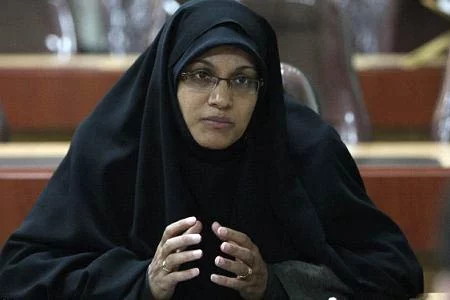
According to Mehr News Agency: Iranian MP Zohre Elahian on Wednesday called on the United Nations to take appropriate action to prevent the U.S. government from putting down the Wall Street protesters. Elahian, who is the chairperson of the Majlis Human Rights Committee, also said that the UN Human Rights Council should address the issue of the violation of U.S. protesters’ rights. “The scenes of the suppression of U.S. protesters are upsetting and necessitate pursuing human rights (violations),” she said. She went on to say that the era of U.S. claims about human rights has come to an end and the U.S. government has lost face due to the suppression of the people. In addition, she called on the international community to condemn the use of excessive violence by the U.S. police against protesters.

It is heartwarming that Elahian, an Iranian MP, steadfastly supports the Occupy Wall Street protesters from 6000 miles away! But when it comes closer to home, that is Tehran, there has been no urgency for Elahian to defend the rights of the peaceful protesters, the ones that she actually represents, at least on the paper. In fact she has gone as far as calling for the violent suppression of the Iranian opposition by the Revolutionary Guards (IRGC) (Source: Fars News Agency, July 10, 2011)! Elahian justifies her position by claiming that the opposition is after overthrowing the regime and equates them with external enemies. Let’s assume the opposition is truly after dismantling the Islamic Republic and brining a new system. Isn’t that the right of the people to do that? Elahian obviously doesn’t think so! But she and the rest of the regime’s officials are joyfully beating the drums and making lots of noise about how Occupy Wall Street movement is going to overthrow the capitalist governments of the west. But while death is good for the Iranian opposition, crying is in order for the opposition in U.S.!

Elahian has repeatedly referred to the Iranian opposition as seditionists. She has also blamed the protests by Iranians as instigated by foreigners. In November 2009, she participated in ademonstration in front of British Embassy and claimed Neda Agha Soltan’s killing during a rally in Tehran was carried out by foreigners. Elahian gave a speech at the rally (see video below) and said that Western countries are trying to create tension in Iran. She said that Neda was shot in the heart, which demonstrates that her killer was very professional. She added that an investigation by the Iranian authorities shows that “foreigners” planned Neda’s murder.

We have to give kudos to the Iranian authorities, and to Zohre Elahian, for so quickly pinpointing Neda’s murder on foreigners (every crisis is foreigners’ faults anyway!), considering she was killed during a huge rally in Tehran; even though we have to wonder why the evidence hasn’t been made public?

On the other hand, the authorities haven’t been as quick in identifying those who murdered the opposition protesters in Kahrizak, a notorious detention center under full control of the regime and a much smaller place in comparison to the capital city’s streets. But we can still give kudos to the regime for getting rid of the evidence, that is the two physicians who worked at Kahrizak and refused to stay silent about the murders. And what has Elahian done for the Kahrizak victims? She has made some noise, but certainly she hasn’t been after any serious resolution, unless she can somehow connect that to foreigners as well:

“The Kahrizak atrocities saddened many [Iranians]. However, we must not forget this incident was resolved with the guidance of the Leader of the Islamic Revolution. And it was the Leader’s direct order that led to the closure of the Kahrizak detention center,” she stressed.

So Elahian pretty much sees the Kahrizak case as closed and thanks the Supreme Leader, Ayatollah Khamenei, for resolving it, the very same person who should be held accountable for this and other atrocities in Iran. In fact it was Khamenei who explicitly threatened the opposition to stop their protests after the June 2009 elections, and when they didn’t, he turned the Basij and the Guards lose on them. So where was Zohre Elahian then to ask United Nations to protect the rights of the Iranian protesters, the ones she was supposed to represent and protect? One only has to wonder!

Considering the trampling of so many of rights of the Iranian people by the regime, and considering the fact that so many journalists, students, lawyers and activists are in prison in Iran, the Occupy Wall Street protesters will certainly not be fooled by the offer of support by the Iranian regime. And you madam Elahian better not lose focus on your highest priority, that is the violent suppression of the Iranian opposition so you can continue enjoying your precious seat in your parliament!


Source

Is Ahmadinejad’s team planning a military coup in Iran?

0


Al Arabiya – The fundamentalist movement in Iran close to the supreme leader of the Islamic republic, Ayatollah Ali Khamenei, has criticized president Mahmud Ahmadinejad and his close circle, referring to it as “the perverted team,” of planning a military coup in a bid to take full control of the country.

Newspapers in Iran have spilled a lot of ink about what is going on in the country, especially after Daoud Ahmadinejad, the Iranian president’s brother, declared that the so-called perverted team might resort to the military option soon.

The Iranian press has raised the following questions: Will Ahmadinejad resort to a military coup? Will division and inner conflict between Ahmadinejad’s supporters and opponents take over the Revolutionary Guard? Or will the Bassij and the Revolutionary Guard enter into confrontation for Ahmadinejad’s sake?

These questions were raised after Daoud Ahmadinejad pointed to the intentions of the “perverted team” to lead a military coup d’état without identifying the side he was talking about.

The term “perverted team” was used for the first time by the fundamentalist movement to designate the people close to the president’s brother. Did Daoud mean by the “perverted movement” the reformists who demonstrated in the streets after the presidential elections results had been published, in June 2009, to protest the reelection of Mahmud Ahmadinejad for a second presidential term?

Furthermore, press outlets in Iran reported that the president’s brother has referred to secret talks held few weeks ago in Machhed city between members of Ahmadinejad’s government and a number of leaders in the Revolutionary Guard and to which he personally assisted with a group of observers from the supreme leader’s office.

Ahmadinejad wants war

Some sources disclosed information about General Ahmad Wahidi, a former leader of the Revolutionary Guard who is in charge of the defense portfolio in Ahmadinejad’s government and who is believed to be the eye of the Guard in the government, stating in a meeting that “we have definite information that some of the government’s members are planning to leave the country and we were also advised that Ahmadinejad has prepared the ground for a U.S. military attack against Iran.”

Analysts believe that the military choice the president’s brother was talking about deals with Ahmadinejad’s capacity to reveal details of the assassination attempt that targeted the Saudi ambassador in Washington. This information gave the U.S. the perfect alibi to wage a war against Iran. Ahmadinejad’s team had prepared this scenario to justify the attack on Iran where the main accused will be the shadowy Quds force of the Revolutionary Guard. However, during his visit to the United States, Ahmadinejad might have reported the conspiracy to the American officials to complete the puzzle and put the Revolutionary Guard in the front line.

Experts consider that Ahmadinejad is aware that he is running out of time before the presidential elections in 2013 and that the parliament might be preparing to adopt a new ruling system wherein the parliament could be used instead of the people to elect officials holding executive power. Moreover, the parliament might even remove the very position of presidency and bring the prime minister to the front row. Thus, Ahmadinejad might be excluded from his position before the legal term of his mandate.

According to these experts, Ahmadinejad’s choices are narrowing. In fact, he sees in war the only option to stay in power, or at least to keep his position until the end of his presidential mandate, in August 2013.

Some sources say that Ahmadinejad believes that war is another pretext to force the ruling authority in Iran to enter into a direct dialogue with the United States. He might even have sent a relevant message to the U.S. and the U.S. might have responded to this request and gicen him positive signs.

According to one source, “Ahmadinejad considers that he laid the cornerstone of these talks, especially if we take into consideration the pressure exerted on the supreme leader to isolate Ahmadinejad. Nejad’s opponents believe that his wrong policies allowed the West to expand the sanctions against Iran and aggravated the economic situation in the country. Furthermore, Ahmadinejad has put the military choice on the Western table to direct a military attack against Iran because of the Iranian nuclear project, lead by Ahmadinejad”.

Isolating the president

Recently, the Society of Combatant Clerics in “Jame-ye Rouhaniyat-e Mobarez” expelled Sheikh Jafar Shajouni after his interview with a Lebanese newspaper during which he said that the Iranian regime is attached to Ahmadinejad until the end of his second mandate in 2013. The society accused Shajouni of supporting Ahmadinejad’s stance against them and that the ruling regime in Iran had taken its final decision to cancel Ahmadinejad’s presidential functions before the end of his mandate.

The society also said that Shajouni is close to the “perverted team.”

It was also said that one of Khamenei’s sons met with the former reformist president, Muhammad Khatemi, to discuss the return of reformists to the Iranian political scene.

However, nothing in all of this has confirmed, and it is interesting to note that the regime did not put the name of any of Ahmadinejad’s government officials on the list of persons banned from traveling outside the country.

Furthermore, we cannot underestimate the role of Ayatollah Abbas Vaez Tabasi in these talks, especially with the commander of the Revolutionary Guard


Source

The IRGC Caught in the CIA’s Trap

0

Farsi Translation

Iran Briefing – Less than ten days after the US announced that two Iranian citizens linked to the IRGC were involved in an assassination plot against the Saudi ambassador to the US, the scope of this news intensified to include punitive action against the IRGC. The United Kingdom, Canada, and the European Union together have placed five suspects who are linked to or members of the IRGC (Mansour Arbabseer, Gholam Shakouri, Ghasem Suleymani, Abdolreza Shahlaei, and Hamed Abdollahi) under travel restrictions and investigation. These individuals’ assets have also been frozen.


Although there are people who consider the accusations of the US deceptive, the fact that the US and its supporters (Canada and the EU countries) have taken a position in less than ten days categorically shows the power of the US to mobilize its supporters. Without doubt, the power of the US in mobilizing world opinion against the Islamic Republic will not be enough. It is very likely that Saudi Arabia (which, based on US claims, is the victim of this incident) will encourage the Arab world to align with other US supporters.


Most interestingly, after the EU placed sanctions on the five aforementioned individuals, the European Union’s High Representative for Foreign Affairs and Security Policy, Katherine Ashton, stated that the EU made its decision in the name of combating terrorism.


In reality, Ms. Ashton’s announcement opens a new door against the IRGC: its name will practically be included on the list of terrorist organizations.


Meanwhile, the IRGC already has a bad history from the past to the present. Exploits such as the assassination of Shapour Bakhtiari and his secretary in France, the Mykonos assassinations in Germany, the bombing of the Jewish Center in Argentina, the IRGC’s heavy presence in Afghanistan and Iraq, the transfer of arms to Nigeria and Senegal (which eventually cut Senegal-Iran relations), the rumored IRGC involvement in crushing the ongoing protests in Syria, and most importantly the IRGC’s influential role in the crackdown on the Iranian protests—have complicated the IRGC’s efforts to negate accusations against it.


Now the IRGC has changed into a military-security-economic organization with a heavy presence in all of Iran’s institutions and projects. The appointment of Rostam Ghasemi as Minister of Oil symbolizes the peak of IRGC influence on the Ninth Government. At the same time, the IRGC is the Supreme Leader’s eyes and arms. Both the IRGC and the Supreme Leader aim to change the IRGC from just a military organization to a more powerful security-economic organization.


Hence it’s clear why, before September 7, Deputy IRGC Commander General Hossein Salami announced that the “Regime’s response to the enemy’s threats will be hard and crushing.” General Salami implied that he was very well aware of the scope of the incidents that the Islamic Republic aimed to carry out.


Soft Trap


Looking at the wide-scale attack against the IRGC following the US announcement, it’s expected that the scale of these attacks will increase. It’s highly likely that in the near future the IRGC’s name will enter the list of terrorist organizations.


General Salami and many others in the Islamic Republic—which is delighted with the IRGC’s missile and varied armed capabilities—are ready to give “hard and crushing response.” It seems that they didn’t realize that the US possesses knowledge of the IRGC’s hardware capabilities and would put to work its software power to fight the IRGC. The IRGC lacks the ability to execute operations in the area of software.


In essence, the CIA and the FBI soft trap avoids old-fashioned hard combat with the Islamic Republic (in which the IRGC plays a critical role).


Before President Barack Obama begins his presidential campaign for a second term in the White House, the US will avoid entering an old-fashioned war.


If the latest US claims at the UN Security Council will be proven correct, the IRGC will bear hard consequences. Even without substantiation of the claims, America and its allies will fundamentally choose to debilitate the IRGC and eventually the Supreme Leader because of the IRGC’s bad history of cracking down on the Iranian protesters, its cancerous presence in even the minutest details of government, and its position as the biggest force of the Iranian establishment.


Understanding this soft trap and considering reports from inside the IRGC that indicate many IRGC personnel are discontent with the crackdown on the Iranian people’s protests, placing elite IRGC members under a variety of sanctions will deprive them of the possibility to act.  It’s enough to look at the US and EU human rights sanctions lists to find the names of many elite IRGC members. Furthermore, the names of many influential IRGC members are on the list of sanctions related to Iran’s nuclear program.


Most interestingly, the latest rounds of EU sanctions against the Islamic Republic specifically target the IRGC Quds Forces, not because of the nuclear issue, human rights violations, or the crackdown on the Iranian people’s protests, but for supporting the Syrian government in suppressing the ongoing protests in Syria.


The Complementary Trap


While the UN’s Special Rapporteur on Iran Human Rights, Ahmad Shaheed, presented his report to the Secretary General, thanks to the pressure from the US and its allies (EU, Canada, some Arab countries, as well as Australia, Japan, and South Korea), the Islamic Republic is now psychologically isolated.

In addition to the soft trap targeting the IRGC, the United States’ other trap is to basically disturb the Islamic Republic’s financial operations. Based on claims from US officials, the Islamic Republic’s Central Bank (the country’s main artery in conducting transactions with the outside world) will also be sanctioned.


If China and Russia block this resolution containing such proposals and the US fails to get UN Security Council to sanction the Islamic Republic’s Central Bank, then the US and its supporters will still disturb the financial transactions between the Islamic Republic’s banks, in the end seriously affecting the IRGC’s activities.