Home Blog Page 676

Germany urges Iran to free two journalists

0

Monday, 31 January 2011

BERLIN, January 30, 2011 (AFP) – Germany on Sunday urged Iran to immediately release two journalists arrested for covering the case of a woman whose sentence to death by stoning provoked international condemnation.

“I call on the Iranian government to immediately free the journalists imprisoned since October 10 and to make possible their return,” German Justice Minister Sabine Leutheusser-Schnarrenberger told newspaper Bild am Sonntag.

The pair, Marcus Hellwig and Jens Koch, work for Bild am Sonntag.

The two reporters were arrested in October in Tabriz for interviewing the son and lawyer of Sakineh Mohammadi Ashtiani, a woman sentenced to death by stoning for adultery, a case that triggered an uproar around the world.

Iran accused the pair of having links with an anti-revolutionary group and said they had not obtained a special government permit to work in the country which is usually required of foreign journalists.

German Deputy Foreign Minister Wolf-Ruthart Born travelled to Tehran last week to discuss the case but was unable to obtain any results, Bild am Sonntag said.

Iranian Foreign Minister Ali Akbar Salehi earlier this month demanded “apologies” from the Axel Springer group, which owns Bild am Sonntag, over the incident.

“If the publisher and the editor-in-chief acknowledge they made a mistake, it would be a very useful gesture,” he said in an interview with Der Spiegel magazine.

Source

More news websites blocked in Iran

0

January 31, 2011

TEHRAN Jan 31 (Reuters) – Iranians have found their access to major news websites even more restricted than usual as more foreign sites were blocked by a government filter, Reuters witnesses observed on Monday.

Yahoo News and Reuters.com, both usually accessible in Iran, were unavailable, joining other long-blocked news sites such as the BBC and social networks Facebook and Twitter as beyond the reach of Iranians using a standard Internet connection.

There was no official confirmation of new Internet restrictions. One Iranian government official contacted by Reuters said authorities were “looking into the source of the problem” to remove it.

The move comes as many Iranian politicians, including President Mahmoud Ahmadinejad, are portraying anti-government protests in Egypt as being inspired by Iran’s Islamic Revolution which overthrew the U.S. backed Shah in 1979.

Many analysts outside Iran have compared the events in Egypt and elsewhere in the Arab Middle East to the huge protests which followed the re-election of Ahmadinejad which were eventually stamped out by a government that condemned them as “sedition” inspired by hostile foreign powers.

Google News was still accessible on Monday, but links from there to many foreign news websites were blocked and a list of government-approved sites offered instead. No reason was given for why certain sites are filtered.

Yahoo’s home page could be accessed and softer news items, including a CNBC item on American football cheerleaders, were not blocked. Links to harder new stories and the home page of Yahoo News, however, failed to load.

Source

Kurdish political prisoner’s life in danger

0

January 31, 2011

NCRI – A Kurdish political prisoner sentenced to death in Iran has been taken to an unknown location from Ward 4 of the Gohardasht prison in Karaj.

According to Harana news agency on Sunday, Loqman Moradi was transferred from the ward and never returned.

In view of the recent spike in the number of executions by the clerical regime, there is a probability for political prisoners to be hanged in secret.

Loqman and Zanyar Moradi have been sentenced to “moharebeh” (enmity against God) and charged with killing the son of Marivan city’s Friday prayer leader.

Neither the defenders nor their lawyers have been notified of the sentencing, according to the news agency.

In a letter, the two prisoners have written that they were forced to confess to the allegations after being threatened in prison with rape.

Loqman Moradi was previously arrested on a number of occasions for supporting the Kurdish political opposition in Iran.

Source

Jailed Supporter of Mourning Mothers in Poor Health and Banned from Prison Visits

0

January 31, 2011

Persian Report by Mothers of Laleh Park
Translation by Roya Irani | Edited byPersian2English

January 20, 2011 – Family members of Hakimeh Shokri announced that in their previous [attempt at a] prison visit, which [is supposed to] take place every two weeks,  prison officials did not allow them to visit nor follow up on Hakimeh’s condition. The family said that Shokri has been banned from prison visits, and after hours of waiting for news on Hakimeh, they had no option but to leave.

Hakimeh Shokri was arrested on Decmber 5, 2010 along with several other mothers who were celebrating the birthday anniversary of Amir Arshad Tajmir, one of the killed protesters during the 2009 Ashura protest (December 27, 2009). They were gathered at Behesht Zahra Cemetery and were arrested. Even though other mothers were released the same night of their arrest, Hakimeh was transferred to Evin prison. She is charged with “Espionage” and “Acting against national security”.  Hakimeh has done nothing but sympathize with the mothers and families who lost their loved ones after the 2009 Iranian Presidential election.

In a previous prison visit with Hakimeh and a month after the arrest, her family said that when they met with her, the torture Hakimeh has endured was noticeable from her face and the heavy shaking of her hands. However, her spirits are high and she has faith in her innocence, despite all of the pressures, insults, and tortures she has had to withstand in addition to pressures to make false confessions against herself and the Mothers of Laleh Park (Mourning Mothers of Iran).

While Hakimeh’s brother and sister were able to previously visit her, two men were pacing behind Hakimeh and one man was sitting right next to her and monitoring all of her movements. According to her family, Hakimeh is in very poor physical condition, and for two hours the night before she was interrogated and was put under severe pressure and torture and to be transferred to a hospital. Hakimeh Shokri is now under new pressures and the ban from visits is very troubling.

During the last 2 years, the Mothers of Laleh Park endured tyranny and misery, but they stand firm and carry on with integrity and don’t allow anyone to hinder their movement. They are hoping for the release of dear Hakimeh Shokri soon.

Source

Ben Ali’s Departure; Seyed Ali’s Tenacity

0

January 30, 2011

Akbar Ganji

The Collapse of the Revolutionary Culture and its Rebirth with Conflicting Values.

Iran’s revolution and its outcome (a dictatorial regime, incredible levels of violence, etc) have weakened revolutionary culture in different ways. Peaceful methods to attain ends have given way to violent ones. But still, the idea of revolution lingers in the back of the minds and will not go away this easily. When Zine al-Abidine Ben Ali, the president who had ruled over Tunisia for 24 years fled to Saudi Arabia on January 14 of this year, suddenly everybody began to ponder: why not topple seyed Ali and force him to flee as well. The period between the start of Tunisian demonstrations against their economic and political conditions on December 17 and the flight of Ben Ali on January 14 is not very long, so how come the many month demonstrations of Iranians did not produce a similar result? Even though the number of deaths among protestors in both countries were about the same (Tunisia’s transition government announced 78 deaths of which 42 were among the detainees who died of burns in prison, while the UN presented over a 100 deaths), this event demonstrated that revolutionary culture is still alive among us and if an opportunity arises, many people will rise to topple an existing order.

Historic Evidence for Cyclical Patterns of Revolution and Destruction

Opponents of the Iranian regime, who have been waiting for years for changes in the political structure of the country, rejoiced at the flight of the Tunisian dictator and brought new optimism to them. This joy also brought about questions and directions. The goal now was to topple Ali Khamenei just as Ben Ali was removed. But can this optimism to topple or remove Iran’s supreme leader be supported by historic observations and evidence, and theoretic basis? As far as I know, there are two historic evidences and one theory that support the possibility of replicating in Iran what took place in Tunisia.

Revolutions of 1848

The revolutions that erupted in Europe in 1848 began in Paris. When it succeeded there and a republic was declared on February 24, 1848, the wave flowed to other European cities and within a short time everybody was impacted. On March 2 revolution conquered the south-western regions of Germany, in Bavaria on March 7, Berlin on March 11, Vienna and Hungary on March 13, in Milan on March 18, etc. In other words, this revolution soon spread to 10 countries (today known as France, Germany, Austria, Italy, Czech Republic, Slovakia, Hungary, parts of Poland, former Yugoslavia and Romania). But within just a few months, all of these revolutions failed and in 18 months all of the toppled regimes (except in France) returned to power. As Eric Hobsbawn, the British Marxist historian, some of these regimes such as the Habsburg Empire became even more powerful than the past. Thousands of revolutionaries were killed in the most brutal manner and ten times as many were exiled or imprisoned. Quick victories along with unbelievable reach, and magnanimous promises, the climate of citizenship and romanticism soon gave way to very rapid defeats, retreats, and returns. These are the most important features of the revolutions of 1848.

Revolutions of 1989

The second series of events that makes Iranians hopeful are Eastern European revolutions of 1989 which succeeded in a relatively short time. On the second bicentennial of the 1789 French revolution, staring from August and continuing till the end of 1989 the communist regimes of Poland, Czechoslovakia, Hungary, Romania, Bulgaria and the Democratic Republic of Germany all collapsed without the firing of a single bullet (except for Romania). Then came the turn of the Union of Soviet Socialist Republics which fell in December of 1991. But along with these successes one should also mention the communist regime in China which in 1989 ruthlessly fired at its opponents at Tiananmen Square and ended that peaceful revolution.

Perhaps what has begun in Tunisia is similar to the revolutions of 1989. Since Tunisia, we are now witness to replications of Mohammad Albo Azizi’s act of setting himself on fire in Egypt, Saudi Arabia, Mauritania and Algeria where people have already set themselves on fire resulted in popular protests and demonstrations in other Arabian towns (in Jordon, Algeria, Egypt, Saudi Arabia, etc). The thousands of demonstrators in the streets of Cairo last week chanted “Viva Free Tunisia”, Death to Hosni Mubarak” in the presence of thousands of policemen. Demonstrators across Egypt chanted slogans against Mubarak – who has been in power for some 30 years – and clashed with police. Last Tuesday, the demonstrators in Egypt called the day “Revolution Day against Torture, poverty, bureaucratic corruption and unemployment.” There were even demonstrators in front of the Egyptian Supreme Court where protestors held posters that said, “Tunisia is the solution.” These actions bear witness to the claim that Tunisia has turned into the revolutionary model.

The theory of Archetypal

This theory asserts that when a dictatorial regime falls and is replaced with a democratic regime, the event turns into a model for other dictatorial societies thus spreading democracy in this way. This theory is particularly true for countries that are adjacent to each other in the same region. In other words, this view believes that when an undemocratic regime collapses, pressure mounts on authoritarian regimes across the globe.

Comparing Iran with Tunisia

Both countries share a dictatorial form of government. But beyond that, the two regimes have nothing else in common.

Ben Ali was the leader of a 10-million people secular regime with a liberal economy and a pro-Western orientation. Ali Khamenei is at the head of a religious regime that has a state-oil economy, is anti Western and is in complete isolation with the West. Tunisia lacks oil and earns its income through tourism (with about 6 million tourists per year in 2006) while the economy generated revenues through the export of domestic products. The Iranian economy in contrast is essentially dependant on oil revenues (between 2005 and 2010 Iran generated 391 billion US Dollars through the export of oil). Income per capita in Tunisia in 2009 stood at USD 7,810 while at Iran it was USD 11,470. 8.3 percent of Tunisians in 2010 lived under the poverty line while in Iran this figure is at least 20 percent. Inflation in Tunisia in 2010 was 5.4 percent while in Iran it stood at 9 percent. The inequality factor in 2010 in Tunisia was 400, about the same figure as that of Iran. Regarding corruption, Tunisia has been rated as 59th from amongst 178 countries in 2010 while Iran was 146th, with Iran being much worse. Social and economic structures and demands in both countries have outpaced the political system.

These figures and facts indicate that Tunisia’s economic conditions are not as bad or in a crisis. Iran’s economy is much worse than Tunisia’s. Inflation, unemployment, poverty and corruption were all worse in Iran than in Tunisia. While some commentators have pointed to the levels of corruption committed by Ben Ali and his family, this issue must be looked at across the regime, not just the head of the system. According to Transparency International, corruption in Iran is almost three times worse in Iran than it is in Tunisia.

Finally, Tunisia enjoys legal civil institutions. Examples of this are the Workers Union, the national women’s union, and the national students union. In contrast to this, in Iran no civil institution independent of the government is tolerated. Even though Tunisia’s unions were formed in a dictatorial system and its leaders are known to be corrupt, the members of the unions were not. They have played a central role in the demonstrations. Iranian dissidents lack any organization, desire democracy and human rights, while in Tunisia Muslim fundamentalists and the communist party were and still are among the key opponents of Ben Ali. In the 1980s, Ben Ali arrested some 30,000 members of the fundamentalist Islamic organization. One such leader Rashid al Ghannushi has now returned to Tunisia from exile in the UK, as leaders of the communist party and Islamists assert that they are after a democratic system.

Source

Supreme Commander, Leader’s Representative and IRGC PR are Cited

0

January 30, 2011

Bahram Rafiee

In recent years, and particularly since the disputed June 2009 presidential elections in Iran, commanders of the Revolutionary Guards (IRGC) have regularly appeared in the media and accused many political personalities, civil activists, and media professionals of engaging in “sedition” activities against the state, trying to overthrow the regime, and even having relations with foreigners – a term implying being foreign spies – because of their criticism of the current administration and also their protests over the official announcement of the 2009 presidential elections. But in its latest statement, the public relations office of the IRGC announced that, “The official position of the IRGC will be announced only by the supreme commander (of the IRGC), the representative of the supreme leader and the PR office of the force.”

In remarks that were posted on the IRGC website and official news agencies of the Islamic republic, Guards commander General Ramezan Sharif said, “Based on existing directives and criteria in the armed forces and IRGC policies, only what is said and published by the supreme commander, the representative of the supreme leader and the public relations office of the IRGC through its statements, news, interviews or reports, shall be the official positions of this institution.” He specifically reiterated that what “other commanders and officials of the Guards announce about various issues and subjects are not necessarily the official position of the force.” But he also further added that, “force commanders and organization authorities and those whose responsibilities have been announced by the supreme leader and the supreme commander also shall engage in reporting on their performance within the realm of their responsibilities.”

It should be noted that this announcement comes at a time when ever since the June 2009 presidential elections IRGC commanders have widely expressed their support for Mahmoud Ahmadinejad through the official media, despite the specific ban on such activity in the charter of the force and also the directive of ayatollah Khomeini who had said that “the Guards should not engage in political affairs.”

Among those commanders whose views have been viewed as representative of the IRGC is the

General Yadollah Javani, the head of the IRGC political office. He normally publishes his political views in the IRGC’s official publication, Sobh Sadegh, under the purview of the representative of the supreme leader in the force. He has regularly defended and supported Ahmadinejad in his writing and has called those who had questioned the 2009 presidential election as “seditionists.”

General Javani has also written much against Mir-Hossein Mousavi, the leading presidential contender in 2009 who was the country’s prime minister during the 8-year war years in the 1980s. He has accused Mousavi of orchestrating a velvet revolution to overthrow the theocratic regime and also asserted that his views reject the principle of the absolute religious leader, known as thevelayat faghih in Shiite political doctrine. In his pieces, he had also said that the IRGC would destroy any attempts to advance a velvet revolution.

Last month when former two-time president Mohammad Khatami announced the minimum requirements for reformers to participate in future elections, General Javani lashed back that Khatami was “changing tactics to implement a soft war.”

Another commander who has been vocal in expressing the views of the IRGC is Mohammad Hossein Saffar Herandi, the advisor to the IRGC commander. After being removed as the minister of culture, he returned to the IRGC and was appointed advisor to the leadership of the force. Herandi was the head of the IRGC political office between 1989 and 1993. When he returned to the force after a stint in Ahmadinejad’s administration, he too launched verbal accusations on many reformers and political activists. His attacks included those on veteran politician and two-time president and Majlis speaker, Hashemi Rafsanjani who now heads the Expediency Council on Leadership. He accused Rafsanjani of striving to weaken the powers of the supreme leader. Just last week, Herandi again attacked Rafsanjani and charged that, “the enemies focused on the prominent personalities of the regime and presented the view that the spiritual leader rested with the velayat faghih (i.e., supreme leader) while the political leadership rested with Mr. Rafsanjani, so as to present a dual regime in Iran which has unfortunately not been disclaimed by Rafsanjani and his associates.” In his more recent remarks, Herandi implicitly called for the removal of Rafsanjani as the head of the Assembly of Experts on Leadership which constitutionally is empowered to supervise the work of the supreme leader and confirm his status. “Mr. Rafsanjani has a shining record in the revolution, but we miss those days and must find him only in the records,” implying that he no longer has a shinning positive record because of his implicit and indirect acknowledgement of the issues related to the 2009 presidential election and the over reaches of the current administration.

It should be noted that the supreme IRGC commander General Mohammad Ali Jaafari too has engaged in publicly attacking Iranian reform leaders by name. He has named Mohammad Khatami, ayatollah Mousavi Khoeniha, Mostafa Tajzadeh, Behzad Nabavi, Abolfazl Fateh, and Mehdi Hashemi, among others, as activists who had planned to unseat the country’s supreme leader.

Last year, a person who was simply announced as General Moshafagh repeated these same accusations against dissidents and pro-democracy leaders but also named specific organizations, including Majmae Rohaniyun Mobarez (the Combatant Clergy), Majmae Niroohaye Khate Imam (Coalition of Forces Following the Path of the Imam), Mosharekat party, Mojahed Enghelabe Eslami (the Mujahidin of the Islamic Revolution), Kargozaran (Executives of Construction) and others as having a hand in planning to overthrow the regime and the supreme leader adding, “We (IRGC) stopped their (reformists) efforts to accomplish this.”

A similar charge against these organizations had been made earlier by the commander of the IRGC which had prompted in an official response by seven reformist political activists who filed a court suit against the IRGC supreme commander. Soon after that, the complainants were arrested and sent to prison, as these accusations against protesting civil activists continue by IRGC commanders and authorities.

Source

Karoubi’s Son Interrogated for Six Hours

January 30, 2011

Leyla Tayeri

Hossein Karoubi, prominent pro-reformist cleric Mehdi Karoubi’s eldest son was released from top security Evin Prison after six hours of interrogations. This is the second time in two weeks Mr. Karoubi was summoned to Evin and interrogated.

A Rooz reporter reports from Tehran that Mr. Karoubi was interrogated over his interviews about the atrocities committed at Kahrizak Prison where rape, murder and torture have been reported. Hossein Karoubi was told that he had dishonored the country through the interviews.

During the interrogations, Mr. Karoubi was accused of targeting the supreme leader of the Islamic republic and in his interviews had weakened him, after Mr. Karoubi’s father’s was raided by plainclothes agents and Basiji militiamen last year.

In February of 2010 over 50 plainclothes agents, which included some women, gathered in front of Mehdi Karoubi’s house and chanted slogans against him, Mir-Hossein Mousavi and Mohammad Khatami – all leaders of Iran’s Green Movement that has challenged the 2009 presidential election results – and then engaged in the destruction of his house while calling on authorities to confront this cleric.

During Ghadar and then Fitr festivities, Mehdi Karoubi’s house was again surrounded by plain-clothes agents as his house was damaged by fire while law enforcement officials merely watched the events from a distance.

In more recent months, security forces set up a post outside Mehdi Karoubi’s house and prevent visitors from entering the house, which include a senior cleric, ayatollah Bayat Zanjani. Mr. Karoubi’s wife told the press at the time that her house was under a temporary siege.

Following those violent events, Hossein Karoubi spoke with the media and informed the public of the attacks on his father’s house. The summons and questioning and charges raised against him last week pertain to the interrogations he gave regarding the attacks on his father’s house.

After leaving Evin, Hossein Karoubi told Rooz that he was released after several house of interrogations and was not formally charged with anything while the interrogations were all recorded in writing. Most of the questions were over the interview with Saham News, a website belonging to the Etemad Melli (National Unity) party.

Some newspapers had reported two days ago that Hossein Karoubi had been arrested. IN the meantime, Fatemeh Karoubi, Mehdi Karoubi’s wife told Rooz, “Hossein left the house at 10:30 am and I sent a couple of the kids along with him. They called us about 4pm and told us a man wearing a black shirt came out of Evin prison and said that Hossein had been arrested and that they should leave the scene. But eventually Hossein did come out of the prison.”

Mrs. Karoubi added that authorities were trying to exert pressure on the family these actions. She reiterated that none of these pressures would have any effect and that they would not be shaken off because of them.  “Look at what they are doing. They recently published a photograph of Mr. Karoubi belonging to the sixth Majlis when he was in hospital and are claiming that his health is not good, whereas in reality his health is fine and he is in great spirits and we feel sorry for the IRGC (i.e. Revolutionary Guards) website for publishing this claim and rejoicing at someone’s death while claiming to be Muslims. They are in fact expressing their hopes and wishes,” she concluded.

Source

Political prisoner Arzhang Davoudi gets 14 more months on a newly made case

0

January 30, 2011

On Monday Jan. 4 the day of the execution of two supporters of PMOI, Mohammad Reza Haj Aghaee and Jafar Kazemi, another political prisoner Arzhang Davoudi was taken to branch 3 of the so-called Revolutionary court, was charged with newly made-up allegations and was condemned by the head of the branch Mir Qhafari to another 14 months of incarceration.

This new case is opened by the interrogators of the Intelligence Ministry accusing him of ‘propagation against the Establishment, offending the officials of the Establishment and disrupting the public opinion inside and outside the country against the Establishment’!

It is to be mentioned that these are the accusations based on which the religious fascism ruling Iran marks political prisoners with as a ‘Mohareb’ to have an open hand for their execution.

Mr. Davoudi was then transferred from ward 3 to saloon 12 of ward 4, the newly formed ward, a crypt in Gohradasht (Rajaee Shar) Prison.

This newly made case comes at a time that Mr. Davoudi has spent near 8 years in regime’s prisons so far.

His house that was confiscated and sealed by the so-called Revolutionary Court is given to a female Pasdar (member of IRGC) by the decree of Khamenei.

Source

Iranian hangings spark protest in Berlin

0

January 28, 2011

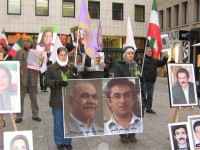
BERLIN, Jan. 27 (UPI) — Germans and exiled Iranians gathered in front of the German Foreign Ministry Thursday to demand that Berlin take a stance against a wave of executions in Iran.

Around 60 people, sporting banners and chanting “no more silence,” Thursday braved the Berlin cold to assemble outside the foreign ministry. They gathered after news surfaced that two Iranians, who were arrested last summer amid protests following Iran’s disputed presidential election, were hanged Monday.

“We want German Foreign Minister (Guido Westerwelle) to break his silence and condemn the execution of political prisoners in Iran,” Masoud Azadih, an Iranian national living in Berlin, told United Press International.

Iranian authorities have executed at least 71 prisoners since the beginning of this year, Amnesty International said Monday, adding that thousands more are on death row. Opponents of the regime claim Tehran cracks down on activists as it fears Tunisia-style unrest in its streets.

Azadih, is an activist with the NCRI, the organizer of the Berlin protest and a European-based exiled Iranian opposition group linked to the outlawed People’s Mujahedin of Iran, which aims to overthrow the Iranian regime.

Critics of the PMOI, listed as a terrorist organization by Iran and the United States, denounce it as a sect and point to its paramilitary campaigns of the past. Its supporters say the group wants a free, democratic Iran and note that the European Union removed the PMOI from its terror list in 2009. The United States disarmed the PMOI, which has around 3,500 members living in Iraq, in 2003.

The prisoners hanged Monday, Jafar Kazemi and Mohammad Ali Hajaghaei, had been convicted of moharebeh (enmity against God), anti-regime propaganda and having contacts with the PMOI, Amnesty International reports. U.S. Secretary of State Hillary Clinton last year urged Iranian authorities to release the activists, despite the PMOI terrorist label.

Whatever the PMOI’s motives, the Iranian regime’s crackdown on its opponents inside the country has sparked condemnations from Western officials and human rights groups.

“The noose has tightened, in some cases literally, around the necks of activists in Iran,” Sarah Leah Whitson, Middle East director at Human Rights Watch, said in a statement accompanying the group’s new report on human rights abuses, which was released this week. “The government’s crackdown has gone beyond silencing post-election demonstrators and is now a broad-based campaign to neutralize Iran’s vibrant civil society and consolidate power.”

Britain’s Alistair Burt, a conservative MP and a high-ranking diplomat in Britain’s Foreign Office, condemned the executions and called on Iran to “to cease using the death penalty.”

The protesters in Berlin said they would like to see Germany follow Britain’s example and condemn Iran’s hard-line course.

“The German government is acting when it comes to executions in the United States but is silent when political prisoners are executed in Iran. That’s a scandal,” said Christian Zimmermann, a Berlin human rights activist, who was at Thursday’s protest. “The German foreign minister believes in appeasement and silent diplomacy but the Iranian regime has made it clear that it’s not interested in that at all.”

Source

Detained Journalist Saeid Matinpour Denied Prison Leave

0
28 , January , 2011
Human rights activist and journalist Saied Matinpour has been in detention for the past 2 years and has been continously denied prison leave.
Matinpour, 35, has been denied prison leave despite the medical certification indicating his poor health. According to Human Rights House of Iran, he was a philosophy student at Tehran University who is suffering from severe back pain and has been diagnosed with lung infection in prison and his condition has worsened due to lack of medical care.  His family who has to travel to Tehran from Zanjan in order to visit him has not requested that he would be transferred to Zanjan since they believe that the conditions in Zanjan are even worse than Evin Prison. Matinpour was arrested before the elections and was released on bail after 9 months of detention. He was once again arrested after the disputed elections.