Home Blog Page 72

Iran cozies up with Taliban, fearing ISIS threat in Afghanistan

0

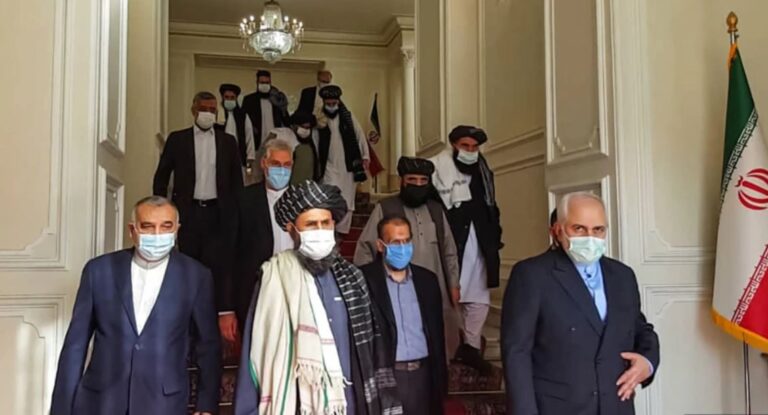
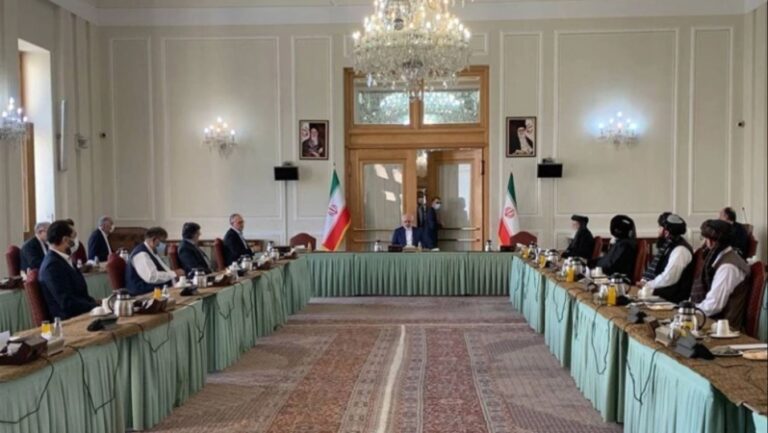
Concerned with the re-emergence of ISIS in its borders, and fully aware of Taliban’s inevitable rule in Afghanistan after the withdrawal of U.S. troops, The Islamic Republic of Iran hosted the first significant talks in months between Taliban and Afghan government representatives on Wednesday.

The Government of Iran, exploiting the withdrawal of Americans from Afghanistan, plays the role of mediator between the Kabul government and Taliban, but what truly worries the Iranian government is the future of Afghanistan.

The Kabul regime cannot stand up to the Taliban insurgents without the help of Western countries, and as a result, the deep reconstruction of Afghanistan’s political scene is an inevitable reality, which is why Tehran is already trying to keep the Taliban on its side.

The Islamic Republic of Iran knows that ISIS remains a very serious threat in the country as it is taking advantage of the turmoil that prevails in Afghanistan.

 Tehran is extremely fearful of an ISIS uprising in Afghanistan, as it is well aware of its hostility toward the fundamentalist Shiite government in Iran.

From Tehran’s point of view, the Taliban are the only local power that can prevent ISIS from expanding its influence in Afghanistan.

 The Iranian government also knows that it cannot expect much from the Tehran conference, since it is impossible to assume a temporary even-reaching ceasefire between Kabul and the Taliban.

The Taliban have made relentless territorial wins since April when President Joe Biden announced the last 2,500-3,500 US soldiers and 7,000 allied Nato soldiers would depart Afghanistan. With their victories in northern and southern Afghanistan, the Taliban are escalating pressure on provincial cities and gaining control of key transportation routes.

What Tehran wants is to receive some guarantees from the Taliban, while the group’s grip on Afghanistan seems inevitable. In fact, Iran’s fear of the ISIS threat in Afghanistan and its re-emergence in the borders is one of the main reasons behind Iran cozying up with the Taliban.

Also read: Widespread blackouts and water shortage spark protests across Iran

Iran’s priorities become clearer as IRGC’s weapons show-off continues

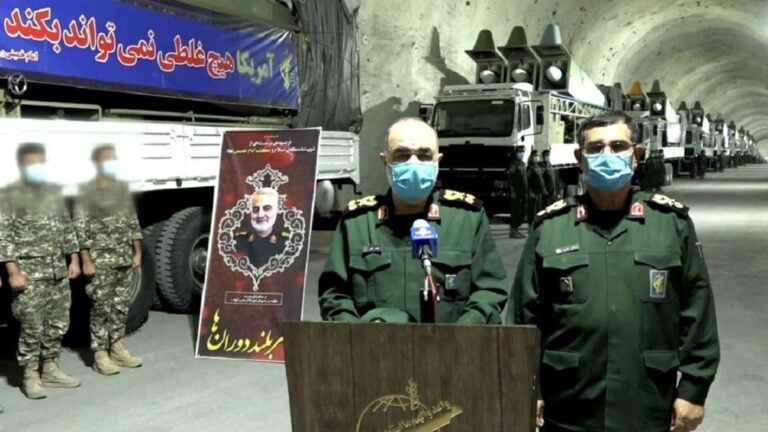
As the Israel-Hamas ceasefire and discussions about the presidential elections in Iran began in late May, the IRGC unveiled several military weapons, including the Gaza Drone, the Quds Radar System, and the surface-to-air missile system called “December 30”, highlighting Iran’s priorities while the country is grappling with the Covid-19 pandemic.

The weapons unveiled, their range, as well as IRGC’s series of missile developments, especially since last year, draw a larger picture of a program that is underway within the Islamic Republic.

In introducing the Gaza Drone, Tasnim news agency said the drone was capable of carrying “13 bombs up to an operational radius of 2,000 kilometers and carrying 500 kilograms of intelligence and signal collection equipment.”

It appears that the “Gaza drone” is the previously named “Witness 149” drone, which Akbar Karimlu, the IRGC commander, had previously promised to unveil in May last year, a drone that has now taken a different name in light of the recent dispute between Israel and Hamas.

The IRGC has dropped the 1980’s “nuclear energy” trumpet and picked up the “missile industry” horn ever since the mid-1990s to the present. So much so that IRGC commanders even interpreted the recent presidential elections with “missile” literature, saying that “the value of every vote of the people is greater than a missile unto the heart of our enemy”

But in response to these remarks by the IRGC, less than 30% voter turnout in Iran’s 2021 presidential elections clearly demonstrated how important the regime’s missile program is to the Iranian people.

Iran’s and IRGC’s nuclear and missile programs thus far, have brought nothing but poverty, corruption, and sanctions to the Iranian people, with millions of people currently facing widespread blackouts, water disruptions, and food shortages.

The Islamic Republic of Iran’s priorities have been clearly displayed in recent years, and so have the priorities of its people.

Also read: Iranian militias recruiting child soldiers and human trafficking in Iran

Widespread blackouts and water shortage sparks protests across Iran

0

Frequent and unannounced power outages in Iran have caused anger among people, resulting in protests across Iran in recent days. A crisis that could cost the lives of patients hospitalized in medical centers, whose life depends on electronic devices.

The continuation of power outages in at least 15 locations of Iran, including Tehran, Qazvin, Karaj, Shahriar, Rasht, Bandar Abbas, Ahvaz, Isfahan, Mashhad, Shiraz, Zahedan, Kermanshah, Karaj, Semnan, and Zabol has been reported by citizens. Officials at the national electricity company in Iran said the cause of the power outages was receiving an order to do so, as two of the main power plants in the country are “out of order.” However, Iran’s electricity industry spokesman earlier stated that the “unauthorized extraction of cryptocurrencies was one of the main reasons behind power outages.”

The reason behind the widespread blackouts is Iran’s Islamic Revolutionary Guard Corps(IRGC) illegal cryptocurrency mining in cooperation with Chinese companies.

In addition, many parts of the country face severe water crises due to the inability of authorities to manage minimal rainfall. In this regard, the CEO of The National Water and Wastewater Company said that 101 cities are in a red state of water supply.

Extended power cuts that started in May decreased in the first half of June before the controversial presidential election on June 18 as it became certain that millions of disenchanted voters were inclined to boycott the vote. After the election, when a hardliner judge well-known for his human rights violations was announced the winner, power cuts again became more frequent.

The continuation of unannounced power cuts has resulted in people gathering in many cities, sparking protests across Iran. In Tehran and countless other cities, people are shouting “Death to the dictator”.

Also read: Ex-Intelligence minister admits Mossad has penetrated the Iranian regime

Iranian militias recruiting child soldiers and human trafficking in Iran

In its annual report on human trafficking, the U.S. Department of State lists 17 countries, including Iran, which have not met the minimum standards for combating human trafficking. In addition, the regime has made no major effort to reach those standards, has consistently failed to address the issue of human trafficking in Iran, and therefore ranks third.

In the report, which surveyed 188 countries, Iran is mentioned among other countries such as China, Myanmar, Venezuela, North Korea, South Sudan, Venezuela, and Afghanistan.

Child soldiers are among the human trafficking cases mentioned in this report. The report says Iran is forcing child soldiers to join militant groups in Syria and Yemen.

Tehran identifies its militia groups such as Fatemiyoun Brigade in Syria, among them children, as forces defending the shrine.

Fatemiyoun Brigade is an Afghan Shia militia funded, trained, and equipped by Iran’s Islamic Revolutionary Guard Corps (IRGC) since 2014 to fight in Syria and follows the command of Iranian officers.

The report also says that Iran continues the same pattern of previous years in violation of the rights of victims of sex trafficking and has made no effort to reduce the demand for illegal sex services, child spouses, or child sexual abuse.

In this report, the U.S. Department of State categorizes countries at three levels based on measures and how to deal with human trafficking, transparency, and compliance with standards.

The countries present at the first level are countries that fully comply with the standards. The “second level” is a set of countries that do not meet all the requirements, but whose governments are working to improve conditions.

The third level of the list includes countries whose behavior is inconsistent with minimum standards for combating human trafficking and who do not take any action to improve the situation.

Human trafficking has affected 25 million people worldwide, most of them women and children and despite the COVID-19 pandemic, human trafficking still continues.

Source: The Independent
Also read: Iran official defends execution of minors

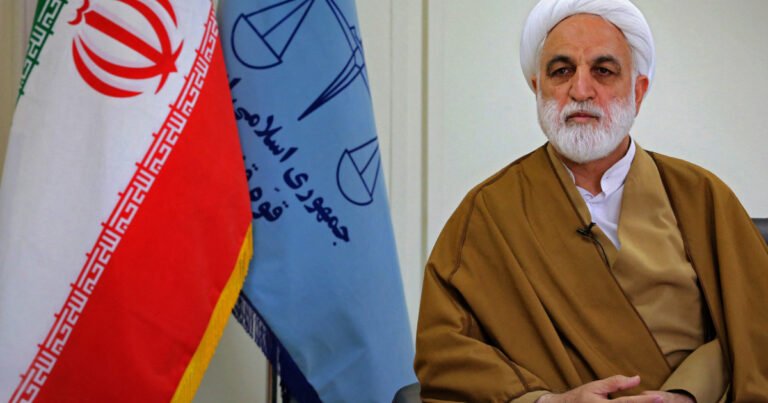
Iran names hardline cleric as top judge amid calls for probe into past abuses

Iran’s supreme leader promoted a hardline cleric to serve as head of the judiciary on Thursday, amid international calls for investigations into allegations of abuses.

Gholamhossein Mohseni Ejei, now the judiciary’s deputy head, will replace Ebrahim Raisi, who takes office in August as president after winning a June 18 election.

Ejei was put on U.S. and EU sanctions blacklists a decade ago for his role in a crackdown on a popular uprising when he served as intelligence minister during a disputed election.

The choice of someone with such a high profile as a hardliner could draw further attention to allegations of past abuses by Iran at a time when the new U.S. administration is trying to negotiate a thaw with Tehran.

This week, a U.N. expert called for a new investigation into Raisi’s alleged role in the deaths of thousands of political prisoners when he served as a judge in the 1980s. Raisi denies wrongdoing.

In a statement reported by state media, Supreme Leader Ayatollah Ali Khamenei called on Ejei to “promote justice, restore public rights, ensure legitimate freedoms, and oversee the proper implementation of laws, prevent crime, and resolutely fight corruption”.

Rights groups have criticised the election of Raisi in a vote in which prominent rivals were barred from standing.

In a statement, Khamenei urged Ejei to “promote justice, restore public rights, ensure legitimate freedoms, and oversee the proper implementation of laws, prevent crime, and resolutely fight corruption”, state news agency IRNA reported.

The U.N. investigator on human rights in Iran, Javaid Rehman, told Reuters this week there should be an independent inquiry into allegations of state-ordered executions of thousands of political prisoners in 1988, and the role played by Raisi as Tehran deputy prosecutor at the time. 

Read the complete article at: Reuters

Also read: Iran Elects Hardline Cleric Linked to Mass Killings as President

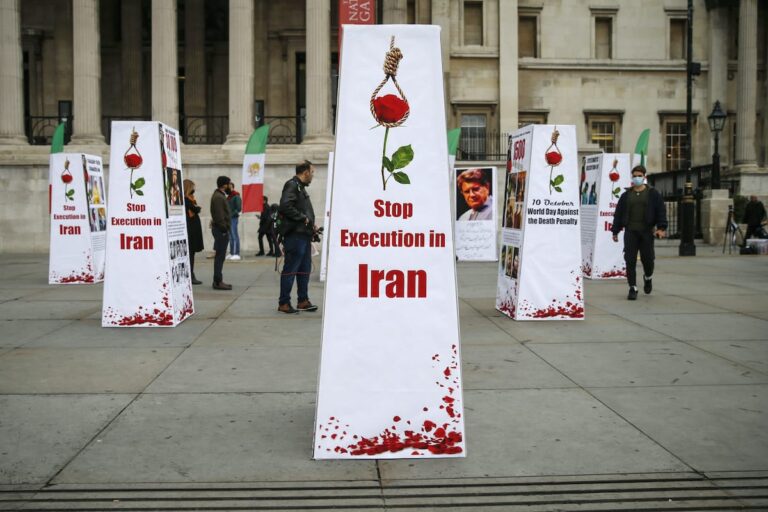
Iran official defends execution of minors

A member of Iran’s High Council for Human Rights, Majid Tafreshi, has defended his country’s use of the death penalty against minors, saying it does not constitute a human rights violation.

“The main objective of our council is to reduce, as much as possible, the number of people who are executed after being sentenced to the maximum penalty, but no one applauds Iran for its efforts,” Tafreshi said on Tuesday.

He explained that minors who are sentenced to the death penalty for their crimes are not five or six years old, but “we are talking mainly about seventeen-year-olds, young adults (…) which the court finds to be mature enough to realise the consequences of their actions.”

Tafreshi stressed that authorities make every effort to persuade families to forgive the perpetrators.

“We would like them to forgive. We try to give them money, we ask them, we beg them (…) not just once, but [over] six or seven years for forgiveness. Therefore, it is unfair after all that, to accuse the [Iranian] authorities of favouring the death penalty,” he added.

Tafreshi added that the execution of three or four minors is not a symbol of human rights violations.

According to the latest UN report, the Iranian authorities have executed at least four minors in 2020. Last week, the UN High Commissioner for Human Rights, Michelle Bachelet said “over 80 child offenders are on death row, with at least four at risk of imminent execution”.

Earlier this year, Amnesty International reported that Iran, Egypt, Iraq, and Saudi Arabia accounted for 88 per cent of all known executions globally.

Source: Middle East Monitor

Also read: Iranian woman ‘executed by her own DAUGHTER under chilling laws that let kids exact revenge on their parents’

Iranian cyber-threat groups make up for lack of technical sophistication with social engineering trickery

0

Iranian state-sponsored threat actors are often perceived to be unsophisticated, but security experts quizzed by The Daily Swig warned it would be unwise to underestimate the danger the country poses in cyberspace.

The main objectives of Iranian state-sponsored espionage are to target organizations in multiple industries across the world and dissidents or those tagged as enemies of Iran.

Iranian state-sponsored threat actors are often perceived to be unsophisticated, but security experts quizzed by The Daily Swig warned it would be unwise to underestimate the danger the country poses in cyberspace.

The main objectives of Iranian state-sponsored espionage are to target organizations in multiple industries across the world and dissidents or those tagged as enemies of Iran.

How do Iranian threat actors compare to groups elsewhere in the world?

Nation state-backed Iranian hackers are generally considered to be less advanced than their well-resourced counterparts in Russia or China.

Iranian attackers may rarely exploit zero-day vulnerabilities, but what they lack in technical sophistication they make up for in social engineering trickery.

For example, they are known to invest considerable effort in developing more elaborate social engineering personas on LinkedIn and elsewhere in order to persuade potentially suspicious targets to open malicious links or attachments.

Cyber operations attributed to Iran display a wide range of skill levels, according to threat intelligence experts.

Emiel Haeghebaert, associate analyst at Mandiant Threat Intelligence, commented:

On the lower end of the skills spectrum, Iran has a large community of hackers active on underground forums. Some of their members engage in politically motivated, disruptive operations such as distributed denial of service attacks, generally considered to be rather unsophisticated, against Iran’s adversaries in the Middle East.

Meanwhile, mid-level operators target the Iranian diaspora and conduct surveillance of internal opposition groups.

“These operations typically rely on social engineering through spear-phishing or SMS messages, and generally follow a predictable pattern of tactics, techniques, and procedures [TTPs],” according to Heghebaert.

Read the complete article at: The Daily Swig

Also read: Iran ‘giving Hezbollah cyber training’ as it embraces digital warfare


Iran’s policy towards the Taliban after US withdrawal of troops

The US withdrawal of troops from Afghanistan, as well as NATO’s decision to withdraw its troops from the country, enabling the Taliban to capture most of its cities, makes the future of Iran-Afghanistan relations a major issue in Iranian foreign policy. As such, regional security and balance of power in the region should also be questioned after the withdrawal of foreign troops from Afghanistan.

member of the Parliament of Iran even described the Taliban as one of the region’s main movements. Never being in favor of the long-term presence of the US in Afghanistan, Iran resorted to both soft and hard power. Hence, it was an advocate of anti-US rebels and was against the Bilateral Security Agreement between Afghanistan and the US. Tehran has a significant interest in Afghanistan in terms of security. It has sent to Afghanistan its Fatemiyoun Brigade, which employed Afghan Shia fighters in the past, to fight the Islamic State in the Khorasan Province. Iran will do the best it can to not lose its access to the Afghan market, to promote Shia ideology in Afghanistan, and to try to avoid transnational threats, such as militant acts, drug trafficking, and uprisings. It generally pursues the strategy of utilizing soft power to work its way quietly to spread its influence.

Regarding the reasons underlying Tehran’s need for a relationship with the Taliban, another Iranian expert believes that it is necessary for the Islamic Republic of Iran to establish contacts with the Taliban in order to protect its interests and security so that it is at least be aware of their plans for Afghanistan. Meanwhile, much of the long-shared border between Iran and Afghanistan is now under Taliban control. This means that the central government of Kabul is no longer able to manage and control the entire border with Iran. Therefore, Iran must continue its relations with the Taliban to ensure at least its security in the borders controlled by this group.

Some Iranian experts on Afghanistan believe that Iran’s foreign policy in Afghanistan prior to the withdrawal of foreign troops and during the country’s peace process was focused on three principles:

  1. Opposing the continued presence of foreign troops in Afghanistan and emphasizing the end of their presence,
  2. Supporting the start of negotiations led by the Afghans themselves, and
  3. Giving the right to self-determination to the people of Afghanistan in an environment without foreign interference.

Iran-Taliban Meeting

In recent years, Iranian and Taliban delegations have met in Qatar, and in January, the Taliban delegation traveled to Tehran to hold talks with Iranian Foreign Minister Javad Zarif and the Secretary of the Supreme National Security Council, Ali Shamkhani. Even back in 2019, a delegation from the Taliban had traveled to Tehran. In November 2019, a delegation from the Taliban led by Mullah Abdul Ghani Baradar met with Iranian Foreign Minister Mohammad Javad Zarif in Tehran. According to Soheil Shahin, spokesman for the Taliban in Qatar, the delegation met with senior Iranian officials in Tehran, including Foreign Minister Javad Zarif. Government news sources also confirmed the news, noting that the Iranian foreign minister met with his deputy. The Taliban have been “continuing Iran’s efforts to bring peace back to Afghanistan.”

By November 2019, and during the meeting between the Iranian Foreign Minister Zarif and the Taliban delegation, the Iranian side expressed a readiness to expand economic and cultural cooperation with the country and the people of Afghanistan based on the common interests of the neighborhood. “This meeting was held in line with the Islamic Republic’s efforts to restore peace and stability in Afghanistan, and its most important goal is to encourage the Afghan parties to inter-Afghan dialogue, to encourage solutions through dialogue, to support all Afghan forces to find the joint chapter on cooperation in the withdrawal of foreign troops and the security of Afghanistan took place after the withdrawal of foreign troops.”

A high-ranking Taliban delegation visited Iran on an official invitation, and some Afghan political analysts believe the visit was intended to put pressure on the new US administration. By sending its delegation to Tehran, the Taliban wants to show the United States that if the peace agreement is revised, the group will have other supporters, like Tehran. Taliban forces have said that neighboring countries and the region, especially the Islamic Republic of Iran, are of special importance to the group. An Afghan expert on the advance of Taliban forces and the capture of Afghan cities believes that what is happening in Afghanistan today was almost predictable some time ago. The Taliban had prepared for war, and the stalemate in the Istanbul talks caused the Taliban to use this capacity to move towards a physical confrontation with the central government.

Last February, Iranian Foreign Minister Mohammad Javad Zarif met with Mullah Abdul Ghani Baradar, the Taliban’s political deputy, and his entourage in Tehran. He said that Iran supported the formation of an “inclusive Islamic state” in Afghanistan and that the conditions for achieving a “future government” in Afghanistan should be “participatory”. During an interview with Afghanistan’s TOLOnews television on December 20th about Iranian officials’ meeting with members of the Taliban, the foreign minister of Iran said, “According to the law, Iran has not yet expelled the Taliban from the terrorist group.” In response to a tweet from the secretary of Iran’s Supreme National Security Council, Ali Shamkhani, praising the Taliban for “fighting the United States,” the Afghan army chief said Mr. Shamkhani had a “misunderstanding” of the Taliban.

What is Iran’s policy toward Afghanistan?

An Arab expert believes that there is no doubt that the Revolutionary Guards have prepared their plans to intervene in Afghanistan and are waiting for the withdrawal of American troops from the country next September. Although it is clear to everyone that the Taliban and the Takfiris (Jihadists in the Western sense) dominate the Pashtun area and its environs, few in the West know that Iran is planning to build a land corridor and perhaps an air bridge in the area. It is the center of Afghanistan, where most of its inhabitants are Shiites, especially the Hazaras. As might be expected, Iran intends to create a region in central Afghanistan that is under its control and influence, and to achieve this goal, Tehran relies mainly on about 20% of the Afghan population, which will have the direct support of Iran. To provide a prelude to the move, the Iranian government has sent intelligence agents to “Hazara” areas and some Tajik areas in Afghanistan.

Since Iran shares its borders with Pakistan and Afghanistan, it sees itself to be actively under security threats by these two countries. This perception of threat would be intensified with the Taliban regime in Kabul; however, Iran has maintained its connections with the Hazaras in Afghanistan and played all sides. Even though both sides were not on good terms with each other and were not on common grounds in terms of theological beliefs, Iran not only made way for the Taliban a few years ago, but even hosted a Taliban delegation in Tehran recently. In recent months, a Taliban delegation visited Iran and met with Iranian officials.

Apparently, Iran is seeking to protect the Afghan minority group Shi’ite the Hazaras who – regardless of gender or age have been the targets of genocidal bombing attacks by the Taliban and Islamist extremists linked to Pakistan and ISIS. Although Iran has tried to prevent the continuation of such attacks, it did, in the past, host the members of Al Qaeda, and had contacts with other extremist groups. It is still not completely clear how this blends in with the pursuits of Turkey and Pakistan. On the other hand, with a new agreement with China to last 25 years, Iran is seeking to expand its trade with China as well as with Pakistan. However, instability in Afghanistan would be an obstacle to achieving this goal. Hence, if the Taliban is supported by Pakistan, then their aim of controlling the country will be relaxed. This design could also accommodate Turkey’s move into the airport.

Conclusion

After decades of conflict, the number of Iranian infiltrators among all ethnic groups in Afghanistan has grown significantly. Iran has even used its proxy forces in Afghanistan since the time of the Shah. Iran is using its oil as a lever of political and strategic pressure. Oil in Iran is sold through the National Oil Company. The company, together with the Iranian Ministry of Oil, sets oil prices monthly. The price of oil still depends on where it is offered in the world. Given the weakness of the central government, through the excessive increase in the level of Taliban activity, and the capture of most cities by this group, we should see an increase in the role of this group in the political future of Afghanistan. Currently, peace between the central government and the Taliban is unlikely. With the withdrawal of American troops, the conditions for the group to gain more control over Afghanistan have increased. The capture of border towns along the Iranian border and the issue of national security are the main reasons for Tehran’s increasing ties with the Taliban. Moreover, it could benefit from this group in the political future of Afghanistan. It is natural that the withdrawal of American forces is in Iran’s interest. US bases are in western Afghanistan, which is close to Iran. Naturally, the US military presence in the region is not pleasant for Iran. With the withdrawal of the United States, Tehran will be relieved of these concerns. Iran fears that it will not be in Iran’s best interest to bring the Taliban to power. Even if the group shares power and Afghanistan transforms its political structure into a federal one, which is highly likely, the Taliban will almost border Iran from South Khorasan to Sistan and Baluchestan provinces.  If this does not happen, it will not be very pleasant for Iran. But overall, the US military withdrawal is in Iran’s favor.

During the Raisi presidency, it is expected that Iran will continue to support proxy groups, and it can see an increase in Iran’s influence in the region, including in Afghanistan. The issue of water could increase tensions between Iran and the next Afghan government, but it could also help increase relations between the two countries. “Afghanistan’s water will now be sent to Iran in exchange for oil,”. Emphasizing that the economies of Afghanistan and Iran are complementary, Mohammad Ashraf Ghani said in his speech that his country no longer provides free water to anyone. According to him, Iran should now sell oil to Afghanistan to receive water. Iran will try to maximize the political, economic, and geopolitical interests in the developments in the region. But it should not be forgotten that stability and security in Afghanistan will have a direct impact on Iran’s national security. Interference that causes instability in the country or jeopardizes the interests of other countries in the region will also have an impact on regional security.

Source: Mena Affairs
Also read: Ex-Intelligence minister admits Mossad has penetrated the Iranian regime

Human rights activists demand a serious international stance to confront Iranian terrorism and its militias in the region

Activists: Faisal Al-Qaifi, head of the European organizations allied for peace in Yemen, stressed that the Iranian regime is a rogue totalitarian regime that does not respect international laws and relies on stirring up sectarianism to interfere in state affairs.

In a seminar held at the Geneva Convention Center under the title (the Iranian regime’s policy of destabilizing security in the region, drug smuggling as a model), Faisal Al-Qaifi said that the Iranian regime is working to export terrorism to the countries of the region to destabilize their security and stability under the slogan of exporting the revolution and exporting terrorism.

For her part, Irina Zuckerman, a lawyer specializing in national security affairs, said that the Houthis are adopting Hezbollah’s policy of drug trafficking to develop their economic resources.

Zuckerman emphasized that the spread of drugs by the Houthis led to the destruction of local communities and economies.

She explained that the Houthi militias rely on spreading drugs to recruit naive or disaffected followers, who then become addicted and ignore their own interests.

In addition, Nasser Al-Qadari, head of the Yemeni-Dutch Center for Human Rights, spoke about the effects and consequences of exploiting these goods (drugs) as sources of income for armed groups.

Al-Qadari stressed that Iran smuggles drugs to its groups and loyalists everywhere, including the Houthi militia, to numb its followers, and throw them into battlefields on its behalf and to denigrate its opponents.

Al-Qadari revealed that Captagon and Ecstasy pills had been found in some of the prisoners and killed of the Houthi militia.

In turn, Mansour Al-Shadadi, head of the European Yemeni House for Human Rights, spoke about the Iranian regime’s policy of destabilizing security and stability.

Al-Shadadi pointed out that Iran is seeking to restore the glories of the ancient Persian empires, and that sectarian motives are one of the drivers of the Iranian approach.

He stressed the need to adopt fortifying policies and an offensive strategy to confront the Iranian role by Arab countries and the main players in the Middle East.

Al-Shadadi also called on the international community to take a serious stand to prevent this terrorism, stressing the need to find a real project to confront terrorism that would harm the interests of the Arab nation.

Source: Ebonyst

Also read: Could Iran use Shi’ite centers in France to spread terror?

Iran’s new president says ballistic program non-negotiable, but restoring ties with Riyadh possible

Iran’s president-elect said Monday there are “no obstacles” to restoring ties with Saudi Arabia, but said he is not willing to negotiate over Tehran’s ballistic missiles or support for regional militia.

Ebrahim Raisi made the comment Monday in a news conference with journalists, his first since winning Friday’s election in a landslide.

“There are no obstacles from Iran’s side to re-opening embassies… there are no obstacles to ties with Saudi Arabia,” he said

He called himself “a defender of human rights” after being asked directly about his involvement in the 1988 mass executions of some 5,000 people.

“The US is obliged to lift all oppressive sanctions against Iran,” he said.

Raisi was part of a so-called “death panel” that sentenced political prisoners to death at the end of the 1980s Iran-Iraq war.

Raisi said his country’s foreign policy will not be limited by the 2015 nuclear agreement, in his first news conference since his victory in Friday’s election.

“Our foreign policy will not be limited to the nuclear deal,” Raisi said in Tehran. “We will have interaction with the world.”

“We will not tie the Iranian people’s interests to the nuclear deal.”

The victory of Ebrahim Raisi comes amid the lowest turnout in the Islamic Republic’s history. Millions of Iranians stayed home in defiance of a vote they saw as tipped in Raisi’s favor.

Of those who did vote, 3.7 million people either accidentally or intentionally voided their ballots, far beyond the amount seen in previous elections and suggesting some wanted none of the four candidates. In official results, Raisi won 17.9 million votes overall, nearly 62 percent of the total 28.9 million cast.

Raisi’s election puts hard-liners firmly in control across the government as negotiations in Vienna continue to try to save a tattered deal meant to limit Iran’s nuclear program, at a time when Tehran is enriching uranium at 60 percent its highest levels ever, though still short of weapons-grade levels. Representatives of the world powers party to the deal returned to their capitals for consultations following the latest round of negotiations on Sunday.

Source: The Rahnuma Daily

Also read: Khamenei’s indirect answer to NATO, G7 pointing at Iran ballistic missiles

restoring ties restoring ties