Home Blog Page 80

Iran’s influence crumbling in Iraq as militias defy IRGC handlers

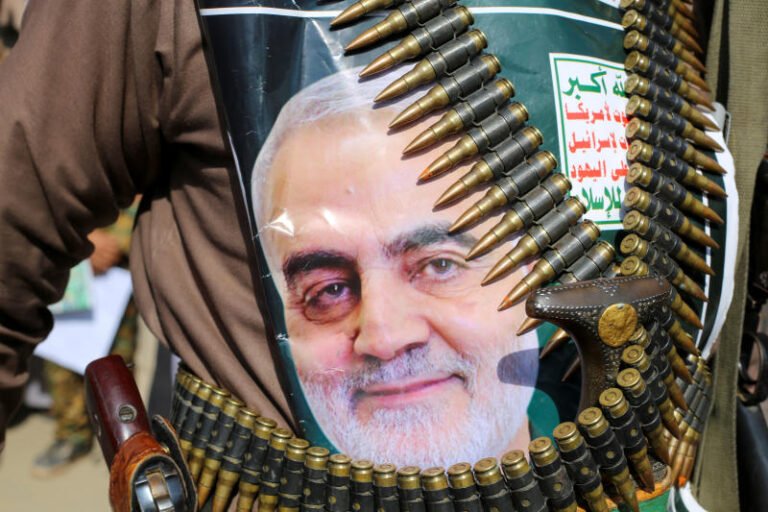
There are fresh signs of a widening rift between Iraqi militias controlled by the Islamic Revolutionary Guard Corps and their IRGC handlers, a telltale sign of Iran’s influence crumbling in Iraq.

Recent tensions appear to have been fueled by the Iraqi militias’ failure to comply with the IRGC’s orders, and by Iran’s desire to distance itself from rogue actors as it pursues its own interests on the world stage, they said.

Meanwhile, others maintain that Iran and its proxies remain as close as ever.

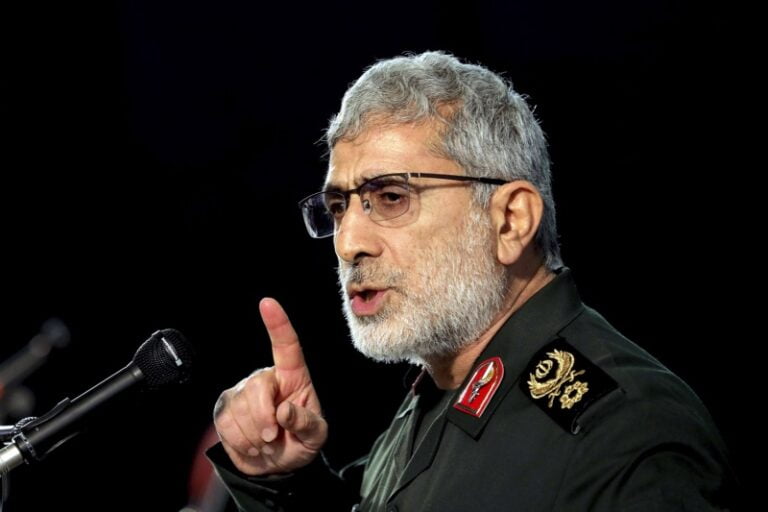
The militias have faced strong criticism from senior IRGC commanders, led by IRGC Quds Force commander Esmail Qaani, for their behavior in Iraq.

Iran’s Supreme Leader Ali Khamenei in March, after receiving an update report from Qaani about the disappearance of $4 billion generated via arms and drug smuggling activities, even went as far as calling the militias “thieves”.

According to a Saturday (May 22) report in Middle East Eye, IRGC general Haider al-Afghani, a former aide to the late IRGC-QF commander Qassem Soleimani, last week asked Qaani for a transfer out of Iraq.

Sources said al-Afghani made the request after he had repeatedly complained that the leaders of Iraqi militias did not comply with his orders and that “every one of them did whatever they wanted, and did not listen to him”.

Iraqi tribal leader Thaer al-Bayati said Iran is reaping what it sowed.

“The hungry militias have become deadly groups, and it is no longer easy to tell them to do this and not to do that,” he told Al-Mashareq.

Recent reports reflect the dissatisfaction of IRGC leaders, especially field commanders, with their partners in the Iraqi factions, he said, adding that the “iron fist” Soleimani consolidated in Iraq is crumbling faster than expected.

Source: Diyaruna
Also read: UK MP calls for banning IRGC after flag flown at London demonstration

Iran’s destabilizing role has been exposed in Gaza

While it appears that the cease-fire between Israel and Gaza is holding, the latest eruption of violence between Israel and Gaza was just the latest illustration that this long-simmering conflict remains unresolved. It is a conflict that has deep roots in historical grievances and geopolitical fault lines, and would be challenging enough were it not for the encouragement and direct enabling of violence by a third party, one that has continued to escape accountability: Iran.

The almost surreal images of Israel’s “Iron Dome” anti-rocket system engaging Hamas-fired projectiles masks the fact that Tehran is supplying Hamas and other Palestinian militant groups with technology, assistance, and materials, enabling these very groups to amass some 30,000 rockets and mortars. To be sure, these militant groups are assembling and manufacturing their own projectiles using everything from plumbing supplies to dud Israeli munitions, but the more advanced and more capable rockets are being supplied from Iran.

In May 2019, Yahya Sinwar, leader of Hamas in Gaza acknowledged just how important Tehran has been to the militant group’s efforts, saying “If it wasn’t for Iran’s support, we would not have had these capabilities.” In a September 2020 video on Al Jazeera, members of Izz al-Din al-Qassam, the militant wing of Hamas, were seen collecting Iranian Fajr missiles, Kornet anti-tank rockets, and other munitions.

This should not come as a surprise, but must be acknowledged as a not insignificant obstacle to resolving the open conflict between Israel and Palestinians. Ayatollah Khamenei himself said, “Zionists understand nothing but the language of force, so the Palestinians must increase their power and resistance to force the criminals to surrender and stop their brutal acts.” A constructive partner for peace, Iran is most certainly not.

Iran’s involvement in the current crisis is barely concealed. Esmail Ghaani, the commander of Iran’s Islamic Revolutionary Guard Corps (IRGC) Quds Force, and successor to Qasem Soleimani — killed by the United States at the beginning of 2020 — is in close contact with Hamas leader Ismail Haniyeh. Iranian press reports that Hamas, likely with the assistance of Tehran, has increased the speed of rockets, as well as the volume and accuracy of the projectiles, in an attempt to thwart the Iron Dome system.

Read the complete article at: The Hill

Also Read: The multimillion-dollar secret unit in Gaza Qasem Soleimani put together

UK MP calls for banning IRGC after flag flown at London demonstration

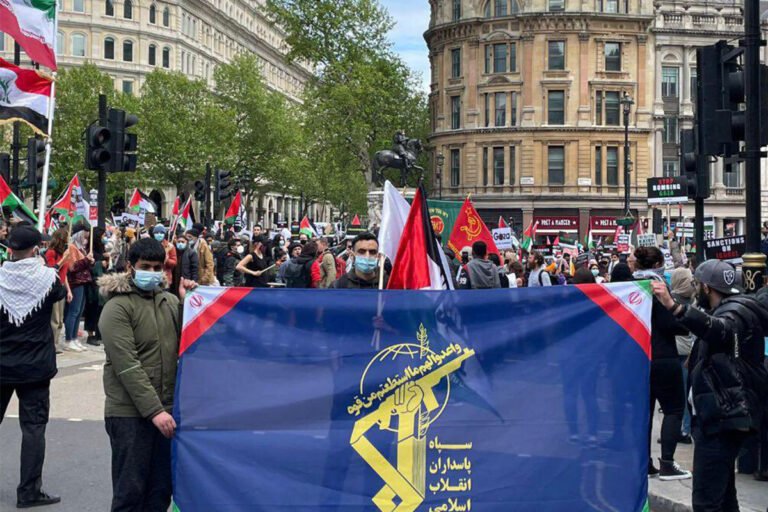
A British MP who also serves as the Conservative Party’s chair of the Foreign Affairs Committee has called on the government to follow the US in designating Iran’s Islamic Revolutionary Guards Corps (IRGC) as a terrorist organization and deems banning IRGC as necessary.

MP for Tonbridge and Malling, Tom Tugendhat, reportedly called for banning IRGC after footage surfaced on social media of an IRGC banner at a Palestine solidarity march that took place in London last weekend, along with a flag of Palestine and Iraq’s Popular Mobilization Forces (PMF), which includes some armed factions supported by the IRGC.

Tugendhat was quoted by the Telegraph yesterday as stating: “It is disturbing to see the flag of the Iranian Revolutionary Guard Corps being so brazenly displayed on the streets of London.

“This is a terrorist organisation that is responsible for sowing instability across the Middle East and promotes Islamist extremism all over the world.”

“The US has proscribed this vile organization; the UK Government should do the same, as recommended by the Foreign Affairs Select Committee. We should never have to see its flags on British streets again,” he added.

In 2019 former US President Donald Trump approved the designation of the IRGC as a terrorist organization despite it being part of Iran’s military. It has both operated independently and in cooperation with the regular armed forces, the Artesh. Should the UK also brand the IRGC a terrorist entity, it would be the first time a state group has been proscribed as such in the country.

Trump’s designation preceded the assassination of General Qasem Soleimani head of the IRGC’s elite branch, the Quds Force at the beginning of last year after making a dubious claim that he posed an “imminent” threat to the American people.

The U.S. Department of the Treasury claims one of the reasons behind banning IRGC is that it has supported several organizations the U.S. deems to be terrorist, including Hezbollah, Hamas, Palestinian Islamic Jihad (PIJ), The Popular Front for the Liberation of Palestine-General Command (PFLP-GC), and the Taliban.

Source: Middle East Monitor
Also read: Blinken: Iran Funds ‘Extremist Groups,’ But Biden Wants to Return to Nuclear Deal Anyway

Report: Criminal cyber actions are used to cover Iranian strategic operations against Israel

0

A new study from Israeli company SentinelOne is claiming that an Iranian hacker group, operating under the Iranian government, is behind numerous cyber attacks against a variety of Israeli targets in recent years.

Israeli companies were the targets of countless attacks attributed to Iranian hackers in recent years, but so far it had not been clear what the motivation was behind these actions. Some studies referred to the attacks as criminal assaults, while others saw them as strategic actions. So far, the assumption was that Iranian hacker groups operate mainly with criminal motives rather than strategic ones. 

According to researcher Amitai Ben Shushan Ehrlich, this specific group, named Agrius, has been operating in Israel since the beginning of 2020. While SentinelOne is very careful when discussing the group, the company assesses with “medium confidence” that this group is of Iranian origin, “engaged in both espionage and disruptive activity.” Furthermore, according to information obtained by Calcalist from other sources in the industry, this group was behind the attacks on Shirbit and the KLS Capital. 

While in its report, SentinelOne admits “it is hard to provide a definitive attribution for Agrius,” it does state that “a set of indications pointing the activity towards an Iranian nexus came up throughout the investigation.” 

The report goes on to state that Agrius’ actions, as in past attacks by Iranian hackers, seem to be correlated with Iranian interests. It also states that some of Agrius’ tools in the attack were uploaded from Iran and other Middle East countries and that some of the attack’s infrastructure was hosted on servers “that have also resolved to Iranian domains in the past.” 

The report also touched on the “usage of the DEADWOOD wiper,” an Iranian-made tool, writing “Agrius utilized the DEADWOOD wiper, which was previously attributed to an Iranian-nexus actor,” and while “the ties between Agrius and the threat actor who originally deployed DEADWOOD remain unclear, it’s possible that the two groups have access to shared resources.” 

Read the complete article at: Calcalist Tech

Also Read: Iranian hacking group targets Israel with wiper disguised as ransomware


cyber actions cyber actions

The multimillion-dollar secret unit in Gaza Qasem Soleimani put together

Private sources have informed Al-Arabiya, that before his death, Qasem Soleimani, commander of the Quds Force branch of Iran’s Islamic Revolutionary Guards Corps, had established a special unit to develop the military capabilities of Hamas.

According to this information, Qasem Soleimani had secretly sent money to Hamas to develop its military and capabilities to be able to bypass Israel’s Iron Dome and more.

The sources also mentioned that there is a specialized team to develop missiles that includes 7 people, including Iranians, Lebanese, and a Syrian. They added, that Iran has established an underground Hamas communications unit and weapons development laboratories.

They pointed out that an Iranian official in the Quds Force visited the Hamas factories about five times, the last of which was in January 2021, revealing that Iran has trained 25 Hamas military commanders in Tehran.

The sources revealed to Al-Arabiya that Iranian and Palestinian engineers have worked during the last period to develop drones to carry explosives, adding that this missile development unit, had developed the latest missiles used by Hamas to target Tel Aviv.

The sources confirmed that the missiles were fully developed inside the Strip, and that Iran has transferred its expertise to Hamas military officials.

An Iranian diplomat in the region has also said millions of dollars were handed over to Hamas representatives almost every month, either carried into Gaza or neighbouring countries.

One Iranian security official said Hamas now had at least three underground factories to produce rockets in Gaza, confirming what the sources had claimed earlier.

“We were extremely surprised by Hamas’ capacities this time around. They had long-distance rockets they didn’t have before. That is all down to Iran,” said a senior European official on condition of anonymity.

Source: Al Arabiya
Also read: Iran Grows New Loyalist Iraqi Militias

Iranian hacking group targets Israel with wiper disguised as ransomware

0

An Iranian hacking group has been observed camouflaging destructive attacks against Israeli targets as ransomware attacks while maintaining access to victims’ networks for months in what looks like an extensive espionage campaign.

The threat actor, tracked as Agrius by SentinelLabs researchers, has targeted Israel starting with December 2020.

“Initially engaged in espionage activity, Agrius deployed a set of destructive wiper attacks against Israeli targets, masquerading the activity as ransomware attacks,” said Amitai Ben Shushan Ehrlich, Threat Intelligence Researcher at SentinelOne.

From wiper to fully functional ransomware

At first, the group deployed a wiper malware known as DEADWOOD (or Detbosit) designed to destroy data on infected devices and previously used in attacks against Saudi Arabian targets in 2019.

Agrius has slowly transitioned into using a new wiper malware dubbed ‘Apostle,’ which, although broken in its first variants, has gradually replaced DEADWOOD and was upgraded into a fully-featured ransomware strain.

The attackers have used multiple attack vectors, including SQL injection, FortiOS CVE-2018-13379 exploits, and exploits targeting various 1-day web app vulnerabilities.

“We believe the implementation of the encryption functionality is there to mask its actual intention: destroying victim data,” the researcher added.

“This thesis is supported by an early version of Apostle that the attacker’s internally named ‘wiper-action.’ This early version was deployed in an attempt to wipe data but failed to do so possibly due to a logic flaw in the malware.

“The flawed execution led to the deployment of the DEADWOOD wiper. This, of course, did not prevent the attackers from asking for a ransom.”

The Iranian hackers have also developed their own custom .NET malware named ‘IPsec Helper’ designed to provide the threat actor with basic backdoor capabilities to help deliver additional malware on compromised hosts and exfiltrate data.

A complete list of all commands supported by the IPsec Helper backdoor is available in SentinelOne’s full report.

Read the complete article at: Bleeping Computer

Also Read: Hacker group with alleged ties to Iran, targeted 25 medical researchers in US, Israel

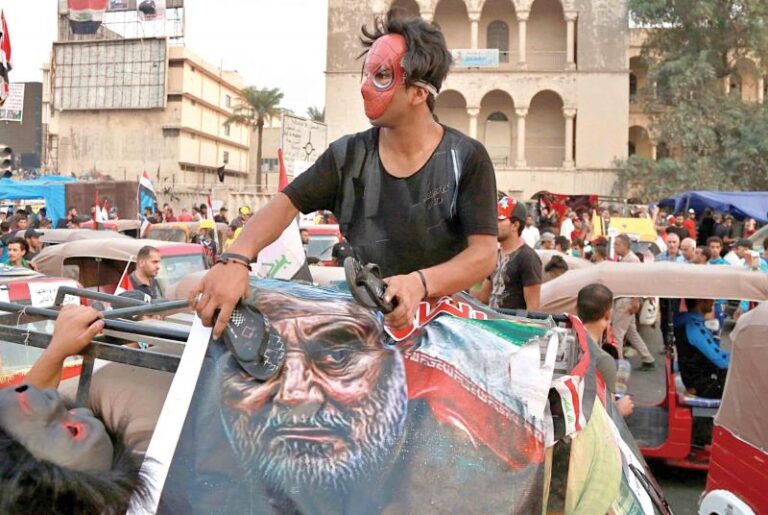
Protesters In Baghdad Chant Against Iran-Backed Militia As One Dies

One person died and several were injured on Tuesday when Iraqi security forces fired live rounds in the air to disperse anti-government protests in central Baghdad, according to security and medical sources.

The sources said 14 protesters and seven members of the security forces were hurt in the clashes.

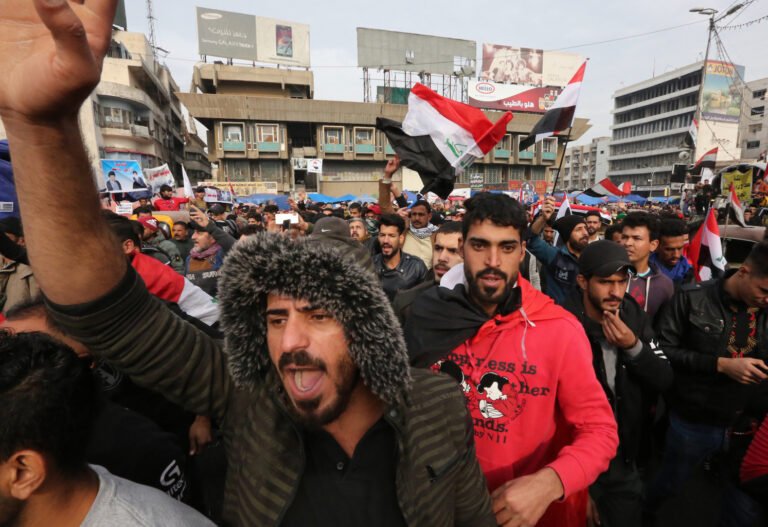
Hundreds demonstrated in Tahrir Square, shouting slogans against Iran-backed militias and accusing Prime Minister Mustafa al-Kadhimi’s government of failing to answer for the deaths of dozens of activists shot dead in different parts of Iraq in recent months.

One protester, who gave only his first name Yousif, carried a photograph of an activist he said had been killed recently.

He blamed unnamed militias, who are supported by neighbouring Iran, for the death. The militias, who enjoy considerable influence over Iraq’s security affairs, have in the past denied any involvement in activists’ deaths.

Tuesday’s clashes erupted after protesters started throwing bricks towards security forces, a Reuters witness said.

When nationwide protests erupted in 2019, hundreds of mostly unarmed demonstrators were killed and Prime Minister Adel Abdul Mahdi was forced to resign.

He was replaced by Kadhimi, who pledged to investigate activists’ deaths but also imprisoned hundreds of demonstrators.

The government has vowed to crack down on what it says are criminal armed groups trying to destabilise the country, and to impose state control over weapons as part of efforts to reduce the influence of militias.

Source: Iranintl

Also Read: Mass grave of civilians executed by IRGC-made militias unearthed in Iraq


When nationwide protests erupted in 2019, hundreds of mostly unarmed demonstrators were killed and Prime Minister Adel Abdul Mahdi was forced to resign. He was replaced by Kadhimi, who pledged to investigate activists’ deaths but also imprisoned hundreds of demonstrators. The government has vowed to crack down on what it says are criminal armed groups trying to destabilise the country, and to impose state control over weapons as part of efforts to reduce the influence of militias. Iran-Backed Militia Iran-Backed Militia Iran-Backed Militia

China-IRGC Bitcoin mining in Iran leads to power outage crisis

0

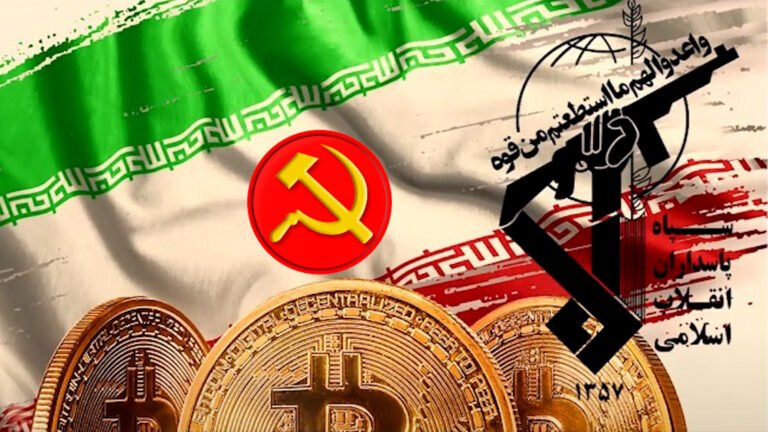
Speculation as to why there are widespread blackouts in various cities in Iran continues. Some state-run media on Monday acknowledged it involves China’s bitcoin mining in Iran. According to the Deputy Minister of Energy, bitcoin mining occurs even in schools and mosques, all of which are covered by the Basij and the IRGC. According to official statistics, these devices consume as much electricity as a city, and Iran is in third place in bitcoin mining after the United States and China. 

Iranians are suffering from power outages in recent days. Many Iranian cities are experiencing a large power blackout. Since the beginning of this week, extensive, long, unannounced power outages disrupted people’s lives, factories, hospital treatment, and businesses, and even shut down more than 2,000 telecommunication towers. 

“According to Dr. Hamid Emadi, Head of Infectious Diseases Department, of Khomeini Hospital these days, power outages have plagued patients diagnosed with Covid-19 with acute pulmonary problems. This is because one of the most basic treatments for these patients is the use of an oxygen machine,” wrote the state-run Jahan-e Sanat daily on Monday.  

“According to a report published by the Tehran Chamber, quoted by a Chinese newspaper, since late 2018, Iran has become a turning point for the Chinese in terms of bitcoin mining,” wrote the state-run Rahe-Pardakht website on July 9, 2020. 

In other words, the regime is putting Iranians’ lives in danger for circumventing sanctions so it could fund its illicit activities.  

In addition, the regime exports Iran’s electricity to the neighboring countries, while the people of Iran are paying the price of the massive blackouts.  

The power outage in Iran is having a devastating effect on people’s lives. But the mullahs’ regime only intends to plunder Iran’s wealth for funding its illicit activities. The regime’s corruption and illicit activities have turned society into a powder keg. Iranian people’s ongoing calls for boycotting the regime’s sham presidential election show they consider regime change the only solution to Iran’s problems.  

Read the complete article at: NCRI
Also read: Iran-China deal will increase IRGC’s terrorist activity

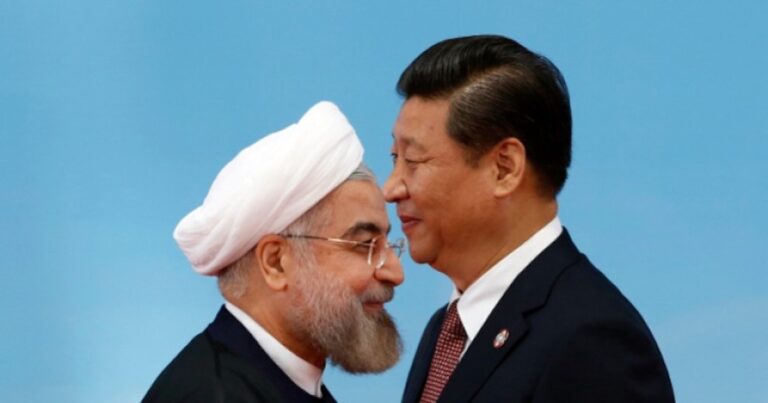
Iran-China deal set to destroy the region by strengthening IRGC’s terrorist activity

The details of the 25-year, $400 billion Iran-China deal, officially the “strategic co-operation pact” signed in March are murky at best.

A previously leaked draft document of the agreement suggested a wide-spanning agreement to include infrastructure, telecommunications and security co-operation.

Iran-China deal first proposed in 2016, also calls for joint military training and exercises, joint research and weapons development, and intelligence sharing.

Expanding Chinese assistance to Iran also means that Beijing would be providing direct support to Iran’s Islamic Revolutionary Guard Corps (IRGC).

The IRGC, through its overseas arm, the Quds Force, has been responsible for exporting terror and for arming the Iranian regime’s proxy militias throughout the region, including in Iraq, Syria, Lebanon, Bahrain, Yemen and Afghanistan.

The IRGC has undermined the sovereignty of regional governments and is responsible for thousands of deaths and misery throughout the Middle East and beyond.

Chinese-Iranian deal-making could extend to arms sales to Iran, though any such sales by China risk incurring sanctions from the United States.

Tehran’s greatest interest lies in Russian tanks, jets and air defence systems, Defence News reported in November. That said, some opportunities do exist for Beijing.

“Iran’s interest in procuring loitering munitions (otherwise known as kamikaze drones), UAVs and armed unmanned boats means China will likely supply modern technologies to help the Middle Eastern country develop unmanned naval vessels and aerial drones,” Defence News reported, quoting Bahraini analyst Abdullah al-Junaid.

The IRGC is a big supporter of Tehran’s deal with Beijing, because it hopes to buy missiles from China, so it can reverse engineer them and improve its own weaponry.

A large section of the Iranian public is against Chinese presence on Iran’s economic scene.

Even if the regime were to earn money from such a deal with China, the funds would not reach the Iranian people, but would rather, as repeatedly proven before, line the pockets of corrupt politicians and fund the malign regional activities of the IRGC.

The inability of the Islamic Republic’s leaders to secure the needs of the Iranian public is so profound that China’s presence cannot compensate for it.

Source: Al-Mashareq
Also read: Blinken: Iran Funds ‘Extremist Groups,’ But Biden Wants to Return to Nuclear Deal

Iran’s IRGC Quds Force commander: “Islamic Jihad defeated Zionist pride”

The recent war against Israel “destroyed the pride of the Zionist army,” IRGC Quds Force Commander Esmail Ghaani told his Palestinian Islamic Jihad (PIJ) counterpart, Akram al-Ajouri, in a letter, Iran’s Tasnim News Agency reported.

His comments came after Hamas reportedly thanked Iran for its support in the war. Iran backs Hamas and Islamic Jihad, which has offices in Damascus.

Ghaani’s macabre letter praised death and martyrdom, adding that while the killing of pro-Iran operatives is a threat, they look forward to death with longing and passion, according to Al-Mayadeen, a Beirut-based pan-Arabist satellite television channel.

The letter to Ajouri, one of several letters and memos of support that have been sent from Iran to Hamas and PIJ recently, said: “We believe that every drop of blood that falls on the way to Jerusalem brings us closer to liberating it from the filth of the occupier.”

The term “filth” is used in anti-Israel protests in the West in which Jews have been described as “filth.” It may be that Iran’s messaging uses Islamist terminology so that terms such as “filth” can being applied to Israel and Jews, much as the Nazis used such terminology. These terms were also used in recent anti-Israel protests in Germany.

The support for PIJ includes more imagery about martyrdom and calls for Palestinians to be “steadfast.” It calls on “all the mujahideen in the land of Palestine. I kiss your striving hands, which God throws at his enemy, and which pave the way to making the clear conquest, God willing.”

Clearly, Ghaani is trying to bolster the “resistance” axis and thank them for fighting Israel on behalf of Iran’s IRGC Quds Force. It appears that Iran timed this war to coincide with Quds Day on May 7, ordering Hamas to begin the battle on May 10.

Read the complete article at: TJP
Also read: Iran, a longtime backer of Hamas, cheers attacks on Israel