Home Blog Page 82

Bahrain to prosecute Iranian financial institutions on money laundering

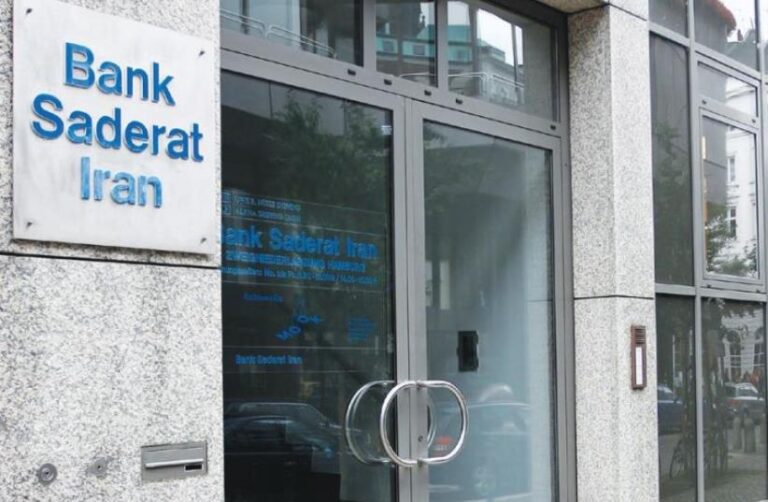
In the largest such case in Bahrain’s history, the Gulf state’s public prosecutor on Wednesday announced that the Central Bank of Iran and 12 other Iranian banks, most notably Bank Melli Iran (National Bank of Iran) and Bank Saderat Iran (Export Bank of Iran) will be tried on charges of money laundering in a scheme valued at $1.3 billion.

Ali Al Buainain, the Bahraini attorney general, said that “Bank Melli Iran and Bank Saderat Iran used Future Bank to transfer $1.3 billion, using an alternative system that was not licensed by Bahraini authorities and was not subject to them, and these funds were kept, settled and laundered in order to evade international sanctions against Iranian entities and personalities.”

The case goes back to April 30, 2015, when the Central Bank of Bahrain ordered the closure of Future Bank and the confiscation of all its records to investigate alleged money laundering offenses. Future Bank was established in Bahrain in 2004 as a joint venture of Ahli United Bank and the two Iranian state-owned banks named by the attorney general.

The Public Prosecution continued to investigate and Bahraini courts issued several prison sentences to officials, some Bahraini and others Iranian, in addition to fines totaling more than $345 million.
The case took more than six years to probe, in cooperation with several international investigators, Interpol and others.

A source in the Bahrain Public Prosecution told The Media Line “the investigation proved that the transfer orders were issued by several banks, most notably the Central Bank of Iran.”
The investigation revealed that Future Bank “was also exploited by the attempts to transfer money to Iran and to finance several terrorist entities, but this did not happen due to the strict controls imposed by Bahraini authorities on banks,” he added.

Read the complete article at: The Jerusalem Post

Also Read: Bahrain jails 18 men for forming Iran-backed cell
Iran sanctions relief will continue funding the ongoing war in Syria

0

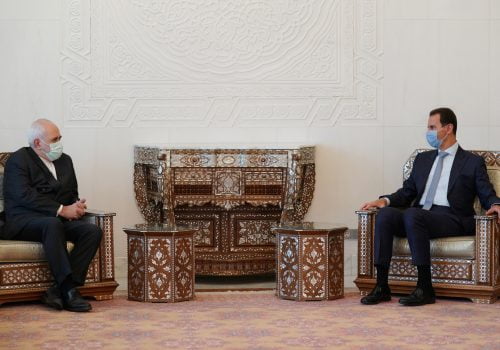
The leaked audiotape of Islamic Republic Foreign Minister Mohammad Javad Zarif has elicited much fanfare in recent weeks. Among the less scrutinized aspects of the tape has been Zarif’s reference to the Islamic Republic’s ongoing support of the Bashar al-Assad regime, including the fact that Iran Air—the flag carrier of the country—continues to transport arms and fighters into the Syrian conflict. As the Joe Biden administration negotiates a potential return to the Joint Comprehensive Plan of Action (JCPOA) in Vienna, Tehran’s backing of the Assad regime should not be left off the table.

Proponents of an unqualified return by President Biden to the 2015 Iran nuclear deal have frequently argued that doing so is necessary to prevent conflict and even war in the Middle East. As the administration has slow-played any such moves in recent months, analysts who have long warned of an impending war with Iran that has never come are once again sounding the alarm bells and urging Biden to return to the JCPOA immediately to prevent war. Yet in Iran’s “thirty-fifth province,” as those close to Supreme Leader Ayatollah Ali Khamenei refer to Syria, a return to the deal wouldn’t prevent war, it would escalate and expand one that has now been raging violently for a decade.

The sanctions reimposed on the Islamic Republic after the US withdrawal from the JCPOA in May 2018 by the Donald Trump administration have, according to a report by the International Monetary Fund, caused Iran’s foreign reserves to dwindle to as low as $4 billion—limiting the regime’s funding for its war machine. But international estimates have indicated that, if the Biden administration were to ease sanctions, Tehran’s foreign reserves would swell to more than $100 billion, rapidly enriching an actor that has shown no hesitation to arm and fund the region’s worst elements. In a recent United Nations Security Council briefing on the Syrian conflict, Secretary of State Antony Blinken remarked that “[W]e have to find a way to do something to take action [in Syria]…That is our responsibility, and shame on us if we don’t meet it.” By cutting off the spigot flooding the Syrian regime’s coffers and military, the secretary of state can meet that responsibility.

Read the complete article at: Atlantic Council

Also Read: Why Iran absorbs Israeli inflicted blows on its militant proxies in Syria

sanctions relief sanctions relief

The IRGC’s Propaganda Machine in Europe

0

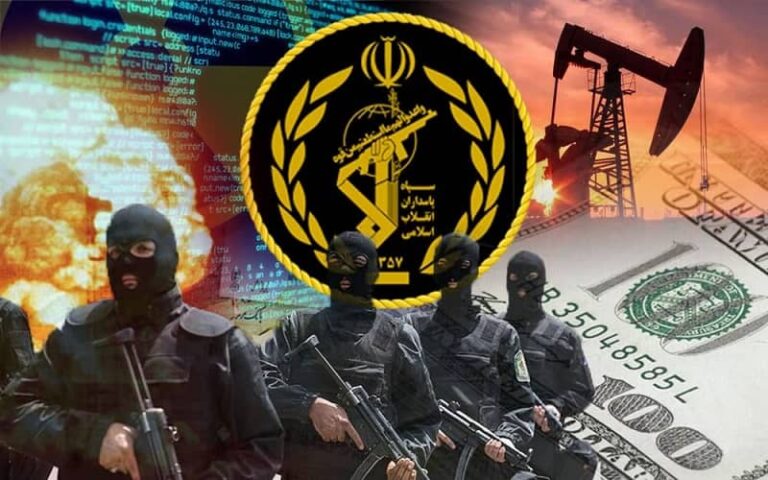
EXECUTIVE SUMMARY: While most European intelligence services are alert to the terrorist activities of Iran’s IRGC, they pay too little heed to the its propaganda machine, which spreads propaganda across the continent from Frankfurt, London, Paris, Stockholm, Amsterdam, and Prague.

On July 13, 1989, Iranian operatives in Vienna under diplomatic cover assassinated the head of an Iranian Kurdish dissident group and two others. As of that moment, most European intelligence services began to monitor the malign activities of the Iranian regime on European soil. They committed resources to uncovering Iranian cells, terrorism, fake refugees, pro-regime lobbies, and phony Iranian activists in the European media.

Iran has continued to be active in Europe for decades. In 2018, authorities in Belgium, France, and Germany arrested several Iranian operatives, including an Iranian government official, on charges of conspiring to plant a bomb in the middle of a political rally in Paris.

While EU intelligence services are alert to the terrorist activities of the IRGC network, they tend to neglect the influence of the IRGC on Persian external media. These media services are based in Frankfurt, London, Paris, Stockholm, Amsterdam, and Prague, where they broadcast slanted reports in favor of the Iranian regime.

The largest Iranian intelligence center in Europe is in Vienna. European think tanks that are supposedly monitoring the activities of Persian media networks cannot be relied upon, as in some cases they contain regime apologists.

The IRGC is committed to the silencing of both internal and external opposition, and does much to control both Iranian public opinion and Western media perceptions. Pro-regime journalists, part of Iran’s propaganda machine, normalize and legitimize the crimes of the Islamic regime and systematically lie and spread propaganda in the mullahs’ interests.

Read the complete article at: BESA Center
Also read: Is Iran Behind The Outbreak Of Israeli-Palestinian Violence?

Iran’s presidential elections are all about the post-Khamenei era

0

Iran will hold presidential elections on June 18 and despite considerable efforts by the authorities, the battle at the ballot box is set to be a lifeless affair. A solid majority of Iranian voters have by now entirely lost hope that voting makes any difference. Actual turnout could be as low as 20% as compared to the 73% recorded in 2017. Ayatollah Ali Khamenei, the unelected supreme leader who has ruled over Iran since 1989, is not on the ballot. Nor are the Revolutionary Guards, the armed defenders of the Islamic Republic’s theocratic system. These two institutions wield the real power in Tehran, not the Presidential Palace.

And yet, the Islamic Republic is addicted to holding make-believe elections every four years. For the June 2021 elections, aspiring candidates had five days to register. A total of 592 applicants, including 40 women, did so. In about 24 hours, some 93% of them were said by the Guardian Council not to meet the criteria. The 12-man council, which is controlled by Khamenei, decides who can run for office. No woman has ever been allowed to run in the Islamic Republic since 1979. Of the about 40 men that will be considered, all can be expected to be political insiders that Khamenei and the Revolutionary Guards can live with as possible occupants of the Presidential Palace.

In fact, Khamenei approved a last-minute change to the constitution allowing senior military men to run for the presidency, something which they could not do before. Among the candidates to be approved, a majority will come from the ranks of the Revolutionary Guards, including Mohsen Rezai, Hossein Dehghan, and Saeed Mohammad. This is not an institution without its schisms and rival factions, but the broader trend is that as a grouping, the Revolutionary Guards wants to have a more visible presence on the official political scene as a way to safeguard their future interests as the 82-year-old Khamenei’s reign is in its twilight years.

Read the complete article at: MEI.edu

Also Read: Military candidates in Iran elections raise worry of further IRGC control

Iran ‘wants chaos in Israel,’ says retired British military official

0

Airstrikes continued Monday night into Tuesday in Palestine and Israel, as President Joe Biden expressed support for a ceasefire in a phone call with Israeli Prime Minister Benjamin Netanyahu.

“The cause of it, in effect, is internal Palestinian power struggles,” said retired British Colonel Richard Kemp to The National Desk’s Jan Jeffcoat. “It involves more than just Israel and Hamas, it involves also Israeli clashes with Palestinians inside Israel itself, and in the West Bank, and also attempted rocket attacks being launched from Lebanon and Syria into Israel, as well as the massive bombardment from Gaza.”

Col. Kemp says the most recent violence was set in motion by Palestinian Authority President Mahmoud Abbas canceling “long overdue” elections.

“Canceling them because he knew he was going to lose, and then blaming Israel,” said Col. Kemp. “That, in turn, helped to fuel riots in Jerusalem, which were perpetrated by Palestinians.”

According to Col. Kemp, Hamas “saw itself as a defender of Jerusalem, and launched the rocket strikes,” with help from Iran.

“Iran has done much more than advise Hamas. Iran has provided them with missiles, it’s provided them with other munitions, it’s provided them with the wherewithal to make their own rockets with money and with direction,” said Col. Kemp. “Iran wants chaos in Israel, of course, it wants the annihilation of Israel, but right now what it’s looking for also is leverage.”

Col. Kemp says that by influencing unrest in the Middle East, it will give them extra leverage in nuclear deal talks being negotiated between the Europeans and Iran on behalf of the Americans. Israel has been targeting tunnels and other military infrastructure as part of its strategy.

“I think Israel has done immense damage to the tunnels under Gaza, there are dozens of kilometers of tunnels dug since the 2014 conflict to house fighters, to house munitions, to house command facilities,” said Col. Kemp. “In one strike, they deployed 160 airplanes firing bunker buster bombs at these tunnels and caught many Hamas fighters in those tunnels and destroyed many munitions as well.”

Read the complete article at: ABC7 News

Also Read: Is Iran Behind The Outbreak Of Israeli-Palestinian Violence?

chaos

Yemen accuses Iran of ‘fueling war’ over weapons seizure

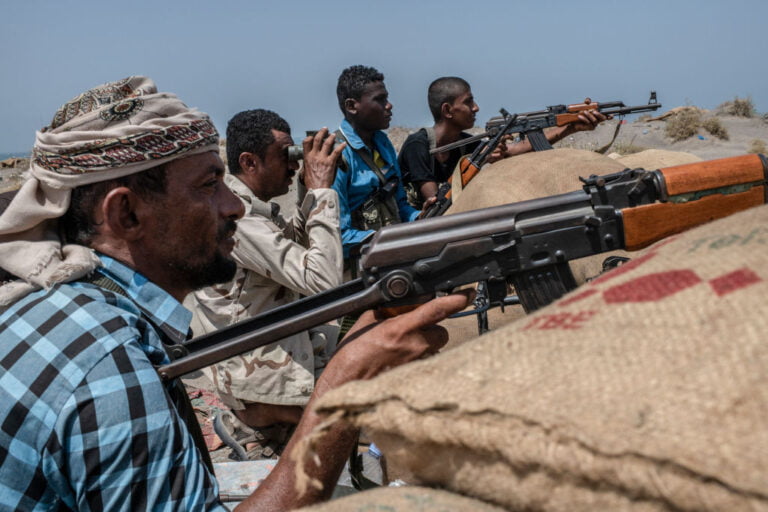
The internationally recognized government of Yemen has accused Iran of fueling the country’s civil war by supplying Houthi militias with weaponry and military know-how.

Following the accusations, Yemeni officials repeated demands for Iran to face punishment for meddling in the country’s affairs.

It came as the US Navy announced on Sunday that it had seized a new arms shipment of thousands of weapons concealed on a vessel in the Arabia Sea.

The shipment was sent by Iran and was destined for Houthi militias, a US defense official told The Associated Press.

Muammar Al-Eryani, Yemeni minister of information, culture and tourism, said that the shipment is “further evidence” of Iran’s support for the Houthis and their use of the militia as a “tool to destabilize the region.”

He said: “This confirms the continued smuggling of Iranian weapons to the militia and using them (the Houthis) as a tool to implement their expansionist plan, spreading chaos and terrorism in the region and threatening international interests.

“We call on the international community, the UN and the permanent members of the UN Security Council to take a clear and explicit stance against the continuation of Iranian interference in Yemen.”

For more than a decade, successive Yemeni governments have accused Iran of supporting the Houthis militarily and financially by smuggling advanced weaponry, and more recently, sending Iraqi and Lebanese fighters into the country.

Yemeni officials believe that military expertise and weapons from Iran have shored up Houthi strength and firepower depleted by years of fighting and Arab coalition airstrikes.

“Unfortunately, as we approach the conclusion of Ramadan, instead of ending the conflict, the Houthis are still escalating it. And this is evidenced by the interception of another cache of smuggled arms coming from Iran going to Yemen,” the Embassy of Yemen in Washington, D.C said on Twitter on Sunday, adding: “The Iranian regime should stop supporting and supplying arms to the Houthis, both foreign procured or domestically produced.”

Read the complete article at: Arab News

Also Read: Iran talks peace while arming the Yemeni Houthi rebels
 

Why Iran absorbs Israeli inflicted blows on its militant proxies in Syria

 Israel has launched hundreds of strikes against Iran and its allied proxies in Syria since the country’s descent into civil war over a decade ago, with officials in Tel Aviv making it clear they will refuse to tolerate any Iranian entrenchment along their northern border.

Israeli warplanes have repeatedly attacked Iran-linked facilities and weapons convoys destined for Tehran’s Hezbollah proxies in Lebanon. On May 5, Israeli strikes in the Syrian provinces of Latakia and Hama claimed the lives of at least eight individuals on the payroll of Iran’s Islamic Revolutionary Guards Corps (IRGC).

Despite the persistent bombardment and loss of personnel, experts say the IRGC is unlikely to strike back directly or relinquish its military presence any time soon. The reason: Syria is simply too precious a strategic prize for Tehran to give up.

“Both Israel and Iran believe that they have vital national security interests at stake in Syria,” Chris Bolan, professor of Middle East Security Studies at the US Army War College, told Arab News.

The Iran-backed Lebanese militia Hezbollah, which intervened early in the Syrian civil war in support of the Assad regime, is the crux of Israel’s national security headache in Syria, said Bolan.

“Israeli concerns with Iran’s support to Hezbollah are enduring and will continue regardless of the outcome of (nuclear) negotiations in Vienna. These concerns have only been exacerbated with Iran’s growing military presence and intervention on behalf of Syrian President Assad since the onset of the civil war,” he said.

“Israel will continue to take whatever actions are necessary — including airstrikes — to both minimize the threat posed by Hezbollah’s growing, sophisticated arsenal of missiles and ensure that Iran’s military presence through its proxies in Syria does not pose an immediate threat to Israel.

“Similarly, Iranian leaders view their support to Hezbollah as an essential element of Iran’s national security strategy of forward defense. A well-equipped Hezbollah that poses a significant threat to Israel serves as Tehran’s most potent deterrent against large-scale Israeli or Western strikes.”

Read the complete article at: Arab News
Also read: Iraqis Living In Fear Thanks To Iran-Fueled Violence

Iraqis Living In Fear Thanks To Iran-Fueled Violence

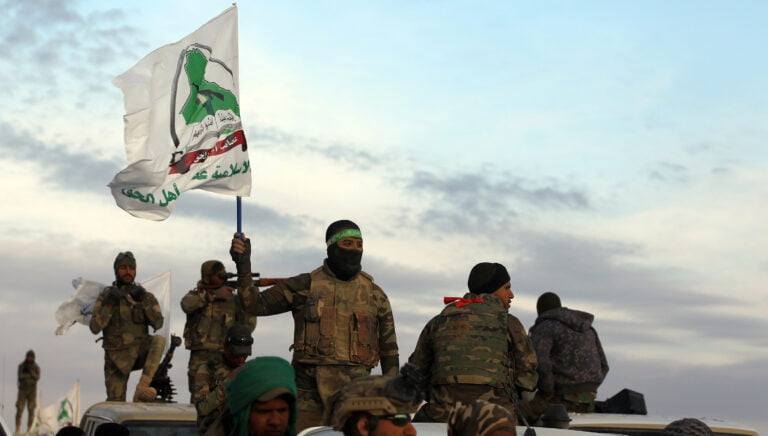
Death has become a major part of Iraq’s daily routine. Pro-Iran militias, death squads, hit lists and cold-blooded assassinations highlight how failed the state of Iraq is despite the international and local denial.

When five Iraqis die, it is not news any more. When 50 get killed, it is not breaking news. When 100 lose their lives in a terrorist attack, Western media may generously talk about it for a couple of hours.

In October 2019, widespread anti-government protests took place in Baghdad and several southern provinces, with protesters speaking out against corruption, outlaw militias and foreign loyalty. Even though the demands of the young demonstrators were not outrageous or luxurious, they were faced with violence and brutality.

More than 800 peaceful protesters were killed, about 25,000 were injured and hundreds were kidnapped, while the government was busy forming fact-finding committees, releasing condemning statements and hiding the real identities of the murderers under the pretext of protecting the Iraqi political process and the new democracy.

Nurturing a young democracy and building an institutional state has never been achieved thanks to the successive governments that have been in power since 2003, which have continued to adopt oppressive policies or provide legal cover for such practices. This means that the dark age of Saddam Hussein’s regime remains as it was, only with different names and political affiliations.

Who is leading these death squads and how do they pick their targets? If any Iraqi official or politician says he does not have an answer, he is hiding the truth, which makes him an accomplice to these heinous crimes.

Despite being filled with thousands of surveillance cameras, main streets and popular squares have witnessed political and human rights activists being gunned down, with the executioners always vanishing into thin air, filled with confidence that their images would never be caught on tape.

Read the complete article at: Eurasia Review

Also Read: Pro-Iran militias in Iraq threaten Israeli interests

Violence Violence

Is Iran Behind The Outbreak Of Israeli-Palestinian Violence?

0

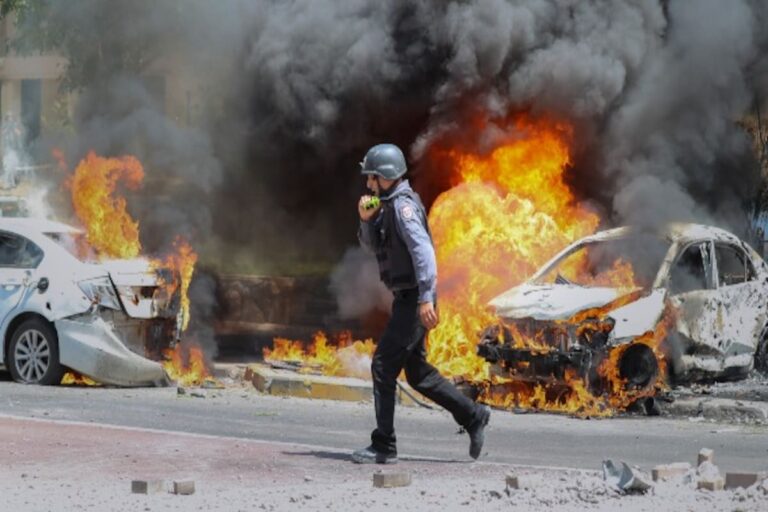
Heavy rocket fire on Israel from Gaza began four days after Iranian Supreme Leader Ali Khamenei declared in a speech on Quds Day that “fighting the Zionist regime is a general duty.” He was addressing the youth of the Muslim world, and told them to “build suitable weapons and strengthen the line of holy war and martyrdom.”

Khamenei reacted to the rocket attacks at another gathering in Tehran, saying “force is the only language the Zionists understand,” and the best way for Palestinians to “force the criminals to surrender and stop their savagery.”

Israel has dealt Iran’s clerical regime several blows in recent years, both inside the country and against its allies and positions in Syria, each time with Iran unable to retaliate. Furthermore, while the suspect deaths of two Revolutionary Guards generals (Mohammad Hossein-Zadeh Hejazi and Mohammad Ali Haqbin) cannot be directly attributed to Israel, reactions by senior Iranian officials suggest they suspect Israel’s hand. Some regional reports on Hejazi’s death have suggested he was poisoned.

Revolutionary Guards commander Hossein Salami said at his funeral that “I heard Israel is rejoicing, but it will disappear.” The latest violence in Gaza seems, at the very least, to be a consolation to Iranian officials, after months of helpless resentment against Israel. But Iran may have had a more direct hand.

The Iranian ayatollahs are telling Israel its attacks and sabotage in Vienna will not go unanswered.

Talks have stalled to revive a nuclear pact between Iran and the West, as Israel and Saudi Arabia pressure the administration of President Joe Biden to prevent its waltzing into a any-old deal with Tehran, and dashed Tehran’s hopes of dealing with an “Obama-style” administration. Iranian officials have repeatedly accused Israel in past weeks of blocking the talks. With the country heaving under economic pressures, the regime has few bargaining chips with the West, besides threatening to rev up uranium enrichment or fueling regional violence.

Read more at: World Crunch

Also Read: Iran is Taking Advantage of the Palestinian Issue to Advance its Own Agenda

Israeli-Palestinian Israeli-Palestinian

Al-Qaeda in Iran Threatens the US and Israel

0

Former Secretary of State Mike Pompeo was the first American politician to openly charge Iran with providing support for al-Qaeda, though the matter was not news to Congress. A recently released CIA report indicates that Iran has allowed al-Qaeda to plot against the US from its territory.

Iran and al-Qaeda have collaborated covertly since the early 1990s in Sudan, and the relationship continued after al-Qaeda relocated to Afghanistan. The group was present on Iranian soil before, during, and after the 9/11 attacks. Since 2001, senior leaders on al-Qaeda’s management council have resided in Iran. Al-Qaeda uses Iran as a facilitation, finance, and transport hub using Muslim Brotherhood-led institutions, such as the Islamic Development Bank, to supply illicit funding. From this sanctuary, al-Qaeda ordered attacks against Westerners in Saudi Arabia in 2003.

The US government has consistently assumed the Islamic regime would not allow al-Qaeda to plot against the US from within Iranian borders, but this assumption is belied by the evidence.

In the mid-1990s, Iran allowed many al -Qaeda members safe transit through its territory to Afghanistan. Iranian border guards were instructed not to stamp their passports to prevent their home governments from suspecting that they had traveled to Afghanistan. Rohan Gunaratna reported in his book Inside Al -Qaeda: Global Network of Terror that that between 1996 and 1998, nearly 10% of Osama bin Laden’s outgoing calls were to Iran.

In 2011, federal judge John D. Bates issued a default judgment finding Iran and Sudan culpable for al- Qaeda’s bombings in 1998 of embassies in Kenya and Tanzania. “Iran had been the preeminent state of terrorism against US interests for decades,” he said. According to his ruling, “The government of Iran aided, abetted and conspired with Hezbollah, Osama bin Laden, and al- Qaeda to launch large-scale bombing attacks against the United States by utilizing the sophisticated delivery mechanism of powerful suicide truck bombs.”

Read the complete article at: Besa Center

Also Read: IRGC Quds Force set up a shop in Turkey’s capital to recruit militants including al-Qaeda aspirants