Home Blog Page 10

Iranian IRGC trains minors as Riot Police without parents’ consent

0

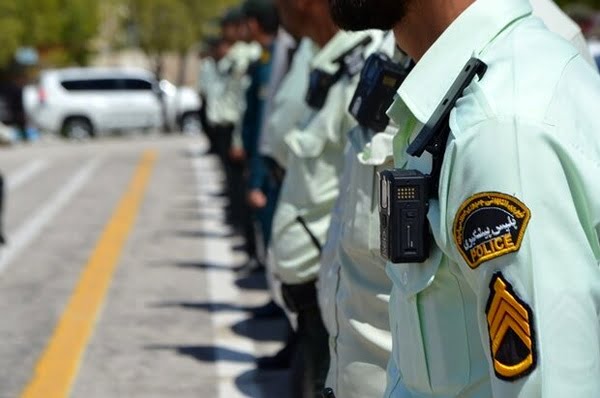
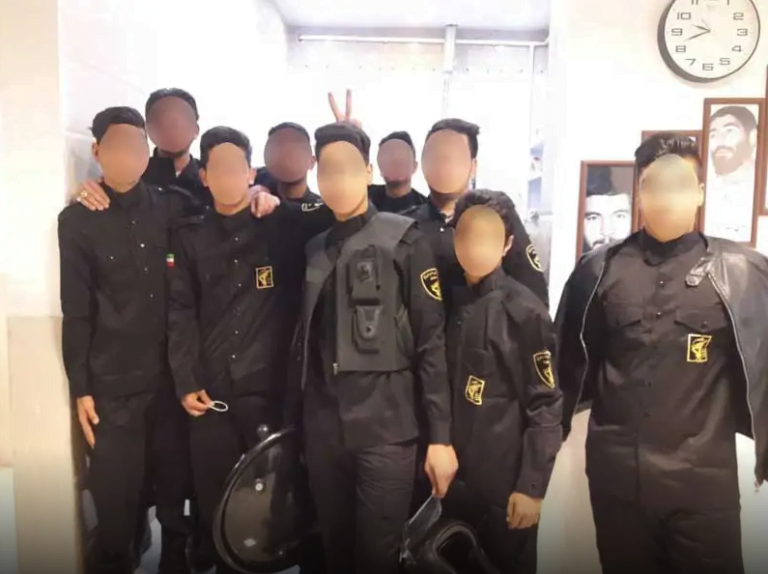
A series of photographs that have reportedly come out of Iran show boys aged 12 to 16 in Iranian IRGC (Islamic Revolutionary Guard Corps) uniforms.

Several Iranian IRGC officers allegedly visited an all-boys high school in recent days, selecting a group of students in secondary school with strongly held religious beliefs.

The officers reportedly told the students that they would receive urban warfare training and be paid for their work after the current unrest ended. The students were also reportedly promised that their compulsory military service would be cut by six months as part of their reward.

Teenagers reportedly received training at the “Imam Ali” security battalion, where they posed for photographs in IRGC uniforms.

The IRGC reportedly recruited the teenage boys without the consent of their parents.

The recent publication of photographs of underage children in riot police uniforms carrying compliance tools has raised eyebrows and sparked public outrage.

However, a closer examination of the photographs shows that the small shields and batons are more like toys than standard-issue riot police gear.

Children must be protected against possible violence in street protests and not exposed to any danger.

Recent attempts to put underage children in riot police uniforms and gear could be seen as an attempt to compensate for the small number of diehard forces loyal to the regime.

The regime is not worried that these children might join protesters. It only wants to increase the number of its forces in the streets because protesters cannot tell the age of these children from a distance.

The state has also used black motorcycles, water cannons, and other tools to scare off protesters. Seeing two water cannons, 20 motorcycles, 20 shields, 20 riot police, and dozens of children in riot gear positioned at an intersection could be extremely intimidating, even though there are only 20 riot police against 1,000 protesters.

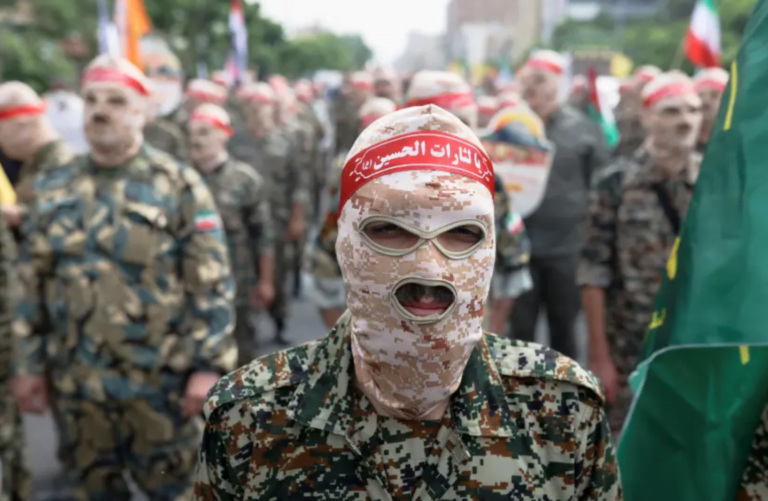
The IRGC at war with the people of Iran

0

Iran is undergoing an identity crisis. For almost a month, in streets and neighborhoods across the country, people are at war with the IRGC and have rebelled against the Islamic Republic, calling for the death of its supreme leader and an end to the theocratic regime’s 43 years of rule, after the death of 22-year-old Mahsa Amini at the hands of Tehran’s morality police.

The protests are mostly led by young women and teenage girls, who have abandoned their state-imposed religious headscarves in rejection of the very premise of Iran’s 1979 Islamic Revolution and the theocracy it birthed.

The nature and scope of the protests have made many wonder whether this could be another revolution – one that could topple the Islamic Republic and replace it with a more liberal and representative democracy. The primary obstacle standing in the protesters’ way is the Islamic Revolutionary Guard Corps (IRGC), the 1979 revolution’s most potent offspring.

In that earlier revolution, it was the Iranian military’s decision to declare neutrality and stand down that signalled the end of the Pahlavi dynasty, setting Iran on a new course. The IRGC, by contrast, was designed precisely to stand with the regime no matter what – even if that means standing against the people.

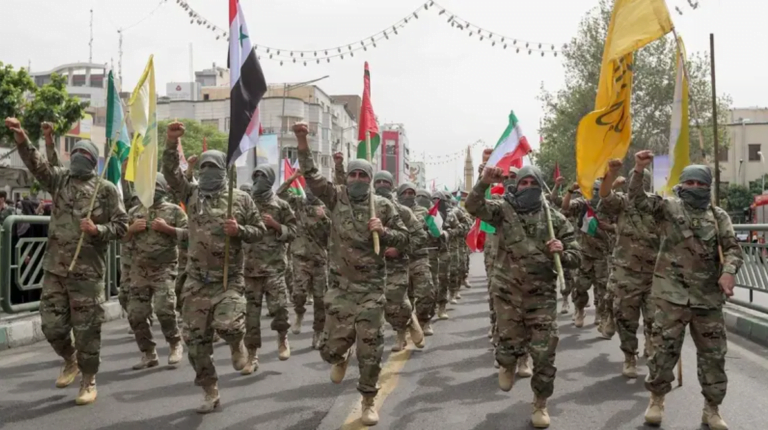
The IRGC is a powerful military force that serves as the bedrock of the Islamic Republic’s order. It oversees the regime’s security and is the most influential voice, apart from the supreme leader, Ayatollah Ali Khamenei, in the country’s strategic decision-making.

That role has made it the primary mechanism for organising repression within the country. In past episodes of political unrest, such as the 1999 student protests and the mass demonstrations that followed the 2009 presidential election, it was the IRGC and its volunteer militia, the Basij, that led the charge against protesters, using brute force, arrests and torture to quell the tumult.

The IRGC reprised that role in protests that stretched from late 2018 into 2020 but escalated its tactics in some places into a fully militarised response, using live fire and armoured vehicles to kill protesters at a much higher scale than in previous crackdowns.

Read the complete article: Iran protests: To win, the regime must go to war with women and teenage girls 

Iranian IRGC helping Russia in Ukraine

0

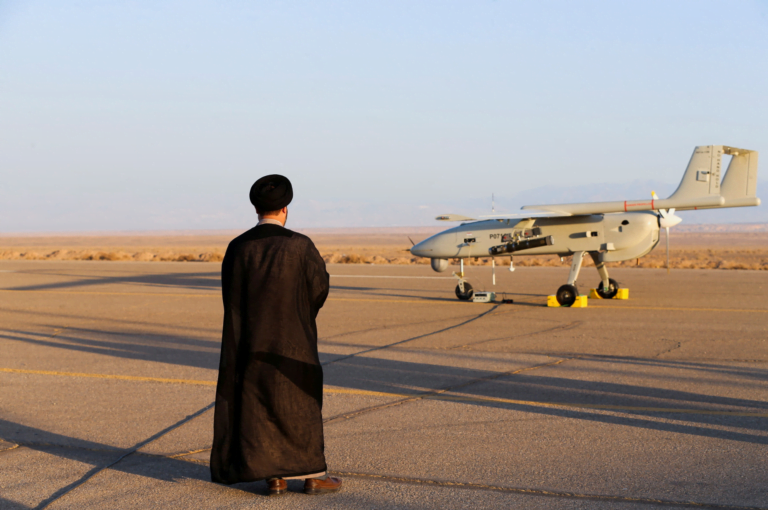
The Iranian IRGC has long been known as a threat across the Middle East. Now, reports from Al Arabiya, The New York Times, and elsewhere indicate that Iran may have sent IRGC members to Crimea to aid Russia’s drone war against Ukraine.

The Iran-Russia connection and the role of the Iranian IRGC are important because they have a legacy in the Syrian conflict.

IRGC Quds Force commander Qasem Soleimani played a key role in developing the organization and its networks across Iraq, Syria, and into Lebanon, and Yemen. He also reportedly encouraged Russian President Vladimir Putin to intervene in Syria in 2015.

The IRGC was already in Syria aiding the regime, and with Soleimani’s prodding, Russia intervened to back the regime. This helped Syria reclaim territory and enabled Hezbollah and Iranian-backed groups to move closer to the Golan Heights and threaten Israel.

Iran has sent trainers from IRGC to help Russia with the Iranian-style drones it is using, the Times reported.

Last week, Al Arabiya reported: “Russian forces took Iranian instructors to the occupied Kherson and Crimea regions to launch Shahed-136 kamikaze drones, the Ukrainian National Resistance Center reported… The Iranians are based in the Russian-administered Ukrainian areas of Zalizniy Port, Hladivtsi in Kherson, and Dzhankoy in Crimea.”

If the reports are credible, these developments would appear to be linked to past work of the IRGC in backing drone and missile threats across the Middle East, as well as working with Russia in the Syrian war.

The IRGC has done the same thing in the past, helping the Houthis in Yemen develop a deadly drone program to threaten Saudi Arabia, the UAE, and ships in the Gulf of Oman. The IRGC also helped Hamas in the Gaza Strip, Hezbollah, and the Syrian regime.

Iranian police slap woman without Hijab on video

0

On Tuesday October 18th as protests across Iran are ongoing for more than a month, a video has gone viral of Iranian police forces physically abusing an unarmed woman unprovoked.

More than 40 human rights organizations are calling on the United Nations Human Rights Council to convene an emergency meeting to discuss the Iranian government’s crackdown on protesters.

The statement released Monday expressed concern over the Islamic Republic’s brutal suppression of nationwide protests in response to the death of 22-year-old Masha Amini. Amini died last month while in detention by Iranian police in Tehran for failing to properly cover her hair with a hijab.

The human rights groups said the evidence suggests a disturbing pattern of security forces deliberately firing live ammunition and metal shells at protesters and bystanders, including children.

The statement says more than 200 protesters have been killed during the demonstrations, including at least 23 children, while more than 1,000 protesters, activists, journalists and students have been arbitrarily arrested.

The groups, including Amnesty International and Human Rights Watch, are urging the UNHRC to establish an independent entity with investigative, reporting and accountability duties. The signatories say if the international community fails to act, numerous men, women, and children will be subjected to death, impairment, torture, physical assault, and imprisonment.

The statement was also signed by Iran Human Rights, the Baluchistan Human Rights Network, the Hengaw Human Rights Organization, the Kurdistan Human Rights Network, and the Women’s International League for Peace and Freedom.

The continued unnecessary and disproportionate use of force against protesters must stop. Arresting people solely for exercising their rights of peaceful assembly and freedom of expression constitutes an arbitrary deprivation of liberty. We call for the immediate release of all those arbitrarily detained. Additionally, we remind authorities that under international law they have an obligation to protect inmates’ physical and mental health and well-being, and that any use of force must strictly comply with the principles of legality, necessity, proportionality and non-discrimination.

Iranian anti-riot police attempt to drive over unarmed civilians

0

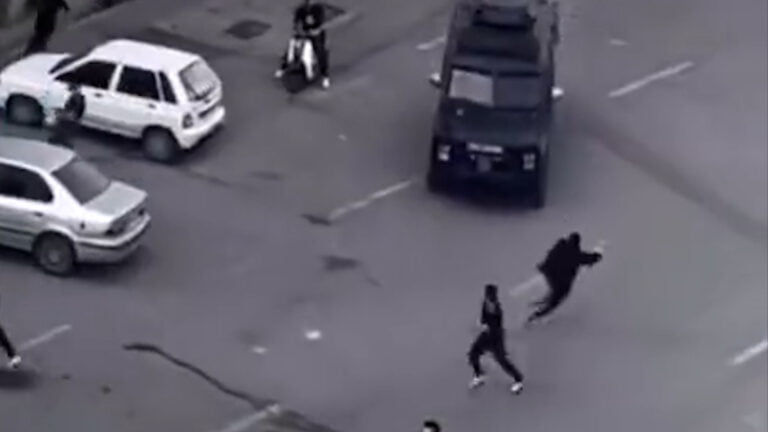
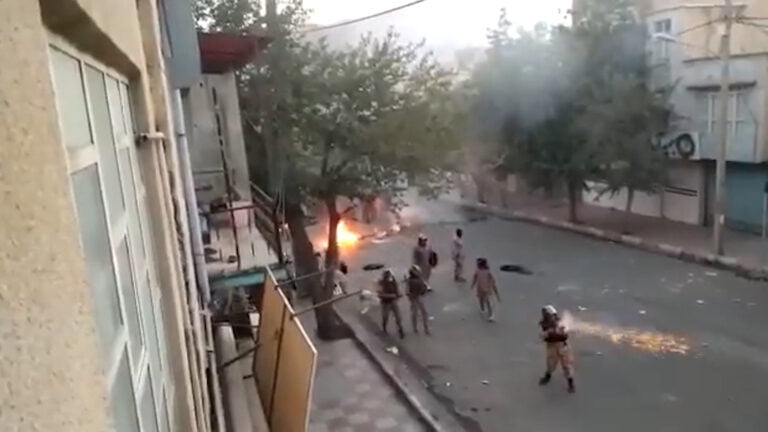
Video has emerged of Iranian anti-riot police attempting to run over civilian protesters on Sunday in Iran’s northwestern city of Ardabil.

Iran’s popular protests have been on-going for nearly a month with many calling it a revolution as citizens have grown impatient with the Islamic Republic’s gross human violations and mismanagement of the country’s resources.

On Saturday, October 15, 2022, the city of Ardabil, northwestern Iran, witnessed one of the largest anti-government protests in the last decade following the news of a killing of a school student in Ardabil by the Islamic Republic’s security forces.

In a rare incident, Ardabili protesters clashed in a one-to-one fight with the anti-riot police forces. The angry protesters of Ardabil blocked the streets and chanted anti-government slogans such as “Death to the dictator;” and “Azerbaijani girls, stars of the sky (in Azeri language). In response, the agents of the Islamic Republic of Iran tried to suppress the people by directly firing bullets and tear gas and driving their cars toward the protesters to run them over.

According to the reports received by Iranwire, the Islamic Republic of Iran arrested at least 50 citizens of Ardabili and injured several others during the protests.

As unrest persists, there continues to be a vast amount of arrests, forcing the transfer of some detainees to Ardabil prison in the past month. There is no new information about the fate of other detainees.

Eight civil activists from Ardabili, who were arrested in the nationwide protests in response to the killing of Mahsa Amini, are still incarcerated in the central prison of this city.

Furthermore, Kamiar Salim, the investigator of the 7th branch of the Ardabil Public and the Revolution Prosecutor’s Office, has not given any clear answers to the families of Asgar Akbarzadeh, Saeed Sadeghifar, Meysham Jolani, Yashar Akbarzadeh, Yousef Kari, Sajad Ghanemoghadam, Mohammed Jolani, and Firouz Moini. He has refused to accept the bail order issued for these citizens and rejected the issue of a temporary release order.

IRGC member, Basij militiaman killed in southern Iran

0

A member of Iran’s Revolutionary Guards and a Basij militiaman were killed in Southern Iran early Friday while chasing individuals spray-painting slogans during protests over the death of Mahsa Amini, state media reported.

They “were martyred while on duty” in the southern province of Fars, state news agency IRNA said.

Their deaths bring to at least 20 the number of security personnel killed in the wave of unrest that has swept Iran since Amini died on September 16 after her arrest by the morality police in Tehran for allegedly violating the Islamic Republic’s strict dress code for women.

Six more have been killed in violence in southern Iran where demonstrations erupted on September 30 over the reported rape of a teenage girl by a police commander.

“Around 5:00 am (0130 GMT) on Friday, in the city of Beyrom, two people on a motorcycle, who were writing slogans, became the target of a chase by two officers,” Fars judiciary chief Kazem Mousavi told IRNA.

The two officers were killed by “shots to the head and chest” from the motorcyclists, Mousavi added.

Iranian officials have blamed the unrest on the country’s foreign enemies, particularly the United States.

Interior Minister Ahmad Vahidi said late Thursday that some protesters were “trained abroad and financed from outside the country.”

He played down the scale of the protests.

“On the busiest day of the recent gatherings, 45,000 people participated in the rallies,” out of a population of more than 83 million, IRNA quoted Vahidi as saying.

“In the universities, at the peak of gatherings, 18,000 people… took part in the rallies, out of a student population of 3.2 million.”

UK considers listing Iranian IRGC as terrorist

0

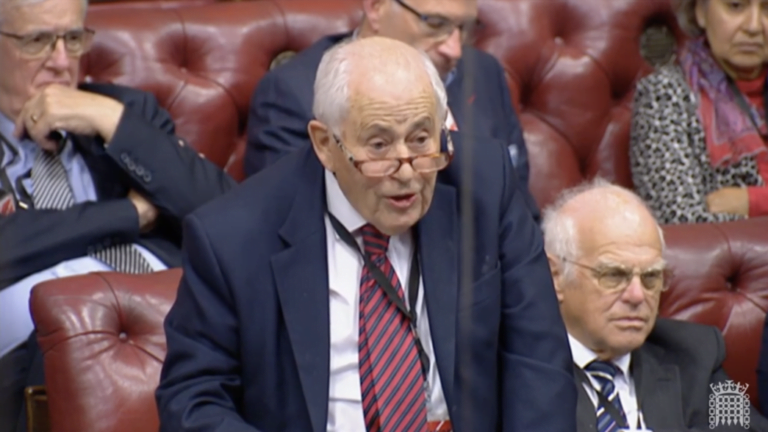
Government ministers have said that the designation of Iranian IRGC as terrorist remains “on the table” after an intervention by a Peer in the House of Lords.

Lord Monroe Palmer of Child’s Hill asked in a debate on Thursday whether the government would proscribe the political enforcement branch of Iran’s armed forces given the country’s “violent oppression against dissidents” and other criminal behaviour.

Responding on behalf of the government, Lord Ahmad of Wimbledon said he “cannot give that assurance”, but added that the government keeps “all issues such as proscribing organisations on the table”.

Iranians have taken to the streets in the last month following the death of Mahsa Amini, a 22-year-old woman arrested by the Iranian IRGC in Tehran on the 13th of September for allegedly breaching Iran’s strict rules requiring women to cover their hair with a hijab or headscarf.

The first protests broke out after Ms Amini’s funeral in the western city of Saqqez, when women ripped off their headscarves in solidarity. The protests have since swelled, with the public demanding reforms ranging from more freedoms to an overthrow of the state.

The House of Lords held a debate on Thursday on the protests and women’s rights in the Islamic Republic of Iran, and what the UK is doing and should be doing to assist ordinary Iranians, particularly women.

Lord Palmer, a Vice President of the Jewish Leadership Council, asked specifically about the proscription of the religious enforcement police, which was labelled a terrorist organisation by the United States in 2019.

The Liberal-Democrat peer asked: “My Lords, the Iranian IRGC and its violent oppression against dissidents inside Iran has long extended beyond Iran’s borders. This summer’s attempted murder of Sir Salman Rushdie, last year’s attempted kidnapping of Iranian women’s rights activist Masih Alinejad and numerous foiled plots are only the tip of the iceberg.

“The Revolutionary Guard represents a present danger to anyone the Iranian regime believes is a threat. Does the Minister agree that now is the time to proscribe the Revolutionary Guard to protect civilians outside Iran as well as those within Iran?”

Russia using Iranian drones to wreak havoc in Ukraine

0

Ukrainian forces have been destroying Iranian drones that Russia has deployed across the country, which are terrorising civilians, even as it becomes clear that Russia’s supply of high-precision missiles has dwindled.

Kyiv on Monday (October 10) accused Moscow of using Iranian-made unmanned aerial vehicles (UAVs) sent from neighbouring Belarus as part of multiple deadly strikes Russian forces launched across Ukraine.

“The enemy used Iranian Shahed-136 UAVs in strikes launched from the territory of Belarus” and the Crimean peninsula annexed by Russia, the Ukrainian military said in a statement, adding that nine Iranian drones were “destroyed”.

Ukrainian President Volodymyr Zelenskyy said Russia targeted Ukraine’s energy infrastructure during Monday’s strikes across the country, including strikes carried out by Iranian-made UAVs, commonly known as drones.

Russia has been using Iranian-supplied drones to attack Ukrainian cities for several weeks, in a collaboration that analysts regard as further cementing the isolation both states face in the international arena.

Iran’s plans to supply combat drones to Russia for use in Ukraine first came to light in July, following reports that the Russian military was facing challenges sustaining its weaponry after significant losses.

According to media reports, Iran has delivered hundreds of its drones to Russia despite warnings from Washington.

Ukraine took steps to reduce Iran’s diplomatic presence in retaliation to Tehran’s deliveries of drones to Moscow.

It removed the accreditation of the Iranian ambassador and said it is “significantly reducing” the Iranian embassy’s diplomatic staff.

On October 6, Ukrainian military spokesman Oleksiy Hromov said Ukraine had destroyed 60% of the 86 Shahed-136 drones Russia has used as part of its military campaign, the Wall Street Journal (WSJ) reported.

The Ukrainian military previously said it was seeing increasing use of drones by Russia as Moscow’s supply of high-precision missiles dwindles.

According to a Ukrainian artillery commander, it said, “Shahed-136 delta-wing drones, repainted in Russian colours and rebranded as Geranium 2”, began appearing in September over Ukrainian armour and artillery positions.

Canada imposes additional sanctions on Iranian IRGC

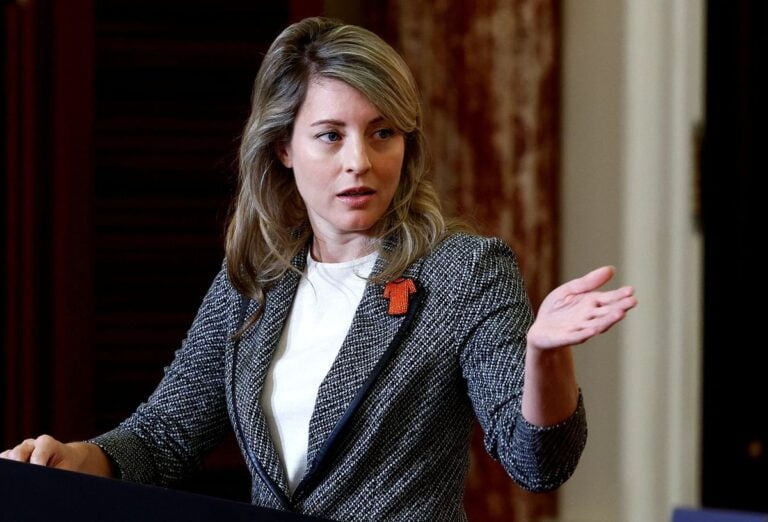
Mélanie Joly, Canada’s Minister of Foreign Affairs, today announced that Canada is imposing additional sanctions on the Iranian IRGC and several high-ranking officials under the Special Economic Measures (Iran) Regulations.

These sanctions build upon the ones announced on October 3, 2022, and respond to the Iranian regime’s systematic human rights violations and ongoing actions that destabilize regional security.

The regime’s continued grave and ongoing breaches of international law are well-known and documented, including its blatant disregard for human life. Canada will always stand with Iranians and the victims of this regime, including with the families and loved ones of the victims of the downing of Flight PS752.

Today’s sanctions list 17 individuals and 3 entities that have participated in or enabled gross human rights violations, including against Iranian women, and perpetuated disinformation activities to justify the Iranian regime’s repression and persecution of its citizens.

This list includes, but is not limited to:

  1. Saeed Mortazavi, the Iranian Revolutionary Court prosecutor who ordered the torture of Canadian-Iranian journalist Zahra Kazemi; Kazemi died as a result of her mistreatment while in custody in 2003.
  2. Amir Hatami, Brigadier General in the Iranian regular army, senior advisor to the Commander-in-Chief of the Iranian Armed Forces and a former minister of defence.
  3. Hossein Shariatmadari, Editor-in-Chief of Kayhan, a conservative state-controlled newspaper that regularly publishes anti-Semitic propaganda, including Holocaust denial, and threats against Israel, the United States and Gulf states.
  4. Manouchehr Amanollahi, Commander of Iran’s Law Enforcement Forces in the Chaharmahal and Bakhtiari province in southwestern Iran.
  5. Gholamreza Ziaei, director of Rajaei Shahr (from October 2017 to June 2019) and Evin (from July 2019 to June 2020) prisons.
  6. Peyman Jebelli, Head of the Islamic Republic of Iran Broadcasting.
  7. Ali Larijani, member of Iran’s Expediency Council, former IRGC official and former speaker of the Islamic Consultative Assembly, also known as the Iranian Majlis or Iranian Parliament.
  8. Mohammad Javad Zarif, foreign minister of Iran from 2013 to 2021.

These measures prohibit dealings related to the listed individuals and entities, effectively freezing any assets they may hold in Canada. Individuals listed in response to gross and systematic violations of human rights are also rendered inadmissible to Canada under the Immigration and Refugee Protection Act.

Iranian government forces fire at civilian homes

Human rights group Hengaw has posted a video showing Iranian government forces shooting at civilian homes and another in which gunfire and cries could be heard during crackdowns on protests in western Iran.

Amnesty International said there were reports that Iranian government forces had used firearms indiscriminately in Sanandaj.

It reported that dozens of civilians had been killed and 400 injured across the region since Sunday.

But it warned that the death toll might be higher because authorities were disrupting local internet and mobile networks.

Protests against the clerical establishment have swept across Iran since the death of Mahsa Amini three weeks ago, a Kurdish woman from the western city of Saqqez who fell into a coma after being detained by morality police in Tehran for allegedly violating the strict hijab law.

The unrest is now considered the most serious challenge to the Islamic Republic since its inception in 1979.

Iran’s leaders have accused foreign enemies and exiled opposition groups of fomenting “riots” that they will not tolerate.

Hengaw reported on Tuesday that over the past three days protests had taken place in 10 areas of Kurdistan, Kermanshah and West Azerbaijan provinces, with Sanandaj the epicentre of the unrest and the crackdown by authorities.

The Norway-based group posted videos which it said showed intense clashes between protesters and the Iranian government forces in the city on Monday night. Repeated gunfire can be heard in the footage, as well as cries and shouts.

According to Hengaw, other footage showed a crowd coming under attack, empty bullet cases, shotgun cartridges and tear-gas canisters left on the streets, and security personnel shooting directly towards homes.

Thousands of people have also reportedly been arrested in the crackdown.

On Monday, dozens of employees blocked roads outside the Assaluyeh petrochemical complex in Bushehr province and shouted: “Do not fear, we stand together.” A regional official insisted it was related to a wages dispute.