Home Blog Page 47

IRGC military commander appointed as Minister of Education in Iran

0

The Iranian regime’s parliament approved a commander of the terrorist designated Islamic Revolutionary Guard Corps (IRGC), Yousef Nouri, as the new Minister of Education.

Yousef Nouri has been one of the directors of the IRGC’s two largest economic conglomerates, known as the “Khatam-al Anbiya Construction Headquarters” and the “Martyrs and Veterans Affairs.”

As an IRGC member since the 1980s, Nouri has no experience whatsoever to be qualified for this role, except for sending students to clear minefields during the Iran-Iraq war, and this seems to be his only link to Education.

In his speech at the parliament, Nouri said, today: “We should turn the education system into Qassem Soleimani’s training school, to train students loyal to the Supreme Leader.”

Nouri’s only mission seems to be brainwashing Iranian children at a young age and turning them into extremists, rather than allowing them to study in a healthy environment, where they can flourish like children in other countries and find the right path for themselves.

With the appointment of an IRGC commander as the Education Minister, the number of IRGC and members of the Quds Force in Raisi’s cabinet will reach 13, including nine ministers (Ministers of Interior, Foreign Affairs, Roads and Urban Development, Cultural Heritage, Tourism and Handicrafts, Energy, Sports, Science, Research and Technology, Health, and Education) and three of his deputies (IRGC Commanders, Mohsen Rezaee, Mohammad Hosseini, Mohammad Eslami), and his Deputy Chief Executive and Head of the Presidential Institution, Ali Ghoraishi.

In addition, on November 21, 2021, in the midst of the protests in Chaharmahal and Bakhtiari, Brig. Gen. Gholam-Ali Heydari was appointed governor of that Province. At the same time, Hassan Bahramnia, a Heydari’s colleague, was appointed as the Governor of Ilam. Raisi has appointed eight other IRGC commanders as governors, including the governors of West Azerbaijan, Khorasan Razavi, Bushehr, Hormozgan, Lorestan, Ilam, Qom, and Khuzestan. He is moving to completely militarize the Interior Ministry.

Two Years After Iran’s Deadly Crackdown On Protests, Victims’ Families Still Fighting For Justice

0

For the past two years, Mahboobeh Ramezani has been grieving the loss of her son while calling for justice over his death at the hands of Iran’s security forces.

Pejman Gholipur was shot and killed during a November 17, 2019, protest in Tehran triggered by a sudden rise in the price of gasoline. He was 18. Ramezani has kept her son’s bloody clothes as evidence that he was murdered.

Gholipur was among thousands of citizens who joined the protests in more than 100 Iranian cities and towns prompted by the government’s sudden decision to increase gas prices. The protests quickly turned political, with many chanting against the Iranian clerical establishment and its leaders.

The government responded with lethal force, according to Amnesty International, which recorded 324 deaths of protesters and bystanders, including children. The London-based rights group believes the real number of those killed is even higher.

Among them was Gholipur, who was reportedly shot in the heart. His family found his body in a hospital hours after he left home to join the demonstrations.

“My son’s bloody clothes are in a box. They’d removed them in the hospital. There were holes in them,” Ramezani testified online last week during a tribunal in London that heard evidence from her and other witnesses about the crackdown on the 2019 protests.

“We want justice. Hear our cries,” Ramezani said. “Tell us who killed our children…. We lost our loved ones in our own homeland,” she told the international people’s tribunal formed by NGOs to assess whether actions by Iran’s clerical establishment constituted “crimes against humanity.” The tribunal, which does not have any legal bearing, is expected to release a report next year.

Ramezani is among the grieving mothers of those killed in the November 2019 protests who have been speaking out about the killings and demanding that the authorities bring those responsible to justice. Many have reportedly faced state intimidation and pressure. But they have refused to be silenced.

Source: RFERL

Also Read: Panel Calls for Justice for Victims of 2019 Iranian Protest Crackdown

Iranian Security Forces Set Protesters’ Tents On Fire In ‘Clean-Up’ Operation In Isfahan

0

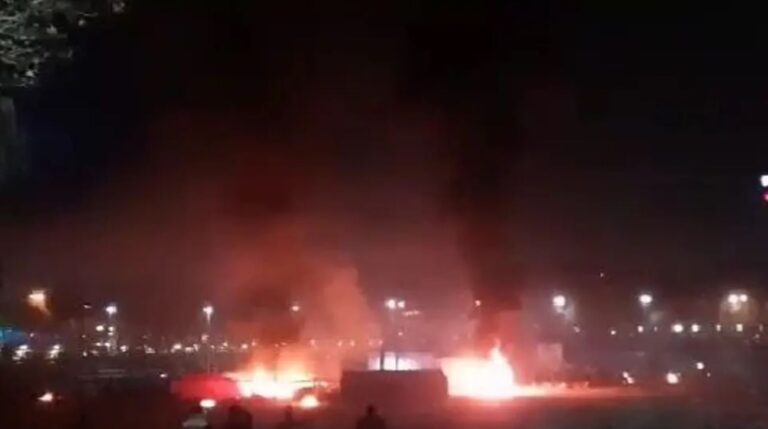
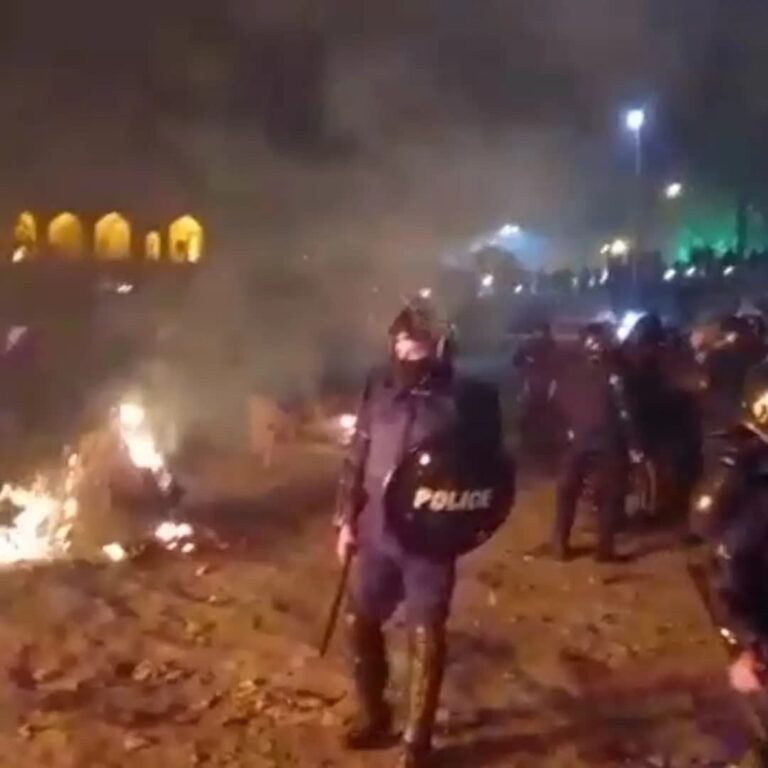
Tents set up last week by Iranian farmers in a dry river bed in Isfahan, Iran’s third-largest city, to protest against water cuts have been set on fire by riot police, and shots could be heard in the area.

The site was being “cleaned up” by the city’s municipality after the tents were set on fire overnight by Iranian security forces, reports said.

The protest movement started in Isfahan on November 8 and a number of demonstrators set up tents in the dried-up bed of the Zayandehrud River that passes through Isfahan last week.

On November 18, thousands of people joined the Isfahan rally to protest against water cuts and the drying up of the river.

Last week, images broadcast on state television and videos published on social networks showed farmers and others from across Isfahan Province gathered in the dry river bed and elsewhere in the city, chanting slogans such as “Give Zayandehrud River back.”

First Vice President Mohammad Mokhber said that meetings were being held over the issue to try to resolve the water problem in Isfahan and elsewhere.

Similar protests have been held across Iran in recent years.

In July, deadly rallies broke out in the southwestern province of Khuzestan amid widespread water shortages.

The Iranian Meteorological Organization has estimated that 97 percent of the country is experiencing drought to some degree.

Mismanagement by the authorities has also been cited as a main cause for the water crisis.

Source: Radio Free Europe Radio Liberty 

Also Read: Iranian IRGC Basij militia and violent oppression of civilians


Iran terrorist designated Basij to ramp up disinformation online campaign

0

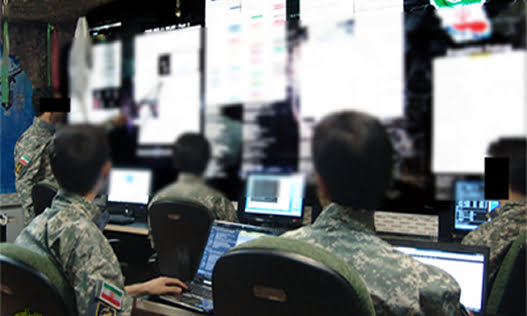
The general commanding Iran’s terrorist designated paramilitary Basij, said Thursday that his social media activists would be given equipment and technical support to boost their work and ramp up their disinformation online campaign.

Organized trolling has been for some time a feature of Iranian politics, helping to spread untruths and unsubstantiated allegations. Iranian authorities, including Supreme Leader Ali Khamenei refer to state-sponsored social-media activists as “cadets of the soft war.”

Iranian activists often allege that the IRGC and other state bodies sponsor organized trolls on social media to anonymously threaten, attack and discredit dissidents and to disseminate fake news.

The Basij, a wing of Iran’s terrorist designated Islamic Revolutionary Guard Corps (IRGC) has around 5 million members, according to leading academic authority Saeed Golkar, with around 200,000 cadres and special Basij, who can act as a paramilitary support to police and security forces. Thousands of members are active on social media to counter news, information and critical opinions disseminated on social-media including by Persian-speaking media abroad.

Besides maintaining extensive network of social media activists to spread disinformation, the Islamic Republic also devotes an unknown measure of resources to control the Internet, block thousands of websites and ban foreign social media platforms such as Facebook, YouTube and Twitter. Almost every Iranian has to resort to VPNs and other tools to have access to blocked sites.

Iran’s Revolutionary Guards Corps (IRGC) has 2,500 websites and is trying to organize “cyber battalions in Basij militia bases”.

The IRGC cyber headquarters began its operation 10 years ago and expanded it after the 2009 presidential election and the widespread street protests that followed it. Yadollah Javani, the head of the political bureau of the IRGC, has been quoted as saying that they have organized the fifth-largest cyber army in the world.

The IRGC cyber headquarters is highly active in the identification and arrest of internet users expressing themselves in the cyber world. In recent years there have been several reports of individuals being arrested by IRGC officers for their activities on the internet.

Iran tampered phones of Ukrainian Flight victims killed by IRGC missiles

0

A new report is accusing Iranian authorities of tampering with the electronic devices and misidentifying the remains of some of the passengers killed on Ukrainian Flight 752.

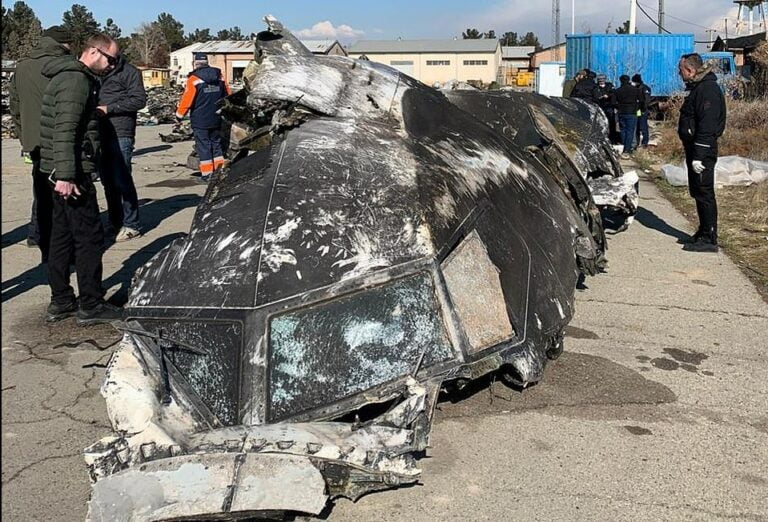
All 176 people on board the Kyiv-bound airliner were killed when the Boeing 737-800 was shot down by a surface-to-air missile fired by Iran’s Revolutionary Guard minutes after taking off from the Tehran airport.

The families enlisted a retired Toronto police homicide detective, Mark Mendelson, whose consulting firm examined a laptop and cellphones returned to the families. He concluded the devices “showed evidence of human manipulation” and showed no evidence of burn patterns or other signs of damage consistent with the plane slamming into the ground.

“The fact that these memory/data components are missing is not consistent with damage caused by a sudden and hard impact. Moreover, the fact that screws were removed and covers pried open strongly suggests that concerted efforts were made to extract these components, rendering a review of data impossible.”

The report accused Iranian authorities of a “systematic coverup” of the cause of the crash.

The report also says Iranian authorities botched the identification of some of the victims, a revelation that will only increase the pain and suffering of their loved ones.

“The association has obtained evidence that DNA testing on some victims’ bodies did not match their stated identification by Iranian authorities,” the report says.

“This neglectfulness on the part of the government of Iran has had serious psychological consequences for families, some of whom did not receive the whole bodies of their loved ones and were given the remains of other victims instead.”

Foreign Affairs Minister Melanie Joly joined counterparts from Sweden, Ukraine, and the United Kingdom, collectively known as the International Co-ordination and Response Group for the victims of Ukrainian Flight PS752, in criticizing Iran’s refusal to meet this week to negotiate reparations.

Iran-linked militia calls up thousands of volunteers to fight US forces

0

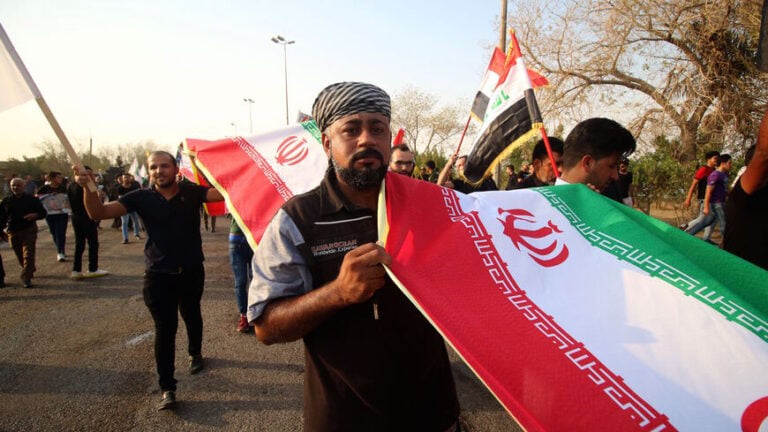
Little more than a month prior to the official end to the US “combat mission” in Iraq, an Iran-linked armed group has called for “volunteers” to fight any forces remaining post-midnight Dec. 31.

A man known as Abu Ala al-Walai, commander of Kataib Sayyid al-Shuhada (KSS), on Nov. 19 announced a call for volunteers to fight the “US occupation” should troops fail to leave.

US President Joe Biden had in July announced after meetings with Iraqi Prime Minister Mustafa al-Kadhimi that US forces in Iraq would “continue to train, to assist, to help and to deal with” the Islamic State (IS), but that they would no longer be “by the end of the year in a combat mission.”

KSS spokesman Sheikh Kadhim al-Fertousi claimed to Al-Monitor on Nov. 24 that “so far we already have 45,000” calls from would-be volunteers for the post-December fight against US forces should they remain in the country.

“We also received calls from organizations that also want to join, each of which has about 1,000 to 1,500” people, he said. “Some used to fight alongside [popular Shiite cleric Muqtada al-] Sadr, while others fought in the past against IS.”

He said they had received several requests from women who also wanted to volunteer, but “we don’t usually accept this sort of request.”

The offer, he said, had nonetheless “lifted our spirits.”

KSS was formed in 2013, initially fighting alongside Syrian government forces against armed opposition groups there. They began fighting against IS in Iraq starting in 2014.

The group has historic links to Kataib Hezbollah and Iran’s Islamic Revolutionary Guards Corps (IRGC).

KSS fighters just across the Iraqi border in Syria have been targeted in at least two attacks over the past year by US forces — in February in the first known offensive military action taken by the Joe Biden administration declaredly in retaliation for rocket attacks on bases hosting international forces, and in June.

Source: Al-Monitor

Also Read: Iran’s proxy militias in Iraq defying its terrorist designated IRGC

Riot police attack water protesters in Iran at midnight

0

Farmers protesting in Esfahan for water say that after midnight on Thursday security agents and riot police attacked their camp, set fire to their tents, and bulldozed the scene.

Protesters, many of whom have refused to leave their tents for over two weeks, said on social media the attack occurred at 3:00 AM while many other farmers and their supporters were gone. According to these reports, security forces then broke the metal frame of the tents and drove a loader over the site to remove the remains. During the attack, protesters say, security forces shot blanks and tear gas to disperse them.

One of the protesters posted a video report that has been widely circulated on social media and shows a large group of riot police advancing towards the camp in the dry bed of Zayandeh Roud river. The citizen-journalist speaking in the video says protesters have been ordered to leave and alleges that security forces set fire to the protesters’ tents. “We only came here for water,” he says.

Promises of water for Esfahan have fueled protests in Shahr-e Kord, the capital of the neighboring Chahar Mahal and Bakhtiari Province, where people have been also protesting the mismanagement of water in the past four days.

The recent water protests took place as many Iranians marked the second anniversary of the bloody November 2019 unrest. In 2019 protests that quickly spread across the country were heavy-handedly suppressed by the security forces who killed hundreds of unarmed people. After two years, no one has been accountable, and the protesters have been accused of serving foreign interests and destroying property.

State-run broadcaster (IRIB), however, in a report Thursday morning alleged that “opportunists” some of whom were arrested by security forces were responsible for burning the tents. This is a well-known technique of Iran’s plainclothes agents where they destroy public property during peaceful protests to use it as leverage and justify killing unarmed civilians.

Australia designates IRGC-backed Hezbollah a terrorist organization

0

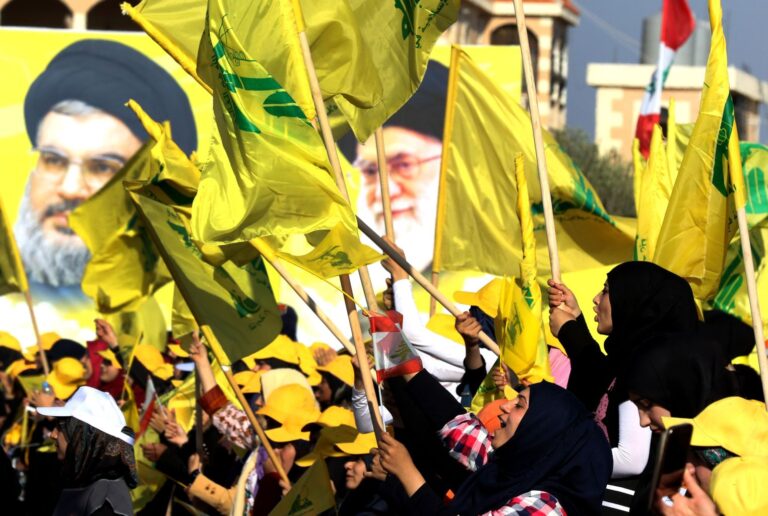
Australia designated all of Lebanon’s Hezbollah as a “terrorist organization”, extending its ban on the group’s military wing to the entire organization.

The Lebanese Hezbollah, involved in terrorist attacks, drug trafficking, weapon smuggling, and money laundering, was founded by Ayatollah Khomeini and funded, armed, and trained by Iran’s terrorist designated Islamic Revolutionary Guard Corps (IRGC).

The militia that acts as a proxy group for Iranian IRGC has been involved in countless terrorist attacks and illegal activities following the direct orders of Iran’s supreme leader Ali Khamenei and has been trying to overthrow the elected government of Lebanon.

Australian Home Affairs Minister Karen Andrews said the Iran-backed Shia group “continues to threaten terrorist attacks and provide support to terrorist organizations.” She added that Hezbollah poses a “real and credible” threat to Australia.

The US has long listed Hezbollah as a terrorist organization.

Meanwhile, Australia had only designated the military wing of the Lebanese Shia group as a terrorist organization since 2003.

IRGC-backed Hezbollah’s money laundering, smuggling, and destabilizing activities have also led to tougher sanctions, which is another cause of the current economic and political crisis in Lebanon, which has put the country back on the brink of civil war.

Hezbollah’s meaning and image have drastically changed in the eyes of Lebanese people, as it is now also considered the biggest obstacle to advancing the investigation into the tragic explosion in the port of Beirut on August 4, 2020.

Lebanese public outcry continues to escalate against Iran and the IRGC-backed Hezbollah’s intervention in Lebanon which has become a major factor in the country’s economic crisis.

Hezbollah chief Hassan Nasrallah is known to control a death squad that has assassinated prominent opponents, intimidating the Lebanese people and holding them hostage to Iran’s agenda.

The Lebanese Hezbollah, involved in terrorist attacks, assassinations, drug trafficking, weapon smuggling, and money laundering, was founded by Ayatollah Khomeini and is funded, armed, and trained by Iran’s terrorist designated Islamic Revolutionary Guard Corps (IRGC).

Record Numbers: Over 30 percent rise in Iranian Child Marriage

0

Child marriage has risen over 30 percent in Iran this year from the same period last year, with 9,750 girls aged 10-14 officially wed in a three-month period.

Figures published by Iran Statistical Center (ISC) relating to the first three months of the Iranian calendar year (March 21-June 20 2021), are the highest for child marriages recorded in a single quarter.

The Iranian Student News Agency (ISNA) in a detailed article Monday said that the numbers published by ISC reflected only registered marriages and not unregistered ones, which are common in rural areas.

Over 54,500 teenage girls above 14 also were officially married. Marriages of boys under 18 − considered ‘underage’ internationally − were far fewer, with only six cases registered for boys under 15 and 6,500 for males between 15-19.

For years the issue of underage marriage has been debated in Iran, with many clerics and religious politicians defending marriages of girls under 15. Proposed legislation to forbid marriage in for girls under 14 has been pursued unsuccessfully even in relatively more reform-minded parliaments.

Fathers are required in law to agree to the marriage of daughters younger than 13, while a religious court must also certify that the girl is ready physically and mentally, and that she agrees to the marriage. ISNA claimed that judges often seek only the father’s consent and disregard the other requirements.

One major reason for the rise in underage marriages is the current economic crisis where poor families struggling to take care of children see early marriage as a better option. There is a government cash grant of around $400 for marrying couples, which acts as an additional incentive.

There are also many reports from officials and in the media of parents receive money for agreeing to wed underage girls, often to far older men. The vice-president responsible for women’s affairs, Ansiyeh Khazali, who does not oppose all underage marriage, recently said that money played a big role.

The wide gender imbalance − with 9,750 under-14 girls marrying as against only six boys under 15 and 6,500 males aged 15-19 − in the SCI figures suggests many child brides went to men in at least their 20s.

Source: Iran International

Also Read: Iranian children are being punished based on their parents’ religion and beliefs

Iran executes man arrested for murder as minor after ‘grossly unfair trial’

Iran executed a man Wednesday who was arrested for murder at the age of 17, the judiciary said, despite appeals to spare his life by rights groups including Amnesty International.

Arman Abdolali was executed at dawn in Rajai Shahr prison near Tehran, in line with the “qesas” eye-for-an-eye style justice demanded by the victim’s family, said the judiciary’s Mizan Online website.

Amnesty International had appealed on October 11 for Iran to halt the execution of the 25-year-old who was arrested in 2014 and later convicted of murdering his girlfriend, Ghazaleh Shakour.

The London-based rights group said he had been sentenced to death twice but that the execution was stopped both times following international outcries.

It said Abdolali was first sentenced to death in December 2015 after “a grossly unfair trial” by a court that “relied on torture-tainted ‘confessions'” following Shakour’s disappearance the year before.

It said Abdolali was sentenced to death again in 2020 in a retrial, where the court ruled the teenager was responsible in the absence of evidence to the contrary, Amnesty reported.

“This young man was not a criminal,” Hadi Sadeghi, a judicial official, was quoted as saying by Iranian media in October.

“Like the victim, he came from a respectable family. In prison, Arman continued his studies to obtain a master’s degree in education,” he said.

“The two families knew each other and the victim and the accused intended to get married,” Sadeghi added.

International criticisms

The body of Shakour, who was 19 at the time of her disappearance, was never found.

According to Mizan Online, the victim’s mother had said she would forgive Abdolali if he revealed the location of her body.

UN human rights experts also appealed to Iran to halt the execution.

“International human rights law unequivocally forbids imposition of the death sentence on anyone under 18 years of age,” said the Geneva-based UN Office of the High Commissioner for Human Rights.

Source: France 24

Also Read: Iran official defends execution of minors