
Home Blog Page 168

Benjamin Netanyahu defeats Benny Gantz with striking 60-seat bloc

0

It is expected that after the third election in one year, this time the prime minister will succeed in forming a government.
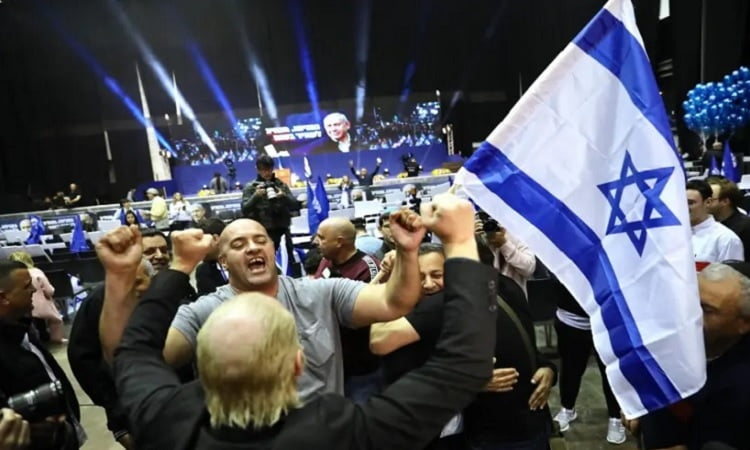
 

Prime Minister Benjamin Netanyahu succeeded in winning 60 seats for his bloc of right-wing and religious parties in Monday’s election, one less than he needed for a majority in the Knesset, according to exit polls on the three television networks.


The exit polls indicated that Netanyahu’s Likud won 36-37 seats. Its allies in Shas, UTJ and Yamina won 9, 7-8 and 6-7 respectively. The polls gave Blue and White 33 seats, its ally Labor-Gesher-Meretz 6-7, the Joint List 14-15 and Yisrael Beytenu 6-8.

The numbers are expected to change overnight. The votes of IDF soldiers, who tend to lean to the Right, have not yet been counted and the Joint List tends to go down a seat when the soldiers’ votes are added. But if the Right does not obtain its 61st seat, it could end up being because the far Right Otzma Yehudit party refused Netanyahu’s repeated requests to quit the race.


Netanyahu immediately tweeted “thank you.”


The outright victory in Israel’s third election in under a year is expected to enable Netanyahu to quickly form a right-wing coalition after having headed a caretaker government since December 2018.


Netanyahu spoke to the heads of the parties in his camp immediately after the exit polls were announced and agreed to form a strong nationalist government as soon as possible.


Sources in Likud said he would even try to get a government in place before his criminal trial begins on March 17.

Blue and White MKs expressed disappointment with the results but said they did not expect the party to break up. They dismissed speculation that Blue and White leader Benny Gantz would quit politics.


The high turnout in Israel’s unprecedented third election in under a year showed no signs of voter apathy, as Israelis cast ballots in an attempt to end the political stalemate.


Read more …

Iran Briefing | News Press Focus on Human Rights Violation by IRGC, Iran Human Rights


Has Iran’s presence in Iraq marginalized Sunnis?

0

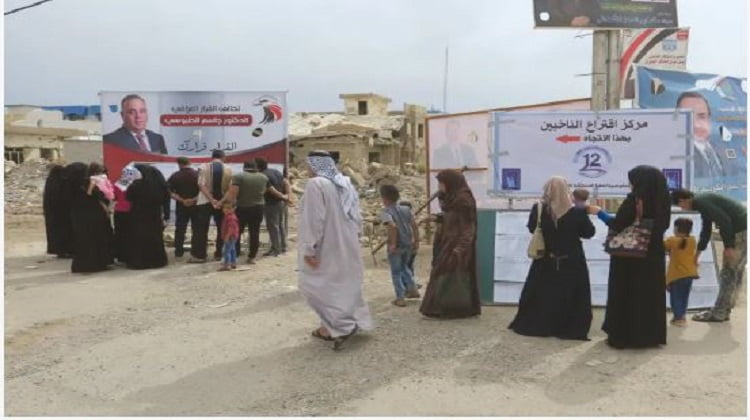
Has Iran’s presence in Iraq marginalized Sunnis?

Has Iran’s presence in Iraq marginalized Sunnis?

When the US overthrew Saddam Hussein in 2003, it saw Iraq as a new democratic pillar in the Middle East that possessed vast riches and economic potential. The war cost more than $1 trillion and resulted in the loss of 4,500 Americans and approximately 500,000 Iraqis.

The Impact of the FATF Blacklist on Iran

0

After months of ups and downs, on February 21, Iran expired its deadline to ratify anti-money laundering measures required to bring it in conformance with international anti-money laundering rules.


The Impact of the FATF Blacklist on Iran


Earlier, in October 2019, the Financial Action Task Force (FATF) extended the last deadline for this country to adopt Countering the Financing of Terrorism (CFT) and Palermo conventions.

However, Iranian officials eventually made their genuine decision to continue supporting terrorism by delaying the issue for months. This defiance, of course, proved how important it is for the ayatollahs to meddle in neighboring countries, fund their terrorist proxies, and fuel ethnic and religious conflicts in the Middle East. It is in fact so vital for their rule that they prefer to bear more economic pressures and isolation rather than quit their costly aggressive policies in the region.

During this period, international supporters of the Iranian government, who have much benefited from the opaqueness of Iran’s economy, honestly attempted to extend the deadline.

However, Russia, China, and the E3 finally realized that the ayatollahs had made a strategic decision to defy the FATF standards. Interestingly, Iran was re-designated in the FATF blacklist under the rotating presidency of its close ally China, which shows the disappointment of Iran’s allies over any further concessions in this context.

What Results from Iran’s Entering into the FATF Blacklist?

FATF as a technical intergovernmental body has been established to protect the international financial system. This non-profit organization requires countries to set their financial transactions based on akin measures hoping to achieve a transparent banking system.

FATF, in fact, pursues to incite the countries for combating financing terrorism and money laundering as the main pillars for protecting the global financial system from risks. In other words, objecting to FATF standards is synonymous with the country’s support for terrorism.

On the other hand, Iran’s willful failure to uphold Anti-Money Laundering (AML) and terror finance standards, doing business with any Iranian bank, the insurance company, or other financial institutions, whether sanctioned or not, comes with heavy risks and high costs.


Read more … 

Iran Briefing | News Press Focus on Human Rights Violation by IRGC, Iran Human Rights


Iran: No Justice for Bloody Crackdown

Iranian authorities have failed to hold security forces accountable for excessive and unlawful use of lethal force in confronting large-scale protests that began on November 15, 2019, Human Rights Watch said today.Iran


Iran: No Justice for Bloody Crackdown


Members of the United Nations Human Rights Council should take urgent action to address the brutal crackdown.

Over three months later, the government has failed to announce the total number of deaths and arrests during the protests, which spread to many parts of the country over a week. Interviews with victims and witnesses, a review of photos and videos from the protests, and satellite imagery analysis strongly suggest that security forces used unlawful lethal force on at least three occasions. The total number of such cases is most likely higher.

“Iranian authorities have systematically repressed dissent for decades, and they are now confronting popular protests with an astonishing level of violence,” said Michael Page, deputy Middle East director at Human Rights Watch. “Principled international voices should send an unequivocal message that Iran cannot get away with killing protesters.”  

The protests began over an abrupt fuel price increase, but they transformed into broader popular discontent with the government’s repression and perceived corruption. The government imposed a near-total internet shutdown from November 15 to 19.

Due to the internet shutdown and authorities’ threats against families of victims, documenting the full extent of the crackdown, including the total number of people killed, has been difficult. Amnesty International has estimated that at least 304 people were killed. The Human Rights Activists News Agency (HRANA) has verified the identities of more 100 people killed. Media reports indicate that the death toll may be much higher. A member of parliament put the number at 170, while official media outlets have reported the deaths at least 5 members of the security forces during the protests. One parliament member said about 7,000 people were arrested.

Four informed sources told Human Rights Watch that the authorities have banned families from conducting interviews with media and threatened them with retaliation if they do. On December 23, the authorities arrested several members of the Bakhtiari family after they called for a public mourning to commemorate the 40th day of their son’s death. On January 22, the authorities released Bakhtiari’s father, pending trial.


Read more …

Iran Briefing | News Press Focus on Human Rights Violation by IRGC, Iran Human Rights


Iran Can’t Hide Its Coronavirus Explosion, But It’s Trying Hard—and Putting the World in Danger

0

Tehran’s efforts to conceal the spread of coronavirus include intimidation of whistleblowing doctors. China tried this when the epidemic began. We know how that worked out.


Iran’s deputy health minister was drenched in sweat at the press conference on Monday where he vehemently denied Tehran was covering up the extent of the coronavirus outbreak. He kept wiping his brow with his handkerchief and was in visible distress as he said quarantines were a “Stone Age” way to address the problem, and Iran doesn’t need them. Then, sure enough, that night he tested positive for the virus himself and put himself in quarantine. 

The irony of Deputy Health Minister Iraj Harirchi’s case would be funny almost, were Iran’s conspicuous bungling of the coronavirus threat not a menace to the whole region and, indeed, to the world.

As The Daily Beast’s partner publication, IranWire, revealed in an exclusive report Thursday, Iran’s Islamic Revolutionary Guard Corps has tried to address the epidemic by telling doctors to shut up about it, much as Chinese authorities in Wuhan did, disastrously, when the disease was just starting to spread last December.

The “official figures” from Iran give the game away. At last count, 16 people have died from COVID-19, but only 95 cases had been confirmed. As Wired UK points out, that would be a death rate of about 17 percent, when the data available from China, where there are huge numbers to work with, suggests the death rate is closer to 2 percent. The statistics don’t add up. Canadian researchers cited by Wired suggest the Iran outbreak probably involves more than 18,000 people, and counting.

The “official figures” from Iran give the game away. At last count, 16 people have died from COVID-19, but only 95 cases had been confirmed. As Wired UK points out, that would be a death rate of about 17 percent, when the data available from China, where there are huge numbers to work with, suggests the death rate is closer to 2 percent. The statistics don’t add up. Canadian researchers cited by Wired suggest the Iran outbreak probably involves more than 18,000 people, and counting.

Source 

Iran Briefing | News Press Focus on Human Rights Violation by IRGC, Iran Human Rights


Iran expert: Regime brutality will not dissuade protests

0

Iran’s failure to prevent violence against its own people by security forces, or to hold senior officials to account, will not dissuade protesters, said the president of the International American Council following the release of a new report by Human Rights Watch (HRW).Iran expert


Iran expert: Regime brutality will not dissuade protests


“Straightforward repression and the use of brute force is something that Iranian people have been enduring for a long time, and they can be expected to continue pushing back against it with extraordinary resilience,” Dr. Majid Rafizadeh, who is also a political scientist at Harvard University, told Arab News.

“This was made clear during the previous nationwide uprising, when dozens of peaceful protesters were killed, either by Islamic Revolutionary Guard Corps (IRGC) gunfire or by torturous interrogations following their arrest. Yet the uprising continued for some time,” he said.

“The US and Europe have the capabilities to provide large segments of the Iranian population with tools that would help them to go on organizing against the regime and countering the IRGC’s efforts to suppress the population.”

HRW said Iran had failed to hold its security forces accountable for violence, including unlawful lethal force against civilians, during mass demonstrations that broke out in November 2019.

Tehran, it said, had also yet to reveal the number of people killed, injured or arrested during the protests. HRW urged the UN Human Rights Council to take action against the regime.

Amnesty International said at least 304 people had been killed by security forces. HRW reported Iranian politician Hossein Naghavi Hosseini as saying as many as 7,000 people had been detained.


Families of victims, it added, had been warned and in some cases threatened by the authorities not to talk to the media or to try to hold public protests or commemorations on behalf of their relatives.


Read more … 

Iran Briefing | News Press Focus on Human Rights Violation by IRGC, Iran Human Rights


Who Is Abdulaziz Al-Mohammadavi, the New Head of Iran-Backed Militias in Iran?

0

At dawn on January 3, Abu-Mahdi al-Muhandis, fugitive deputy commander of Iran-backed militias in Iraq, was killed along with the commander of the Iranian regime’s Revolutionary Guards Quds Force (IRGC-QF) Qassem Soleimani in a precise U.S. drone attack.


Who Is Abdulaziz Al-Mohammadavi, the New Head of Iran-Backed Militias in Iran?


After 50 days, the Iranian regime’s mercenaries agreed on Abdulaziz Al-Mohammadavi as the successor to al-Muhandis. In this respect, who is al-Mohammadavi, known by Abu-Fadak nickname among Iraqi forces loyal to Ali Khamenei, the supreme leader of the Iranian regime?

The Popular Mobilization Forces [Hashd al-Shaabi] is a part of Khamenei’s armed forces in Iraq which was founded in 2014. “The chief of Iraqi Basij assembly Aqil al-Hussaini described Hashd al-Shaabi as the trail of Iran’s Basij, which has benefited from experiences of the Iranian version’s one. ‘In the Iraqi Basij structure, we modeled on the Iranian Basij,’ [then-Iran-backed] Iraqi prime minister Nouri al-Maliki told ABNA news agency in August 2015,’” the Iranian state-run website Tabnak wrote on the same date.

This force has consisted of about 40 different groups, which are generally Shiite armed militias. Many of these groups already operated terrorist attacks against the Coalition Forces on the behalf of the IRGC-QF in Iraq. These militants have a notorious track record of mass killing against religious minorities with total impunity.

In September 2015, the ayatollahs’ Iraqi murderers were eventually recognized as a part of Iraqi government forces, according to the Iran-backed prime minister Heidar al-Ebadi.

  • Militias allied to the Iraqi government have access to arms from at least 17 countries
  • Recent arms transfers have fuelled enforced disappearances, abductions, torture, summary killings, and deliberate destruction of civilian property
  • Iraq is the world’s sixth-largest importer of heavy weaponry
    Amnesty International highlighted in its report on January 5, 2017.

Who is Abu-Fadak?

Abdulaziz al-Mohammadavi is also known by Al-Khal, which means uncle in Arabic. He had a long-time friendship with the slain former chief of the IRGC-QF Qassem Soleimani.


Read more …

Iran Briefing | News Press Focus on Human Rights Violation by IRGC, Iran Human Rights


Coronavirus: New “Human Error” by the Iranian Government

0

Since long ago, most countries around the world suspended all flights to China to prevent the spread of the coronavirus. However, the Revolutionary Guards (IRGC) continued flights to China by using its Mahan Air airlines.


Coronavirus: New “Human Error” by the Iranian Government


In this context, not only did Mahan Airlines not cancel its scheduled flights, but it also launched a pipeline for transferring Chinese cargoes and passengers, seriously endangering the health of Iranian citizens.

IRGC Lies and the Coronavirus Transmission to Iran

“All flights between the two countries have been suspended since the day Iran ordered to stop flights to China,” Reza Jafarzhadeh, a director of Iran’s Civil Aviation Organization, told ROKNA news agency on February 20.

However, as routine flights continued from Iran to China, this official insisted on this false claim, saying, “The flights to China are transferring cargo and not passengers, and are under the supervision of the Ministry of Health and Medical Education.” This false claim, reiterated by other officials, is tantamount to the government’s planned secrecy following the downing of the Ukrainian airliner by the IRGC anti-aircraft system.

The Scandal of Mahan Air’s Flights to China

Iranian authorities firmly pursued to conceal flights of Mahan Air to China; however, their miscalculation resulted in another scandal for their government. Nonetheless, they had already recorded significant instances in secrecy and non-transparency.

However, Iranian officials seem to have not to realize that in the communication age, it is impossible to hide obvious facts, such as the origin and destination, of a plane from the public. In this context, the government’s non-transparency is more costly than its inability to control and curb more outbreaks of the deadly virus.

Notably, the World Health Organization (WHO) has committed to timely reviewing the situation with transparency and update evidence as an essential path to address the Coronavirus disease 2019 (COVID-19). However, in flagrant contrast to WHO’s recommendation and obligation, the Iranian government deliberately concealed the scope of the virus’s expansion in fear of keeping “voters” from the polls during the February 21 parliamentary elections.


Read more …

Iran Briefing | News Press Focus on Human Rights Violation by IRGC, Iran Human Rights


Stop Repressing Your Own, HRW Tell The Mullah’s of Iran

Iran’s failure to forestall violence towards its personal folks by safety forces, or to carry senior officers to account, is not going to dissuade protesters, mentioned the president of the Worldwide American Council following the discharge of a brand new report by Human Rights Watch (HRW).Stop Repressing


Stop Repressing Your Own, HRW Tell The Mullah’s of Iran


“Simple repression and the use of brute pressure is one thing that Iranian folks have been enduring for a very long time, and they are often anticipated to proceed pushing again towards it with extraordinary resilience,” Dr. Majid Rafizadeh, who can also be a political scientist at Harvard College, informed Arab Information.


“This was made clear in the course of the earlier nationwide rebellion, when dozens of peaceable protesters had been killed, both by Islamic Revolutionary Guard Corps (IRGC) gunfire or by torturous interrogations following their arrest. But the rebellion continued for a while,” he mentioned.

“The US and Europe have the capabilities to supply giant segments of the Iranian inhabitants with instruments that may assist them to go on organizing towards the regime and countering the IRGC’s efforts to suppress the inhabitants.”

HRW mentioned Iran had failed to carry its safety forces accountable for violence, together with illegal deadly pressure towards civilians, throughout mass demonstrations that broke out in November 2019.

Tehran, it mentioned, had additionally but to disclose the quantity of folks killed, injured or arrested in the course of the protests. HRW urged the UN Human Rights Council to take motion towards the regime.


Amnesty Worldwide mentioned no less than 304 folks had been killed by safety forces. HRW reported Iranian politician Hossein Naghavi Hosseini as saying as many as 7,000 folks had been detained.

Households of victims, it added, had been warned and in some instances threatened by the authorities to not speak to the media or to attempt to maintain public protests or commemorations on behalf of their kinfolk.


HRW mentioned there had additionally been studies of mass abuse of prisoners in detention, and no less than three demonstrators in custody had been sentenced to loss of life.


Read more …

Iran Briefing | News Press Focus on Human Rights Violation by IRGC, Iran Human Rights


After Soleimani Killing, Iran and Its Proxies Recalibrate in Iraq

0

Iran’s network of influence in Iraq has taken a battering over the past two months. The loss of the Iranian Islamic Revolutionary Guard Corp’s Quds Force commander, Qassem Soleimani, was a significant blow. Soleimani Killing


After Soleimani Killing, Iran and Its Proxies Recalibrate in Iraq


Soleimani was an Arabic speaker with decades of experience operating in Iraq. But his killing came at a time when Iran’s go-to proxy in Iraq, Kata’ib Hezbollah also has been under unprecedented pressure. Its commander, Abu Mahdi al-Muhandis, was killed with Soleimani in January and was viewed by Iran as its military governor in Iraq. His loss and Kata’ib Hezbollah’s partial suppression mean that Iran and its proxies need to recalibrate their strategy in Iraq, and there are indications that alternative militias may be stepping into the breach.

Kata’ib Hezbollah operates under the umbrella of the Hashd al-Sha’abi (Popular Mobilization Forces or PMF), a coalition of armed groups that formed or expanded in response to calls by Shi’ite religious and political leaders in 2014 to prevent ISIS from capturing Baghdad. Iranian “special groups” — militias formed with Iranian support to resist Saddam Hussein and/or the United States — were the principle beneficiaries of this call to arms. Though hugely successful in pushing back ISIS, these groups initially were illegal under the Iraqi Constitution. This changed with legislation passed in 2016 that incorporated the militias into the armed forces.

Creeping State Capture

Since that time, Iranian-backed elements of the Hashd al-Sha’abi have become increasingly enmeshed in the Iraqi government through prime ministerial executive orders designed to bring the Hashd into Iraq’s security sector, and by illegally participating in and influencing elections (the Constitution also bars armed forces from playing politics). Members of Parliament directly linked (and often still belonging) to the militias now constitute a sizeable bloc that was able to influence the choice of prime ministers in 2018 and has gained control of government ministries and authorities. At the same time, PMF-backed MPs have worked to increase funds going to the Hashd al-Sha’abi, effectively creating a parallel armed force with significant political power.


Read more …

Iran Briefing | News Press Focus on Human Rights Violation by IRGC, Iran Human Rights