Home Blog Page 689

Basij Presence on the Internet Triples, Is Crackdown Accelerating?

0

Jaras: Head of Basij Organization says the presence of Basij on the cyber space will triple by the end of the year. In an interview with the IRGC-related Fars News Agency reporter while on a visit to Kordestan Province, Commander Mohammad Reza Naghdi added: a vast network of Basiji Forces will be trained to create, develop and improve its websites by the end of the year and this will triple the country’s power in this regard.

Since the last year’s controversial presidential elections, military and security bodies have increased their supervision over the internet and enacted heavy penalties for “cyber offenders”. The term, however, is different in concept from what is used in other countries. Iranian authorities use this term to describe any one who, for example, has written a single critic piece on his/her weblog even if it’s no even read by less than a dozen viewers.

More Than 5 Million Websites and Weblogs to Be Filtered

According to 2006 figures, more than 18 million Iranians have access to the internet although majority of them have a slow dial-up connection. Nevertheless, Iran is the world’s number four in regard to the number of bloggers. With the filtering of more than five million sites and blogs in Iran, as Abdossamad Khoram Abadi judiciary advisor to the country’s Prosecutor General has announced, Reporters without Borders named Iran as the top freedom-of-speech suppressing country in the cyber space in the Middle East. In other words, the intensity of censorship and internet crackdown is so high in Iran that other suppressing countries like Saudi Arabia, Egypt and Syria rank after Iran. This figures, however, demonstrates the high degree of Iranians’ dissatisfaction with and criticism of the function of the government.

In his speech last year, the advisor to the Prosecutor General acknowledged the social damages of the internet to be more than those of satellite and said: “By misusing the internet, our enemies try to attack our religious identity”. He believes that the internet socially, politically, economically and morally the country and this is a matter of concern.

Basij Quantitative and Qualitative Improvement

In spite of the intense encounters by the security, judiciary and military officials with the media critics active on the internet, it seems that the filtering, imprisoning the internet activists, heavy penalties and the show trials such as the fourth trials of those arrested after the elections could not reduce the fear of the pro-Ahmadinejad militia and that’s why Commander Naghdi announced the plan to triple the Basij presence in the cyber space to establish a new front against their endless enemies.

Commander Naghdi, once known for misbehaving and torturing the Tehran mayors during their arrests in the early years of the reform government, pointed to the measures taken by him and his colleagues and said: valuable plans are being considered to transform the Basij Organization, which require double endeavor and work to come true. One of these plans is the Basij quantitative and qualitative improvement.

He also emphasized: With the effective efforts taken at Basij Bases, it’s our priority to attract the youth and teenagers. Achieving this, the security of Iranian families against foreign plots and deviations will be provided which is, in turn, a significant achievement.

Crackdown Machine

Criticisms to the function of Basij as well as its militarization have been a matter of concern among the reformists for years. Since the last year, however, the violent and cruel conduct of the plain-clothes and Basij groups towards the protesters to the result of the presidential elections took such criticism into a new level.

Last year, at the anniversary of the formation of Basij Organization at Azar 5th, Mir Hossein Musavi issued a statement harshly criticizing its current function while recalling the intended role and status for the Basij back then. In this statement, Musavi said that the Basij power used to be a result of its pure intent and bravery that even led to the attraction of some religion minority toward the organization. Observing such values, Basij became one of the significant historical achievements of the nation. He also confirmed: “The new generation of Basij existed deep into the darkest dubieties and conspiracies. Is the new generation like those who fought along with Amir-al-Momenin in Jamal battle? Such comparisons are vain and those who make these comparisons want to use Basij as a crackdown machine to beat and hurt and even kill those whose only offence is to call for justice”.

In his statement, Musavi asked: “what is the Basij identity?” and continued: Is it an intentless system that closes its eyes when ordered and breaks the hands and feet of its brothers and sisters or is it a body equipped with deepest insights and can distinguish between the right and the wrong in the darkest nights of conspiracy?”.

Concluding that: “Basij, as it was considered by Ayatollah Khomeini, would never confront the nation”, musavi said: “Imam wouldn’t want Basij to be a tool to the authorities”.

Mehdi Karrubi, known for years as a harsh critic of the function of Basij and the IRGC, said in a statement in Khordad 14th: “The armed forces possess guns and the Basij and the IRGC have the control over the fate of the elections’. In another statement he also said: “Republicanism has been seriously weakened or even damaged in the name of Islamism”.

Iranian Rights Group Says Secret Executions Increasing

0

http://freedomessenger.com/?p=13548

October 28, 2010
The International Campaign for Human Rights in Iran (ICHRI) says the number of unannounced executions at the Vakilabad prison in the eastern Iranian city of Mashhad has increased, RFE/RL’s Radio Farda reports.

The U.S.-based organization said in a statement on October 26 there are more than 600 inmates on death row at Mashhad.

ICHRI Executive Director Hadi Ghaemi told Radio Farda on October 26 that a large number of executions have been carried out secretly in Mashhad in recent months. He added that the executions are carried out summarily and without notifying the prisoners’ families or lawyers.

Ghaemi said that according to Iranian law, after a death sentence is confirmed by the Supreme Court the convicted person’s lawyers and family must be informed.

He added that when a court ruling is sent to the Office for the Enforcement of Sentences, the prisoner’s family should be informed of the time of the execution in order to visit the prisoner and even attend the execution.

But Ghaemi claimed such procedures are often not followed by prison officials at Mashhad’s Vakilabad prison.

“The officials only contact the family the day after the execution to tell them to come to the jail in order to pay the cost of the rope [with which the prisoner was hanged] and to receive the body,” he said.

Ghaemi added that the ICHRI has received credible reports about the secret executions from within the prison.

“One of the people who talked about the executions was Ahmad Ghabel, who was rearrested after publishing those reports,” Ghaemi said.

A religious scholar, Ghabel was first arrested in December on his way to the funeral of senior dissident cleric Ayatollah Hossein Ali Montazeri. He spent
six months in jail in Vakilabad before being released on bail, then was rearrested last month in Mashhad.

Ghabel’s wife told Radio Farda then that her husband had said one of the reasons for his detention was his statements about the executions at the prison.

Source: http://www.rferl.org/content/Iranian_Rights_Group_Says_Secret_Executions_Increasing/2204295.html

Iranian regime’s widespread suppression of political prisoners

0

http://freedomessenger.com/?p=13502

Political prisoners who have written or signed statements in Evin or other prisoners have been summoned by the court

and have been asked to deny that they have signed these statements and if they refuse, they will be thrown in solitary or receive other punishments.

According to reports, these political prisoners have also been threatened that if they not deny their signatures on these statements, their visits will also be cut off and new charges will be made against them.

Being denied a condition release and leaves from prison is another thing that these prisoners have been threatened with. Fourteen political prisoners in Evin Prison’s cellblock 350 issued a statement some time ago in reaction to Ahmadinejad’s statement in the UN General Assembly that a truth finding independent group had to look into the September 11 attacks to identify the real culprits of this crime. These 14 political prisoners asked that an international truth finding committee do the same thing in Iran and discover the real facts in the Iranian presidential elections and post-election events.

Those who signed this statement were Bahman Ahmadi Amouyi, Seyed Milad Asadi, Mohsen Amin Zadeh, Ali Parviz, Ali Tajenia, Mohammad Davari, Majid Dori, Amir Khosro Dalir Sani, Mohammad Farid Taheri Qazvini, Keivan Samimi, Kouhyar Goudarzi, Ali Malihi, Abdollah Momeni, and Mohsen Mirdamadi.

Political prisoners Abdollah Momeni, Keivan Samimi, Bahman Ahmadi Amouyi, Mohammad Davari and Kouhyar Goudarzi have been under the most pressure so far to deny that they signed this statement.

A number of these prisoners were summoned to court and pressured last week but none have given in to this demand.

They had stressed in their statement that ‘as some of the innocent detained victims of post-election events, we have been charged, arrested and sentenced to unjust prison terms in the same way that Mr. Ahmadinejad cited (in his speech) and we propose that a national independent truth finding group, made up of people who are credible and trusted in the society be established to discover the truth about the elections and post-election events.

According to reports, Gohardasht (Rajayi Shahr) political prisoners have also received the same kind of threats over publishing political statements.

The Revolutionary Guards’ Looting of Iran’s Economy

http://www.aei.org/outlook/100969

The Revolutionary Guards’ Looting of Iran’s Economy
By Ali AlfonehAEI Online
(June 2010)
No. 3, June 2010

On June 9, 2010, the United Nations (UN) Security Council imposed the fourth round of sanctions on the Islamic Republic of Iran in response to the Iranian leadership’s refusal to comply with its international obligations regarding its nuclear program. The sanctions include the Islamic Revolutionary Guards Corps (IRGC) and its engineering arm, which serves as the engine of Iran’s nuclear program. Sanctions against the IRGC, however, are likely to prove insufficient because they do not target the IRGC’s banking sector. An effective sanctions regime against the IRGC must necessarily also target the IRGC’s financial arm.

Key points in this Outlook:

  • Since President Mahmoud Ahmadinejad’s election, the Islamic Revolutionary Guards Corps (IRGC) has used funds accumulated since the 1980s to purchase state enterprises and businesses privatized through the Tehran Stock Exchange.
  • The IRGC and its front companies have been involved in various scandals that show the militarization rather than the privatization of Iran’s economy.
  • By targeting the economic interests of the IRGC, the international community may be able to force the Guards to recalculate the risk of continuing the Islamic Republic’s nuclear program.

On June 9, 2010, in response to Iran’s refusal to comply with its international obligations regarding its nuclear program, the UN Security Council adopted Resolution 1929, imposing the fourth round of sanctions on Iran, including new measures to limit the role of the IRGC and fifteen IRGC-related companies linked to proliferation.[1] The Security Council’s initiative follows the same line as the U.S. Treasury Department’s February 10, 2010, designation of the Khatam al-Anbia construction base (Gharargah-e Sazandegi-ye Khatam al-Anbia, or GHORB), the engineering arm of the IRGC, and its commander, General Rostam Qasemi, as “proliferators of weapons of mass destruction.”[2] Treasury based its designation upon the U.S. government’s determination that the IRGC is “assuming greater responsibility” for the Islamic Republic’s nuclear program.[3]

Tehran’s answer to the Treasury Department’s initiative was swift. On February 18, 2010, the state-controlled daily Kayhan, whose editor the supreme leader appoints and who acts as his unofficial mouthpiece, editorialized, “The United States does not even know what the Guard is, let alone how to sanction it,” and continued that sanctions would “increase the Guard’s popularity.”[4] With Kayhan preparing the public mind, Ahmadinejad addressed GHORB commanders and executives February 21 and asked them to ready themselves to “enter high-end oil and gas activities in order to satisfy the domestic needs of the country.”[5] Sure enough, on March 15 the Oil Ministry gave GHORB a contract for an $850 million pipeline project.[6] The next month, after Turkish companies said they were withdrawing from the development of the third phase of the South Pars oil and gas field, GHORB was granted–again on a no-bid basis–the $7 billion project.[7] On May 13, Qasemi told parliamentary speaker Ali Larijani that the IRGC was replacing Shell and Total in South Pars.[8] Larijani praised GHORB as “a model of development” and assured Qasemi of parliamentary support.[9] As the Anglo-Dutch Shell and Spanish Repsol withdrew from development of the thirteenth and fourteenth phases of the South Pars oil and gas field on June 4, the Petroleum Ministry granted the $5 billion -project on a no-bid basis to a certain Khatam al-Owsia Consortium (Konsersiom-e Khatam al-Owsia).[10] Khatam al-Owsia Consortium consists of GHORB and two other IRGC-owned companies: Iran Shipyard and Offshore Industries Company (Mojtama’e Kashtisazi Va Sanaye’ Farasahel-e Iran) and Iran Marine Industrial Company (Sherkat-e San’ati-ye Daryayi-ye Iran), along with Oil Industries Engineering and Construction (Sherkat-e Sakhteman-e Sanaye’ Naft) and Iranian Offshore Engineering and Construction Company (Sherkat-e Mohandesi Va Sakht-e Ta’sisat-e Daryayi).[11]

Washington has turned a blind eye to the Guards’ parallel banking sector through which the IRGC manages its financial activities.

Ahmadinejad’s defiance and Larijani’s attempt to ingratiate himself with the IRGC signal the Guards to stay the nuclear course since the Iranian government–as the above examples demonstrate–is ready to compensate the Guards for any sanctions-related losses. The Iranian leadership can also be expected to demonstrate a similar pattern of behavior in the wake of the June 9 UN Security Council resolution. In his first reaction to the fourth round of sanctions against the Islamic Republic, Ahmadinejad said, “These resolutions are not worth a nickel to the Iranian nation. I sent the message to one of them that the resolutions you issue are like a used tissue which must be dumped in a trash can.”[12] Also Brigadier General Hossein Salami, an IRGC deputy, said the Guards were not concerned about the sanctions.[13] There may be a reason for Ahmadinejad and the IRGC commanders’ self confidence: Washington has turned a blind eye to the Guards’ parallel banking sector through which the IRGC manages its financial activities.

The IRGC’s financial activities began during the Iran-Iraq War (1980-88) as its microbanks provided interest-free loans to war veterans and their families. During the postwar reconstruction, IRGC-owned microbanks laundered money from the IRGC’s illicit smuggling enterprise and, in the process, accumulated vast sums. However, these financial activities were very limited compared with the parastatal foundations (bonyads) such as the Islamic Revolution’s Foundation of the Oppressed (Bonyad-e Mostazafan-e Enghelab-e Eslami),[14] Foundation of the Martyrs and Veterans Affairs (Bonyad-e Shahid Va Omour-e Isargaran),[15] and Astan-e Ghods-e Razavi Foundation.[16] The foundations were established by confiscating real estate, funds, and production units of exiled Iranians connected with the Pahlavi regime, which enabled the foundations to dominate the Iranian economy during the first two decades of the Islamic Republic.[17] Since Ahmadinejad’s election, the Guards have used funds accumulated since the 1980s to purchase state enterprises and businesses privatized through the Tehran Stock Exchange. As long as the Guards’ financial institutions remain outside the sanctions regime, the IRGC can expand its control over Iran.

Three-Card Monte

According to Article 44 of the Islamic Republic’s constitution, Iran should have a planned economy in which “the state sector is to include all large-scale and mother industries, foreign trade, major minerals, banking, insurance, power generation, dams and large-scale irrigation networks, radio and television, post, telegraph and telephone services, aviation, shipping, roads, railroads and the like; all these will be publicly owned and administered by the state.”[18] Beyond the state sector, Article 44 also defines a so-called cooperative sector, which includes “cooperative companies and enterprises concerned with production and distribution, in urban and rural areas,” as well as a private sector, which consists of “those activities concerned with agriculture, animal husbandry, industry, trade, and services that supplement the economic activities of the state and cooperative sectors.”[19]

Just over a month before Ahmadinejad’s 2005 election victory, Khamenei issued a decree reinterpreting Article 44 to abrogate the constitution by calling for a smaller government and a 20 percent annual reduction in public-sector economic intervention over five years. Khamenei’s directive called for the privatization of large-scale industries to include large-scale oil and low-end gas industries, mines, foreign trade, many banks, shareholder-owned cooperatives, power generation, many postal services, roads, railroads, aviation, and shipping. Khamenei’s directive obliged the government to transfer ownership of 25 percent of Iran’s economy to the cooperative sector by the end of the five-year plan and to support expansion of cooperatives with tax rebates and loan guarantees with the aim of encouraging cooperatives to participate in all spheres of the economy, including banking and insurance.[20]

Khamenei’s directive, codified into law on January 28, 2008,[21] effectively meant the privatization of $110-$120 billion worth of public assets.[22] Iranian economists worried, however, that the domestic private sector would be barred from the privatization process due to a lack of transparency, and they also expressed concern about Iranian legislation that makes foreign direct investment difficult. In effect, any privatization would constitute the transfer of state-owned enterprises to other parts of the state sector.[23] Coupled with a lack of antitrust legislation in Iran, the economists warned that the privatization proposal would actually strengthen state monopolies.[24]

Ahmadinejad, however, embraced Khamenei’s privatization schemes. In an April 2010 interview, Ahmadinejad said, “The total sum of [privatizations prior to 2005] was 30 trillion rials [$3 billion], but since then, there has been more than 600 trillion rials [$60 billion] worth of transfers, most of which has been through the [Tehran] Stock Exchange.”[25] Ahmadinejad also boasted of Iran’s speed of privatization compared with other state-run economies, which, Ahmadinejad said, had taken twenty years to achieve what Iran had achieved in five.[26]

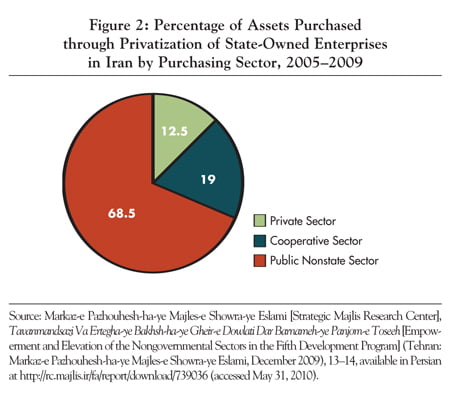
While the Iran Privatization Organization generally supports Ahmadinejad’s claims, reporting 233 trillion rials ($23 billion) worth of privatization conducted through the Tehran Stock Exchange in 2006 alone (see figure 1), the Iranian economists’ concerns were valid. Larijani criticized the privatization efforts of the Ahmadinejad government for not involving “the genuine private sector.”[27] Similarly, a Strategic Majlis Research Center report found that between 2005 and 2009, only 19 percent of formerly state-owned enterprises’ assets were purchased by the private sector, 12.5 percent of the assets were privatized to the so-called public, nonstate sector, and 68.5 percent of the assets were purchased by the cooperative sector (see figure 2).

Figure-1-web

Figure-2-web


The Strategic Majlis Research Center identified a number of factors detrimental to private-sector participation in privatization. The state sector’s privileges, monopolies, and unlimited access to investment capital frustrate private-sector involvement, and the government’s declared policy of withdrawing $10 billion annually from the foreign-exchange reserve to provide credit for the private sector remains more rhetorical than real. Furthermore, the lack of transparency and the presence of state-enterprise employees with privileged access to information at the Tehran Stock Exchange impede private-sector involvement in the process.[28]

Militarization Rather than Privatization

Larijani and the Strategic Majlis Research Center fail to mention the most serious problem: the so-called privatization scheme that enables the Iranian leadership to transfer ownership from relatively transparent parts of the public sector to parts of the public sector shielded from public scrutiny. Purchases of the IRGC and its subordinate volunteer militia, the Basij, are conducted by their credit and finance institutions, such as the IRGC and Basij Cooperative Foundation and their subsidiaries (see appendices 1 and 4). The latter has its own subsidiaries, including the IRGC’s Cooperative Foundation (Bonyad-e Ta’avon-e Sepah) and the Ansar Financial and Credit Institute (Moassesseh-ye Mali/Eghtesadi-ye Ansar). These institutions describe themselves as noninterest or Islamic banking institutes, but, according to Hamid Tehranfar, the Central Bank’s supervision deputy for banks and credit institutes, “they engage in everything but giving interest-free loans.”[29] They function as financial arms of the IRGC and the Basij on the Tehran Stock Exchange and elsewhere, purchasing shares of Iranian companies.

The Mehr Finance and Credit Institution (formerly called the No-Interest Loan Institute of the Basij Members [Moassesseh-ye Gharz al-Hassaneh-ye Basijian]), currently headed by Gholam-Hossein Taghi Nattaj, was established in 1991 and has five main subsidiaries. The No-Interest Loan Institute of the Basij Members performs most of the Basij’s financial activities to provide housing and issue job-creating loans to Basij members.[30] Mehr Finance and Credit boasts more than seven hundred branches across Iran,[31] making it the largest “private” bank in the Islamic Republic.[32] Its own documents suggest that its goals include “loyalty toward the goals of the sacred regime of the Islamic Republic of Iran,” “propagation of the culture of no-interest loan banking,” and “propagation and loyalty toward the culture and thought of the Basij.” Nowhere is there any mention of profit.[33]

The Iranian press has criticized Mehr Finance and Credit for withholding loans from the poor and needy–those without “credible guarantors”[34]–while engaging in major trades on the Tehran Stock Exchange through its subsidiaries, especially Mehr-e Eghtesad-e Iranian Investment Company (see appendix 2 for a full list of Mehr Finance and Credit subsidiaries). Mehr-e Eghtesad-e Iranian Investment Company is one of the largest purchasing entities of the IRGC and owns stakes in a number of major Iranian companies (see appendix 3).

Mehr-e Eghtesad-e Iranian Investment Company has also been involved in various scandals, including the August 2, 2009, purchase of the Angouran zinc mine in Zanjan Province. Iran Zinc Mines Development Company, a subsidiary of Mehr-e Eghtesad-e Iranian Investment Company, purchased the mine for 1.86 trillion rials ($186 million). Following the trade, experts said the real value was closer to 10.55 trillion rials ($1 billion).[35] The acquisition started a wave of criticism against the IRGC. Hojjat al-Eslam Mohammad-Taghi Vaezi, Zanjan Friday prayer leader and representative of the supreme leader to the province, raged from the pulpit: “It would have been better if the government had given the mine away for free!”[36] Parliamentarian Jamshid Ansari, and even Reza Abdollahi, Parliament’s Plan and Budget Committee chairman, attacked Industry and Mines minister Ali-Akbar Mehrabian and demanded an investigation into the privatization of the Angouran Zinc Mine.[37]

Coupled with a lack of antitrust legislation in Iran, the economists warned that the privatization proposal would actually strengthen state monopolies.

The investigation, which was conducted by the Supreme Audit Court, disclosed that the three companies competing for ownership–Zinc Production Company (Sherkat-e Tahiyeh Va Tolid-e Rouy), Pasargad Company (Sherkat-e Pasargad), and Iran Zinc Mines Development Company–all belonged to “the same family.”[38] E’temad reported that “Iran Zinc Mines Development Company owns 100 percent of the shares of Zinc Production Company and 70 percent of the shares of Pasargad Company, while the rest is owned by Mehr-e Eghtesad-e Iranian Investment Company.”[39] The Supreme Audit Court’s investigation also disclosed that the application forms of each company for ownership of the Angouran zinc mine were signed with the same handwriting.[40] The court promptly declared the trade void.

The Mehr Finance and Credit Institution and its subsidiaries are not the only companies to engage in such shenanigans. The IRGC Cooperative Foundation, established August 23, 1986, has developed into one of Iran’s major financial players.[41] (For a list of companies and investment institutes entirely or partially owned by the IRGC Cooperative Foundation, see appendix 4.) While it does not engage directly in trades on the Tehran Stock Exchange, its front companies and subsidiaries are active players. On September 27, 2009, in its latest major assault against Iran’s economy, the IRGC purchased 50 percent plus one of the shares of Iran Telecommunications in the largest trade in the history of the Tehran Stock Exchange, valued around $8 billion.[42] The company completed the trade only after the IRGC disqualified the only genuine private-sector competitor–Pishgaman-e Kavir-e Yazd Cooperative–due to security reasons just hours before.[43] The Mehr-e Eghtesad-e Iranian Investment Company was itself barred from bidding for Iran Telecommunications, but it provided a substantial loan to Tose’eh-ye E’temad-e Mobin Consortium to purchase Iran Telecommunications on its behalf.[44] Tose’eh-ye E’temad-e Mobin Consortium itself consists of Tose’eh-ye E’temad Investment Company (Sherkat-e Sarmayehgozari-ye Tose’eh-ye E’temad), Shahriar-e Mahestan Investment Company (Sherkat-e Sarmayehgozari-ye Shahriar-e Mahestan), and Mobin Iran Electronics Development Company (Sherkat-e Gostaresh-e Elektronik-e Mobin-e Iran).[45] Tose’eh-ye E’temad Investment Company and Shahriar-e Mahestan Investment Company are both owned by the IRGC Cooperative Foundation,[46] although they both deny this to obfuscate the extent of IRGC interests in the economy.[47] Majid Soleymanipour, Tose’eh-ye E’temad-e Mobin’s executive general, and his wife died under mysterious circumstances in their home as the Iranian parliament demanded an investi-gation into the “noncompetitive privatization” of Iran Telecommunications.[48]

Another front of the IRGC Cooperative Foundation is Ansar Financial and Credit Institute (Moassesseh-ye Mali/Eghtesadi-ye Ansar), previously known as Ansar al-Mojahedin No-Interest Loan Institute (Sandogh-e Gharz al-Hassaneh-ye Ansar al-Mojahedin), itself established as a subsidiary of the IRGC Cooperative Foundation in 1986. Its primary task is to provide no-interest loans to Revolutionary Guardsmen, veterans, and active-duty Basij members.[49] According to Nattaj, its director, Ansar Financial and Credit Institute has six hundred branches across Iran, and 6 million Iranians have savings accounts in the bank.[50] Following a long conflict between the Central Bank and no-interest credit and finance institutes, the government reportedly transferred control of Ansar al-Mojahedin to the Central Bank on December 30, 2007, but it is unclear whether the Central Bank is actually in control of the institute.[51]

Conclusion

The IRGC and Basij’s financial activities have a far-reaching impact on the Iranian economy and society. IRGC intervention distorts the market and marginalizes not only the private sector, but also the revolutionary foundations that have dominated the Iranian economy since the revolution. The IRGC also places a burden on the public sector because of the hidden flow of public funds to IRGC companies through generous subsidies. The IRGC distributes some of its profits to keep its officer corps happy, some funds to buy the loyalty of civilians in the political arena, and some funds to elect politicians who then allocate additional national resources to the IRGC or its front companies. In addition, the IRGC’s increasing wealth makes it increasingly independent of the state budget. The IRGC’s transfer of wealth into these front companies, however, can also make these companies targets for international sanctions. By targeting the economic interests of the IRGC, the international community may be able to force the Guards to recalculate the risk of continuing the Islamic Republic’s nuclear program. But as long as the international community does not target these companies, the IRGC can simply continue to play three-card Monte.

Ali Alfoneh ([email protected]) is a resident fellow at AEI.

Click here to view this Outlook as an Adobe Acrobat PDF.

Notes

1. United Nations Security Council, “Security Council Imposes Additional Sanctions on Iran, Voting 12 in Favour to 2 Against, with 1 Abstention,” news release, June 9, 2010, available at www.un.org/ News/ Press/docs//2010/sc9948.doc.htm (accessed June 15, 2010).

2. U.S. Department of the Treasury, “Treasury Targets Iran’s Islamic Revolutionary Guard Corps,” news release, February 10, 2010, available at www.treas.gov/press/releases/tg539.htm (accessed June 14, 2010).

3. Stephen Kaufman, “Iranian Decisions Increasingly Being Made by Revolutionary Guard,” America.gov, February 17, 2010, available at www.america.gov/st/peacesec-english/2010/February/20100217145832 esnamfuak0.6569178.html (accessed June 14, 2010).

4. “Vaghti Amrika Asabani Mishavad” [When the United States Gets Angry], Kayhan (Tehran), February 18, 2010.

5. “Ahmadinejad: Nezam-e Solteh Dar Moghabel-e Mellat-e Iran Be Parakandeh-Gouyi Oftadeh Ast” [Ahmadinejad: The World Order Speaks Incoherently in the Face of the Iranian Nation], Islamic Republic News Agency (Tehran), February 22, 2010, available in Persian at www.irna.ir/View/FullStory/?NewsId=974074 (accessed March 29, 2010).

6. “Vagozari-ye 850 Melyoun Dolar Prozhehpye Jadid-e Nafti Be Khatam al-Anbia” [$850 Million New Oil Project Given to Khatam al-Anbia], Abrar (Tehran), March 16, 2010.

7. “Gharargah-e Khatam al-Anbia Jaygozin-e Torkiyeh Dar 3 Faz-e Pars-e Jonoubi Mishavad” [Khatam al-Anbia Base to Replace Turkey in Three Phases of the South Pars], Abrar (Tehran), April 19, 2010.

8. “Gharargah-e Khatam al-Anbia-ye Sepah Mitavanad Olgouyi Baraye Sazandegi-ye Keshvar Bashad” [Khatam al-Anbia Construction Base Can Serve as a Role Model for Development in the Country], Fars News Agency (Tehran), May 13, 2010, available in Persian at www.farsnews.net/newstext.php?nn=8902221585 (accessed May 13, 2010).

9. Ibid.

10. “Jaygozinan-e Dakheli-ye Shell Va Repsol Dar Pars-e Jonoubi” [Domestic Replacements for Shell and Repsol in South Pars], Poul (Tehran), June 5, 2010.

11. Ibid.

12. “Ahmadinejad: In Ghat’nameh-ha Pashizi Nemiarzand” [Ahmadinejad: These Resolutions Are Not Worth a Nickel], Poul (Tehran), June 9, 2010.

13. “Sardar Salami: Negaran-e Tahrim-e Sepah Nistim” [Commander Salami: We Are Not Concerned about Sanctions against the Guards], Tabnak (Tehran), June 14, 2010, available in Persian at http://tabnak.ir/fa/pages/?cid=104295 (accessed June 16, 2010).

14. “Bonyad Dar Yek Negah” [The Foundation at a Glance], Bonyad-e Mostazafan-e Enghelab-e Eslami, n.d., available in Persian at www.irmf.ir/About-Us/History.aspx (accessed June 16, 2010).

15. “Moarrefi-ye Bonyad” [Presentation of the Foundation], Bonyad-e Shahid Va Omour-e Isargaran, n.d., available in Persian at www.isaar.ir/homepage.aspx?site=IsaarPortal&lang=fa-IR&tabid=0 (accessed June 16, 2010).

16. “Astan-e Ghods-e Razavi,” Astan-e Ghods-e Razavi, n.d., available in Persian at www.aqrazavi.org/index.php?module=pagesetter& func=viewpub&tid=21&pid=110 (accessed June 16, 2010).

17. For a survey of the activities of the foundations, see Suzanne Maloney, “Agents or Obstacles? Parastatal Foundations and Challenges for Iranian Development,” in The Economy of Iran: Dilemmas of an Islamic State, ed. Parvin Alizadeh (London and New York: I. B. Tauris Publishers, 2000), 145-76.

18. Constitution of the Islamic Republic of Iran, chap. IV, art. 44, available at www.iranchamber.com/government/laws/constitution_ch04.php (accessed June 14, 2010).

19. Ibid.

20. “Matn-e Eblaghiyeh-ye Rahbar-e Mo’azzam-e Enghelab-e Eslami Dar Khosous-e Siyasat-ha-ye Kolli-ye Asl-e 44” [Text of the Directive of the Supreme Leader of the Islamic Revolution Regarding the General Policies of Article 44], Majma’-e Tashkhis-e Maslehat-e Nezam, May 22, 2005, available in Persian at www.maslehat.ir/Contents.aspx? p=c4eaa3d8-2de0-45c5-8ad9-9004a79af493 (accessed June 2, 2010).

21. “Ghanoun-e Eslahi Az Ghanoun-e Barnameh-ye Chaharom-e Tose’eh-ye Eghtesadi, Ejtema’I Va Farhangi-ye Jomhouri-ye Eslami-ye Iran Va Ejra’e Siasat-ha-ye Kolli-ye Asl-e Chehel Va Chaharom Ghanoun-e Asasi” [Corrective Legislation to the Law on the Fourth Economic, Social, and Cultural Development Program of the Islamic Republic of Iran and Execution of the General Policies of Article Forty-four of the Constitution], Vezarat-e Omour-e Eghtesadi Va Darayi (Tehran), n.d., available in Persian at http://asl44.mefa.ir/ghanon-matn-fa.html (accessed June 2, 2010).

22. “Kord-e Zangeneh: Khosousisazi Be Nimerah Resid” [Kord Zangeneh: Privatization Has Reached Halfway], Jam-e Jam (Tehran), November 29, 2009.

23. Rouzbeh Mehrzad, “Bahs-e Dagh-e Mahafel-e Eghtesadi-ye Iran Darbareh-ye Farman-e Ayatollah Khamenei” [Hot Discussion in Economic Circles about Ayatollah Khamenei’s Decree], BBC Persian (London), June 16, 2006, available at www.bbc.co.uk/persian/business/story/ 2006/07/060716_ra-rm-article44.shtml (accessed June 3, 2010).

24. Ibid.

25. “Kasi Tavanayi-ye Asib-zadan Be Iran Ra Nadarad” [No One Has the Capacity to Harm Iran], Fars News Agency (Tehran), April 14, 2010, available at www.farsnews.net/newstext.php?nn=8901250001 (accessed June 2, 2010).

26. Ibid.

27. “Enteghad-e Larijani Az Ravand-e Vagozari-ye Sherkat-ha-ye Dowlati” [Larijani’s Criticism of the Trend of Privatization of State Companies], Jam-e Jam (Tehran), June 3, 2010.

28. Markaz-e Pazhouhesh-ha-ye Majles-e Showra-ye Eslami [Strategic Majlis Research Center], “Tavanmandsazi Va Ertegha-ye Bakhsh-ha-ye Gheir-e Dowlati Dar Barnameh-ye Panjom-e Tose’eh” [Empowerment and Elevation of the Nongovernmental Sectors in the Fifth Development Program] (Tehran: Markaz-e Pazhouhesh-ha-ye Majles-e Showra-ye Eslami, December 2009), 19, available in Persian at http://rc.majlis.ir/fa/report/download/739036 (accessed May 31, 2010).

29. “Akharin Hoshdar-ha-ye Bank-e Markazi Be Moassesseh-ha-ye Gheir-e Mojaz” [The Central Bank’s Final Warnings to Nonstandard Institutions], Iranian Students News Agency (Tehran), December 27, 2009, available in Persian at http://isna.ir/ISNA/NewsView.aspx?ID= News-1462846 (accessed June 2, 2010).

30. “Tarikhcheh Va Amalkard” [History and Performance], Moassesseh-ye Mali Va Etebari-ye Mehr [Mehr Finance and Credit Institution] (Tehran), n.d., available in Persian at www.mehr-fci.ir/ index.aspx?siteid=1&pageid=190 (accessed June 2, 2010); and “Modir-Amel Va Showra-ye Moavenin” [Executive Director and the Council of Deputies], Moassesseh-ye Mali Va Etebari-ye Mehr [Mehr Finance and Credit Institution] (Tehran), n.d., available in Persian at www.mehr-fci.ir/index.aspx?siteid=1&pageid=3605 (accessed June 2, 2010).

31. “Mozoue Va Faaliatha” [Fields and Activities], Moassesseh-ye Mali Va Etebari-ye Mehr [Mehr Finance and Credit Institution] (Tehran), n.d., available in Persian at www.mehr-fci.ir/index.aspx? siteid=1&pageid=193 (accessed June 2, 2010).

32. “Shekl-giri-ye Bozorgtarin Bank-e Khosousi Dar Iran” [Formation of the Largest Private Bank in Iran], Donya-ye Eghtesad (Tehran), April 9, 2009.

33. “Sanad-e Rahbordi-ye Moassesseh-ye Mali Va Etebari-ye Mehr” [Strategic Document of Mehr Finance and Credit Institution], Moassesseh-ye Mali Va Etebari-ye Mehr [Mehr Finance and Credit Institution] (Tehran), n.d., available in Persian at www.mehr-fci.ir/ index.aspx?siteid=1&pageid=425 (accessed June 2, 2010).

34. “Moassessat-e Mali Va E’tebari Vam-e Kouchak Be Faghiran Nemidahand” [Credit and Finance Institutes Don’t Lend Small Loans to the Poor], Sarmayeh (Tehran), July 20, 2008.

35. “Ebtal-e Mozayedeh-ye Madan-e Rouy-e Angouran” [Cancelation of Privatization of Angouran Zinc Mine], Sarmayeh (Tehran), September 24, 2009.

36. Ibid.

37. Alireza Behdad, “Divan-e Mohasebat E’lam Kard: Tabani Dar Bozorgtarin Mozayedeh-ye Ma’dani-ye Keshvar” [Supreme Audit Court Announces: Conspiracy in the Largest Mine Bidding Project of the Country], E’temad (Tehran), September 29, 2009.

38. Ibid.

39. Ibid.

40. Ibid.

41. “Asasnameh-ye Bonyad-e Ta’avon-e Sepah-e Pasdaran-e Enghelab-e Eslami” [Statute of the Islamic Revolutionary Guards Corps Cooperative], n.d., available in Persian at www.tooba-ir.org/ _book/defa/ ghavanin/ghavan12.htm (accessed June 2, 2010).

42. “Anjam-e Movafaghiatamiz-e Bozorgtarin Kharid Va Foroush-e Tarikh-e Bours” [Successful Execution of the Largest Trade in the History of the Stock Exchange], Bourse News (Tehran), September 27, 2009, available in Persian at www.irbourse.com/NewsDetail.aspx? NewsIdn=10607 (accessed June 2, 2010).

43. Masoumeh Taherkhani, “Hame Chiz Darbareh-ye Esm Va Rasm-e Kharidaran-e Moameleh-ye Bozorg” [Everything about Purchasers of the Great Deal], Donya-ye Eghtesad (Tehran), September 9, 2009.

44. “Vam-e 300 Milliard Toumani-ye Moassesseh-ye Mehr Be Kharidar-e Mokhaberat” [300 Billion Touman Loan to Mehr Institute in Order to Purchase Telecommunications], Donya-ye Eghtesad (Tehran), November 18, 2009.

45. Masoumeh Taherkhani, “Hame Chiz Darbareh-ye Esm Va Rasm-e Kharidaran-e Moameleh-ye Bozorg.”

46. Ibid.

47. “Konsersium-e Kharidar-e Saham-e Mokhaberat: Hich Ertebati Ba Sepah Nadarim” [Consortium Purchasing Communications Shares: We Have No Relationship with the Guards], Jam-e Jam (Tehran), October 4, 2009.

48. “Marg-Modir-Amel-e Sherkat-e Kharidar-e Saham-e Mokha-berat Bar Asar-e Gaz-Gereftegi!” [Death of Executive Director of the Company Purchasing Communications Shares Because of Gas Poisoning!] Aftab (Tehran), December 12, 2009.

49. “Sandogh-e Ansar al-Mojahedin Az Radif-e Boudjeh-ye Dowlati Va Sepah Be Hich Onvan Estefadeh Nemikonad” [Ansar Al-Mojahedin Institute Does Not under Any Circumstance Use Governmental Funds of the Guards], Sobh-e Sadegh (Tehran), September 9, 2002.

50. “Pas Az Tasvib-e Showra-ye Poul Va E’tebar: Pazireh-nevisi-ye Bank-e Ansar Aghaz Mishavad” [After Passing in the Council of Money and Credit: Ansar Bank to Be Established], Sobh-e Sadegh (Tehran), September 7, 2009.

51. “Dar Pey-e Tasmimi Gheir-e-Montazereh Sepah-e Pasdaran Ekhtiar-e Do Moassesseh-ye Ansar Va Mehr Ra Be Bank-e Markazi Sepord” [Following an Unexpected Decision, the Revolutionary Guards Transfers Control of the Ansar and Mehr Institutes to the Central Bank], Sarmayeh (Tehran), December 30, 2007.

See PDF version of this Outlook to view larger versions of the appendices.



Hard-Line Force Extends Grip Over a Splintered Iran

0

http://www.nytimes.com/2009/07/21/world/middleeast/21guards.html

CAIRO — As Iran’s political elite and clerical establishment splinter over the election crisis, the nation’s most powerful economic, social and political institution — the Islamic Revolutionary Guards Corps — has emerged as a driving force behind efforts to crush a still-defiant opposition movement.

From its origin 30 years ago as an ideologically driven militia force serving Islamic revolutionary leaders, the corps has grown to assume an increasingly assertive role in virtually every aspect of Iranian society.

And its aggressive drive to silence dissenting views has led many political analysts to describe the events surrounding the June 12 presidential election as a military coup.

“It is not a theocracy anymore,” said Rasool Nafisi, an expert in Iranian affairs and a co-author of an exhaustive study of the corps for the RAND Corporation. “It is a regular military security government with a facade of a Shiite clerical system.”

The corps has become a vast military-based conglomerate, with control of Iran’s missile batteries, oversight of its nuclear program and a multibillion-dollar business empire reaching into nearly every sector of the economy. It runs laser eye-surgery clinics, manufactures cars, builds roads and bridges, develops gas and oil fields and controls black-market smuggling, experts say.

Its fortune and its sense of entitlement have reportedly grown under President Mahmoud Ahmadinejad. Since 2005, when he took office, companies affiliated with the Revolutionary Guards have been awarded more than 750 government contracts in construction and oil and gas projects, Iranian press reports document. And all of its finances stay off the budget, free from any state oversight or need to provide an accounting to Parliament.

The corps’s alumni hold dozens of seats in Parliament and top government posts. Mr. Ahmadinejad is a former member, as are the speaker of Parliament, Ali Larijani, and the mayor of Tehran, Mohammad Baqer Qalibaf. And the influence of the Revolutionary Guards reaches deep into the education system, where it indoctrinates students in loyalty to the state, and into the state-controlled media, where it guides television and radio programming.

“They are the proponents of an authoritarian modernization, convinced that the clergy should continue supplying the legitimation for the regime as a sort of military chaplains, but definitely not run the show,” said a political scientist who worked in Iran for years, but asked not to be identified to avoid antagonizing the authorities.

They are so influential partly because they present a public front of unity in a state where power has always been fractured. By contrast, clerics have many different agendas and factions. Nonetheless, there are glimmers of fractures under the corps’s opaque and disciplined surface.

Political analysts said that behind the scenes there were internal disagreements about the handling of the election and the demonstrations against disputed results that gave a second term to Mr. Ahmadinejad.

“I have received reports, at least part of the top commanders in the Revolutionary Guards are not happy with what is going on,” said Muhammad Sahimi, a professor at the University of Southern California, who says he has a network of contacts around the country. “There are even reports of some who have protested.”

Even a former commander in the corps, Mohsen Rezai, who served for 16 years, decided to challenge the status quo by running for president this year, and he openly complained of the government’s failure to investigate accusations of vote-rigging.

One political analyst said that many of the rank and file were known to have voted for Mohammad Khatami, an outspoken reformer, when he was first elected president in 1997.

The corps is not large. It has as many as 130,000 members and runs five armed branches that are independent from the much bigger national military. It commands its own ground force, navy, air force and intelligence service. The United Nations Security Council has linked its officials to Iran’s nuclear program. The West suspects Iran of trying to build nuclear weapons, an allegation the government denies.

The corps’s two best-known subsidiaries are the secretive Quds Force, which has carried out operations in other countries, including the training and arming of the Hezbollah militia in Lebanon; and the Basij militia. The Basiji, who experts say were incorporated under the corps’s leadership only two years ago, now include millions of volunteer vigilantes used to crack down on election protests and dissidents.

Members of the Revolutionary Guards and their families receive privileged status at every level, which benefits them in university admissions and in the distribution of subsidized commodities, experts said.

Mr. Nafisi, the RAND report co-author, said a former commander in the corps estimated that all the corps and Basiji members, together with their families, added up to a potential voting bloc of millions of people. “This new machinery of election was quite important in bringing Ahmadinejad forward,” Mr. Nafisi said.

Within this bloc is a core of military elites who have displaced — and at times clashed with — the clerical revolutionaries who worked beside Ayatollah Ruhollah Khomeini in founding the Islamic republic. They are the second generation of revolutionaries, ideologically united and contemptuous of first-generation clerics like former President Ali Akbar Hashemi Rafsanjani, and of reformers and those eager to engage with the West. The corps has even trained its own clerics.

In an essay describing the rise of the Revolutionary Guards phenomenon, Professor Sahimi drew a portrait of the new elite: leaders in their mid-50s who as young men joined the corps and fought two wars: one against Iraq in the 1980s and another to force out the Mujahedeen Khalq, which the United States considers a terrorist organization and which is now based in Iraq.

The corps then split into two groups. One believed that Iran needed a chance to develop politically and socially; the other, which emerged the victor, was intent on maintaining strict control. Mr. Nafisi said Iran’s supreme leader, Ayatollah Ali Khamenei, was close to that second group.

“He went to the war front several times, more than any other commander,” Mr. Nafisi said. “He made personal contact with many commanders, got to know them and earned their loyalty. Now all the people in charge were basically assigned to him at the time of war.”

Today, the corps has expanded its role and reach. Its financial interests have, for example, been linked directly to the government’s foreign policy. Iran may well have remained silent on the attacks on Uighur Muslims in China this month in part because Beijing is one of the main trading partners with the corps.

Shortly after the Iran-Iraq war, Mr. Rafsanjani, then the president, encouraged the corps to use its engineers to bolster its own budget and to help rebuild the country. Since then, a Revolutionary Guards company, Khatam al-Anbia, has become one of Iran’s largest contractors in industrial and development projects, according to the RAND report. Its contracts with the government, including projects like the construction of a Tehran subway line, hydroelectric dams, ports and railway systems, are carried out by the company’s subsidiaries or are parceled out to private companies.

What is less quantifiable is the corps’s black-market smuggling activity, which has helped feed the nation’s appetite for products banned by sanctions, while also enriching the corps. The Rand report quoted one member of Iran’s Parliament who estimated that the Revolutionary Guards might do as much as $12 billion in black-market business annually.

In his will, Ayatollah Khomeini asked that the military stay out of politics, and senior Revolutionary Guards officials have been careful to defend themselves against accusations of political meddling after the June 12 election. But Gen. Yadollah Javani, director of the corps’s political arm, warned the public that there was no room for dissent.

“Today, no one is impartial,” he said, according to the official news agency IRNA. “There are two currents: those who defend and support the revolution and the establishment, and those who are trying to topple it.”

Nazila Fathi contributed reporting from Toronto, and Neil MacFarquhar from the United Nations.

The Role of the Revolutionary Guards and Basij Militia in Iran’s “Electoral Coup”

0

http://www.jamestown.org/programs/gta/single/?tx_ttnews[tt_news]=35277&tx_ttnews[backPid]=26&cHash=e3e29e9833

The Role of the Revolutionary Guards and Basij Militia in Iran’s “Electoral Coup”

Publication: Terrorism Monitor Volume: 7 Issue: 21
July 17, 2009 01:45 PM Age: 1 yrs
Category: Terrorism Monitor, Global Terrorism Analysis, Home Page, Iran, Military/Security, Featured
A member of Iran’s Basij militia

Established in the aftermath of the 1979 Islamic Revolution to defend the Islamic Republic against domestic and foreign threats, Iran’s Revolutionary Guard Corps (IRGC) has been accused of playing a decisive role in the re-election of the incumbent President, Mahmoud Ahmadinejad (Fars News Agency, June 12; Etemad Meli, July 7).  Together with the Basij, a volunteer militia force charged with the task of internal security and suppression of anti-government demonstrations, the IRGC’s role in the June 12 presidential election and its aftermath has largely consisted of campaign activities, the organization of rallies for the president, monitoring the elections and conducting crackdowns on anti-government demonstrations (Fars News Agency, May 30; June 6).  While the highest authority in the country continues to be the Supreme Leader, Ayatollah Ali Khameini, the June 12 election marks a new stage in the paramilitary’s emergence as a major political force within Iran’s theocracy, entailing a shift in the balance of power towards the Militant Right faction within the conservative establishment.

The Revolutionary Guards Enter Politics

It was during the 2001 re-election of reformist president Mohammad Khatami that the IRGC began to emerge into Iranian politics. This development followed the growth of a tense rivalry between reformers and conservatives in the late 1990s. The re-election of Khatami and the rise of the reformists posed a major threat to the institutionally-based military forces, such as the Guard and the Basij.  During the 2004 parliamentary elections, the conservative Guardian Council for the first time approved the candidacy of a number of former Guard officers. In many ways, the politicization of the IRGC was seen by the reformists as a strategic attempt to bring a “security” mindset to the Iranian legislative branches, a strategy that included the disqualification of a large number of reformist candidates by the Guardian Council. [1]

The political dominance of the Revolutionary Guards became manifest with the victory of the hardliner Ahmadinejad in the 2005 presidential election, when a number of former officers with close ties to the paramilitary force were assigned to the new administration. Between 2005 and 2008, the IRGC grew in both economic and political influence, with key figures present in the government, including key posts in the Interior Ministry, which is officially in charge of overseeing elections. Moreover, the IRGC gained the full support of the Supreme Leader, who has increasingly become reliant on the paramilitary force to control internal pressure for reforms.

Not Just a Military Force

The second phase of the entry of the Guard into politics came during the 2008 parliamentary elections, when the Supreme Leader appointed Ali Reza Afshar, an ex-IRGC serviceman, to oversee the elections. The appointment marked an unprecedented development in the history of the Islamic Republic, since for the first time elections came under the direct supervision of a former military officer who would be accountable only to the Supreme Leader. The appointment of Afshar followed the bellicose remarks of a number of Revolutionary Guard commanders, who argued aggressively that it would be blasphemy to view the IRGC and Basij as merely military forces, having no involvement in the politics of the country (Mizan, November 21, 2007). [2] Despite opposition from a number of reformist and pragmatic politicians, like Ayatollah Hashemi Rafsanjani, against the entry of the Guard and the Basij into politics, the Supreme Leader continued with his push to qualify more former officers to run for the parliament (Etemad, December 2, 2007; Iran Student News Agency [ISNA], December 31, 2007). By spring 2008, the hardliners, most of whom are former Guard or Basij officers, dominated not only the parliament but also the new administration.

In summer 2008, however, a major transformation occurred within the IRGC’s command, which many reformists believe laid the grounds for an “electoral coup” in the 2009 presidential elections. The new command apparatus included a number of important hardline figures closely connected with the Supreme Leader (such as Mohammad Hejazi and Jafar Assadi) in senior positions in the Guard’s 31 new command units (Islamic Republic News Agency [IRNA], June 16, 2009).  Hojjatoleslam Hussain Taeb was appointed to lead the new Basij force, now an integrated unit within the IRGC. The new commanders can be described as major Khameini loyalists, ideologically close to a number of former officers now serving in parliament and the president’s administration.

The reshuffling of the IRGC’s command highlights the consolidation of a hard-line faction within the paramilitary unit. To many dissidents, these promotions were seen as an attempt by the Supreme Leader to cement loyalty within the IRGC and stifle opposition against the president, seen by many middle-ranking and pro-reform commanders as too erratic and unfit for the office. The promotion of hardline officers sent a powerful message to the opposition working within Iran’s civil society, at that time anticipating the 2009 elections. Aimed at evoking fear in the minds of dissidents, the Guard accordingly displayed its readiness to confront its domestic and foreign foes by conducting a number of military exercises in the Persian Gulf and in Iran’s border provinces (see Terrorism Focus, July 23, 2008).

The Political Emergence of the Basij

Units of Iran’s Basij, a lightly-armed volunteer militia under the command of the IRGC and the Supreme Leader, emerged to play a more important role in the practical aspects of the recent election. Just weeks prior to June 12, the Basij became directly involved in the pro-Ahmadinejad political campaign around the country (the president is a well-known veteran and patron of the Basij). With campaign headquarters in major cities, young Basijis recruited through summer camp programs organized rallies for the incumbent president. [3] Days before the election, Ahmadinejad’s Basiji campaigners organized their largest rally at a massive public place (Mossalai-e Imam) in Tehran. The organizers mobilized supporters from other Basij bases set up in the cities and villages around the capital city, creating the largest pro-Ahmadinejad rally in the pre-election period. During the election, the Basiji forces were present at the voting stations, at times appearing to intimidate some of the younger voters who seemed to favor the reformist candidate, Mir-Hussain Mousavi. [4]

On the campaigning level, the IRGC continued to advance its political influence through propaganda. Some weeks prior to the elections, units of the Guard and some of its leading commanders began a negative campaign against Mousavi and his supporters that continues to this day (Tabnak, July 7). Drawing similarities with the “Velvet Revolution” in Czechoslovakia, the Mousavi supporters were branded as “green anti-revolutionaries.” After the elections, Mousavi was described as a “traitor” for challenging the legitimacy of the elections by the Supreme Leader’s representative in the IRGC, Abul-Ghasem Alizadeh (Fars News Agency, June 12; Tabnak, July 9). When pro-Mousavi demonstrators stormed into the streets of major cities around the country protesting the election results, the IRGC began to organize major pro-Ahmadinejad rallies televised by state TV (Fars News Agency, June 16).

The most controversial aspect of the IRGC’s involvement in the electoral process lays in the actual vote counts. Some opposition activists believe that many ballots were never counted and the computer system, set up by the intelligence units of the IRGC, contributed a number of votes in favor of Ahmadinejad. The reality, however, might be somewhat more complicated and less conspiratorially determined. What remains certain is the security role the Guard played in crushing the post-election protest movement. Deploying 30% of its forces, plus the Basij militants, the Revolutionary Guards actively participated in both intelligence and anti-riot tactical operations to crush the demonstrations (Tabnak, July 5). The role of the intelligence services was critical in this process, as hidden video surveillance helped the Revolutionary Guard detain a number of protestors, including those who used cell phones to record the events unfolding on the ground. [5] By early July, the IRGC proudly declared victory over a “foreign plot” to topple the regime (Tabnak, July 5).

Conclusion

Opposition groups and dissidents, including the defeated reformist candidate Mousavi, view the above declaration as the latest attempt by IRGC-Basij forces, together with the intelligence-security apparatus, to reshape the Islamic Republic into a military junta. The Guard is now perceived as the main political force within the theocratic establishment, remapping its factional political landscape into a new military oligarchy. It remains to be seen how the opposition will eventually respond, but one development that has certainly shifted the Iranian political scene is the growing might of the Revolutionary Guard. One of the most important implications of this development is the consolidation of a military state that can be described as a theocracy only in name. But a more important implication is the impact of the post-election period on regional security, as many of Iran’s neighbors, particularly the Persian Gulf states, would perceive the rise of such a junta state as a major threat to their national security. What may have begun as an Iranian internal conflict could eventually lead to a major regional crisis.

Notes:

1. This observation and many others in this article are based on extensive interviews carried out in Tehran between June 5 and June 18, 2009. For reasons of personal safety in current conditions, the names of those interviewed have been withheld by request.

2. Such statements contradicted Ayatollah Khomeini’s last will, which stated that not only the Revolutionary Guard but also the entire armed forces should refrain from political activities, thus maintaining a separation between the civilian and military spheres. See Ruhollah M. Khomeini, The Last Message: The Political and Divine Will of His Holiness Imam Khomeini: www.irna.ir/occasion/ertehal/english/wil/lmnew1.htm.

3. Fieldwork observation, Tehran, May 25-June 10, 2009.

4. Fieldwork observation, Tehran, June 12, 2009.

5. Based on fieldwork, Tehran, June 14-18, 2009.

Iranian Blogger Sentenced to Justify Regime’s “Coup Plot” Claims

0

http://www.payvand.com/news/10/oct/1131.html

 10/17/10

 By Omid Memarian; source: Institute for War & Peace Reporting (IWPR)

Hossein Derakhshan had hoped to return Iran safely, but hardliners arrested him and made him centrepiece of “coup plot” case.

The long jail sentence handed down to well-known Iranian blogger Hossein Derakhshan exemplifies the sometimes baffling way in which decision-making takes place in Iran. While he had certainly expressed dissident views in the past, Derakhshan had tempered his criticism more recently and had agreed with officials that he could safely return to live in Iran, where he planned to work for a state television channel.

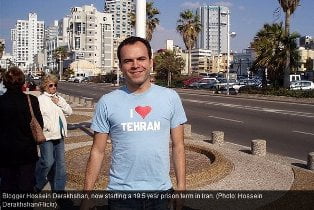
The return to the fold of the man once known as Iran’s “blogfather” might have offered the regime a rare propaganda coup. Yet he was arrested soon after his return in 2008, and held for almost two years. In September this year, he was sentenced to 19 years and six months plus a hefty fine for colluding with “hostile governments”, anti-regime and counterrevolutionary propaganda, offending Islamic sensibilities and running “obscene” websites.

Rumours had even circulated that he would receive the death penalty.

Derakhshan emigrated to Canada in 2000 and took out dual citizenship. His blog posts, which served as an inspiration to many young Iranian web users, were supportive of the reform movement and raised taboo religious, political and even sexual issues.

When Mahmoud Ahmadinejad came to power in 2005, Derakhshan changed tack and openly backed the conservative new president, attacking the reformers and advocates of democracy and human rights.

At the same time, he courted controversy by visiting Israel in 2006 and describing the trip on his blog.

Derakhshan’s family had close ties to powerful forces in the regime. He himself wrote in his blog that Supreme Leader Ayatollah Ali Khamenei personally officiated at his first marriage, which indicates the level of access enjoyed by the family. His father is a bazaar merchant and close to traditionalist, conservative forces represented in politics by the Motalefeh party. Sources close to family members say the party still holds informal meetings at their home.

Before returning to Iran, he was interviewed times by Press TV, the Iranian government’s English language channel, during which he defended Ahmadinejad, spoke of the decline of the West and Israel, and criticised “some Iranians who call themselves dissidents and are now siding with the Israeli lobby against their own president, against their own people”.

In one of the few interviews given by a family member, Derakhshan’s mother Ozra Kiarashpour told the Kamtarin website last month that he had been planning to work for Press TV in Tehran and had cleared this with the High Council of Iranian Affairs Abroad, which promised he would not face any problems coming back to the country.

The council, a government agency which deals with Iranian expatriates, is headed by the highly influential Esfandyar Rahim Mashai, a close ally of President Ahmadinejad and currently his chief of staff.

Despite this, Derakhshan was warned by friends and critics alike that he might face problems on his return. His response was that they did not understand how the system worked.

On arriving in Iran in October 2008, he was arrested within a few days by the Intelligence Bureau of the Iranian Revolutionary Guards Corps, IRGC. He was held incommunicado and in solitary confinement for eight months, without access even to a lawyer.

His mother said that because of the guarantees he had received, “even though he knew they might call him for questioning, he was unprepared for being arrested”.

“After Hossein’s arrest, a representative from the council told us that they pursued his case on behalf of the Council but that unfortunately they couldn’t do anything further. Why are there such splits in the country’s security apparatus?”

The very fact that Derakhshan was in prison remained unclear until July 2009, the month following Ahmadinejad’s re-election as president.

In a bid to prove that the protests following the vote were a “velvet coup planned from abroad”, Tehran deputy prosecutor Mehdi Sepehri cited a confession obtained from “a spy in custody whose identity cannot be revealed for security reasons, who returned to the country to play a role in the presidential election”. There was no doubt this “spy” was Derakhshan.

As part of the indictment, the prosecutor named a number of organisations allegedly behind the plot, including Hivos, a Dutch non-governmental organisation, Harvard University’s Global Voices project and the Memri media institute, which Derakhshan had either worked for or been in contact with.

A source familiar with the case told Mianeh that Derakhshan was asked to at one point in the proceedings to give a televised confession, but refused to do so. He added that that Derakhshan told him the confession had been extracted under pressure and had no foundation.

The fact it was the IRGC that arrested Derakhshan is significant, given the central role the corps went on to play in dealing with the post-election unrest. The IRGC used him as the centrepiece of an indictment document which resulted in the jailing of leading opposition politicians and journalists.

A source close to the Derakhshan family told Mianeh that because they had high-level contacts in the Iranian establishment, the Supreme Leader sent an emissary to the IRGC Intelligence Bureau to seek a review of the case. But senior IRGC figures turned this down, saying Derakhshan’s switch to supporting Ahmadinejad after so many years criticising the regime was just a ruse.

After sentence was passed, some influential figures in the regime planned to visit the family at their home, but the IRGC intervened to foil this expression of sympathy. The family itself was told not to publicise the case or members would be arrested, and a source close to them says all their communications are being intercepted.

Because Derakhshan distanced himself from former friends and colleagues both in Iran and in the diaspora, his case has not received as much media coverage as those of other imprisoned dissidents.

His IRGC captors not only refuse to take Derakhshan’s change of heart seriously, they are unlikely to allow him to be released in case he reveals how they attempted to secure a confession from him several months in advance of the June 2009 election. That would suggest that long before any protesters took to the streets, the IRGC was concocting the “velvet coup plot” in order to crush the reform movement, journalists and human rights defenders.

Omid Memarian is a journalist and Iran expert who lives in San Francisco.

… Payvand News – 10/17/10 … —

Iranian Father Worried For Jailed Son’s Health

0

http://www.payvand.com/news/10/oct/1161.html

10/20/10

Source: RFE/RL

Jailed Iranian student Hamed Rouhinejad, who suffers from multiple sclerosis, is in critical condition in Zanjan prison, his father has told RFE/RL’s Radio Farda.

Mohammad Reza Rouhinejad said on October 18 he last saw his son three weeks ago. He said on that occasion, “Hamed was in very poor health, physically and mentally.”

Rouhinejad’s father stated that his son is losing his vision, he has no sense of touch, and the disease has affected his hearing. He also said that Hamed has developed kidney and liver problems in jail.

“My son’s disease was under control before he was arrested,” Rouhinejad said, “but it has worsened in the course of his imprisonment.”

He added that physicians at Evin prison and Imam Khomeini hospital have said that Hamed should be released from jail for at least three months for medical treatment, but neither the judge, nor the prosecutor agreed to that.

A philosophy major at Tehran’s Shahid Beheshti University, Hamed Rouhinejad was arrested in May 2009.

According to his father, Rouhinejad was initially charged with spreading propaganda against the Islamic Republic. At his trial, he was accused of membership in the Association of Iran’s Monarchy.

Rouhinejad has denied the charges. He was sentenced to death, but an appeal court commuted the sentence to 10 years’ imprisonment.

Hamed Rouhinejad was transferred from Evin prison to a prison in Zanjan, northwestern Iran, where he is being held in solitary confinement. He has been denied visits and phone calls.

Payvand News – 10/20/10

Jailed Iranian Scholar Denies Charges In Court

0

http://www.payvand.com/news/10/oct/1176.html

 10/21/10

Source: RFE/RL

Jailed Iranian religious scholar Ahmad Ghabel has appeared in court where he again denied charges of acting against national security, his wife has told RFE/RL’s Radio Farda.

Ghabel was arrested in December on his way to the funeral of senior dissident cleric Ayatollah Hossein Ali Montazeri. He spent six months in jail before being released on bail, then was rearrested last month in Mashhad, northeastern Iran.

His wife, Marzieh Pasdar, said the October 20 hearing was held in branch five of the Revolutionary Court in Mashhad in the presence of Ghabel’s lawyer, Saleh Nikbakht, and family members.

Pasdar said there was no representative for the prosecutor present at the session.

“Ahmad Ghabel was only questioned about his intentions behind [the charge of] acting against national security, in response to which he denied the charges completely and emphasized that he had in fact acted against those who act against the principles of Islam and law,” Pasdar told RFE/RL.

Pasdar said Ghabel’s actions were more in favor of national security and the government than against them.

“The judge postponed the case for another 10 days due to the absence of the representative of the prosecutor and the objection of Ghabel’s lawyer regarding that matter,” she said, adding that he has been asked to submit his defense in writing to the court by then.

A critic of Supreme Leader Ayatollah Ali Khamenei, Ghabel was also arrested in 2001 after writing an open letter critical of him. Ghabel then spent 125 days in solitary confinement in Tehran’s Evin prison.

… Payvand News – 10/21/10 … —

Government raids office of Iranian reformist organization

0

http://www.payvand.com/news/10/oct/1173.html

10/21/10

 Source: Radio Zamaneh


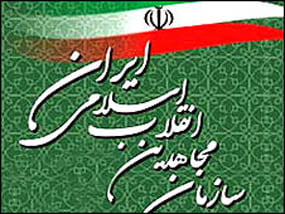
Mojahedin of the Islamic Revolution of Iran logo

The office of the Iranian reformist party, Mojahedin of the Islamic Revolution, was raided by a number of officers in plain clothes. Jaras website reports that the officers confiscated all computers, and documents from the office.

The report adds that two of the employees were present at the office and were locked in a room during the raid.

Last month, Iran’s prosecutor and spokesman for the judiciary announced that the two reformist parties Mohajedin of the Islamic Revolution and Islamic Iran Participation front have been officially dissolved by the judiciary.

The two organizations disputed the decision and the IIPF even published a document revealing that one of the branches of the Revolutionary court has in fact annulled the move against their organization and reinstated them.

Last week, Mohammad Salamti, secretary general of Mojahedin of the Islamic Revolution announced that his organization still considers itself a legal entity and will continue all its activities within the framework of the law.

He announced that the organization has not been involved in any legal action against it and none of its representatives have been summoned to any legal proceedings.

Mojahedin of the Islamic Revolution started its political activities in its current form in 1991. Following the 2009 presidential elections and the widespread protests over the alleged vote fraud that returned Mahmoud Ahmadinejad to power, several executive members of this organization were arrested.

… Payvand News – 10/21/10 …