Home Blog Page 85

Iranian Citizens Bearing The Cost of Religious Institutions in Syria

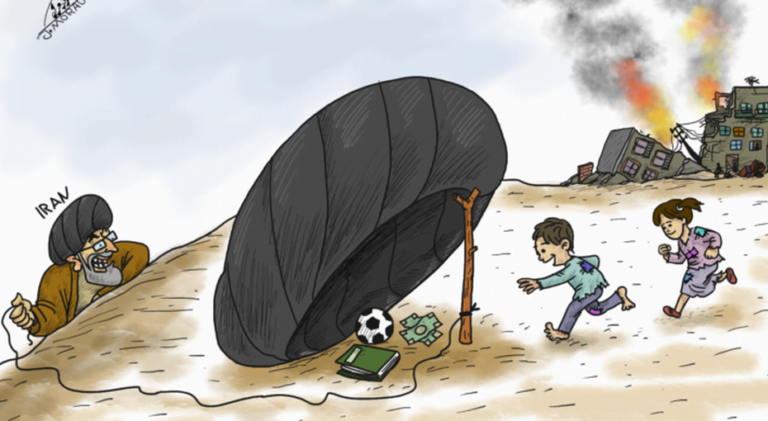
Iran has established more than 38 institutions during the 8-year long war in Syria, the budget for which has been taken directly from the pockets of Iranian citizens. This includes but is not limited to Al-Zahraa Charitable Society, Jihad of Construction, Al-Hadi Charitable Society, Nour Foundation and countless other institutions.

What is the purpose of these organizations and how do they benefit the average Iranian?

https://youtu.be/-qmB5PTtjZw

Majority of these institutions are religious and affiliated with Iranian Seminaries. The Iranian people pay for the spread of Shiism in Syria. These institutions are spread all over Syria.

9 In Damascus Province, 9 In Aleppo Province, 7 In Homs Province, 2 In Deir Ez-zor Province, 1 In Hama Province and 1 In Latakia Province. As Well as affiliated institutions established in Daraa and Quneitra provinces.

Many of these Shia institutions offer food packages and cash loans to Syrian people with the goal of attracting them to the ideology of the Islamic Republic of Iran.

Iran’s government also provides budget for 5 religious studies institutions affiliated with Shia Seminaries as well as 4 social studies organizations.

More importantly, all these institutions and organizations are in contact with Shia militias and terrorist groups.

These institutions are also responsible to provide financial support for militias trained and backed by Iran’s Islamic Revolutionary Guard Corps, to spread Shia Islam among the Syrian population and to hold Shia exclusive celebrations and commemorations under the guise of social activities.

Should Iranian citizens bear the cost of spreading Shiism and the ideology of the Islamic Republic of Iran’s government in a country where only 1% of people follow the Twelver branch of Shia Islam?

Also read: Similarities Between Iran’s IRGC and Al-Qaeda, Daesh
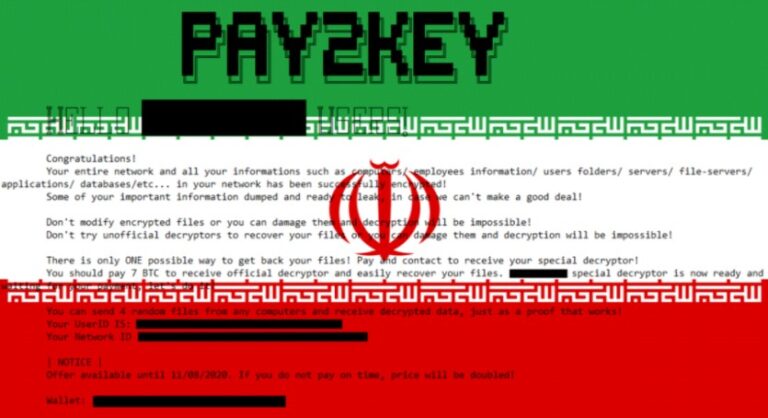
Suspected Iranian Ransomware Group Targets Israeli Firms

0

Suspected Iranian hackers have reportedly hit multiple Israeli companies with ransomware, in a new campaign of attacks.

A group describing itself as ‘N3tw0rm’ (Networm) on Sunday added the logo of H&M Israel to their naming and shaming website, just three days after another local firm, Veritas Logistics, was hit.

Networm is threatening to publish 110GB of data stolen from the fashion retailer and 9GB from transport firm Veritas, including information on customers, invoices, employees and possibly payment data, according to Haaretz.

The group reportedly demanded 3 Bitcoin ($168,000) from Veritas Logistics to delete the data.

A local cybersecurity firm that Haaretz spoke to claimed it was providing incident response for three Israeli companies that had recently been hit by ransomware. There are suspicions an unnamed non-profit may also have been targeted in the ongoing campaign.

The Networm group has been linked to ‘Pay2Key’ — an Iranian cyber-attack group that hit scores of Israeli firms at the end of last year in what some commentators described as an ideological rather than financially motivated operation.

If that’s true, the attackers have no intention of releasing the stolen information but instead want to undermine the status of Israel as a pre-eminent cyber power, the report claimed.

In fact, it’s not uncommon for ransomware threat actors to hold onto some or all of the data they’ve stolen. A Sophos report out last week claimed that although a third (32%) of victim organizations now elect to pay, only 8% got all their data back last year and 29% didn’t manage to grab more than half of what they lost.

Source: Info Security Magazine

Also Read: Iran cyber misinformation campaign takes aim at Scottish independence

European Intel Agencies Find Iran Sought Nuclear Weapons

Iran sought on multiple occasions in 2020 to obtain technology for its nuclear weapons program, intelligence agencies from the Netherlands, Sweden and Germany said, according to a Fox News report on Monday.

The General Intelligence and Security Service of the Netherlands stopped “multiple acquisition attempts,” the agency wrote in its April report.

“The joint counter-proliferation unit of the AIVD [the General Intelligence and Security Service] and the MIVD [the country’s Military Intelligence and Security Service] is investigating how countries try to obtain the knowledge and goods they need to make weapons of mass destruction. Countries such as Syria, Pakistan, Iran and North Korea also tried to acquire such goods and technology in Europe and the Netherlands last year,” said the report.

The Swedish Security Service said in its 2020 intelligence report that Iran tried to attain technology from its country for its nuclear weapons program.

“Iran also conducts industrial espionage, which is mainly targeted against Swedish high-tech industry and Swedish products, which can be used in nuclear weapons programs. Iran is investing heavy resources in this area, and some of the resources are used in Sweden,” the report said.

Germany’s Bavarian Office for the Protection of the Constitution, the domestic intelligence agency for the German state, said in its 2020 report: “Proliferation-relevant states like Iran, North Korea, Syria and Pakistan are making efforts to expand on their conventional arsenal of weapons through the production or constant modernization of weapons of mass destruction.”

Source: Algemeiner

Also Read: Iran still seeks mass destruction weapons – German intelligence report

Iran cyber misinformation campaign takes aim at Scottish independence

0

Iran is peddling misinformation in an attempt to swing Scotland’s parliamentary elections in favor of pro-independence parties to destabilize the UK, a report has warned.

A study from the UK-based Henry Jackson Society (HJS) think tank found that operatives linked to Iran were creating fake accounts, groups and pages on Facebook and Twitter to target voters.

They posed as pro-independence Scots and distributed separatist material, memes, graphics, and cartoons to their legitimate connections.

The activity was, according to the HJS, an attempt by the Iranian regime to “attack the constitutional integrity of the United Kingdom.”

It found that operatives established fake websites with targeted domain names in an effort to trick internet users, a tactic that was part of a wider disinformation strategy designed to sow chaos, division and weaken Iran’s adversaries.

“Iran has shown itself to be a country which engages in Russian-style disinformation campaigns, repeatedly establishing fake websites and internet accounts in an effort to disrupt the political systems of liberal democracies,” the report said. “Judged within this context, Iran is almost certainly looking to disrupt our current elections, most likely those under way for the Scottish assembly.”

The study also said the campaigns were being generated by agents acting on the regime’s behalf so that its leaders could deny responsibility and avoid repercussions.

The aim was to “cause harm to adversaries with clear military superiority, and at the same time, maintain a margin of denial that will prevent international censure or even sanctions and a counterattack.”

Amin Sabeti, an Iranian cyber operations expert and executive director of Digital Impact Lab, said the report’s findings were part of an “established pattern of behavior.”

“They are opposed to Western democracy and Western values — this disinformation is not a surprise,” he told Arab News.

Read the complete article at: Arab News

Also Read: Hezbollah cyberattack on Australian company is part of a growing cyber-threat emanating from Iran

Blinken faults Iran for taking ‘American hostages’ as hawks see ransom payments coming

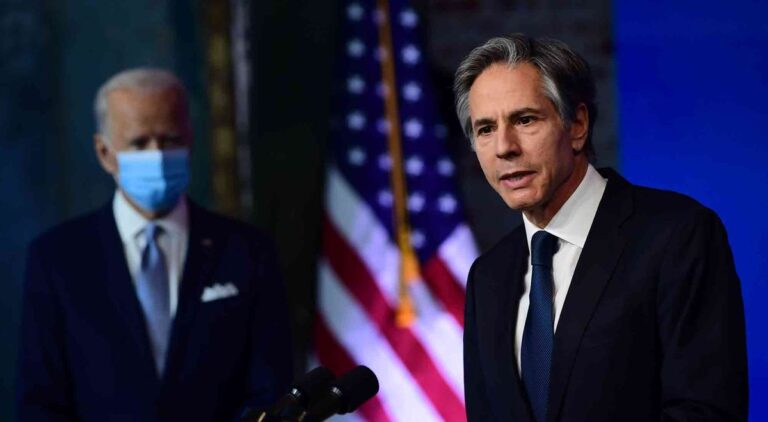
Secretary of State Antony Blinken condemned Iran’s imprisonment of several Americans amid a swirl of now-disputed rumors that U.S. and British officials were nearing a deal to pay the regime billions to release a handful of people.

“I have no higher priority than bringing arbitrarily detained Americans, American hostages, home to the United States,” Blinken said after a meeting with British Foreign Secretary Dominic Raab. “And as Dominic said, the reports coming out of Tehran are not accurate. We are very closely engaged ourselves on this issue, and we’ll remain so. And as I said, I am determined to bring every American home.”

Iran has seized British and American citizens alike, claiming they are subject to legitimate criminal charges — an allegation that Blinken dismissed implicitly by choosing to use the term “hostages.” However, the cases are being discussed in different terms as British officials are explicit that Tehran is using a British national as a bargaining chip to pressure London to pay millions, stemming from a historic dispute, while Iranian officials are careful to claim that they are not using American citizens as a lever for sanctions relief — to the chagrin of Iran hawks who fear that a de facto ransom payment is in the offing.

“If the past is prologue, we should anticipate some kind of unacknowledged deal to pay Iran for the release of American hostages alongside the return to JCPOA,” former White House National Security Council official Richard Goldberg, who worked on Iran issues in former President Donald Trump’s administration, told the Washington Examiner. “There might be a shortage of pallets around due to the pandemic, but they’ll find a way to pay the mullahs’ extortion racket.”

That comment was an allusion to President Barack Obama’s decision to send $1.7 billion to Iran in 2016 to settle a decades-old arms deal dispute, but $400 million of that payment was delivered in cash in conjunction with the implementation of the 2015 Iran nuclear deal and the release of five Americans held by the regime.

Read the complete article at: Washington Examiner

Also Read: US calls on Iran to release all American citizens wrongfully detained

Female political prisoners in Iran facing ‘psychological torture’, say campaigners

Female human rights activists imprisoned in Iran face increased jail terms and transfers to prisons with “dangerous and alarming” conditions, hundreds of miles away from their families, according to campaigners.

Warnings of the deteriorating treatment of female prisoners in Iran come days after Nazanin Zaghari-Ratcliffe, the British-Iranian national who has served a five-year prison sentence in Iran, was sentenced to a further year in jail and a year-long travel ban by the Iranian courts.

Human rights campaigners said that in the past six months increasing numbers of Iranian women jailed for human rights and political activism had been moved from Evin prison in Tehran to prisons outside the capital city without warning.

The women were locked up in the same area as criminals who had committed serious offences such as murder, in breach of Iranian law and international standards. Campaigners said that some had been raped by interrogators, attacked by fellow prisoners or denied medical treatment.

Shiva Mahbobi, spokesperson for the Campaign to Free Political Prisoners in Iran, described it as “a way of subjecting them to psychological torture”.

“It is really, really bad,” she said. “[The guards] take away all their stuff; the family does not know where they are. There is a lack of drinking water, and lots of illnesses and contagious diseases.

“The guards intentionally plan for non-political prisoners to attack them. Some families can’t go and visit; if they can, it’s difficult to do often.”

Nasrin Sotoudeh, a human rights lawyer imprisoned for her work defending women’s rights and protesting against Iran’s forced veiling laws, was transferred from Evin prison to Shahr-e Rey prison in Varamin, outside Tehran, in October last year. In January she was diagnosed with a myocardial bridge – symptoms include angina, chest pain and other heart complications. She was told by a doctor to avoid stress and that she should be held in a well-ventilated space.

Read the complete article at: The Guardian

Also Read: Families of Europeans imprisoned in Iran accuse governments of kowtowing to Tehran

Iran adds advanced machines at underground enrichment plant — IAEA

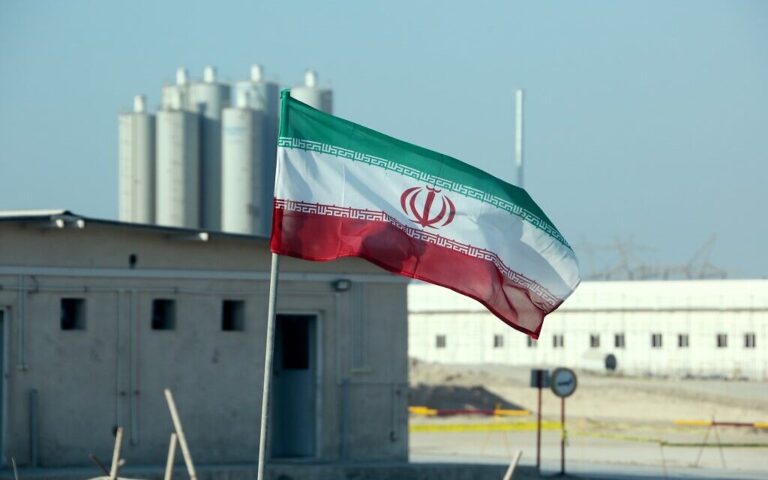
Iran has installed extra advanced centrifuges at its underground uranium enrichment plant at Natanz and plans to add even more, a report by the UN atomic watchdog on Wednesday showed, deepening Iran’s breaches of its nuclear deal with major powers.

The report is the latest evidence that Iran is pressing ahead with the installation of the advanced machines, even though it is not allowed to use them to produce enriched uranium under the 2015 agreement.

The accord only lets Iran produce enriched uranium at its underground Fuel Enrichment Plant (FEP) at Natanz with first-generation IR-1 centrifuges, which are far less efficient than the advanced models.

“On 21 April 2021, the Agency verified at FEP that: … six cascades of up to 1,044 IR-2m centrifuges; and two cascades of up to 348 IR-4 centrifuges … were installed, of which a number were being used,” the International Atomic Energy Agency (IAEA) report to member states said, referring to the underground Fuel Enrichment Plant at Natanz. The report was seen by Reuters.

According to a previous report, the IAEA verified on March 31 that Iran was using 696 IR-2m machines and 174 IR-4 machines at the FEP.

Wednesday’s report also said Iran informed the IAEA that it plans to install four more cascades, or clusters, of IR-4 centrifuges at the FEP, where both of the IR-4 cascades it had planned have now been installed.

Meanwhile, the European parties to the agreement have seen progress in the first two rounds of indirect US-Iran negotiations to revive the deal but said on Wednesday that there were still major hurdles to overcome. The United States withdrew from the accord in 2018 and re-imposed sanctions on Iran. (Reporting by Francois Murphy; Editing by Grant McCool)

Read the complete article at: Arab News

Also Read: Iran says it will enrich uranium to 60 percent purity after Natanz attack

Families of Europeans imprisoned in Iran accuse governments of kowtowing to Tehran

Amid efforts to revive the tattered 2015 Iran nuclear agreement, relatives of Europeans held in Iran say their governments are kowtowing to Tehran.

In recent interviews, relatives of five dual nationals and one French citizen described the efforts of European governments to end their loved ones’ detention as ineffective. Most said they felt officials had been too soft on Iran and implored them to take more assertive action to secure their relatives’ release.

“I don’t know why they don’t want to call out Iran. I don’t know why their attitude towards Iran is one of appeasement rather than confrontation, because it hasn’t worked,” Sherry Izadi, the wife of Anoosheh Ashoori, a British Iranian prisoner, said recently by phone from London, referring to the British government.

“Why not call this hostage-taking?”

Izadi has not seen her husband, a retired engineer, for nearly four years after he was arrested while on a trip to Iran in August 2017.

A year and two months later, he was sentenced to 10 years in Iran’s notorious Evin Prison for “cooperating with a hostile state,” referring to Israel, and to 2 years for “obtaining illicit funds” to be served concurrently, Izadi said. She says he is an innocent father caught up in a geopolitical game.

Shahrokh Nazemi, head of the media office at Iran’s mission to the United Nations, said that Iran “categorically rejects” the “hostage” label and that a number of Iranian citizens are in jail in the U.S. and beyond who are “guilty of nothing.”

“The U.S. with its ‘maximum pressure’ campaign — which includes illegal sanctions and arbitrary arrests of Iranians — has sought to bring Iran to submission, and that is tantamount to hostage-taking,” he said in an email.

Read the complete article at: CBC News

Also Read: Franco-Iranian, German citizens arrested in Iran – Le Figaro

Iran still seeks mass destruction weapons – German intelligence report

The German intelligence agency for the state of Bavaria said last week in its new report that the Islamic Republic of Iran has not ceased its drive to obtain weapons of mass destruction during 2020.

“Proliferation-relevant states like Iran, North Korea, Syria and Pakistan are making efforts to expand their conventional arsenal of weapons through the production or constant modernization of weapons of mass destruction,” wrote the Bavarian Office for the Protection of the Constitution, the formal name for the domestic intelligence agency.

“In order to obtain the necessary know-how and corresponding components, these states are trying to establish business contacts to companies in high-technology countries like Germany,” said the Bavarian intelligence report in its section on weapons of mass destruction.

The German agency is the rough equivalent of the Shin Bet (Israel Security Agency).

The intelligence report defines proliferation as “the unauthorized spread of atomic, biological, chemical weapons of mass destruction or the products used for their manufacture as well as the corresponding weapon carrier systems, including the necessary know-how.”

With respect to the section of the report on the Islamic Republic’s espionage activities, the intelligence document stated that “Germany remains in the focus of intelligence activities. This includes information from foreign and security policy as well as business and science. An additional focus [of Iran’s intelligence services] is the observation of, and fight against, opposition groups domestically and abroad.”

The Jerusalem Post reviewed the 380-page intelligence document which contains 28 references to the Islamic Republic. The report lists additional threats to Bavaria’s democracy.

Hezbollah, the Iranian regime’s chief strategic ally in the Middle East, has 30 members in Bavaria, according to the report. The Bavarian intelligence officials noted that there are 1,050 Hezbollah members across Germany. Last year, Germany’s government outlawed Hezbollah’s activities in the federal republic. The US, Canada, the Arab League, Israel, the United Kingdom, the Netherlands and many other European and Latin American countries classify Hezbollah as a terrorist organization.

Source: JPost

Also Read: Iran says it will enrich uranium to 60 percent purity after Natanz attack

Remembering the Mothers of Protest in Iran

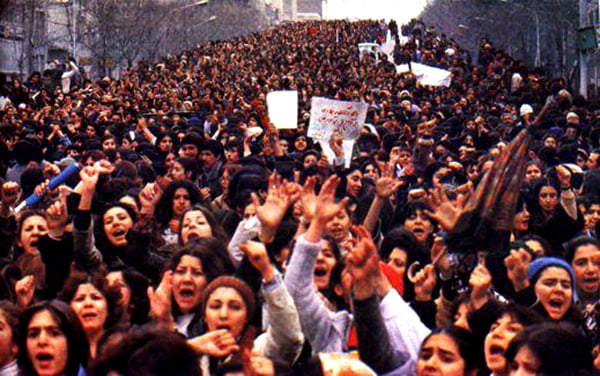
On April 27, 1981, brave Iranian mothers risked their lives to expose the Revolutionary Guard Corps’ (IRGC) crimes in suppressing dissent. They staged a peaceful rally to protest the attacks on and killings of the People’s Mojahedin Organization of Iran (PMOI/MEK) supporters by the IRGC and other militias that were working on the orders of regime founder Ruhollah Khomeini. (At least 8 MEK supporters were killed in mid-April.)

Over 200,000 people from all walks of life took part in the demonstration by the Association of Mothers, which was way more than anyone has expected, considering that the protest was almost spontaneous, organised by women who just told their friends and relatives what they were going to do.

Attacks on peaceful protesters

But the mullahs refused to let the gathering continue in peace, so they ordered the IRGC to violently suppress the protest. The IRGC attacked the mothers and those who came out in support, killing two MEK supporters and injuring dozens more.

Several elderly women were doused in tear gas, which nearly killed them until locals took them into their house for treatment. One of these women, Abrishamchi (Farahanchi), was suffering greatly but urged others to “let [her] die” so that the world would “know what a criminal Khomeini is”. Another woman refused to leave after the IRGC hurt her young child.

Still, the IRGC could not stop the protest march. The women wanted to expose their crimes more than they cared about living or dying. Afterwards, many of the mothers who took part in this were arrested and executed

The director of the Association of Mothers said: “On April 27, [1981,] all mothers left home early and gathered in the house of the Mother of the martyred Rezaii’s. They wrote their last wills. I can remember the heroine mother, Massoumeh Shademani [Mother Kabiri], saying, ‘I would love to among those who have to give their lives [for freedom].’”

Read the complete article at: Iran News Update

Also Read: Iran Regime to Destroy 1988 Massacre Grave