Home Blog Page 13

Iranian IRGC prepares for harsher suppression of protests

0

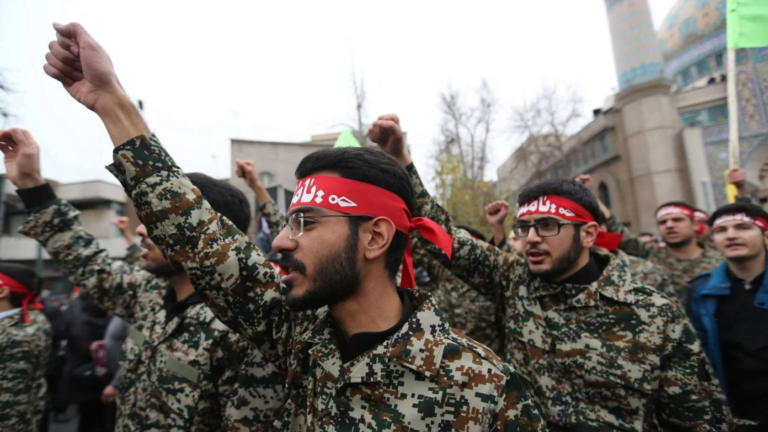
The Iranian IRGC media has issued warnings that the recent popular protests would likely be suppressed more harshly after President Ebrahim Raisi returns from the UN General Assembly in New York.

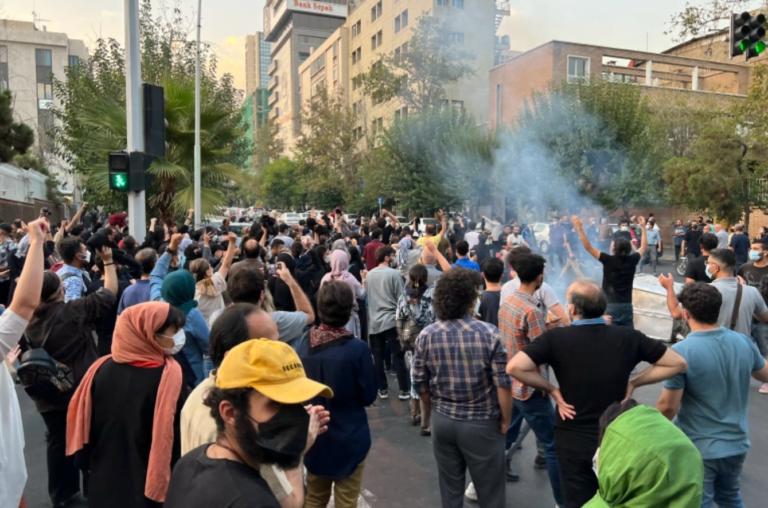
Since the suspicious death of Mahsa Amini, 22, on September 16 while in police custody, most Iranian cities have seen waves of protests against police brutality, the moral police’s imposition of the hijab requirement (which was the direct cause of Amini’s arrest), Supreme Leader Ayatollah Ali Khamenei, and the regime as a whole.

On September 20, the Iranian IRGC stated on Telegram that foreigners were behind the planning of the Iranian hijab demonstrations. The security forces allegedly detained numerous “leaders of the demonstrations,” who were “armed” by foreign countries, and they allegedly “admitted they meant to kill protestors” before blaming the security forces, according to Mashregh News, which is affiliated with the Iranian IRGC.

In an editorial on September 21 that was authored by political analyst Saad-Allah Zarei and published by the hard-line Kayhan daily, reformist leaders were accused of “joining demonstrators” and working with foreign foes to incite “ethnic disturbance” among Iran’s Kurds.

The IRGC’s spokesperson While Tasnim News blamed the banned Mujahedeen-e Khalq group for being the originator of the hijab protests and arson assaults against mosques, Javan News similarly rejected the hijab protests as a foreign plan.

While Khamenei himself steered clear of the topic in his first public appearance following the incident, state-censored media in Iran has responded in a variety of ways, from reformist newspapers criticizing the government’s enforcement of the hijab to unprecedented criticism of the “totalitarian regime” on Iranian television to not so subtly threatening the protesters.
Iranians demand end of morality police after death in custody

0

Following the murder of a 22-year-old Kurdish woman while in morality police detention, Iranian government authorities have condemned the fourth day of rallies, alleging the protestors were the victims of an enemy plot.

Mahsa Amini passed away on Friday after being detained by the morality police for not appropriately donning her headscarf and her pants. This terrible incident has sparked outrage in the streets over the unjustified and occasionally harsh treatment of women by this branch of the police.

Local petitions calling for the disbandment of the morality police have begun, arguing that their tactics in enforcing the hijab are unfair and unhelpful.

It is hard to evaluate the severity of the violence and the number of arrests on Monday night on their own. However, social media users recorded recordings of beatings and demonstrations, some of which featured shootings.

One death in each of three protests in the towns of Divandareh, Saqqez, and Dehglan, according to the Kurdish human rights organization Hengaw, which is located in Norway.

In the Kurdistan area, where there had also been a nationwide strike on Monday, it was also said that 221 people had been hurt and another 250 had been detained.

A 10-year-old girl was injured in the town of Bukan but was still alive, according to photographs of her covered in blood that has gone viral on social media.

The UN Human Rights Office in Geneva said that Iran’s morality police had increased its patrols recently, focusing on women for improperly donning the Islamic headscarf, known as the hijab. Verified footage, according to the report, showed women being assaulted with batons, slapped in the face, and hauled into police vans for draping their heads in the hijab too loosely.

“Mahsa Amini’s terrible death and claims of torture and ill-treatment must be immediately, impartially, and properly investigated by an independent competent body,” said Nada Al-Nashif, the acting UN High Commissioner for Human Rights.

Iranian IRGC general behind various drone attacks in middle east

0

Israeli military authorities have started mentioning Iranian IRGC General Amir Ali Hajizadeh as an Iranian in recent weeks.

Tehran’s expanding drone capabilities and its purported attacks on a number of ships with links to Israel have been blamed on the commander of the Islamic Revolutionary Guard Corps (IRGC) Aerospace Force, most notably the Mercer Street tanker in the Gulf of Oman.

According to Israeli Defense Minister Benny Gantz, “Amir Ali Hajizadeh, head of the IRGC’s air force, is behind scores of terror assaults in the region, using [unmanned aerial vehicles] UAVs and missiles.”

Israeli security officials, experts, and observers have even suggested that Hajizadeh may be the “next Qassem Soleimani,” a Revolutionary Guard commander who influences Iranian policy and has the support of Iran’s supreme leader.

Hajizadeh is developing in prominence both at home and abroad, despite the fact that he has not yet attained the level of Soleimani, who was killed by the United States in a drone hit with the assistance of Mossad.

The IRGC general is also turning into a more deadly adversary for Iran’s foes as Iran and its allies use drones in military operations around the Middle East.

According to a military expert living in Iran, the Iranians and Americans have recently engaged in an asymmetrical conflict that is supported by two foundations.

The Aerospace Force is the first pillar. According to the expert, Khamenei has not fired Hajizadeh despite the incident involving the Ukrainian plane because of his division’s performance.

The Republican Guard’s elite foreign unit, the Quds Force, which was formerly notably headed by Soleimani, serves as the second pillar. However, both its influence and efficacy have decreased since Soleimani’s death.

“Hajizadeh is becoming a less charismatic Soleimani as a result of his accomplishment in the Aerospace Force. For security considerations, the analyst spoke to MEE on the condition of anonymity. “But we should pay attention to the fact that compared to Esmail Qaani, the new Quds Force commander, he is far more valuable,” the analyst said.

Protests in Iran continue after woman dies over Hijab arrest

0

As Iranians were outraged by the death of a young woman while in the care of morality police who were enforcing tight hijab laws, protests in Iran continued on Sunday and #MahsaAmini became one of the most popular hashtags ever on Persian-language Twitter.

After being arrested in Tehran earlier in the week, 22-year-old Amini went into a coma and passed away on Friday. The case has drawn attention to Iranian women’s rights.

Police denied claims made on social media that she had been beaten, claiming that she became unwell while waiting with other women who had been arrested.

“According to the authorities, my daughter had a number of ongoing medical issues. I personally refute these allegations since my daughter was healthy and fit “On Sunday, Amini’s father spoke to the pro-reform Emtedad news website.

According to footage posted online, hundreds of demonstrators gathered near the University of Tehran on Sunday while yelling “Woman, Life, Freedom.”

Amini was from the nation’s Kurdistan area, and on Saturday there were demonstrations there as well as at the burial in her hometown of Saqez.

Iran is home to between 8 and 10 million Kurds. For years, Iran’s Revolutionary Guards (IRGC) have suppressed dissent in the Kurdish regions of the nation, and the hardline court has executed or condemned numerous activists to lengthy prison sentences.

Police put down the protests in Saqez. Online footage indicates that at least one man suffered a head injury.

A sizable billboard of the deceased IRGC Quds Force leader Qassem Soleimani was also taken down by protesters. In January 2020, a US drone attack near the airport in Baghdad claimed his life.

A few individuals were hurt at the funeral, Behzad Rahimi, a member of parliament representing Saqez, said to the mostly unofficial ILNA news agency.

He stated that one of them was hospitalized at the Saqez Hospital after being struck by ball bearings in the intestines.

However, the Kurdish rights organization Hengaw said that 33 people were hurt in Saqez.

Cybersecurity agencies warn of Iranian ransom attacks

0

The US, UK, Australia, and Canada’s cybersecurity agencies have issued warnings that Iranian state-sponsored hackers are using Log4j vulnerabilities in their ransomware attacks.

In a warning released this week, cybersecurity agencies claimed that the Islamic Revolutionary Guard Corps (IRGC) of Tehran was responsible for many assaults that used vulnerabilities in VMware Horizon Log4j on unsecured networks to allow disc encryption and data extortion.

These include the assaults from February on a US local government and an aerospace firm that took advantage of the initial Log4Shell issue CVE-2021-44228 as well as related vulnerabilities CVE-2021-45046 and CVE-2021-45105.

According to the notice, this is consistent with other IRGC tactics that attacked Microsoft Exchange ProxyShell weaknesses and Fortinet FortiOS devices using zero-day vulnerabilities.

The IRGC-affiliated individuals probably choose a course of action after acquiring access to a network based on how valuable they believe the data to be. The perpetrators may exfiltrate data or encrypt data for ransom depending on the perceived worth, cybersecurity agencies said.

“The attackers may sell the data or utilize the exfiltrated material in double-extortion” ransom operations, in which a threat actor combines encryption and data theft to coerce targeted companies to pay ransom demands.

This would signal a new stage in Iranian threat activities if the state-backed actors intended to use these attempts to raise money for the Islamic Republic. Up until this point, Tehran has mostly concentrated on cyber-espionage for geopolitical ends and strikes meant to impair vital physical infrastructure, like the current campaign against Albania.

Indictments against three Iranian nationals were announced by the US this week as well. They are accused of being behind ransomware attacks that targeted hundreds of small businesses, government organizations, nonprofits, educational, and religious institutions throughout the US, UK, Israel, and even Iran.

The three men charged by the Department of Justice were among 10 people and two businesses tied to the IRGC that the US Treasury announced sanctions against at the same time (DoJ).

Iranian meddling in Iraq pushes it closer to a Shiite civil war

0

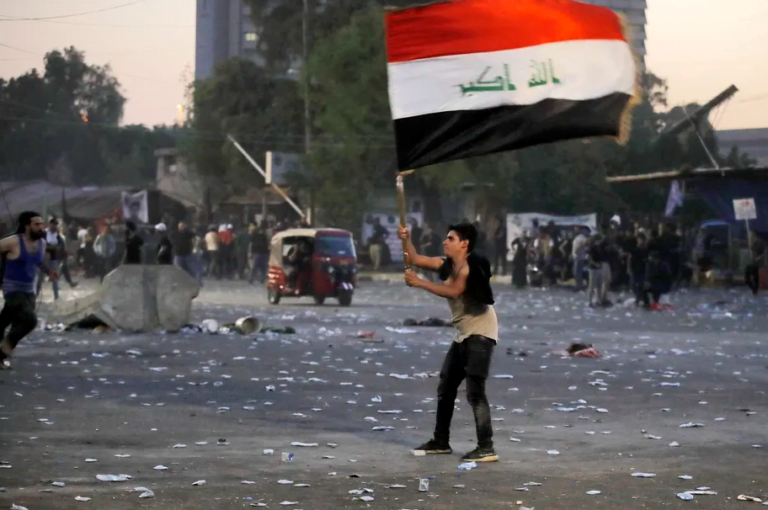
Moqtada al-Sadr of Iraq was able to show the depth of his authority in a matter of 24 hours when the streets of Baghdad bowed to and then subsided from saw massive violence, both at his command. Sadr’s supporters turned the capital into a war zone on August 29 which could lead to civil war until he declared a halt to hostilities the next morning.

The events that preceded the unrest made clear the geopolitical conflict between Iran and Iraq’s attempts to establish a government in Baghdad. This violence was directly brought on by Iranian involvement in the nation, in contrast to the grassroots demonstrations of 2019, which were sparked by discontent over governmental corruption.

The unexpected announcement by the Iraqi Shiite spiritual leader Ayatollah Kadhim al-Haeri that he was resigning from his position and urging his followers to support Iran’s Ayatollah Ali Khamenei in its place set off a chain of events that culminated with portions of Baghdad being a war zone, almost turning into an all-out civil war.

After Moqtada’s father, Ayatollah Mohammed al-Sadr, was killed in 1999, his supporters broke their political and religious allegiances and turned to Haeri, who had the support of the older Sadr, for spiritual direction. Haeri’s unclear retirement and support of Khamenei as his successor raises the possibility that Iran’s political influence was at play.

Tehran’s attempt to influence Sadr’s supporters, however, was poorly planned. Following Haeri’s unexpected departure, Sadr announced his withdrawal from politics, prompting his heavily armed supporters to pour onto Baghdad’s streets.

Since the country’s political impasse was caused by Iraq’s elections in October 2021, this conflict with Iran has continued. Sadr’s party won the largest bloc in the cabinet, outnumbering the alliance of militias supported by Iran, and dealt a severe blow to Tehran with 73 of 329 seats.

Although Tehran may not have explicitly requested the violence on Baghdad’s streets, its ongoing attempts to sway the nation are having a negative impact on both Iran and Iraq and are raising tensions in the region.

With a Shiite population that is sharply split, Iraq has descended once more into even greater unrest, nearing an all-out civil war. The only possibility is that Iran would finally distance itself from Iraqi affairs and allow the country to try to shape its own future.

Iran-backed Houthi militia set up more illegal checkpoints in Yemen

0

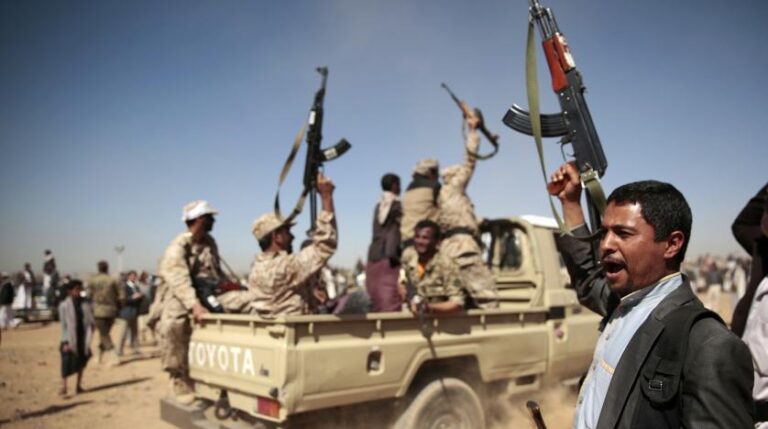
Yemenis travelling to the city from areas under government control are alarmed by the number of Iran-backed Houthi checkpoints at the southern approach to Sanaa, according to witnesses.

The crackdown coincides with growing public resentment of the Houthis’ activities and is largely regarded as a manifestation of the group’s anxiety.

Many people travelling from Aden and other government-controlled areas to Sanaa said that at checkpoints outside of the city, masked Iran-backed Houthi members questioned them about the purpose of their journey.

Private sector employee Saleem al-Harazi claimed that Houthi militants interrogated him after homing in on his response that he was returning from Aden at a checkpoint in Yasleh, in the Sanhan area of Sanaa.

Sami al-Zuraiqi said to Iran Briefing that he was detained at the Yasleh checkpoint on his recent return from a trip to Aden after a Houthi element accused him of working with the Arab coalition and going there to get paid.

Al-Zuraiqi said that he informed the Houthi members that he works for a commercial telecoms business and had travelled to Aden to visit his family for Eid al-Adha.

During an eight-year battle, the Houthis’ checkpoints and their interrogations worsen the misery of Yemenis in all areas, according to economist Abdul Aziz Thabet.

According to Thabet, the Houthis have created lists with the names of former government officials as well as journalists and activists from the opposition, “to prevent them from entering Sanaa.”

According to economist Faris al-Najjar of Iran Briefing, the Houthis’ activities make things worse for the local populace since they are compelled to take other routes between provinces to avoid clashes.

He continued by saying that the Iran-backed Houthi militias do not care about peace and that they are using the cease-fire to buy time to gather their forces.

US sanctions Iranian IRGC affiliated cyber actors for malicious acts

0

10 people and two organizations that the US claims are connected to the Iranian IRGC and engaged in “malicious” cyber activities, such as ransomware activity, have been subjected to sanctions.

The US Department of the Treasury charged a “group of Iranian IRGC affiliated hostile cyber actors” on Wednesday with hacking into networks in the US and other countries since at least 2020.

The organization, according to the agency, “is known to use software vulnerabilities to carry out their ransomware activities, as well as engage in unauthorized computer access, data exfiltration, and other harmful cyber activities.”

As the two nations battle to find a way back into the 2015 nuclear agreement, the restrictions follow punitive measures taken last week against Iran’s Ministry of Intelligence and Security for what the US called “malign cyber activity.”

Last Friday’s penalties were a reaction to a July hack that affected official websites in Albania and was attributed to Tehran by Washington and Tirana. Any involvement has been refuted by the Iranian government.

Wednesday’s sanctions prevent the targeted companies and people from accessing their assets in the US and forbid US citizens from doing business with them.

A division of the Iranian military, the IRGC ultimately responds to Ali Khamenei, the Supreme Leader. It oversees the Iranian government’s clandestine overseas activities and military assistance to allies in the area.

According to Treasury official Brian E. Nelson, “Ransomware actors and other cybercriminals have targeted businesses and critical infrastructure across the board, regardless of their national origin or base of operations—directly threatening the physical security and economy of the United States and other nations.”

The Treasury Department also said that reported ransomware payments in the US increased to approximately $590 million in 2021 from a total of $416 million in 2020.

Another IRGC Cyber Warfare Commander Exposed

0

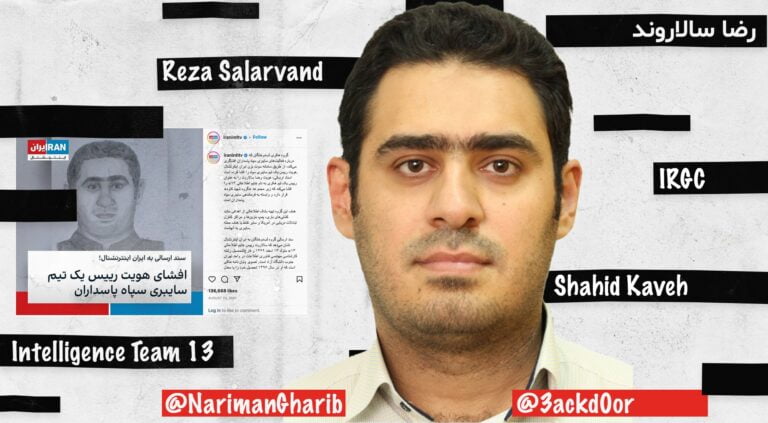
The photo of Reza Salarvand, who commands one of Iran’s IRGC cyber hacking squads, has been published to the public.

The fresh photo, which was made public for the first time on Tuesday by an account named “3ackd0or,” confirmed Salarvand’s identity. Iran International had previously published a face composite of Salarvand that had been received from the Lab-Doukhtegan (Sealed Lips) hacktivist organization.

He is in charge of “Intelligence Group 13,” which is reportedly a division of the Shahid Kaveh force under the direction of IRGC cyber warfare commander Hamidreza Lashkarian (Lashgarian)

A database of potential targets for cyberattacks, such as cargo ships, petrol stations, and marine control centers in the US and overseas, was put together under Salarvand’s supervision.

According to his BS certificate, which was also made public by Lab-Doukhtegan, the 30-year-old holds a bachelor’s degree in information technology engineering from the South Branch of Tehran’s Azad University with a below-average mark of 13.

On Monday, Iran International published images of prominent Iranians involved in international cyberattacks who are connected to several Tehran-based government intelligence services.

Albania severed diplomatic ties with Iran this week, expelled its diplomats, and then its security officers stormed the embassy grounds in search of proof.

The Iranian intelligence ministry and its minister were subject to sanctions by the United States, and Albania was also supported by NATO as a member state.

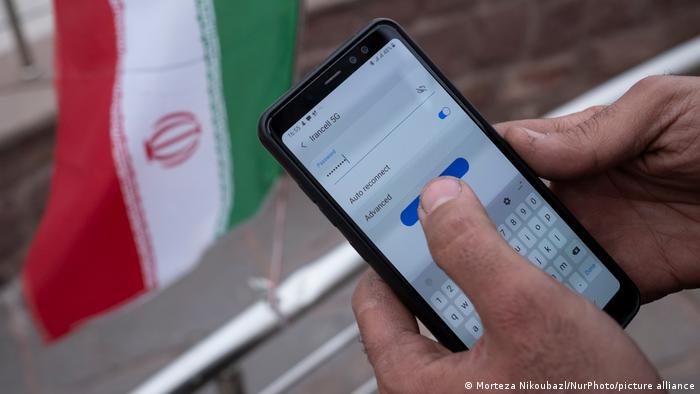
The IRGC adamant to further restrict Internet in Iran

0

The ruling hardliners in Iran have found an alternative after a measure to severely limit access to the Internet in Iran was submitted in the parliament last year and failed to get support.

A hardliner politician named Mohammad Saleh Jokar informed the media on Monday that the Supreme Council of Cyberspace had been given the bill and that nothing could be done about it.

The measure is no longer on the Majles’ agenda, according to Jokar, an IRGC general, who urged other members not to follow the matter anymore since “this is a job done” and “there is nothing to be followed up regarding the case.”

He said, “The bill is now like a dead guy who is buried. What are you searching for now?” in an effort to discourage members from investigating further.

The Siyanat (Protection) plan is a proposed law named “Legislation to Protect Cyberspace Users’ Rights” that was created by ultra-hardliners in June 2021. The Siyanat bill’s general provisions were passed by an ad hoc parliamentary committee in February, which will result in significant limitations on social messaging services and access to the internet in Iran.

Concern over the case’s transfer to the Supreme Council of Cyberspace, which is run under the direction of Supreme Leader Ali Khamenei, has been widely expressed on Iranian social media.

According to Mohammad Keshvari of the council, who was reported by the moderate website Rouydad24, the measure has already been adopted and the relevant executive entities have been properly informed.

The US State Department had earlier criticized Iran for its plans to restrict Internet access and urged the government to “allow its citizens to exercise their right to freedom of expression and to freely access information.” The statement also said that the so-called “User Protection Bill” aims to further restrict Internet access, increasing censorship, and restricting free speech online.