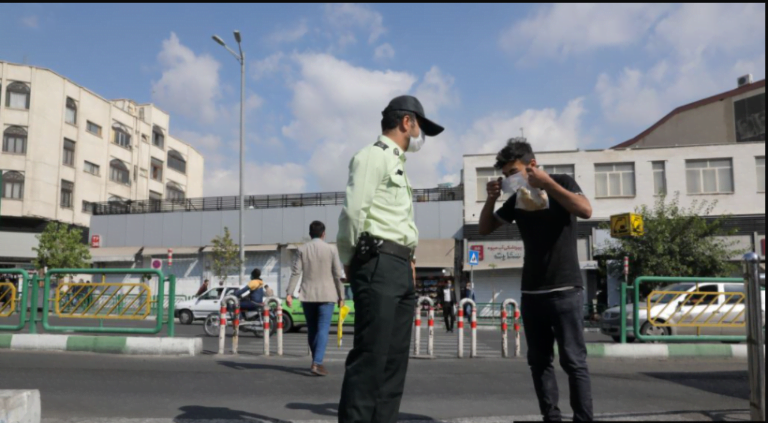
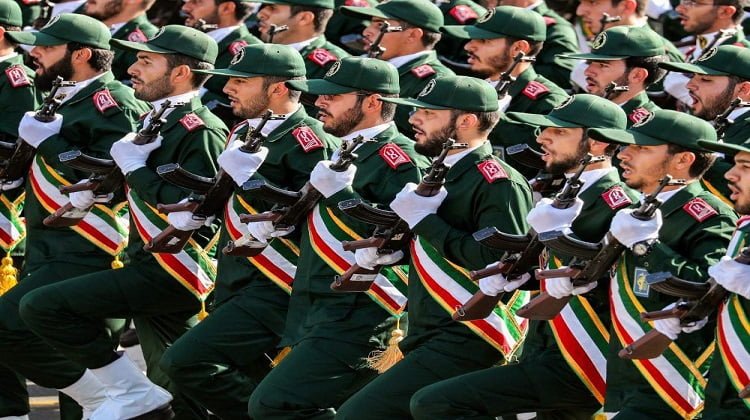
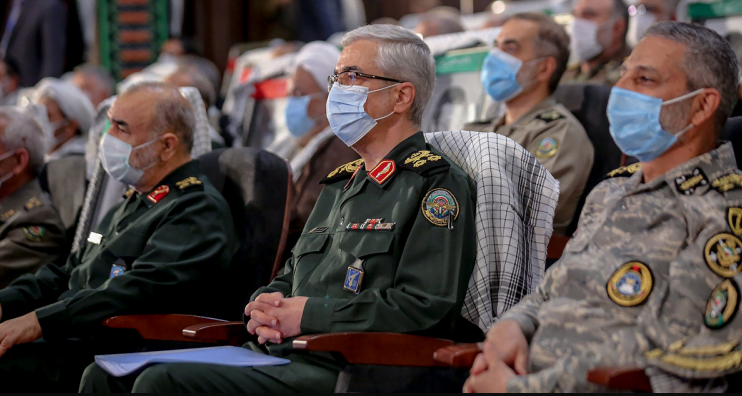
The commander of the Islamic Revolution Guards Corps (IRGC) of Greater Tehran Mohammad Reza Yazdi, announced the formation of a special coronavirus-related unit called “Enjoining the Good and Forbidding the Evil.”
The unit will deal with people who are inattentive to observing health protocols in public places, said Brigadier General Yazdi, who commands the Tehran province’s IRGC forces. Tehran
Yazdi did not elaborate further on how the “Enjoining the Good and Forbidding the Evil” unit would deal with offending citizens. Yazdi also announced the free distribution of the face masks by the IRGC, adding, “We are ready to place the IRGC’s medical equipment and facilities at the Ministry of Health’s disposal to deal with the coronavirus.”Last week, President Hassan Rouhani announced a fine of 500,000 to 2000,000 rials (about $12 to $48 at the official rate) for those who do not comply with COVID-19 regulations, saying that the police and the Basij forces, IRGC’s militia, would oversee the collection of the fines. According to Iranian health officials, more than four in five Iranians respected health protocols in March in the early weeks of the pandemic, but that has now dropped to as low as 40 percent. Iran passed as health ministry spokeswoman Sima Sadat Lari announced 253 more deaths in the past 24 hours. In March, Iranian Supreme Leader Ayatollah Ali Khamenei assigned the Armed Forces to work on necessary methods to prevent a further spread of coronavirus, as well as other activities such as treatment of patients and establishment of medical centers like field hospitals and convalescent homes. Despite those measures, the virus has continued to spread in Iran. In March, Iranian Supreme Leader Ayatollah Ali Khamenei assigned the Armed Forces to work on necessary methods to prevent a further spread of coronavirus.
Turkey’s TRT World chief was suspect in police probe into Iran’s IRGC network
Turkey’s TRT World chief was suspect in police probe into Iran’s IRGC network
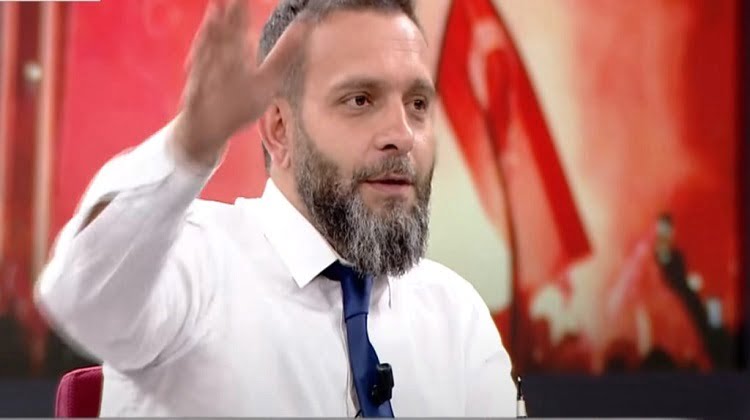
The director of a Turkish state-run English-language news channel was named and investigated by police as a suspect in a 2013 probe into an Iranian paramilitary network in Turkey, reported the Nordic Monitor on Monday, citing secret court and police documents.
Commander: IRGC to Use All Medical Capacities to Help Coronavirus Patients
Commander of the Islamic Revolution Guards Corps Major General Hossein Salami said that the IRGC will provide coronavirus patients and medical staff with all its possibilities and capacities to fight against the disease.
“Upon the order issued by the Supreme Leader (Ayatollah Khamenei), we are committed to bringing to the field all IRGC’s treatment capacities and possibilities, including fixed and mobile hospitals as well as possibilities to produce and distribute masks and hygiene packages, cooperate in screening and assist the devoted medical staff by the medical society’s Basij (volunteers),” General Salami said, addressing the IRGC and Basij commanders in a video conference on Tuesday.
He added that the decision was made after Ayatollah Khamenei entrusted the Armed Forces, including the IRGC, with a new mission to cooperate with the medical staff with all their power in the area of coronavirus prevention and treatment.
General Salami said that besides these measures, the IRGC and Basij forces continue gathering and distributing public aid packages among the poor people.
The Iranian health ministry announced on Tuesday that 4,108 new cases of coronavirus infection have been identified across the country during the past 24 hours, adding that 254 patients have passed away during the same period.
“4,108 new patients infected with COVID-19 have been identified in the country based on confirmed diagnosis criteria during the past 24 hours,” Iranian Health Ministry Spokeswoman Sima Sadat Lari said on Tuesday, and added, “1,946 patients have been hospitalized during the same time span.”
She added that the total number of COVID-19 patients has increased to 508,389.
“Unfortunately, 254 patients have lost their lives in the past 24 hours, increasing the number of the dead to 29,070,” the spokeswoman noted.
Lari expressed satisfaction that 411,840 coronavirus patients have recovered or been discharged from hospitals so far.
Once upon a time, nuclear weapons were the main threat to global peace and security. In fear of starting another world war, the international community adopted many resolutions and instructions, deterring nuclear weapons production and proliferation.
Director of Turkish state-run TRT World News was named as a suspect in IRGC Quds Force probe
Director of Turkish state-run TRT World News was named as a suspect in IRGC Quds Force probe
Secret court and police documents obtained by Nordic Monitor have revealed that the director of TRT World, the English news channel of Turkey’s state broadcaster, was investigated as a suspect in a probe of Islamic Revolutionary Guard Corps (IRGC) Quds Force operatives and assets in Turkey.
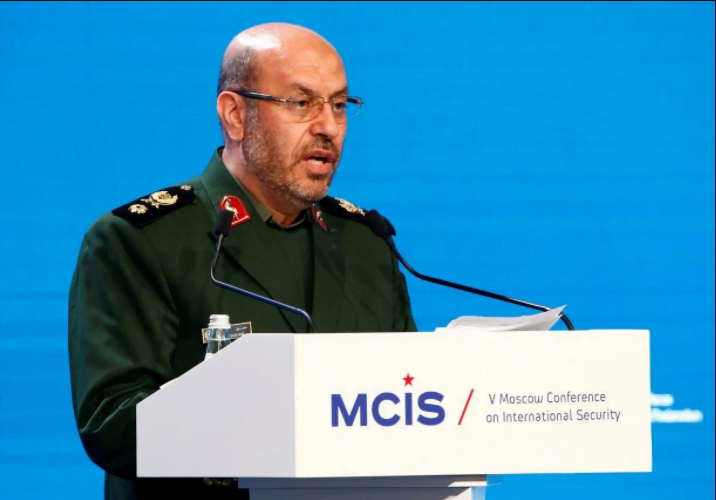
Hossein Dehghan Could Win Iran’s Presidency For The Revolutionary Guards
In 2001, then-Defense Minister of Iran Ali Shamkhani decided to run for the presidency.
He launched a longshot bid, having never run for elected office, and faced off against his boss at the time, President Mohammad Khatami.
Shamkhani, a former Islamic Revolutionary Guards Corp (IRGC) and Artesh, or Islamic Republic of Iran Army, naval commander, justified his candidacy by arguing it was time for a “military man” to ascend to the presidency, and that he had the “authority to take action instead of mouthing slogans.”
He lost that race, but that campaign illustrates the intrigue surrounding the decision of another military man and his former deputy, Hossein Dehghan, to run for the presidency exactly twenty years later, in 2021.
Dehghan has two qualities that have fueled his rise and make him an important presidential contender: skill in navigating Iran’s ideological spectrum and credentials spanning Iran’s armed, deep, and elected states.
Who is Hossein Dehghan?
Born in Isfahan in 1957, Dehghan was involved in some of the most consequential episodes in Iran’s fraught relationship with the United States.
He played a role in the seizure of the U.S. embassy in Tehran in 1979. Dehghan was also the commander of the IRGC forces in Lebanon and Syria in 1983, which coincided with the bombing of the Marine barracks in Beirut, killing 241 U.S. service personnel—a fact the U.S. government highlighted when it sanctioned him in 2019.
Dehghan had been on the U.S. radar in the 1980s. According to testimony before the U.S. Senate in 1985 by Nathan Adams, then an investigative reporter for Reader’s Digest, Dehghan coordinated “personnel, indoctrination, and training” of Hezbollah.
Adams also revealed that Dehghan’s “dual control [was] the Islamic Republic’s embassies in Beirut and Damascus.”
Dehghan therefore likely liaised with Iran’s then-Ambassador to Syria Ali Akbar Mohtashamipour, who directed attacks against U.S. interests in Lebanon during this timeframe.
Over the past decade, Iran has made a concerted push to expand its cyber capabilities, an effort in which the Islamic Revolutionary Guard Corps (IRGC), the branch of the Iranian military charged with safeguarding the 1979 revolution against internal and external threats, has played a central role.
The IRGC reports directly to Supreme Leader Ayatollah Ali Khamenei and acts as the eyes and ears of the ruling clergy throughout all corners of the country, spying both digitally and physically on its own citizens. Given the IRGC’s expansive and growing power, scholars, analysts, and many Iran watchers have long thought that at some point it could take over control in Iran, replacing the theocratic government with a military one.
As Iran approaches an inflection point over the issue of succession after Ayatollah Khamenei, that day could be coming soon, and the IRGC is well placed to bring about such a transition given the hybrid mix of physical and cyber capabilities that it has developed and perfected over recent decades.
This was on clearest display during the 2009 Green Movement when the IRGC crushed the opposition to the contested electoral victory of former President Mohammad Ahmadinejad.
That same year also saw the introduction of two new trends.
Many Israelis Ready To Spy For Iran, IRGC Commander Says
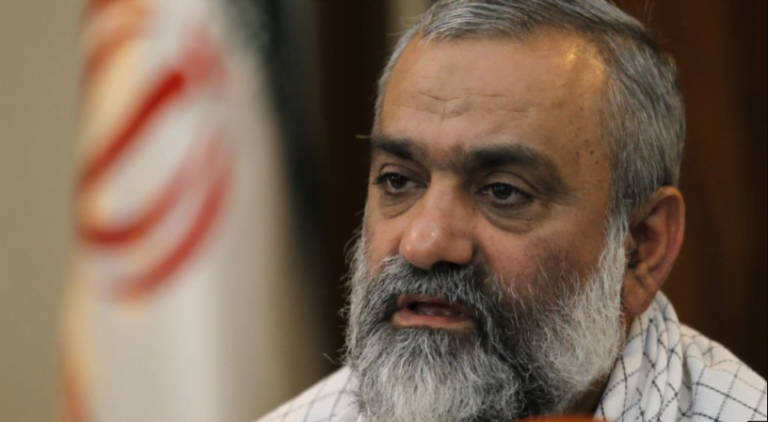
“Many people” in Israel have “a lot of motives” to cooperate with Tehran, said a top commander of the Islamic Revolution Guards Corps (IRGC), Mohammad Reza Naghdi, on a TV show on Friday.
Naqdi expressed his claim nearly two years after a former Israeli minister was convicted of “espionage” for Iran.
Naqdi went even further by boasting that the clergy-dominated Iran was “closer to Israel” than “imagined” and that one day, it would “suddenly fall apart.”
In August 2019, the Islamic Republic Minister of Intelligence, Mahmoud Alavi, also claimed in a TV show that an Israeli cabinet member had been “under control” of his agents.
Alavi, a black-turbaned cleric, was referring to the case of Israel’s former Minister of Energy, Gonen Segev.
64-year-old from 1995 to 1996, was sentenced to ten years in prison for “espionage and transfer of information to an enemy country” in an Israeli court. Israel announced Segev had been in contact with Iranian embassy officials in Nigeria, where he lived as a physician. Later, Segev traveled to Iran twice, using his German passport. In the heat of the information and intelligence war between Tel Aviv and Tehran, the Israeli security service in recent years has reportedly arrested several Palestinians and other Arabs for allegedly “collaborating,” and “spying” for Iran. There have also been reports of the arrest of spies affiliated with the Israeli government in Iran. In May 2015, a Paris-based member of “Iranian national-religious Coalition,” Reza Alijani, wrote in a report on the Rooz Online website that the heads of the Israeli desk at Iran’s Ministry of Intelligence and the IRGC’s fearsome Intelligence Organization had been “arrested on charges of spying for Israel.”
Saudi-US partnership critical to confronting Iran, Pompeo says after Prince Faisal meeting
Saudi-US partnership critical to confronting Iran, Pompeo says after Prince Faisal meeting
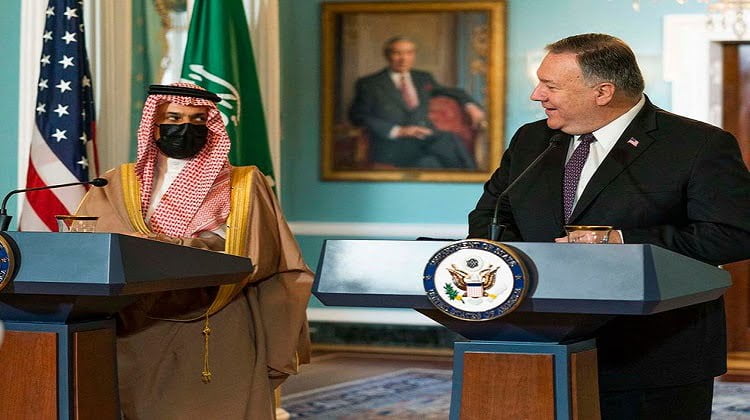
Saudi Arabia’s Foreign Minister Prince Faisal bin Farhan met US Secretary of State Mike Pompeo in Washington Wednesday. Prince Faisal discussed with Pompeo the historical strategic partnership between the two countries.
UK Lawmakers in Online Event, Threats of Iran Regime’s Terrorism
UK Lawmakers in Online Event, Threats of Iran Regime’s Terrorism
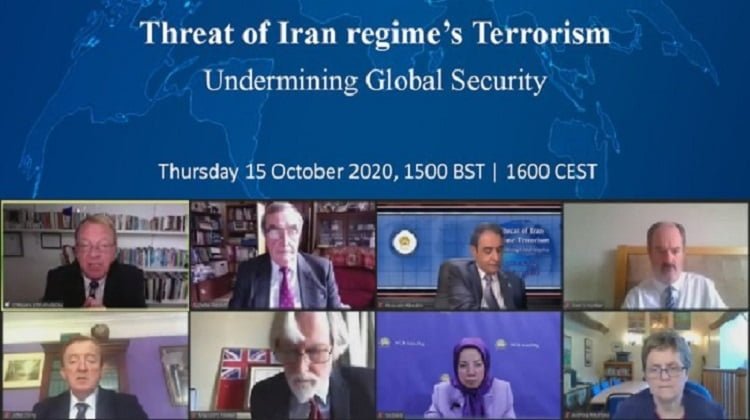
The National Council of Resistance of Iran (NCRI) holds an online event today on the Iranian regime’s terrorism and how it undermines global security. This event is being attended by several prominent lawmakers from the United Kingdom. Participants are highlighting the persistent threat of terrorism stemming from the Iranian regime.